Machine Learning and AI for revolution of Tech Companies are changing and streamlining businesses.


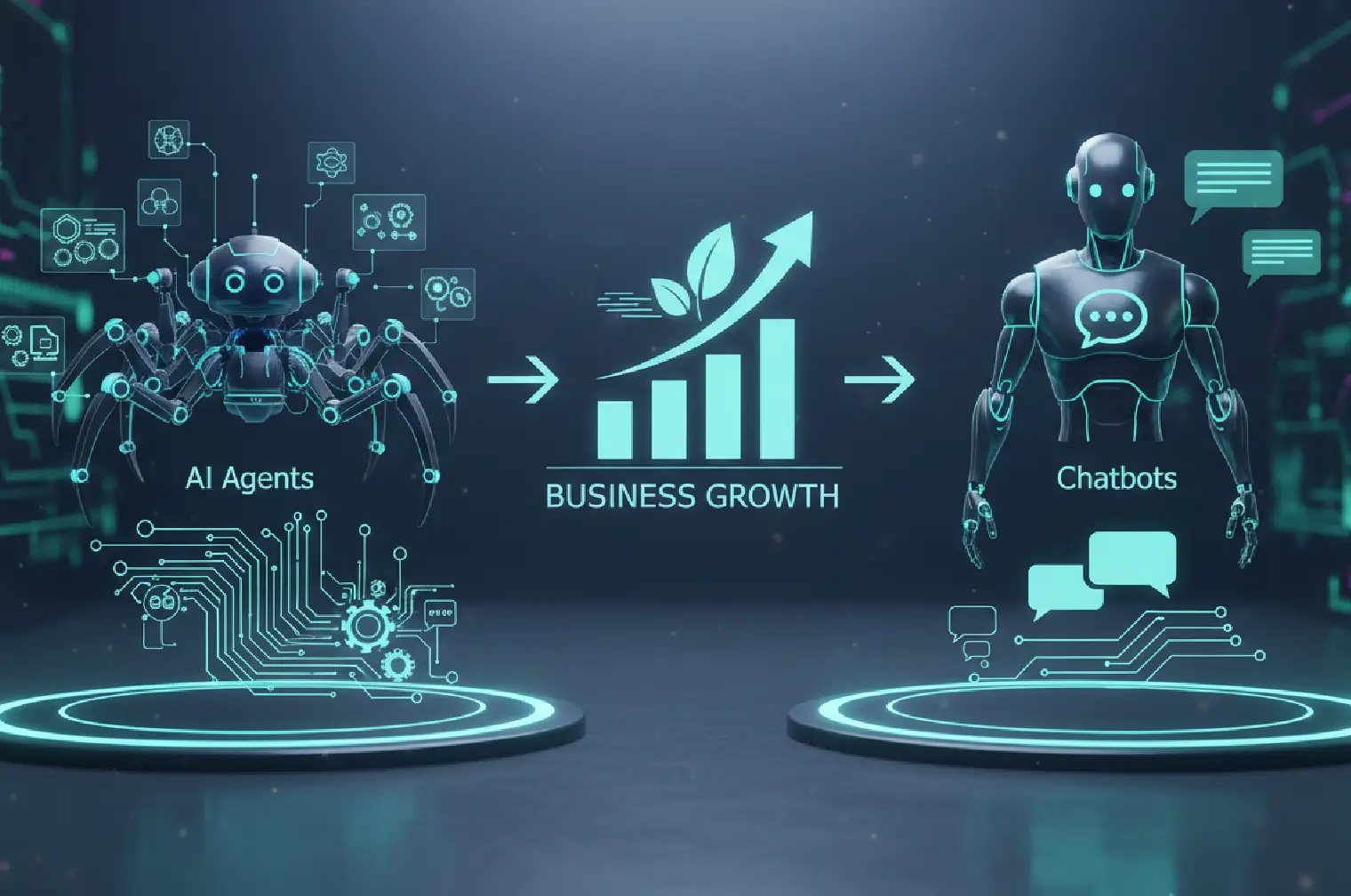
Business automation is entering a new phase where the goal is no longer “better conversations,” but measurable outcomes, which result in faster resolution, fewer handoffs, and cleaner operations. For SMEs evaluating AI agents vs chatbots, the right choice can determine whether teams stay ahead of demand or get buried under it.
In logistics, healthcare, and SaaS, the decision is less about novelty and more about operational resilience: chatbots improve responsiveness, while AI agents can redesign how work gets completed across systems.
AI Agents vs Chatbots
An AI chatbot is primarily built to converse and respond; traditional versions rely on rules and scripted flows, while more modern bots add NLP and retrieval to answer from a knowledge base. This design is fundamentally reactive: a user asks, the bot answers, and the loop usually ends there.
An AI agent, in contrast, is designed to achieve a goal, not merely respond to a message; it can gather information, make decisions, and execute a plan, often across multiple systems. Salesforce describes AI agents (autonomous agents) as going beyond limited chat to take actions and operate more independently than chatbots.
In practical deployments, agents are commonly connected to internal tools, APIs, CRMs, ERPs, ticketing systems, and knowledge bases, so they can move from “explaining what to do” to actually doing it with auditability and guardrails.
The technical jump from chatbot to agent is usually the shift from a decision-tree or retrieval pattern to a reasoning-and-execution loop: interpret intent, plan steps, call tools, validate results, and self-correct when something fails.
This is why many teams are moving past surface-level “AI agents vs chatbots” debates and instead asking a sharper question: “Do we need conversational support, or autonomous task completion with custom AI agents?”
Choose the Right Path: AI Agents vs Chatbots
Understand how AI Agents vs Chatbots impact your SME and build Custom AI Solutions that drive real business outcomes.
Structural differences and architectures
At a high level, chatbots are optimized for repeatable Q&A, while AI agents are optimized for multi-step workflows that span systems. The table below captures the structural differences most SMEs feel during implementation and scaling.
| Feature | AI chatbots | AI agents |
| Primary output | Answers and guided interactions (text-first). | Completed tasks and workflows (action-first). |
| Core logic | Scripted flows or retrieval-driven responses. | Reasoning, planning, and tool use with adaptive steps. |
| Autonomy | Low; typically needs explicit user prompts and narrow intents. | Higher; can decide next actions and chain tools toward a goal. |
| Best fit | High-volume FAQs, status checks, basic triage. | Complex processes: ticket resolution, approvals, multi-system operations. |
| Enterprise integration | Often limited to a few predefined actions. | Designed to connect across systems and update records end-to-end. |
| Operating model | Single assistant experience. | Often deployed as multi-agent patterns for specialization and control. |
This is where “chat-first” versus “agent-first” architecture becomes a real engineering decision. A multi-agent system (MAS) is commonly defined as multiple AI agents working collectively to perform tasks on behalf of a user or system. In enterprise automation thinking, MAS is often positioned as a foundation for broader autonomous operations, where specialized agents coordinate across departments and systems.
For SMEs, MAS can be a governance advantage rather than extra complexity: one agent can focus on intake and validation, another on policy checks, another on execution, and a supervisor layer can orchestrate and monitor outcomes, an approach also discussed in modern enterprise orchestration patterns. Deloitte also frames multi-agent systems as a way to transform rules-based processes into more adaptive, cognitive processes.
Advantages and challenges (the realistic view)
Chatbots win on speed-to-launch and stability when the scope is narrow and the questions are predictable. This is why they remain a strong “first automation” step for many SMEs—especially when the target is deflection (reducing human-handled inquiries) rather than full resolution.
In the selection of AI agents vs chatbots, AI agents win when the business wants AI automation that resolves work, not just routes it. ServiceNow highlights that autonomous AI agents can gather data, make decisions, and execute plans, while most chatbots are limited to answering questions and performing predefined actions without deeper autonomous decision-making. In operational terms, that difference shows up as fewer escalations, fewer swivel-chair handoffs, and lower cycle time across workflows.
The tradeoff is that AI agents raise the bar for security, infrastructure, and data readiness. OWASP’s Non-Human Identities (NHI) project notes that NHIs are used to identify, authenticate, and authorize software entities such as applications, workloads, APIs, bots, and automated systems, and they are not intrinsically tied to a human.
Okta similarly defines non-human identity security as protecting, managing, and monitoring credentials used by machines, applications, and automated processes to access systems and data—often autonomously and at scale. If an AI agent can take actions, it effectively becomes an NHI that must be governed like any other privileged identity, with least privilege, monitoring, and lifecycle control aligned to modern identity security practices.
From an engineering standpoint, agent programs also require stronger foundations: reliable data pipelines, clean system boundaries (APIs), observability, and an evaluation discipline that measures not only response quality but task success rate and safe failure behavior. Multi-agent deployments amplify this need because orchestration without monitoring can turn small inconsistencies into repeated operational errors at scale.
Build Smarter Systems with Agentic AI
Move beyond traditional Chatbots and adopt Agentic AI through Custom AI Solutions tailored for scalable SME growth.
Industry use cases and decision matrix
In logistics, a chatbot might answer shipment status or capture a pickup request, but an AI agent can coordinate actions across routing, yard operations, and exception management, especially when integrated with TMS/WMS/ERP APIs and rule constraints. In real operations, this supports “sense-and-act” workflows such as dynamic rerouting, proactive delay notifications, and structured exception resolution, where the output must be an operational change rather than a message.
In healthcare, chatbots typically handle appointment questions and basic pre-visit guidance, while agents are positioned to automate intake workflows and documentation-adjacent tasks when integrated responsibly with clinical systems. The broader industry narrative around healthcare agents includes scheduling, EHR-oriented automation, and generating structured documentation outputs as part of workflow automation.
In SaaS and IT operations, chatbots handle repetitive support entry points such as FAQs and basic access guidance, but agents can triage tickets, execute safe remediation steps, update ITSM records, and escalate only when approvals or high-risk actions are required. This aligns with the general “agents can execute multi-step workflows across systems” framing seen in agent vs chatbot guidance across enterprise platforms.
In finance and retail, chatbots can support routine customer queries, while agents are increasingly mapped to end-to-end workflows like identity verification steps, proactive risk signals, and personalized service actions—where compliance and audit trails matter as much as speed.
To decide quickly, use this practical matrix for AI agents vs chatbots planning:
| Your situation | Choose a chatbot | Choose an AI agent |
| Primary goal | Reduce repetitive support load and improve response time. | Automate multi-step processes and reduce human intervention. |
| Workflow complexity | One-step answers and simple routing. | Cross-system tasks with validation, approvals, and updates. |
| Risk tolerance | Low-risk informational interactions. | Managed risk with guardrails, identity controls, and audits. |
| Data readiness | Limited structured data; knowledge-base heavy. | Strong APIs, reliable records, and defined business rules. |
| Target outcome | Deflection (fewer tickets reach humans). | Resolution (tickets are completed end-to-end). |
Budgeting matters going into 2026, because customer operations are steadily shifting toward automation-first service models. A commonly cited Gartner expectation is that 70% of customer interactions will be handled by AI technologies. Even if the exact percentage varies by channel and industry, the directional signal is clear: SMEs that invest in scalable automation now are more likely to keep unit economics under control as interaction volume grows.
Finally, the future direction is “agentic AI,” where agents collaborate and optimize workflows continuously rather than waiting for prompts, especially in supply chain coordination and care operations where timing and dependencies are everything. Multi-agent thinking supports this by letting organizations separate responsibilities, apply policy gates, and improve governance through orchestration instead of building one oversized assistant.
Turn AI Decisions into Business Advantage
Leverage insights from AI Agents vs Chatbots to implement Custom AI Solutions that improve efficiency and decision-making.
ViitorCloud’s approach to this shift is straightforward: build custom AI solutions that match real operational boundaries, integrate cleanly with enterprise systems, and are secure by design. If the next step is moving from reactive chat to proactive AI automation, the fastest path is a focused pilot that targets one measurable workflow, proves value, and scales into an agent-first architecture without creating unmanaged non-human identities.
Explore our AI expertise at ViitorCloud, and let’s build your first autonomous agent today. Contact us at [email protected].


Innovative tech solutions aligning with your goal
Transformation starts here
- Strategic consultation
- Collaborative approach
- Agile development