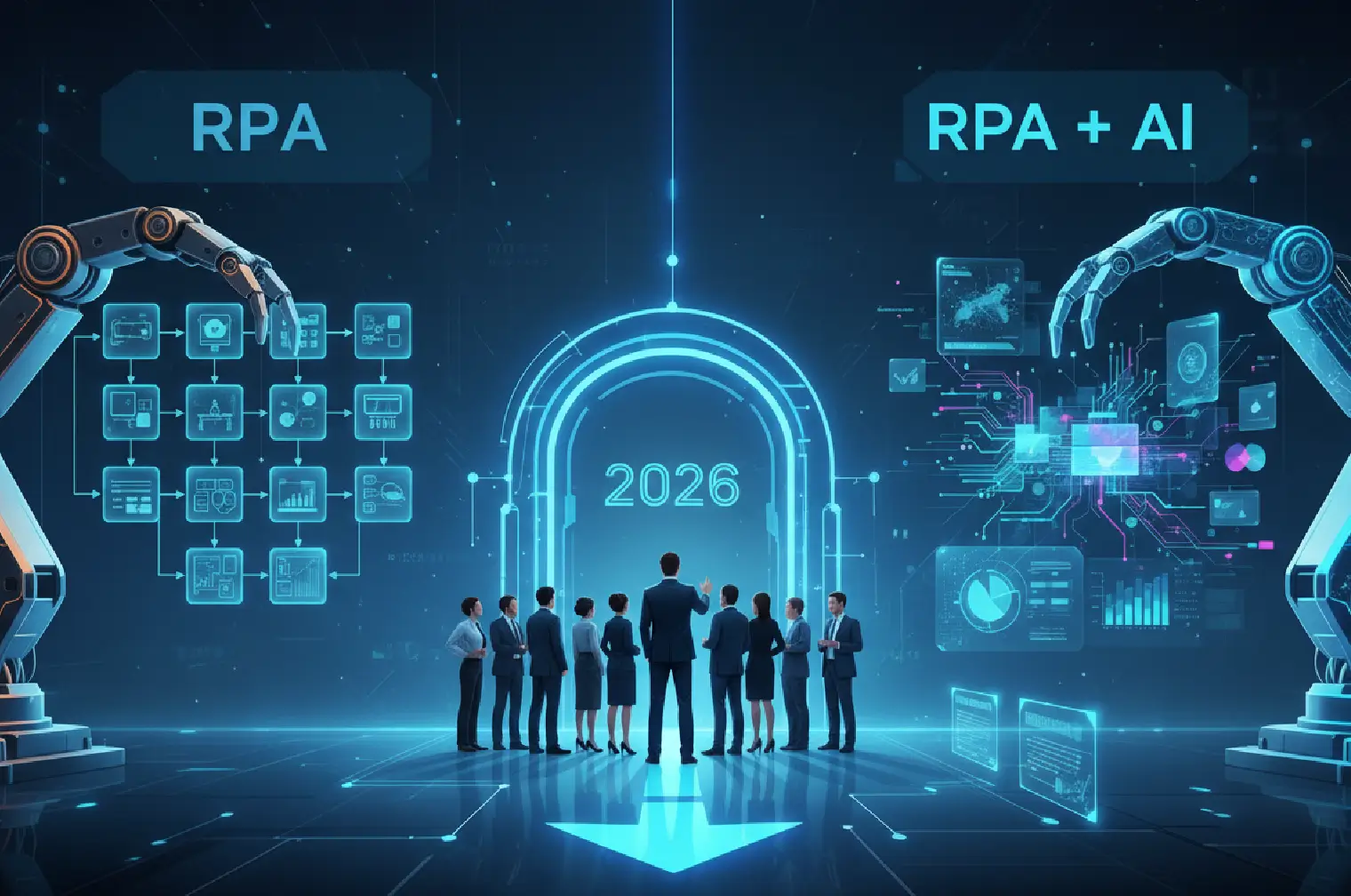
Leaders in the banking, financial services, and insurance (BFSI) sector are re-evaluating their technology stacks. The primary debate centers on RPA vs RPA + AI.
Traditional Robotic Process Automation (RPA) focuses on repetitive tasks. It uses scripts to perform actions that follow strict rules.
In contrast, adding Artificial Intelligence (AI) allows systems to handle unstructured data and make decisions. This transition defines the current standards for efficiency.
What is the State of Automation in 2026
Automation has evolved from a tool for cost reduction into a core requirement for operational resilience. In 2026, the global market for these technologies is reaching new heights.
According to Precedence Research, the RPA market is projected to reach $35.27 billion this year. A large portion of this growth comes from the BFSI sector. Small and Medium-sized Businesses (SMBs) use these tools to compete with larger institutions.
Traditional automation relies on structured inputs. If a data field changes format, the process stops. This limitation creates maintenance burdens for IT teams. Leaders now prefer AI-driven automation to solve this problem.
These systems use machine learning to adapt to changes without manual intervention. This adaptability is the main reason why firms are moving away from basic scripts.
RPA vs RPA + AI Automation: Technical Differences
To understand RPA vs AI automation, you must look at how each handles data. RPA acts like a digital worker following a manual. It logs into applications, moves files, and fills out forms. It cannot “read” an email to understand the sender’s intent. It only knows that a specific button must be clicked when a specific screen appears.
When you integrate AI, the system gains cognitive capabilities. AI-driven automation uses Natural Language Processing (NLP) to interpret text. It uses Computer Vision to understand documents that are not in a standard format. This allows a bank to automate the processing of loan applications that arrive as handwritten scans or varying PDF layouts.
| Feature | Traditional RPA | RPA + AI (Intelligent) |
| Data Input | Structured (Excel, CSV) | Unstructured (Email, Voice, Images) |
| Logic Type | If-Then-Else (Deterministic) | Probabilistic (Reasoning) |
| Error Handling | Process stops on exceptions | System learns and resolves exceptions |
| Scalability | Limited by rule complexity | High through model learning |
| Decision Making | Human must intervene | Autonomous based on parameters |
Choose the Right Path: RPA vs RPA + AI Automation
Understand what fits your business goals and move forward with scalable AI Automation built for real impact.
Implement Automation in BFSI
The adoption of automation in BFSI is no longer optional. Regulatory requirements and customer expectations for instant service drive this change. SMBs in this sector face unique challenges. They have smaller budgets but face the same compliance burdens as large banks.
Leaders use automation to handle Know Your Customer (KYC) processes. A bot can pull data from a government database and compare it to a customer’s application. However, if the names have slight spelling variations, a standard bot fails. This is where RPA vs RPA + AI automation becomes a critical choice. AI models can determine if “Samantha Ruth Prabhu” and “Samantha R. Prabhu” are the same person with high confidence.
ViitorCloud provides AI-driven automation services that help firms bridge this gap. These services allow SMBs to deploy intelligent agents that handle complex workflows.
For example, in cross-border payments, systems must check transactions against sanctions lists. These lists change daily. Rule-based systems generate too many false positives. AI-driven models reduce these errors by understanding the context of the transaction.
The Role of AI-Driven Automation in Risk Management
Risk management is a primary use case for automation in BFSI. Financial institutions must monitor transactions for fraud in real-time. Traditional systems use static thresholds. For example, they flag any transaction over $10,000. Criminals know these rules and stay under the limits.
AI-driven automation identifies patterns rather than just following limits. It analyzes the behavior of a user over months. If a user typically spends $50 at a grocery store and suddenly attempts a $5,000 purchase in a different country, the system acts. It can pause the transaction and send a verification request automatically. This level of automation in BFSI protects both the institution and the customer.
Firms can learn more about these integrations in our blog on RPA and AI hybrid automation for payments. Combining these technologies ensures that the speed of RPA meets the intelligence of AI. This combination is essential for maintaining a competitive edge in 2026.
Efficiency Gains for SMBs
SMBs must optimize their human resources. Staff should focus on client relationships rather than data entry. Automation allows this shift to happen. In 2026, leaders are choosing “Agentic AI.” These are autonomous agents that can plan their own tasks to reach a goal set by a human.
When discussing RPA vs AI automation, the conversation often turns to ROI. RPA has a lower initial cost but higher long-term maintenance. AI-driven automation requires more investment in data preparation and model training. However, it delivers higher value by automating end-to-end processes.
Forrester indicates that 2026 is a year of pragmatic AI deployment. Their Predictions 2026 report suggests that leaders are moving away from experimental projects. They are now focusing on specific business outcomes.
For a small insurance firm, this might mean using AI to automate claims processing. The system receives the claim, verifies the policy details with RPA, and uses AI to assess the damage from photos.
Go Beyond RPA with AI Automation
Upgrade static automation with intelligent workflows using Custom AI Solutions designed for modern enterprises.
Strategic Selection: RPA vs AI Automation
Choosing the right tool depends on the process. Leaders follow a specific framework to decide between RPA vs AI automation.
- Process Stability: If the process never changes, use RPA.
- Data Volume: If you process millions of structured rows, RPA is efficient.
- Complexity: If the process requires judgment or interpretation, use AI-driven automation.
- Regulation: If every step must be audited with 100% predictable logic, pure RPA is often safer for the final execution step.
Automation in BFSI often uses a hybrid approach. The AI makes the decision, and the RPA bot executes the transaction in the legacy banking software. This method avoids the need to replace old core banking systems, which is expensive and risky for SMBs. You can see how this applies to different sectors in our article on AI workflow automation.
Operationalize AI-Driven Automation
To succeed with AI-driven automation, a firm needs a clear data strategy. AI models require clean data to learn. Many SMBs have data siloes where information is trapped in different departments. Automation tools can help consolidate this data.
Once the data is accessible, the institution can deploy AI-driven automation to handle customer service. AI chatbots in 2026 are not simple decision trees. They use Large Language Models (LLMs) to provide helpful, human-like responses. They can resolve issues like password resets or balance inquiries without human help. When the issue is resolved, RPA updates the customer’s record in the CRM.
The implementation of automation in BFSI also reduces human error. Manual data entry in financial services leads to costly mistakes. Automated systems do not get tired. They maintain the same level of accuracy at 3 AM as they do at 9 AM. This reliability is vital for maintaining regulatory compliance and avoiding fines.
Future Outlook for 2026 and Beyond
The trend for automation in BFSI is moving toward total autonomy. We are seeing the rise of “Autonomous Finance.” In this model, the software manages treasury functions, liquidity, and investments with minimal human oversight. Leaders are preparing for this by building the foundation today with AI-driven automation.
The choice between RPA vs AI automation is becoming a choice of scale. RPA helps you do things faster. AI helps you do things smarter. For an SMB in 2026, doing things smarter is the only way to survive. The cost of AI models has decreased, making them accessible to smaller firms. This democratization of technology allows SMBs to offer the same level of service as global banks.
Build Smarter Automation for 2026 and Beyond
Adopt AI Automation that learns, adapts, and scales—powered by ViitorCloud’s Custom AI Solutions.
Conclusion
Success in 2026 requires a balanced automation strategy. Leaders utilize automation for back-office tasks and AI-driven automation for customer-facing and decision-heavy roles. The integration of these technologies creates a digital workforce that is both fast and intelligent.
Firms must evaluate their current workflows to identify where automation in BFSI can have the most impact. Start with high-volume, rule-based tasks using RPA. Then, introduce AI to handle exceptions and unstructured data. This phased approach reduces risk and allows the team to learn.
ViitorCloud assists organizations in navigating these choices. By using our expertise in automation, businesses can transition from manual processes to intelligent, autonomous workflows. The goal is to build a system that executes tasks and improves over time. In 2026, the leaders are those who treat automation as a strategic asset rather than just a technical tool.

Vishal Shukla
Vishal Shukla is Vice President of Technology at ViitorCloud Technologies.