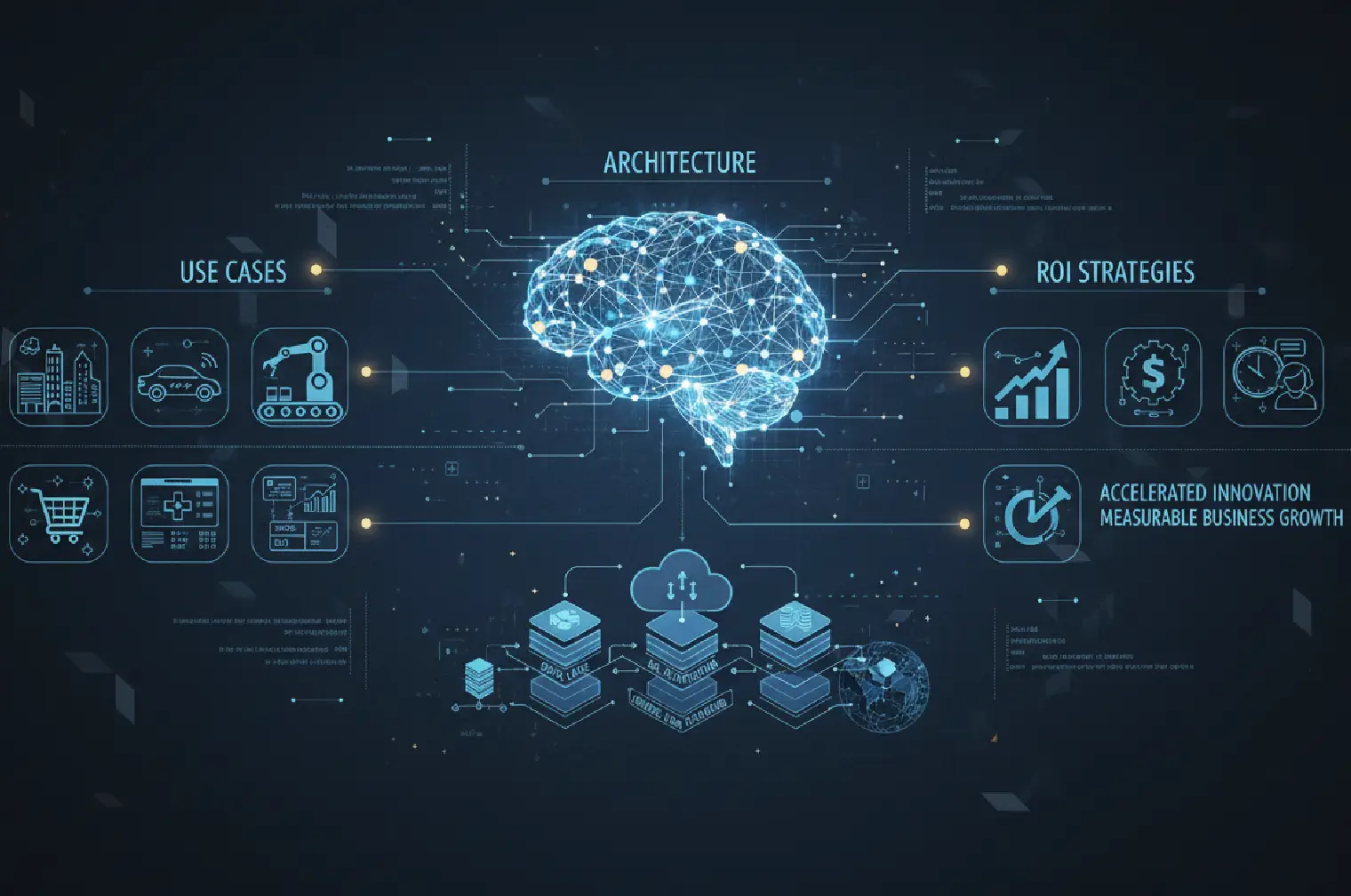
Technical buyers in SaaS, FinTech, and HealthTech now prioritize AI ML development that delivers measurable financial outcomes. This article details the architecture, industry-specific use cases, and Return on Investment (ROI) frameworks required for modern machine learning development services.
AI ML Development in 2026 (What’s changed)
The current year marks a shift toward “Intelligence Orchestration.” Organizations no longer focus on standalone models. Instead, they build integrated systems where AI agents handle complex workflows. According to the McKinsey Global Tech Agenda 2026, top-performing CIOs are weaving AI into their core operating models to drive growth.
Successful AI ML development projects now require a data-first approach. This involves building robust data pipelines before selecting model architectures. For companies in Europe and the USA, compliance with evolving AI governance standards is now a primary requirement for any machine learning development services provider.
Core Industry Use Cases
| Industry | Primary AI Use Case | Technical Outcome |
| SaaS | Predictive Churn & Dynamic Pricing | 15–20% increase in Customer Lifetime Value (CLV). |
| FinTech | Real-time AML & Fraud Detection | Reduction in false positives by up to 45%. |
| HealthTech | Medical Image Analysis & EHR Automation | 40% reduction in administrative resource consumption. |
Turn AI Vision into Measurable ROI
Implement high-impact use cases with ViitorCloud’s AI/ML Development Services and scalable Custom AI Solutions.
Technical Architecture for Scalable AI Solutions
Modern AI ML development relies on modular, cloud-native architectures. The 2026 stack focuses on Agentic AI and multi-agent systems (MAS). These systems allow specialized agents to collaborate on shared goals, such as automating a full real estate transaction or managing a global supply chain.
1. Vector Databases and RAG
To minimize “hallucinations” and ensure data privacy, developers use Retrieval-Augmented Generation (RAG). This architecture connects LLMs to secure, internal data sources via vector databases like Milvus or Pinecone. This ensures that the machine learning development services provided stay relevant to the specific business context without leaking sensitive data into public training sets.
2. Hybrid Cloud and On-Premise Execution
For industries like finance and healthcare, data residency is critical. Hybrid cloud deployments allow sensitive data to stay on-premise while leveraging cloud-based GPUs for model inference. This setup provides a balance between high-performance computing and strict regulatory compliance.
3. MLOps and LLMOps Pipelines
Scaling AI ML development requires automated pipelines for model monitoring and retraining. MLOps ensures that models do not “drift” over time. In 2026, LLMOps has become equally important, focusing on token cost optimization and latency management for real-time applications.
Measure ROI in Machine Learning Development Services
The maturity of machine learning development services is now measured by the “Show Me the Money” standard. PwC research indicates that leadership now applies a top-down strategy to pick high-ROI workflows rather than crowdsourcing minor projects. You can review these trends in the PwC 2026 AI Business Predictions report.
The ROI Calculation Formula
To calculate the value of an AI initiative, use the following technical formula:
- Efficiency Gains: Reduction in manual labor hours (e.g., automated document processing).
- New Revenue: Gains from hyper-personalization or new AI-driven product features.
- Risk Mitigation: Cost savings from avoided fraud or regulatory fines.
- TCO (Total Cost of Ownership): Includes data engineering, infrastructure, and maintenance.
Strategic Impact by Sector
- FinTech: AI-driven credit scoring models allow for 25% faster loan approvals while maintaining risk profiles.
- SaaS: Integrated SaaS product engineering services use AI to automate customer onboarding, reducing time-to-value for new users.
- Logistics: Advanced data engineering solutions allow for real-time route optimization, reducing fuel costs by 12%.
Build Scalable Systems with AI/ML Development Services
Design secure architecture and deploy production-ready Custom AI Solutions tailored to your business goals.
ViitorCloud Capabilities and Implementation
Effective AI ML development requires a partner who understands the intersection of data engineering and business logic. ViitorCloud has delivered over 500 projects, focusing on transforming complex challenges into automated opportunities. Our approach centers on building custom AI solutions that align with specific industry benchmarks.
For example, in the real estate sector, the Klaviss platform successfully automated transactions between multiple parties. This reduced execution time while ensuring transparency and immutability through integrated AI layers.
Our machine learning development services also extend to the agricultural and retail sectors. The Cow Monitor project is a literal example of AI in action, where we developed a system for tracking livestock health and temperature in real-time. This project helped farmers move from reactive treatment to proactive health management. You can find more detailed examples in our AI success stories.
ViitorCloud’s AI integration services follow a milestone-based payment model. This ensures that clients only pay for evaluated work that meets specific performance metrics. We focus on building long-term partnerships rather than one-off experiments. Our technical teams operate as an extension of your product department, ensuring that AI ML development efforts scale alongside your business growth.
Conclusion
The year 2026 is the year of operational AI. For SaaS, FinTech, and HealthTech companies, the choice is to either optimize through machine learning development services or risk operational stagnation. By focusing on modular architecture, clear ROI metrics, and deep industry integration, businesses can turn AI from a cost center into a primary driver of efficiency and revenue.
Accelerate Growth with Custom AI Solutions
Solve complex business challenges using enterprise-grade AI/ML Development Services from ViitorCloud experts.
Frequently Asked Questions
How do we handle AI data privacy in Europe?
We implement Confidential Computing and “Geopatriation” strategies. This ensures that AI workloads run within sovereign or regional cloud providers, adhering to GDPR and local data laws.
What is the typical timeline for an AI MVP?
A production-ready MVP generally takes 8 to 12 weeks. This includes data auditing, pipeline setup, model selection, and integration into existing CRM or ERP systems.
Can we integrate AI into legacy systems?
Yes. We use system integration and modernization frameworks to wrap legacy databases in modern API layers, making them accessible to AI agents without requiring a full system overhaul.
How do we measure the specific ROI of AI ML development?
We measure ROI by comparing total costs against efficiency gains, revenue growth, and risk mitigation. Our AI ML development teams conduct a baseline audit to track these metrics during implementation.
What are the ongoing costs after the initial AI development?
Post-deployment costs include cloud infrastructure, model monitoring, and periodic retraining. Our AI ML development packages include MLOps support to automate performance tuning and keep operational expenses predictable for our clients.

Vishal Shukla
Vishal Shukla is Vice President of Technology at ViitorCloud Technologies.