Legacy system modernization stands as a critical financial imperative for enterprise survival in 2026. Picture this: your enterprise aims to launch an AI-driven predictive analytics tool. You have the executive buy-in and the market demand. However, when your engineering team attempts to integrate this new feature, your decades-old core infrastructure rejects the API. Development grinds to a halt. Instead of driving innovation, your IT budget bleeds into keeping obsolete servers alive.
If this scenario sounds familiar, you are not alone. According to 2025 data from McKinsey, enterprises now burn a staggering 40% of their entire IT budgets merely maintaining legacy systems. This is not money spent on growth; it is money spent on survival. For IT Directors and CIOs in the banking and manufacturing sectors, rising maintenance costs represent the ultimate warning sign. You must identify these red flags and implement strategic legacy software modernization solutions before technical debt paralyzes your operations.
Why Do Rising Maintenance Costs Demand Legacy System Modernization?
Why do outdated systems drain IT budgets so aggressively?
They require specialized, increasingly rare talent to maintain, and they suffer from frequent, costly downtimes.
When you ignore technical debt, your operational expenses multiply. Gartner research highlights that organizations ignoring their technical debt spend up to 40% more on maintenance than their proactive competitors. Developers currently waste nearly 33% of their working hours maintaining legacy code, debugging ancient architectures, and building temporary workarounds. Every new feature takes twice as long to deploy. When your IT budget shifts from creating business value to merely patching old software, you urgently need legacy system modernization services with a strategic roadmap for banking and manufacturing.
Modernize Before Legacy Systems Hold Your Business Back
Strengthen resilience and performance with ViitorCloud’s Legacy System Modernization and advanced System Integration and Modernization Solutions designed for banking and manufacturing leaders.
How Does Technical Debt Cripple the Banking Sector?
What happens when financial institutions rely on outdated code?
They face massive compliance fines, security breaches, and an inability to offer real-time digital services.
The banking sector faces a unique crisis. In 2025, approximately 70% of banks worldwide still operate on decades-old legacy infrastructures. Many of these institutions rely on ancient COBOL applications to process millions of daily transactions. An IDC Financial Insights report warns that outdated core systems will cost the banking industry up to $57 billion annually by 2028 due to inefficiencies and compliance failures.
When a bank cannot process real-time payments or integrate seamlessly with modern fintech apps, it loses market share. To survive, financial CIOs must partner with a leading digital transformation company to execute complete legacy software transformation. Upgrading these systems eliminates the bottleneck, hardens cybersecurity defenses, and enables hyper-personalized, AI-driven banking experiences.
Why Must Manufacturing Leaders Prioritize Custom Legacy Application Upgrade Services?
How do outdated systems disrupt the modern supply chain?
They create isolated data silos, delay production cycles, and prevent the adoption of smart automation.
In the manufacturing sector, operational agility dictates market dominance. Yet, many global manufacturers still run their critical Manufacturing Execution Systems (MES) and Enterprise Resource Planning (ERP) software on aging, on-premises hardware. These brittle systems cannot communicate with modern IoT sensors or automated assembly lines.
When your factory floor generates terabytes of data but your core system cannot analyze it in real-time, you lose your competitive advantage. Implementing custom legacy application upgrade services allows manufacturers to break down these data silos. By moving from monolithic architectures to agile, cloud-native environments, manufacturing IT heads ensure seamless supply chain visibility and absolute operational resilience.
What Are Practical Use Cases for Legacy Application Modernization?
How do modernization strategies look in action?
Consider these proven, real-world applications across targeted industries:
Banking API Integration
A global financial institution struggles to launch a mobile digital wallet due to its rigid mainframe. By utilizing legacy application modernization, they wrap their core mainframe in secure microservices and modern APIs. This API-led strategy allows the bank to launch its digital wallet 50% faster, providing real-time transaction data to customers without rebuilding the entire underlying database from scratch.
Manufacturing Cloud Migration
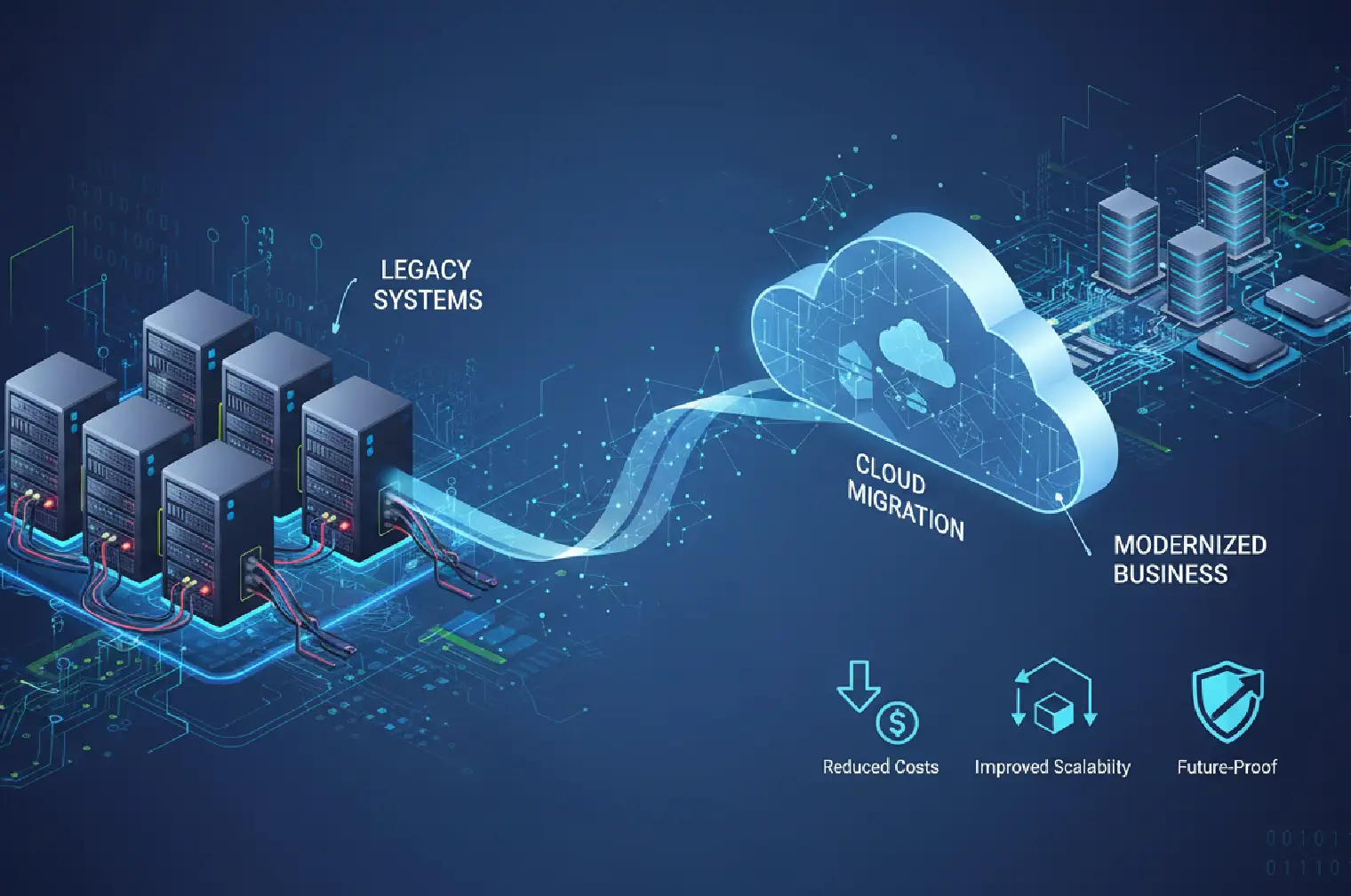
A multinational auto-parts manufacturer experiences frequent production delays due to an outdated, heavily customized ERP system. They leverage expert IT modernization consulting to execute phased cloud migration. They containerize their critical workloads and shift them to a hybrid-cloud environment. This move reduces their infrastructure maintenance costs by 35% and completely eliminates unplanned system downtime during peak production shifts.
Upgrade Legacy Applications Before They Cost You Growth
Future-proof your infrastructure with expert Legacy Application Modernization Services and scalable System Integration and Modernization Solutions from a trusted Digital Transformation Company.
What Are Key Areas and Considerations for IT Modernization Consulting?
What must enterprise IT heads consider before initiating an upgrade?
You must evaluate architectural complexity, business continuity, and comprehensive integration frameworks. Successful modernization is never a simple “lift and shift” operation.
To ensure a smooth transition, focus on these key areas:
- Code and Dependency Mapping
Before touching a single line of code, you must map every system dependency. Understanding how your legacy databases interact prevents catastrophic workflow interruptions during the migration.
- Choosing the Right Modernization Approach
Not every application requires a complete rewrite. You must assess whether to re-platform, refactor, or rebuild. A reliable partner helps you select the path that offers the highest ROI.
- Seamless Interoperability
Upgrading one system while leaving others behind creates friction. You must employ robust system integration services to ensure that your newly modernized applications communicate flawlessly with both external SaaS platforms and remaining internal legacy tools.
ViitorCloud: Your Legacy System Modernization Services Partner
How do you successfully navigate this complex transformation while minimizing operational disruption?
You collaborate with proven experts who specialize in enterprise-grade system integration and modernization solutions.
At ViitorCloud, our legacy system modernization services help organizations identify outdated systems and technologies that actively hinder growth, enabling strategic investments in modern solutions that drive immediate business value. Our experienced IT consulting team develops comprehensive roadmaps by analyzing your existing architecture and aligning it with industry best practices.
We transform aging infrastructure through proven modernization approaches including replatforming, refactoring, and secure cloud migration. With decades of experience providing end-to-end solutions across the banking and manufacturing sectors, we deliver tangible benefits through strategic system upgrades, API integration, microservices architecture, enhanced security, and optimized performance.
Our deep expertise in legacy application modernization helps organizations drastically reduce technical debt while strictly preserving critical business functionality. As your trusted partner, we take a systematic approach that addresses your immediate technical challenges and guarantees your applications remain adaptable and highly scalable for years to come.
Turn Legacy Systems Into Competitive Advantage
Accelerate innovation with ViitorCloud’s Legacy System Modernization, proven Legacy Application Modernization Services, and enterprise-ready System Integration and Modernization Solutions.
Stop Paying for the Past; Invest in the Future
Rising maintenance costs and sluggish performance are glaring warning signs that your enterprise infrastructure is failing. Do not let outdated technology dictate your market position in 2026. By embracing a strategic, phased modernization approach, banking and manufacturing leaders transform their rigid technical debt into a dynamic engine for continuous innovation.
Are you ready to eliminate rising maintenance costs and future-proof your enterprise?
Contact our enterprise IT architects today for a comprehensive modernization assessment and take the first critical step toward absolute digital transformation.

Vishal Shukla
Vishal Shukla is Vice President of Technology at ViitorCloud Technologies.