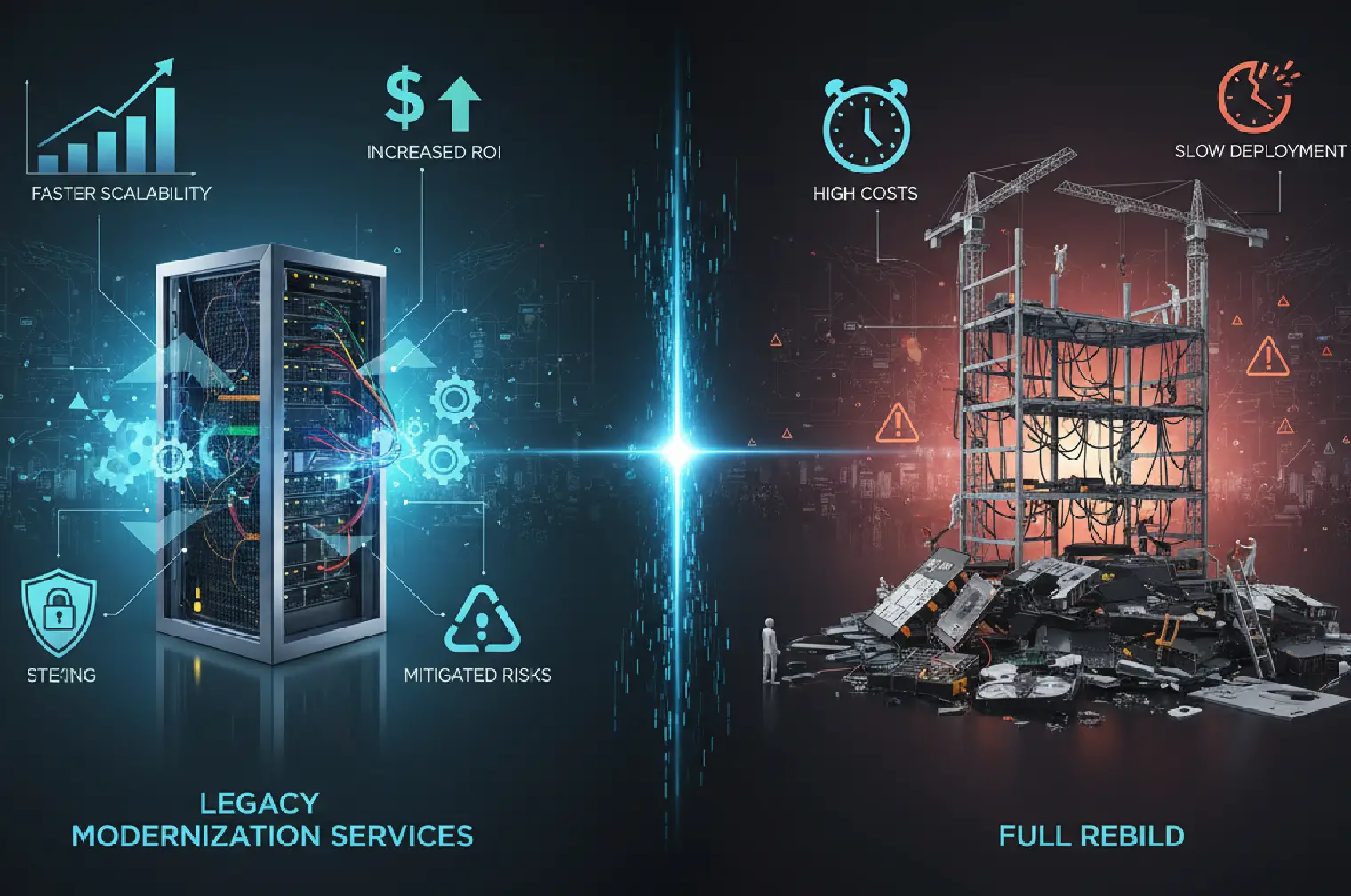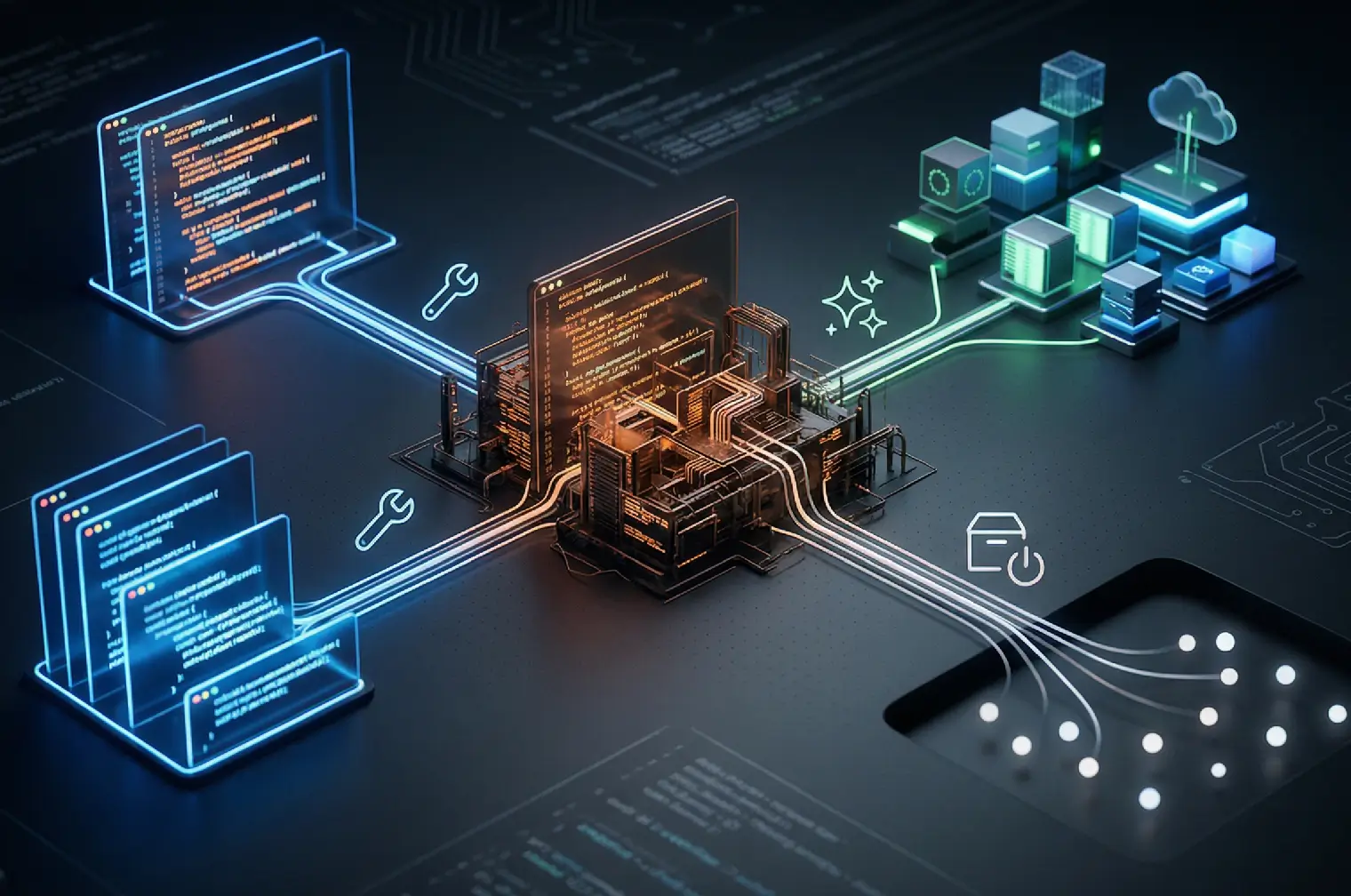
Legacy app modernization is one of the most important decisions an engineering leader makes. Organizations running decade-old applications spend 60 to 80 percent of their IT budget on maintenance alone. That leaves less than 20 percent available for building new capabilities, fixing security gaps, or accelerating release cycles.
The question is never whether to modernize. The question is what to do with each application in your portfolio: refactor it, replace it, or retire it entirely. Getting this call wrong costs millions and slows delivery by months.
The Numbers That Explain Why This Cannot Wait
The financial and security case for action is clear:
- 70 percent of banks globally still run core operations on legacy systems
- Over 60 percent of U.S. hospitals operate at least one critical application on legacy software
- Healthcare data breaches cost an average of $9.77 million, the highest across all industries, according to the IBM Cost of a Data Breach Report 2024
- U.S. accumulated technical debt has reached $1.52 trillion (IT-CISQ)
- Maintenance costs on aging systems increase 10 to 15 percent every year
- 43 percent of IT professionals cite security vulnerabilities as their top concern with legacy software
In regulated industries, the total cost of inaction exceeds the cost of modernization within two to three years. Every delayed legacy code migration adds to that compounding pressure.
Your Application Portfolio Is Already Telling You What to Do
Before selecting an application modernization strategy, assess each application against two dimensions: technical fitness (code quality, security, maintainability) and business value (revenue impact, user volume, regulatory exposure).
These are the signals that demand immediate action:
- Frequent downtime or degraded performance affecting customer-facing operations
- Security vulnerabilities with no vendor patch available due to end-of-life status
- Active compliance gaps under HIPAA, GDPR, PCI-DSS, or sector-specific regulations
- Developer time consumed by navigating legacy codebases instead of shipping features
- Integration failure with modern APIs, cloud services, or analytics platforms
- Release cycles measured in months rather than weeks
If three or more of these apply to a single application, it is not a candidate for further tolerance. It requires an active legacy code migration decision.
Stop bleeding money on dead software architecture
Indecision costs you millions and limits your enterprise growth. You need a proven application modernization strategy to survive. We execute aggressive legacy app modernization and flawless legacy code migration. Rely on our experts for complete system integration and modernization that turns outdated apps into high-speed revenue engines today.
The Framework Behind Every Sound Modernization Decision
Two frameworks structure legacy app modernization decisions at the portfolio level.
The 7Rs Framework
The 7Rs, widely adopted from AWS migration methodology, classify each application into one of seven paths:
| Path | What It Means | Best For |
| Retire | Decommission the application | Redundant or unused systems |
| Retain | Keep as-is short-term | Stable, low-priority apps |
| Rehost | Move to cloud without code changes | Quick infrastructure cost reduction |
| Replatform | Minor optimization plus cloud move | Scalability gains without full rewrite |
| Refactor | Restructure code into modern architecture | Core systems with unique business logic |
| Rebuild | Full rewrite in modern stack | When legacy code is no longer viable |
| Replace | Adopt SaaS or a new custom solution | When off-the-shelf covers the use case |
The Gartner TIME Model
The Gartner TIME framework evaluates each application on two axes: technical quality and functional value.
- Tolerate: High technical quality, low functional value. Keep short-term, no investment.
- Invest: High technical quality, high functional value. Modernize deeply and continuously.
- Migrate: Low technical quality, high functional value. Replatform or refactor the application.
- Eliminate: Low technical quality, low functional value. Retire immediately.
Applying both frameworks across an application portfolio produces a clear, prioritized application modernization strategy that aligns IT investment with business outcomes.
When Refactoring Deserves the Investment
Refactoring restructures code without changing external functionality. It removes technical debt, improves maintainability, and prepares the application for cloud-native deployment.
Choose refactoring when:
- The application holds unique, documented business logic that no SaaS product replicates
- It is core to revenue generation but runs on a monolithic or tightly coupled architecture
- Security patching is possible but requires structural changes to remain sustainable
- Performance issues come from code design, not from a flawed foundational concept
In BFSI, core banking platforms built on COBOL often fit this profile. The business logic is irreplaceable, but the architecture creates risk. A legacy code migration to cloud-native architecture using microservices and containerization allows these systems to evolve without rewriting decades of financial rules.
For healthcare systems with integrated clinical workflows, refactoring enables HIPAA compliance updates and FHIR interoperability without losing the workflow logic that clinical teams depend on daily.
When Replacing Makes More Business Sense
Replacement means retiring the old system and adopting either a SaaS product or a purpose-built custom application.
Choose replacement when:
- A reliable, compliant SaaS solution covers 80 percent or more of the current functionality
- The application has no competitive differentiation embedded in its code
- Integration with modern infrastructure is architecturally blocked, not just difficult
- Annual maintenance cost exceeds the measurable business value the application delivers
Government agencies and telco operators running platforms with no active vendor support face this situation regularly. When no security patches exist, the legacy code migration path shifts from refactoring to replacement. Sixty percent of COBOL-reliant organizations report finding skilled developers as their biggest operational challenge. Replacing those systems removes a long-term staffing risk alongside the technical one.
The decision between cloud migration and full modernization is often where replacement strategies are clarified: migration preserves the existing system in a new environment; replacement removes it entirely.
When Retiring an Application Is the Right Call
Retirement is the most underused option in legacy app modernization planning. Many organizations keep applications running because decommissioning feels risky or requires stakeholder alignment that has not happened yet.
Retire an application when:
- It supports a discontinued or fully automated business process
- Its functionality is duplicated in another active system
- Usage data shows minimal or zero active users over the past 12 months
- It is already scheduled for phase-out, and modernizing it would produce no lasting return
Retiring redundant applications produces immediate results: reduced licensing costs, lower infrastructure spend, smaller attack surface, and fewer systems to include in compliance audits. For BFSI and healthcare organizations where audit scope directly affects cost and risk, a smaller active application portfolio has measurable value.
End the rebuild debate and start scaling your enterprise
Outdated platforms hand your market share directly to your competitors. We deliver a bulletproof application modernization strategy that eliminates the guesswork. Partner with us for rapid legacy app modernization and secure legacy code migration. We handle complex system integration and modernization so you deploy faster and dominate your industry right now.
From Decision to Delivery: A Six-Step Modernization Roadmap
A structured application modernization strategy prevents scope creep and budget overruns.
The proven sequence is:
- Inventory and assess the full portfolio, documenting dependencies, annual costs, and compliance obligations per application
- Rationalize the portfolio using the TIME or 7Rs framework, placing each application in a prioritized category
- Select the path for each application: rehost, replatform legacy app components, refactor, replace, or retire
- Build a phased roadmap with defined milestones, risk mitigation plans, and allocated budget per phase
- Execute with DevOps practices: CI/CD pipelines, containerization, phased rollouts, and automated rollback capability
- Monitor outcomes post-deployment using deployment frequency, incident volume, infrastructure cost, and release cycle time as primary metrics
Avoid big-bang execution. Phased approaches, including the Strangler Fig pattern for progressively replacing legacy components, maintain business continuity throughout the legacy code migration process.
According to the U.S. GAO’s 2025 report on federal legacy systems, agencies that document clear modernization plans with all key practices are significantly more likely to complete the work on time and on budget.
The Pressure Is Different in Regulated Industries
BFSI
Banks and insurers face dual pressure: aging COBOL-based cores and increasing regulatory obligations under frameworks including DORA in Europe and OCC guidance in the U.S. Legacy system modernization for BFSI using API-first, composable architectures allows institutions to update individual services without disrupting customer-facing operations. Accenture data shows 30 to 40 percent infrastructure cost reduction is achievable through cloud modernization in banking when combined with data center consolidation.
Healthcare
Over 700 breaches of protected health information were reported in 2025, affecting more than 170 million records. Proposed HIPAA Security Rule updates expected in 2026 will require mandatory multi-factor authentication, encryption, and 72-hour system restoration timelines. Hospitals on legacy EMR and billing platforms face direct compliance exposure until healthcare digital transformation programs bring those systems into conformance.
Government
The U.S. GAO identified 11 critical federal legacy systems in 2025 requiring immediate modernization, with a combined annual operating cost of $337 million. Approximately 70 percent of security problems in government systems originate in legacy code. The case for phased legacy code migration is both financial and national security in nature.
Telco
5G infrastructure demands event-driven, cloud-native backend architectures. Legacy OSS and BSS platforms were not built for real-time data processing at that scale. Operators that delay application modernization strategy work face growing integration debt as each new network capability requires custom-built workarounds on top of aging systems.
Three Decisions That Derail Modernization Programs
Most failed legacy app modernization projects share the same root causes:
- No portfolio baseline: Teams skip application inventory and rationalization, leading to scope expansion mid-project when hidden dependencies surface
- Big-bang execution: Attempting to modernize everything in one program creates unmanageable risk, delays delivery, and rarely produces the intended outcome
- Measuring migration activity instead of business outcomes: Tracking code movement rather than deployment speed, downtime reduction, and cost savings means the program loses its anchor to business value
Gartner research shows that only 48 percent of digital initiatives meet or exceed their business outcome targets. The gap is almost always an execution and measurement failure, not a technology failure.
ViitorCloud Has Done This Work in BFSI, Healthcare, and More
ViitorCloud works with organizations in BFSI, healthcare, logistics, and government to design and execute legacy app modernization programs that produce measurable outcomes. With 15 years of experience in regulated industries, our team delivers assessment-first engagements that identify which applications to replatform, refactor, replace, or retire based on actual portfolio data.
ViitorCloud’s system integration and modernization practice covers end-to-end delivery: from application portfolio assessment and roadmap design through to phased execution using microservices, containerization, CI/CD automation, and API-first integration patterns. Clients in BFSI have used this approach to decouple core banking services from monolithic platforms while maintaining full regulatory compliance and zero customer-facing downtime.
Start your modernization assessment with ViitorCloud
Transform your fragile systems into a massive competitive advantage
Crashing software kills your enterprise momentum and frustrates your teams. Take control with a custom application modernization strategy that guarantees zero downtime. We drive elite legacy app modernization through precise legacy code migration and seamless system integration and modernization. Upgrade your tech stack today and scale your profit instantly.
Conclusion
Legacy app modernization is a structured business decision. The right outcome depends on assigning the correct strategy to each application: refactor when business logic has irreplaceable value, replace when a better solution exists, and retire when an application no longer justifies its operating cost.
Organizations that apply a disciplined application modernization strategy reduce maintenance costs by 30 to 50 percent, close security gaps, and accelerate release cycles. Those that delay compound the problem at 10 to 15 percent per year. The cost of inaction is not fixed. It grows.

Vishal Shukla
Vishal Shukla is Vice President of Technology at ViitorCloud Technologies.
Frequently Asked Questions
When should an organization begin its legacy app modernization program?
When maintenance costs exceed innovation spend, or when security and compliance gaps pose measurable, growing risk to the business.
What is the difference between replatforming and refactoring in an application modernization strategy?
How long does a typical legacy code migration take for an enterprise application?
Is it always necessary to replatform a legacy app during modernization?