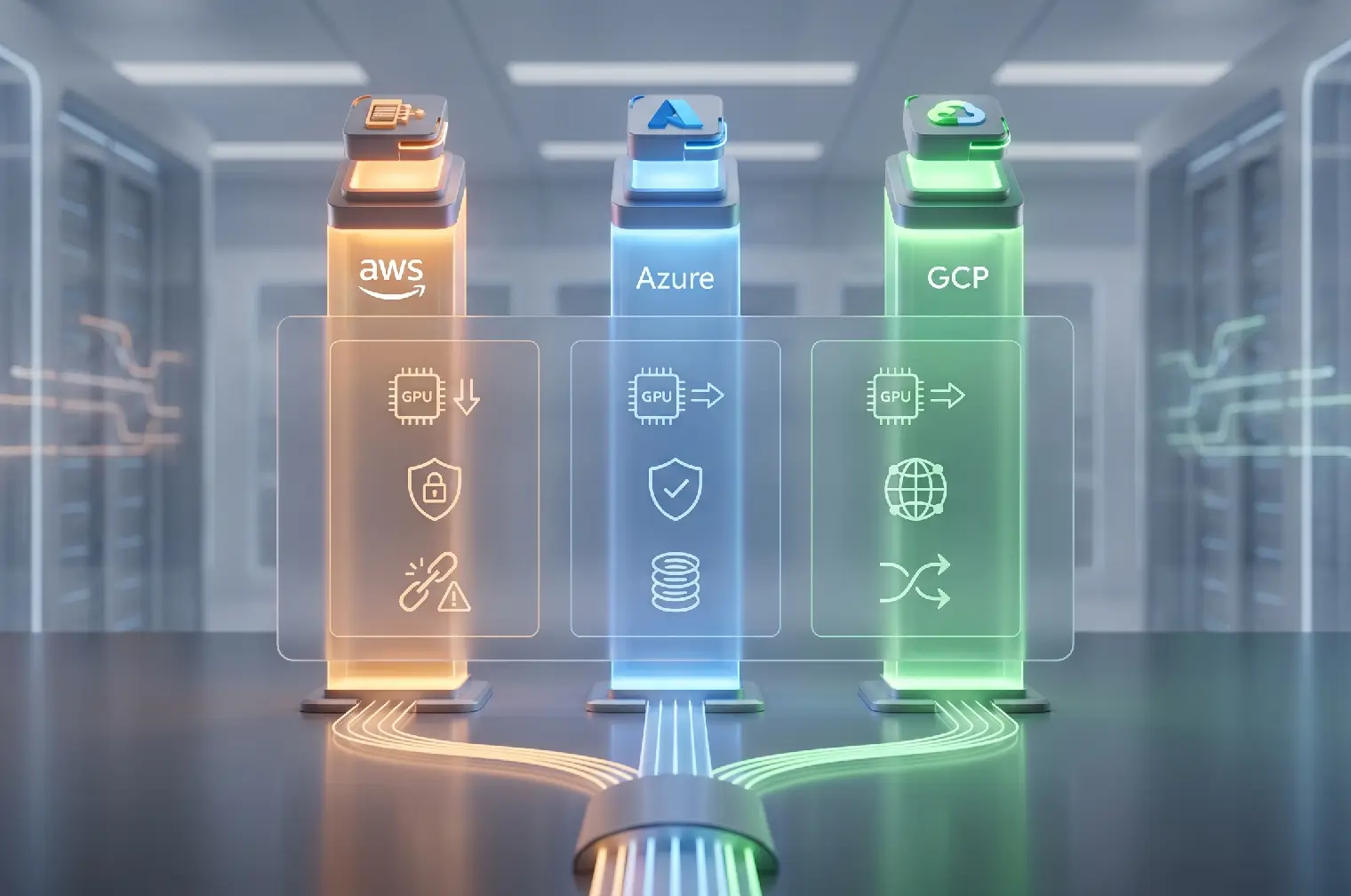
The best cloud for AI workloads in 2026 depends on what you are running. AWS wins on large-scale training and tooling depth, Azure wins on regulated-industry compliance and OpenAI access, and GCP wins on AI-native architecture and TPUs. The honest answer is that cloud migration consulting services exist because picking the wrong one costs more than the entire migration.
I have spent the last several years inside cloud migrations where the AWS vs Azure vs GCP decision was already made by someone else, usually without an honest look at what the AI roadmap actually required. The same pattern repeats. A team picks a cloud for general workloads, scales their ai/ml development inside it, then hits a wall on GPU capacity, pricing, or compliance two years in. This article gives you the real 2026 view so you can avoid that wall.
Key Takeaways
- AWS, Azure, and GCP H100 list prices vary by up to 40% per GPU hour in 2026, but discount programs and committed spend close most of the gap.
- AWS only sells A100s in 8-GPU configurations through p4d.24xlarge, which forces oversized buys for small fine-tuning jobs.
- Vertex AI became the first generative AI platform to earn FedRAMP High in 2025, narrowing Azure’s historic lead in regulated AI workloads.
- 72% of enterprises worry about cloud vendor lock-in, but 58% still build inside a single ecosystem because multi-cloud operations are harder than the marketing suggests.
- The real cost of AI cloud infrastructure is rarely the GPU bill alone. Egress, managed-service surcharges, identity rewrites, and MLOps re-platforming usually run 30-60% on top of compute.
Why Your Cloud Choice Locks Your AI Roadmap for Three Years
Cloud migration consulting services exist because of one fact most vendors will not say out loud. The cloud you pick for your first AI workload becomes the gravity well for every workload after it.
I have seen this in practice. Once a model is trained inside a provider’s storage, indexed by a provider’s vector database, and deployed through a provider’s inference endpoint, moving it costs more than rebuilding it. A HashiCorp 2026 cloud survey found 72% of enterprises are worried about vendor lock-in, yet 58% keep building inside a single provider because the alternative is operational pain.
The lock-in is rarely about the GPUs. It is about IAM, data, networking, and the managed services your team gets used to. Cloud migration consulting work in 2026 spends more time on those four layers than on the workloads themselves. The HashiCorp State of Cloud Strategy survey has tracked this shift in enterprise multi-cloud posture for several years.
Stop Overpaying for AI Compute
Your AI workloads burn through budget fast. We provide a precise GPU cloud cost comparison and expert cloud migration consulting services to slash your infrastructure bills. Optimize your setup and start saving money immediately.
What the GPU Cloud Cost Comparison Actually Looks Like in 2026
Below is a clean GPU cloud cost comparison at on-demand list prices, US regions, May 2026. Spot and committed pricing drops these numbers by 50-90%, but list price is what most teams underestimate during planning. For the source rates on AWS P5 and P4d instances I rely on the official AWS EC2 pricing page and update our internal cost models monthly.
| GPU and instance | AWS | Azure | GCP |
|---|---|---|---|
| 8x H100 (training) | p5.48xlarge, around $98.32/hr full | ND H100 v5, around $98.32/hr full | a3-highgpu-8g, around $80-$90/hr full |
| Single H100 | Not available in single config | NC H100 v5, around $6.98/hr | A3 partial configs, around $9.80-$11.27/hr |
| 8x A100 (legacy training) | p4d.24xlarge, around $32.77/hr full | NC A100 v4, around $31.93/hr raw VM | A2 ultra, single and 8-GPU options |
| Single A100 | Not available, forces 8-GPU buy | Available in NC A100 v4 series | Available in A2 standard series |
| Managed surcharge | SageMaker premium varies by tier | Azure ML adds platform-managed overhead | Vertex AI adds 20-30% over raw GCE |
| Spot discount range | 50-70% off on-demand | 60-80% off on-demand | 60-91% off on-demand |
Any honest GPU cloud cost comparison has to include three things that are easy to miss in this table.
First, AWS forces an 8-GPU buy for A100s. If your team only needs one or two A100s for fine-tuning, AWS makes you pay for all eight. Azure and GCP give you single-GPU options that often cost 60-80% less for the same fine-tuning job. For more on this pattern, our cloud migration consulting checklist covers GPU sizing decisions in detail.
Second, managed AI services add a real markup. Vertex AI Training charges 20-30% on top of raw Compute Engine rates for the same hardware. SageMaker and Azure ML behave similarly. This markup is the price of MLOps automation, but you should budget for it explicitly.
Third, AWS made an aggressive 44% H100 price cut in mid-2025, which closed most of the gap with the other two clouds. The list-price hierarchy from 2024 no longer holds. Treat any GPU cloud cost comparison older than 12 months as outdated when planning AI cloud infrastructure today.
Where Each Cloud Actually Wins for AI Workloads
This is the section the SERP usually dodges. Here is the honest read.
AWS for Training Scale and Tooling Depth
AWS is the strongest pick when you are running large distributed training jobs, you need SageMaker’s broad MLOps surface, and your AI roadmap depends on the widest hardware selection. The 60-plus instance types, the Capacity Blocks for ML, and the maturity of Savings Plans give AWS an edge on workloads that need both flexibility and scale.
I recommend AWS for teams that already run production data infrastructure inside it. The cost of moving petabyte-scale data out of S3 wipes out any GPU savings from a competing provider.
Azure for Compliance-Heavy AI Workloads
Azure remains the safer choice for regulated industries that need HITRUST, FedRAMP High, or IL5 alongside their AI stack. Confidential computing options are stronger here than in the other two clouds. Direct access to OpenAI models through Azure AI Foundry is also a significant pull for teams building on GPT-class foundation models.
For ai/ml development inside healthcare, financial services, or government, Azure’s compliance posture often shortens procurement cycles by months. That is a real cost saving even if the per-GPU rate looks higher on paper.
GCP for AI-Native Architecture and TPUs
GCP is the best pick when your workload benefits from TPU economics, your team values clean MLOps automation, and you are not already locked into another provider’s data plane. Vertex AI is the most opinionated of the three platforms, which is good if you want speed and bad if you want flexibility.
In 2025 Vertex AI became the first generative AI platform to earn FedRAMP High authorization. That single change closed Google’s historical compliance gap and made GCP a credible option for federal and regulated AI cloud infrastructure for the first time.
Scale Your AI Cloud Infrastructure
Weak environments buckle under heavy data. We deliver elite cloud migration consulting services that transform your AI cloud infrastructure into a powerhouse. Migrate flawlessly and handle massive workloads without a single drop in performance.
Compliance Posture Matters More Than Headline GPU Prices
Compliance has become the silent variable in cloud migration consulting work for AI. Every serious AI deployment now needs to clear SOC 2 Type II at minimum, with HIPAA, GDPR, FedRAMP, and ISO 27001 added based on region and industry.
All three providers cover the major frameworks. The differences sit in the AI services themselves, not the underlying infrastructure.
- AWS covers 143 security standards, with HIPAA-eligible AI services across Bedrock, SageMaker, and Comprehend Medical
- Azure has the deepest confidential computing options and the broadest IL5 footprint, making it the default for government-adjacent ai/ml development
- GCP and Vertex AI earned FedRAMP High in 2025, which closes the historical gap for federal AI workloads
Data residency is the second compliance trap. EU clients need to know which region their training data lives in, which region their inference happens in, and which region their model weights are stored in. Treat those as three separate decisions during cloud migration consulting engagements.
Migration Risks That Surface After You Sign the Contract
Cloud migration consulting services that only quote you a GPU price are not consulting, they are reselling. The risks that derail AI migrations rarely show up in the pricing sheet.
For an ai/ml development workload moving between providers, the four most expensive surprises I see in practice are:
- Data egress shock: Pulling 200 TB of training data out of one provider into another can cost more than three months of compute on the new cloud
- Identity rewrite: Replicating IAM roles, service accounts, and access policies across providers usually adds 6 to 10 engineering weeks
- MLOps re-platforming: Pipelines built around SageMaker do not run on Vertex AI without rewrites. Same for Azure ML in reverse
- Skills gap costs: A team fluent in one provider’s stack needs 3 to 6 months to be productive on another, and you pay full salary the whole time
For deeper context on these risks, our analysis of cloud migration consulting costly mistakes breaks down the four most common failure patterns I have seen across enterprise migrations.
A 2026 McKinsey enterprise AI adoption survey found 36% of companies hit infrastructure bottlenecks during AI cloud migrations. Most of those bottlenecks were not GPU shortages. They were data, identity, and pipeline problems that surfaced after the migration kickoff, when it was too late to redesign.
How ViitorCloud Approaches Cloud Migration Consulting Services for AI Workloads
I run our cloud migration engagements with one rule. We do not recommend a target cloud until we have seen the actual data architecture, the actual model lifecycle, and the actual compliance footprint of the AI cloud infrastructure we are about to build or move.
ViitorCloud is an AWS, Azure, and IBM certified cloud partner with 14+ years of delivery experience across 300+ global clients. Real workloads we have built and migrated include a livestock monitoring platform that ingests 1 million IoT sensor readings daily, a healthcare revenue platform that has processed $192.2M, and a citizen registry that serves 70 million users.
Our approach to cloud migration consulting services for AI workloads runs in three phases. We start with a two to four week assessment of data gravity, compliance scope, and AI workload patterns. We then design the target architecture, prove it on a slice of real workload data, and only then commit to the full migration. The same Think Big, Start Small model we use for AI/ML development engagements applies here. Validate the architecture before you commit to the full move.
That phased model is what keeps AI migrations under budget. The teams that blow their budget are almost always the ones who designed the target cloud architecture in a slide deck and then hit reality during execution.
Accelerate Your AI Deployment
Do not let a broken cloud setup delay your models. We offer premium cloud migration consulting services that eliminate technical bottlenecks. Supercharge your AI/ML development and push your projects to production right now.
The Right Cloud for AI Is the One Built for Your Workload
The cleanest GPU cloud cost comparison still cannot tell you which cloud to pick. The right answer depends on where your data already lives, which compliance frameworks you need, and what your AI cloud infrastructure has to do over the next three years.
The teams that get this decision right treat cloud migration consulting services as architecture work, not procurement. They build a target design that survives the next workload pivot, including the workloads their roadmap has not yet defined. If you only remember one thing from this comparison, remember this. The cloud is the easy part. The data, identity, and MLOps decisions around it are where every successful AI migration is actually won or lost.

Vishal Shukla
Vishal Shukla is Vice President of Technology at ViitorCloud Technologies.
Frequently Asked Questions
Which cloud is best for AI workloads in 2026?
It depends on workload type. AWS suits large-scale training, Azure fits regulated enterprises, and GCP wins on AI-native tooling and TPUs.
What do cloud migration consulting services cost for AI workloads?
Can you avoid vendor lock-in when migrating AI workloads to the cloud?
How long does AI workload migration between AWS, Azure, and GCP take?