AI MVP development is the fastest, lowest-risk way to validate a retail AI product: build a focused, working version in roughly 8 weeks, put it in front of real users, and learn whether the idea holds up before committing a full budget. It replaces expensive guesswork with evidence you can act on.
Here is the uncomfortable truth most teams learn too late: the biggest risk in retail AI is not the technology. It is building the wrong thing beautifully.
If you lead product or innovation at a retail, e-commerce, or startup company, you already feel the squeeze. Leadership wants AI on the roadmap yesterday, budgets are tight, and every week spent polishing an unproven concept is a week your competitors spend learning from real customers.
This guide gives you a practical path from idea to a validated AI MVP in eight weeks. You will learn what AI MVP development actually involves, why validation beats over-engineering every time, a realistic week-by-week roadmap, and the warning signs that you are overbuilding. Let’s get you to proof faster.
Key Takeaways
- An AI MVP is a validation tool, not a mini-product. Its job is to test your riskiest assumption with the least possible build.
- Eight weeks is enough. A disciplined AI MVP development sprint runs discovery, build, and live testing in three tight phases.
- Validate demand before you scale infrastructure. About 35% of startups fail because there was no market need, not because the technology was weak.
- Scope is the enemy. Every feature you add before validation multiplies cost and delays the only thing that matters: real user feedback.
- A validated MVP becomes your blueprint. The learnings feed directly into a confident, well-funded path to an AI-first product.
What Is AI MVP Development?
AI MVP development is the process of building a minimum viable product powered by artificial intelligence, designed to test one core hypothesis with real users as quickly as possible. The goal is learning, not perfection. In retail, that might be a tool that suggests the right size to an online shopper, or one that flags which products a store should restock this week.
A traditional minimum viable product strips an idea down to its essential value. An AI MVP adds one wrinkle: the core value depends on a model doing something useful, like predicting demand, ranking products, or reading images. So you validate two things at once, whether customers want the outcome, and whether your data and model can actually deliver it.
AI MVP vs. AI Proof of Concept
People often confuse the two. An AI proof of concept answers a technical question in a lab: can the model hit acceptable accuracy on our data? An AI MVP answers a market question in the wild: will real users change their behavior because of this feature?
You usually need both, in that order. A quick proof of concept de-risks the technology, and the MVP de-risks the business case. If you are weighing whether your concept is a true MVP or just a proof of concept, our team can help you scope it; see how we approach AI MVP development services.
Validate Your Retail AI Idea in 8 Weeks
Skip the over-engineering. Our AI MVP development sprint takes your idea from hypothesis to a tested, real-world product in eight weeks.
Why Validate Your AI Product Before You Overbuild
Overbuilding is the default failure mode of retail AI. The idea sounds exciting, the team gets ambitious, and nine months later a polished system ships to a shrug. According to CB Insights, building something with no market need is one of the top reasons startups fail, cited in roughly 35% of cases.
Consider Priya, head of product at a mid-size fashion retailer. Her team was convinced a hyper-personalized recommendation engine would lift basket size. They spent nine months and a six-figure budget engineering real-time personalization, A/B infrastructure, and a slick dashboard. At launch, shoppers barely engaged. The painful lesson: they validated the technology but never the desire. A two-week test with a simple fake-recommendation widget could have revealed the same thing for a fraction of the cost.
The math is simple. A short validation that kills a weak idea saves the months and the full budget you would have sunk into building it. Speed to learning, not speed to launch, is the real competitive edge.
This is why AI MVP development flips the sequence. You spend a little to learn a lot, then invest heavily only in what the evidence supports. Validation is not a delay on the road to building; it is the cheapest insurance you will ever buy.
What Makes a Retail AI MVP Different
Retail and e-commerce add constraints that generic advice ignores. Your MVP has to respect messy point-of-sale data, seasonal demand swings, thin margins, and customers who decide in seconds. Good validation accounts for all of it.
That changes what minimum means. A retail AI MVP often needs just one season, one store cluster, or one product category to produce a believable signal. You do not need the entire catalog to learn whether shoppers trust an AI size recommendation, or whether managers act on a restock alert.
- Visual search: let shoppers find products from a photo using an existing vision API before training your own.
- Demand forecasting: predict reorders for a single high-volume category, not the whole inventory.
- Personalized recommendations: test a hand-tuned widget on one segment before building a real-time engine.
- Conversational support: deploy a scoped assistant for one common request, like order tracking.
Each idea is small enough to ship in weeks and specific enough to prove or kill the concept. That focus is the heart of disciplined AI MVP development for retail.
From Validated MVP to AI-First SaaS
When the evidence says go, scale a proven idea instead of rebuilding. We extend your MVP into a production-ready AI-first SaaS product.
The 8-Week AI MVP Development Roadmap
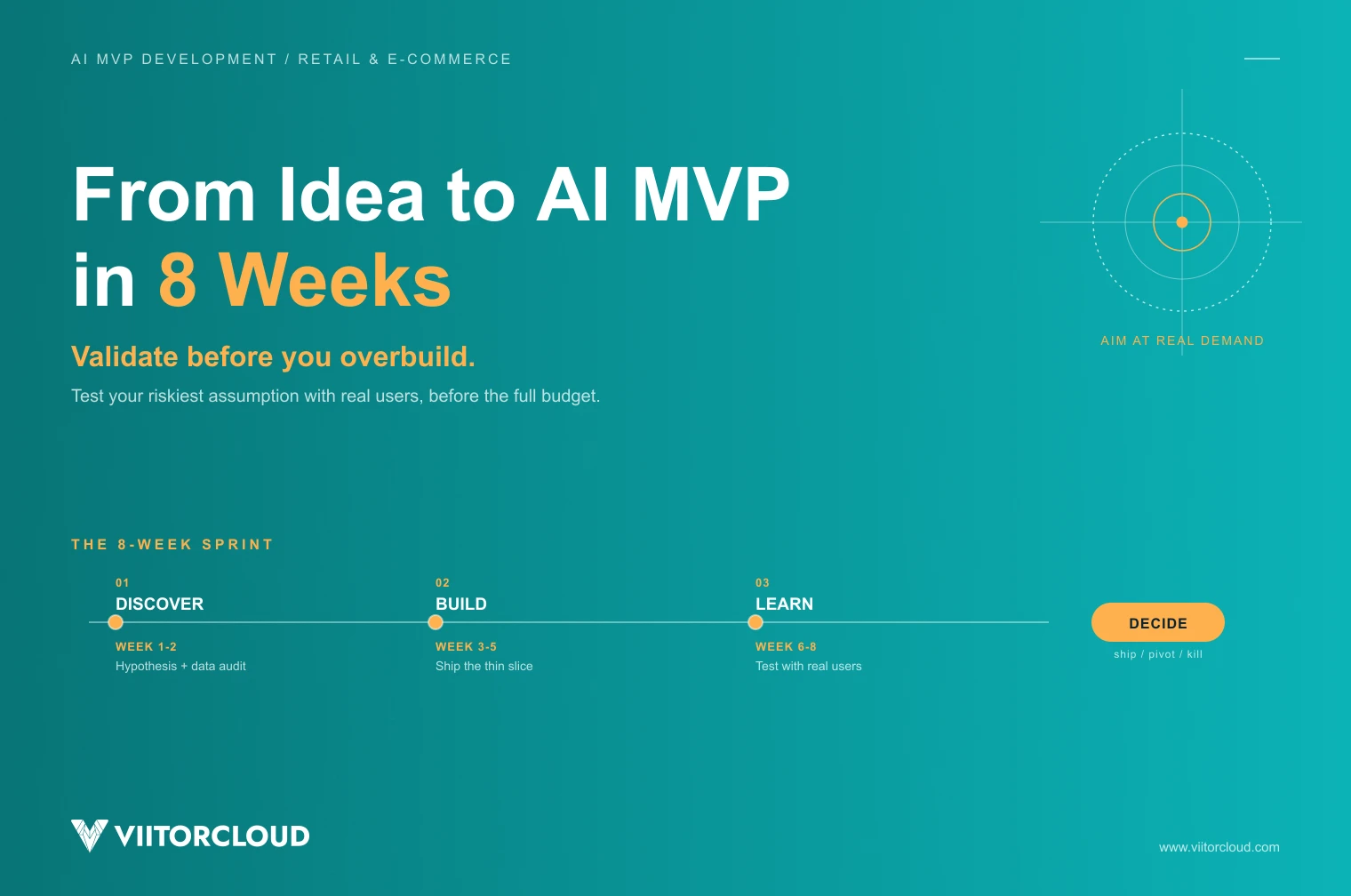
Here is a realistic, battle-tested structure for AI MVP development. The eight weeks split into three phases: discover, build, and learn. Each phase has one job, and finishing on time matters more than finishing everything.
Weeks 1-2: Discovery and Hypothesis
You cannot validate a vague idea. Start by writing down the single riskiest assumption in one sentence, for example: ‘Store managers will trust an AI demand forecast enough to change their orders.’
- Define the core hypothesis and the one metric that proves or disproves it.
- Audit your data. Is it accessible, clean enough, and legally usable? This is where most retail AI projects quietly stall.
- Run a lightweight proof of concept to confirm the model can clear a basic accuracy bar.
- Map the thinnest user journey that delivers the value, then cut everything else.
Designing AI features people actually trust is its own discipline. Google’s People + AI Guidebook is a strong, free reference for getting the human side right from the start.
Weeks 3-5: Build the Thin Slice
Now you build, but only the thin slice. Resist the gravity of ‘while we’re in here.’ The MVP needs just enough interface for a real user to complete the core action, and just enough model to make that action meaningful.
- Use pre-trained or off-the-shelf models where you can; custom training can wait.
- Fake the parts that don’t need to be real yet, a human behind the curtain is fine for an MVP.
- Instrument everything, so you measure behavior, not opinions.
Speed here comes from restraint. The fewer moving parts you build now, the faster you reach the only milestone that counts, real users touching real software.
Weeks 6-8: Test, Measure, and Decide
Put the MVP in front of real users in a contained setting: one store, one category, or one customer segment. Then watch what they actually do.
Picture Daniel, who runs innovation at a grocery e-commerce startup. His team built an eight-week demand-forecasting MVP for a single product category. Within two weeks of live testing, they learned buyers ignored the forecast screen but loved an auto-reorder nudge the team had almost cut. They reshaped the roadmap before committing the full build budget. That is validation earning its keep.
- Track behavior over opinions, did they use it, not just did they like it.
- Watch repeat usage and task completion, not first-click curiosity.
- Ask whether the AI output actually changed a decision or an order.
End the sprint with a clear decision: scale it, pivot it, or kill it. All three are wins, because all three are grounded in evidence rather than opinion.
Ready to scope your own eight-week build?Book an AI MVP consultation and we’ll help you choose the one hypothesis worth testing first.
How to Build an AI MVP Without Overbuilding
The hardest part of AI MVP development is not writing code. It is saying no. Here are the warning signs that you have drifted from validation into over-engineering.
- You’re optimizing accuracy past ‘good enough.’ If users can’t tell 88% from 94%, the extra month isn’t validation, it’s vanity.
- You’re building for scale you haven’t earned. Multi-region failover can wait until you have users to fail over.
- Your roadmap has features no hypothesis asked for. Every feature should trace back to a question you’re trying to answer.
- You keep delaying the user test. ‘Just one more sprint’ is the sound of fear, not progress.
Take a quick example. A home-goods retailer wanted AI visual search, so shoppers could snap a photo and find similar items. The team’s instinct was to train a custom computer-vision model on the entire catalog, a months-long effort. Instead, they wired an existing vision API to 500 top products and tested with 50 loyal customers. Conversion data from that scrappy build justified the bigger investment and showed exactly which categories to expand first.
A Simple Test for Every Feature
Before you build anything, ask one question: which hypothesis does this feature help me test? If the honest answer is ‘none, but we’ll need it later,’ it does not belong in the MVP. Park it on a ‘later’ list, ship the slice, and let real usage tell you whether ‘later’ ever arrives. This single filter prevents most over-engineering.
Not Sure If Your Idea Is Ready to Build?
Tell us your retail AI concept and we’ll help you pin down the one hypothesis worth testing first, before you spend a full budget.
How ViitorCloud Approaches AI MVP Development
At ViitorCloud, we treat AI MVP development as a learning sprint, not a mini-build contract. The aim is to get your retail AI idea in front of real users fast, with a clear go, pivot, or stop decision at the end.
Our teams bring product strategy, data engineering, and applied AI into one focused pod, so discovery, build, and testing don’t get lost in handoffs. We lean on proven components, like generative AI building blocks and pre-trained models, to compress timelines without cutting corners on what matters.
And because a validated MVP is only step one, we design every sprint with the next stage in mind. When the evidence says go, the same foundation extends cleanly into AI-first SaaS product development, so you scale a proven idea instead of starting over.
Throughout, we keep you close to the evidence. You see what real users do with the MVP each week, so the decision to scale, pivot, or stop is yours, and it is grounded in data rather than a vendor’s opinion. That transparency is how a validated retail AI idea becomes a product worth funding.
From Validated Idea to Confident Build
The teams that win in retail AI are not the ones that build the most. They are the ones that learn the fastest. AI MVP development gives you that speed, turning an eight-week sprint into hard evidence about what your customers actually want.
Remember the essentials: validate one hypothesis at a time, keep scope brutally small, test with real users, and let the data, not the hype, decide your next move. Do that, and you protect your budget while moving faster than competitors still polishing unproven ideas.
Your idea deserves proof before it earns a full budget. Start with a focused AI MVP, then scale what works.Talk to our AI MVP development team about validating your retail product in the next eight weeks.

Vishal Shukla
Vishal Shukla is Vice President of Technology at ViitorCloud Technologies.
Frequently Asked Questions
How do you build an AI MVP?
Define one core hypothesis, audit your data, build the thinnest model-and-interface slice that tests it, then validate with real users.
How long does AI MVP development take?
How much does it cost to build an AI MVP?
What is the difference between an AI MVP and a proof of concept?