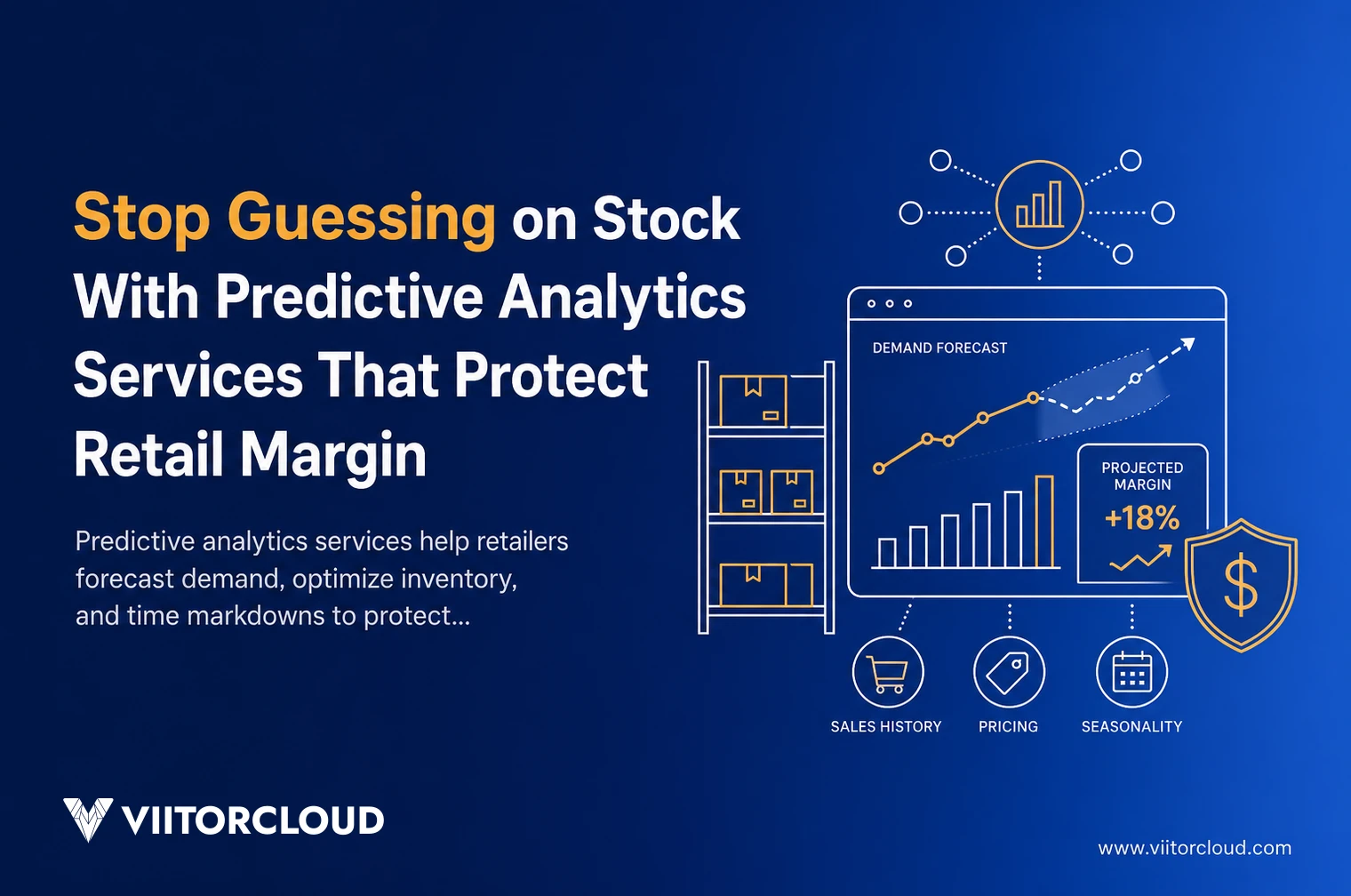
Predictive analytics services help retailers forecast demand accurately, position inventory where it sells, and time markdowns before they erode profit. When seasons turn volatile, that combination separates retailers who protect margin from those who guess and lose it.
I watched a demand planning team at a mid-size apparel retailer get caught out last winter. A warm spell pushed coat sales down for three weeks, then a cold snap spiked them overnight. Their forecast, built on last year’s averages, never saw either move coming. They stocked out on the styles that suddenly sold and sat on the ones nobody wanted.
If you run merchandising or demand planning, you know this pattern. Shopper behavior shifts faster than legacy forecasts can react, and value-seeking customers walk away from any price that feels wrong. Most teams are trying to predict volatile demand with tools built for a stable market that no longer exists.
This article breaks down how modern predictive analytics services fix that, from the data foundation up to markdown decisions. I will cover why forecasts fail, what predictive analytics actually does in retail, and how to start without rebuilding everything at once.
Key Takeaways
- Predictive analytics services forecast demand using live signals, so retailers react in days instead of seasons.
- Most forecasting failures start in the data layer, where siloed channel data hides the real demand picture.
- By some estimates, only around 8% of retailers have truly unified omnichannel data, which keeps legacy forecasts slow.
- Accurate demand forecasting protects margin twice, by preventing stockouts and by replacing panic markdowns with planned ones.
- You can start with one category or one peak season, prove the lift, and scale the model from there.
Why Retail Demand Forecasting Falls Apart in Volatile Seasons
Legacy retail demand forecasting leans on historical averages and a few seasonal rules. That works when next year looks like last year. It fails the moment weather, promotions, or a viral product break the pattern.
The deeper problem sits in the data. Most retailers run separate systems for stores, ecommerce, marketplaces, and wholesale, and none of them share a single view of demand. By some industry estimates, only around 8% of retailers have truly unified omnichannel data.
When your channels cannot see each other, the forecast always works from a partial picture. A product selling out online can still look healthy in a store-only report. Demand forecasting built on that fragmented data reacts late, and late is expensive during a peak season.
This is why I tell retail teams to fix the data before the model. The fastest accuracy gains usually come from connecting channels into one demand view, the same foundation behind strong omnichannel retail experiences.
What Predictive Analytics in Retail Actually Means
Predictive analytics in retail uses historical sales, real-time signals, and external data to forecast what customers will buy, when, and where. Instead of reporting what already happened, it models what is likely to happen next, so merchandising teams can act before demand shifts rather than after.
In practice, predictive analytics services pull together several moving parts:
- Demand signals from point of sale, ecommerce, and marketplace data, refreshed continuously.
- External factors like weather, local events, holidays, and promotional calendars.
- Price sensitivity models that show how value-seeking shoppers respond to discounts.
- Inventory positions across every location, so the forecast maps to what you can actually fulfill.
The output is a forecast that updates as conditions change. That is the core shift, from a static annual plan to a continuously updated one. The engine behind it is solid predictive analytics and data modeling services tuned to your categories and selling patterns.
Build Demand Forecasts You Can Trust
Our retail data teams turn siloed channel data into accurate, real-time demand and markdown models. See what predictive analytics services can protect next season.
Your Forecast Is Only as Good as the Data Underneath It
Every retail forecasting project I have seen succeed or fail came down to the data layer first. The model gets the attention, but the pipeline that feeds it decides the result. Feed it bad data and it will produce confident, wrong forecasts.
This is where data modeling services prove their value. Before any forecast runs, you need clean, consistent definitions across channels, deduplicated product records, and a pipeline that updates fast enough to matter. As Harvard Business Review has long reported, fragmented data is one of the biggest barriers to acting on analytics.
I learned this the hard way on a livestock monitoring system we built, where 15,000 sensors generated more than 1 million data points a day. The predictive model only became accurate once we rebuilt the data pipeline to handle that volume cleanly. The same rule holds in retail, where data pipeline development for retail is the unglamorous work that makes forecasts trustworthy.
Strong data modeling services also future-proof you. Once the foundation is clean, you can add new signals, categories, and channels without starting over each time.
How Predictive Analytics Services Protect Retail Margin
You lose margin in two ways during volatile seasons. You lose sales when you stock out of what people want, and you lose profit when you discount what they do not. Predictive analytics services address both at once.
On the demand side, accurate forecasting means you buy and position the right quantity in the right place. McKinsey research has found that AI-based forecasting can reduce errors in supply chain networks by 20% to 50%. In retail terms, that is fewer stockouts on hot items and less cash trapped in slow ones.
On the price side, the same models flag which products are tracking below plan early enough to act with intent. That turns a forced end-of-season clearance into a planned, measured markdown. The goal is better-timed discounts, not simply more of them.
This is also where a focused predictive analytics capability pays for itself quickly. You do not need a year-long program to see it. A single well-modeled category can show the margin difference inside one season.
Fix the Data Behind Your Forecast
Most forecasting problems start in the data layer. We build the clean, unified pipelines and data modeling services that accurate predictions depend on.
Smarter Inventory Optimization and Markdown Decisions
Once the forecast is reliable, two retail levers get much sharper. Inventory optimization and markdown optimization both turn a prediction into a margin outcome.
Inventory optimization uses the forecast to decide how much to buy, where to place it, and when to replenish. Done well, it keeps fast sellers in stock and stops slow movers from accumulating.
Here is what that looks like in practice:
- Pre-season buys sized to modeled demand, not last year’s order copied forward.
- Store-level allocation that sends product to the locations most likely to sell it.
- Dynamic replenishment that reacts to real sales within the season, not after it.
Markdown optimization handles the other side. Instead of a blanket discount when stock lingers, the model recommends the right markdown depth and timing per product. You clear inventory while protecting as much margin as the demand will allow. Across a peak season, disciplined markdown optimization often recovers more profit than any single buying decision.
Both levers depend on the forecast and the data beneath it. That is why I treat inventory optimization, markdown optimization, and the underlying big data analytics as one connected system, not separate projects.
Start Small, Prove the Lift, Then Scale
The biggest reason retail analytics projects stall is scope. Teams try to model everything at once, the timeline grows, and the value never lands. I recommend the opposite approach.
- Pick one high-stakes category where demand swings hurt the most.
- Unify just that data across channels and clean it properly.
- Run the predictive model for one season and measure margin against your old method.
- Scale what worked to the next categories once the lift is proven.
None of this works without solid data modeling services underneath, so treat the data foundation as step zero. This phased path keeps risk low and delivers a real result in weeks rather than quarters. It also builds trust, because merchandising teams see the model perform on familiar products before they rely on it for the full assortment.
Plan Your Next Peak With Confidence
We built the platform that handled $7.1 million in 72 hours on one Black Friday. Let us scope a predictive model for your toughest demand challenge.
Where a Retail Data Partner Changes the Outcome
Building this in-house is possible, but it is slow when you are also running the business. A partner that has done it before removes most of the guesswork. At ViitorCloud, we build the unified data pipelines, demand models, and markdown logic that retail teams use to protect margin through volatile seasons.
We know peak-season pressure firsthand. For one retail and deals platform, the system we engineered handled $7.1 million in revenue in just 72 hours during a single Black Friday sale. That was part of $46.4 million generated overall. That kind of volatility is exactly where accurate prediction and clean data prove their worth.
If demand swings are costing you sales or margin, ViitorCloud’s retail technology solutions, backed by proven data modeling services, are a practical place to start. We scope a focused predictive model around your hardest category and prove the result before you scale.
Stop Guessing Before the Next Peak Season
Volatile demand is now the normal condition for retail, not the exception. The retailers who hold margin through it are the ones who replaced guesswork with accurate, real-time forecasts built on clean, unified data.
Predictive analytics services give merchandising and demand planning teams that edge. They sharpen demand forecasting, tighten inventory optimization, and make markdown optimization a deliberate choice instead of a reaction. The path starts with your data and one well-chosen category.
Pick the season that hurts most, get the data right, and let the model prove what it can protect. That is how you stop guessing on stock and start defending margin on purpose.

Vishal Shukla
Vishal Shukla is Vice President of Technology at ViitorCloud Technologies.
Frequently Asked Questions
What is predictive analytics in retail?
Predictive analytics in retail uses historical and real-time data to forecast demand, guide inventory, and time markdowns before margin erodes.
How does predictive analytics improve demand forecasting?
Can predictive analytics reduce markdowns?
Do I need clean data before using predictive analytics services?