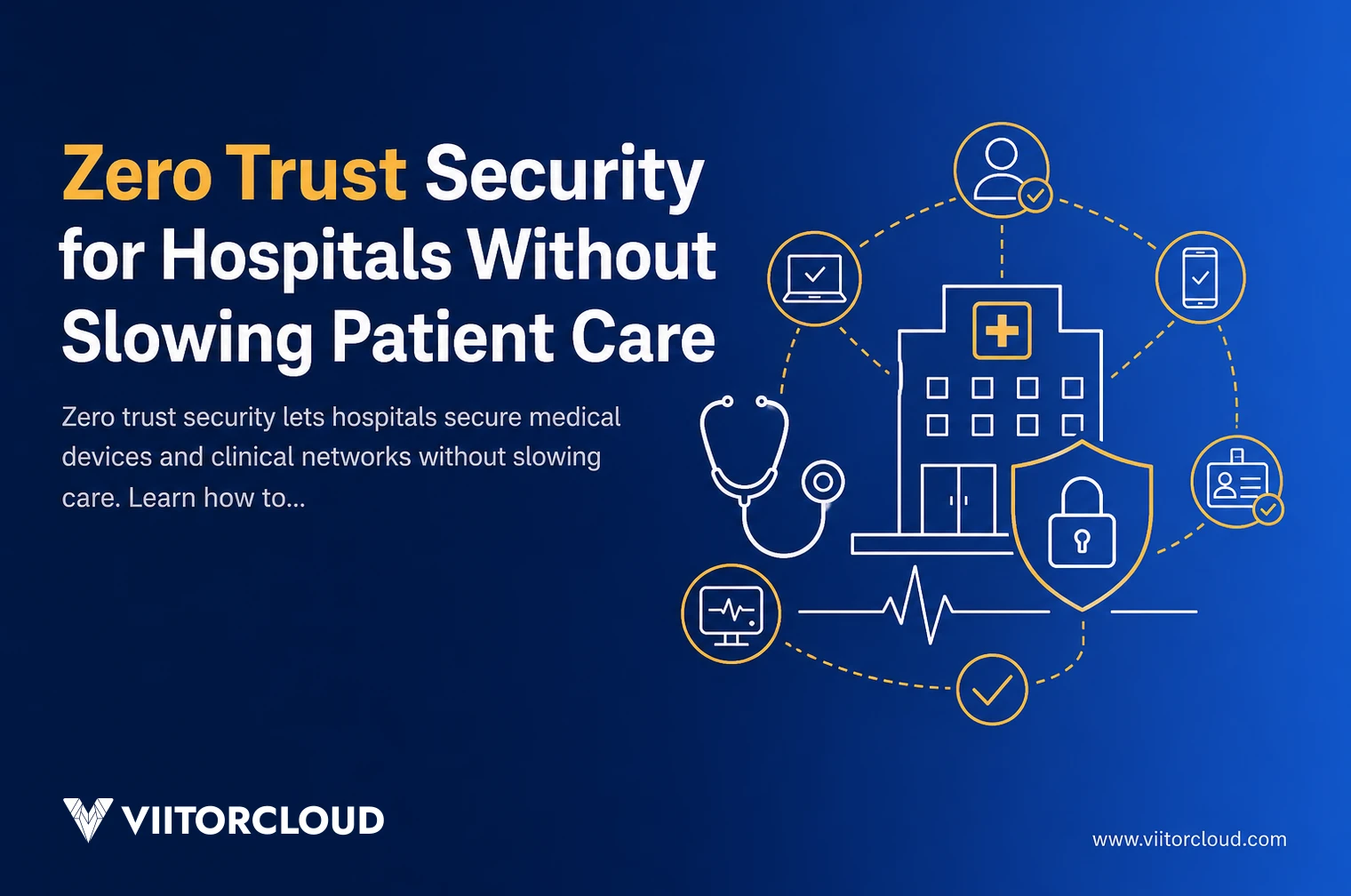
Zero trust security gives hospitals a practical way to secure thousands of connected medical devices and clinical networks without slowing down patient care. The model trusts no device or user by default, verifies every connection, and isolates each device so a single compromise cannot spread across the hospital.
Here is the problem I keep running into. A modern hospital runs infusion pumps, imaging machines, patient monitors, and ventilators that were never designed with security in mind. Many still run software that cannot be patched. Put them on one flat network alongside the electronic health record, and one infected device becomes a doorway to every patient system in the building.
You already know the attack surface is growing faster than your team can map it. This guide shows how a zero trust architecture closes that gap, how network segmentation protects clinical networks without breaking workflows, and how to bring connected medical devices under control before a breach makes the decision for you. It is written for the security and biomedical leaders who carry that risk inside healthcare organizations every day.
Key Takeaways
- Zero trust security treats every device and user as untrusted until verified, which is the correct default for hospitals running thousands of unpatchable connected devices.
- Network segmentation is the core control, isolating medical devices so a compromised pump or monitor cannot reach the electronic health record or other patient systems.
- A well-built zero trust architecture runs in the background and does not add steps or delays to clinical staff workflows.
- Shadow AI tools are entering clinical networks faster than governance can track them, widening an attack surface most security teams are not yet measuring.
- The safest way to adopt zero trust is in phases, starting with device discovery and network segmentation, so operations stay protected while you modernize.
What Zero Trust Security Means Inside a Hospital
Zero trust security is a model that removes automatic trust from the network. No device, user, or application gets access to a clinical system simply because it sits inside the hospital firewall. Every request is authenticated, authorized, and checked against policy before access is granted.
The older approach assumed everything inside the network perimeter was safe. That assumption breaks the moment an attacker gets in, because a flat internal network lets them move sideways and reach almost anything. The formal reference point is NIST Special Publication 800-207, which defines zero trust architecture around continuous verification instead of a trusted perimeter.
For a hospital, three principles carry the most weight.
- Verify explicitly. Authenticate and authorize every device and user based on identity, health, and context, not location on the network.
- Grant least privilege. Give each device and account the minimum access it needs and nothing more.
- Assume breach. Design as if an attacker is already inside, and limit how far they can travel.
Applied well, this is what strong healthcare cybersecurity looks like in practice. It is less about buying one product and more about changing the default answer from trust to verify across the entire clinical environment.
Ready to Secure Your Clinical Network?
ViitorCloud builds HIPAA and GDPR compliant healthcare systems with phased delivery that protects operations while you modernize. Start with a scoped zero trust assessment before any rollout begins.
Why Connected Medical Devices Are the Weakest Link
The fastest growing risk in any hospital is the Internet of Medical Things (IoMT), the fleet of connected medical devices that now outnumbers traditional computers on most clinical networks. Infusion pumps, patient monitors, MRI machines, and smart beds all talk to the network, and most were built to last a decade or more.
That lifespan is the core of the medical device security problem. Many devices run outdated operating systems that the manufacturer no longer patches. Some cannot be taken offline for updates because they are in constant clinical use. Others have firmware locked by regulatory certification, so the hospital cannot change them even if it wants to.
This is why medical device security cannot rely on patching alone. You often cannot patch the device, so you have to control what it is allowed to reach. Strong IoMT security starts with knowing every device on the network and treating each one as a potential entry point.
The stakes are not abstract. Healthcare has recorded the highest average data breach cost of any industry for more than a decade, according to IBM’s Cost of a Data Breach research. When an attack lands, it does not only expose records. It can force a hospital onto paper, divert ambulances, and delay treatment, which is why healthcare cybersecurity now has to start at the device layer.
Consider a 350-bed hospital I will use as a representative example. A biomedical engineering lead, I will call Marcus, inherited more than 6,000 connected devices spread across one flat network. An old infusion pump running an unsupported operating system was the easiest target in the building. On a flat network, that single pump sat two hops away from the systems holding every patient record. This is the exact pattern that disciplined connected device engineering and segmentation are meant to prevent, and it is the reason IoMT security has moved to the top of the agenda.
How Network Segmentation Contains a Breach Before It Reaches Patients
Network segmentation is the single most effective control in a hospital zero trust security program. It divides one large network into smaller, isolated zones, so devices can only talk to the systems they actually need. If a device is compromised, the damage stays inside its zone.
Microsegmentation takes this further by wrapping policy around individual devices or small groups. An infusion pump can be allowed to reach only its management server and nothing else. A CT scanner can talk to the imaging archive and no other system. Everything else is denied by default, which is zero trust architecture applied at the network layer.
Think about what this does during a ransomware attack. Without segmentation, malware that lands on one workstation can sweep the whole network in minutes. With strong network segmentation in place, that same malware hits a wall at the edge of its zone. The compromised device is isolated, the clinical network keeps running, and your team responds to a contained incident instead of a hospital-wide outage.
Getting there is an engineering exercise, not a checkbox. It takes accurate device discovery, careful policy design, and a rollout that does not interrupt care. This is where experienced system integration and modernization work pays off, because the segmentation has to fit the way clinical systems already talk to each other.
Bring Connected Medical Devices Under Control
From device discovery to network segmentation, our team designs zero trust architecture that isolates IoMT without disrupting clinical workflows. Talk it through with an engineer, not a salesperson.
Securing IoMT Without Slowing Down Care
This is the objection I hear first from clinical leaders. They worry that zero trust security will add logins, delays, and friction to workflows where seconds matter. Done properly, it does the opposite. Good IoMT security runs quietly in the background and stays out of the way of care.
The key is to secure the device without touching the device. You cannot install a security agent on a locked infusion pump, so you watch it from the network instead. A few techniques make this work.
- Passive discovery. Identify and classify every device by watching network traffic, without probing or rebooting anything in clinical use.
- Behavioral baselining. Learn how each device normally behaves, then flag the abnormal, such as a monitor suddenly trying to reach the internet.
- Automated policy. Apply segmentation rules by device type, so a new pump inherits the right zone the moment it connects.
None of this asks a nurse or physician to do anything differently. Access decisions happen between the device and the network, not at the bedside. That is the whole point of a zero trust architecture built for healthcare. It protects the clinical network while the people using it barely notice it is there.
Marcus’s team took this route. They mapped and classified the full device fleet passively over a few weeks, then moved the highest-risk devices into isolated zones during planned maintenance windows. There was no downtime, no workflow change, and the medical device security posture improved sharply.
The Shadow AI Problem Most Hospitals Are Not Measuring
Here is the newer risk that worries me most. Clinicians are adopting AI tools faster than any governance process can keep up. Ambient scribes, diagnostic assistants, and chat tools are moving patient data in and out of the network, often without the security team knowing they exist.
This shadow AI widens the attack surface in a way traditional healthcare cybersecurity was never designed to handle. Every unsanctioned tool is a new data flow, a new integration, and a new place a breach can start. AI interoperability makes it harder still, because these tools connect to clinical systems to be useful, and each connection is a path an attacker can follow.
Zero trust security answers this directly. If no data flow is trusted by default, an unapproved AI tool cannot quietly reach patient records. Access is denied until it is explicitly granted and monitored. That is why I treat AI governance as part of the same zero trust program, not a separate project. The AI implementation risks in healthcare are real, and they belong inside your security architecture from day one.
See How We Engineer Healthcare Platforms
Explore how ViitorCloud delivers secure, compliant healthcare technology, from patient monitoring to a platform that has processed $192.2M in healthcare revenue.
How to Roll Out Zero Trust Security in a Hospital Network
You do not deploy zero trust security in one weekend, and you should not try. The approach that works is think big, start small. Set the long-term architecture, then move in phases that protect operations at every step.
A rollout I trust follows a clear order.
- Discover and inventory. Find every device, user, and data flow on the network. You cannot protect what you cannot see.
- Segment the highest risk first. Apply network segmentation to legacy and unpatchable medical devices, the core of IoMT security, before anything else.
- Tighten identity and access. Enforce least privilege and strong authentication for users and service accounts.
- Monitor continuously. Watch behavior across the clinical network and alert on anomalies in real time.
- Automate response. Let policy quarantine a suspicious device automatically, before a human has to react.
Monitoring and response are where automation earns its place. Modern security teams use machine learning to spot the subtle signs of a compromised device, which is one of the clearest examples of how AI strengthens cybersecurity rather than adding risk. Each phase delivers value on its own, so the hospital is safer after step two, not only at the end. That is what makes a zero trust architecture achievable inside a live clinical environment, and it is the backbone of a mature healthcare cybersecurity program.
Building Zero Trust Into Clinical Infrastructure
I have spent years helping teams build secure, compliant systems in regulated environments, and one lesson holds across every healthcare engagement. Security has to be designed into the infrastructure, not added after the device fleet is already live. At ViitorCloud, we build HIPAA and GDPR compliant platforms for healthcare organizations, including the revenue cycle system that has processed more than $192.2M in healthcare revenue for LogixHealth and patient monitoring solutions built for real clinical use.
Our work follows a think big, start small model. We map your device inventory and data flows first, segment the highest-risk systems, and expand zero trust security coverage in phases so patient care is never interrupted. If you are planning a rollout or need to bring connected medical devices under control, the same discipline we apply to cloud security and digital trust is where I would begin before you lock in an architecture.
Conclusion
Hospitals cannot keep treating connected medical devices as trusted just because they sit inside the building. The attack surface is too large, and the cost of a breach is too high. Zero trust security answers this by verifying everything, granting least privilege, and using network segmentation to keep any single compromise contained.
The good news is that a zero trust architecture does not have to slow care. Built in phases and enforced at the network layer, it protects patients and clinical systems while staying nearly invisible to the people delivering care. Start with device discovery and segmentation, and treat medical device security and IoMT security as the foundation of your healthcare cybersecurity program, not an afterthought.

Vishal Shukla
Vishal Shukla is Vice President of Technology at ViitorCloud Technologies.
Frequently Asked Questions
What is zero trust security in healthcare?
Zero trust security assumes no device or user is trusted by default, verifying every request before granting clinical system access.
How does zero trust protect connected medical devices?
Does zero trust security slow down patient care?
Why is medical device security so difficult in hospitals?