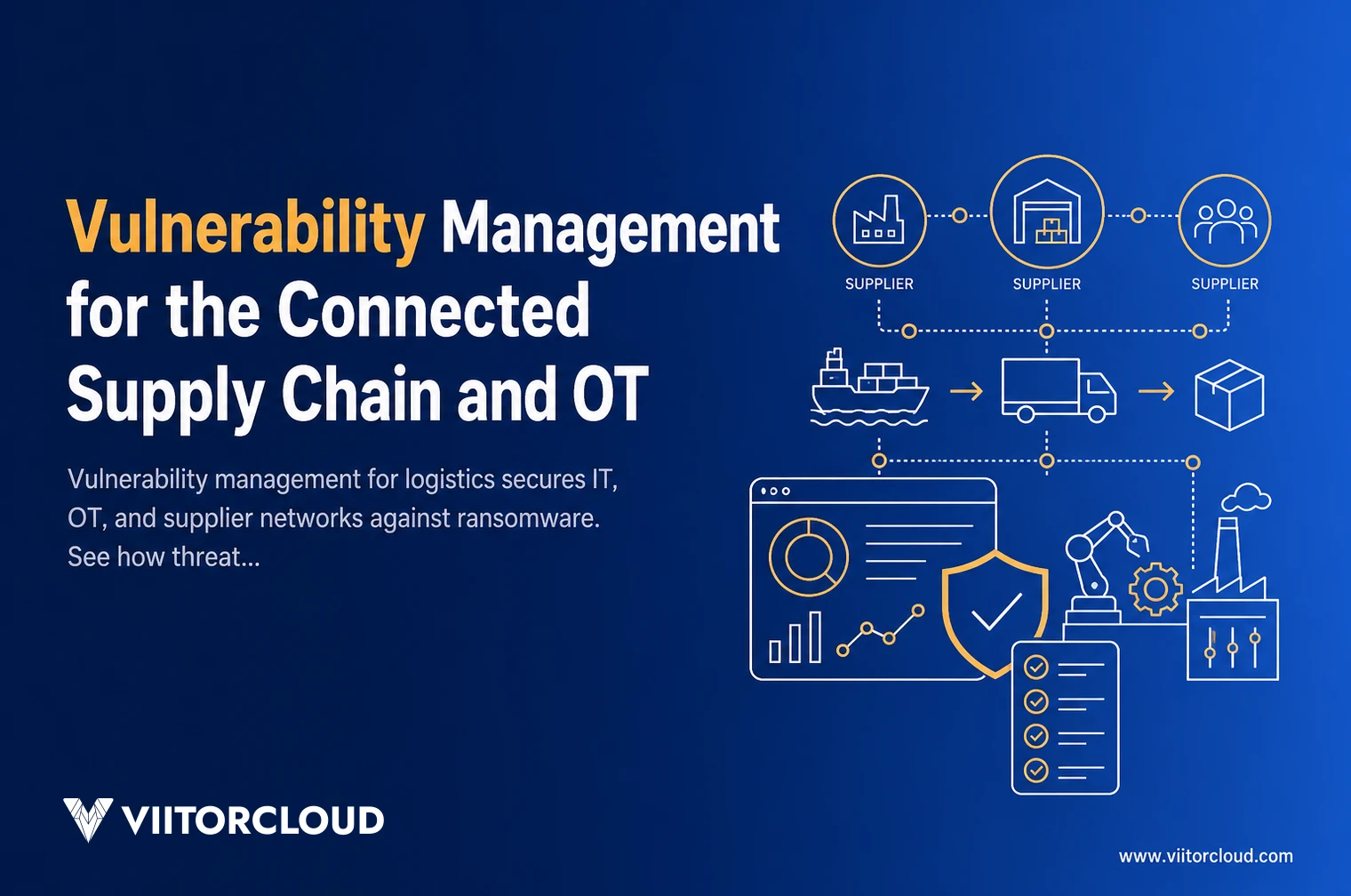
Vulnerability management in logistics is the continuous work of finding, ranking, and fixing security weaknesses across your IT systems, operational technology, and supplier network before an attacker gets there first. For a connected supply chain, that discipline now separates a business that keeps freight moving from one staring at a ransom note across every terminal.
I have spent years building and integrating systems for ports, fleets, and distributors, and the pattern rarely changes. The technology to move goods has raced ahead. The security wrapped around it has not. Most operators can see their Tier-1 partners clearly and almost nothing past them.
This guide covers what practical vulnerability management looks like once IT and OT converge, how threat intelligence gives you early warning, and how to build ransomware defense across an extended supplier network. You will leave with a starting point, not a sales pitch.
Key Takeaways
- Vulnerability management for logistics has to span IT, OT, and the supplier network, because attackers pivot from the weakest of the three.
- IT-OT convergence exposes warehouses, fleets, and ports to ransomware, which makes OT security a board-level concern rather than a plant-floor detail.
- Threat intelligence turns scattered alerts into a ranked action list, so teams fix what attackers are actually exploiting first.
- Ransomware defense depends on supply chain security that reaches beyond Tier-1, where most operators are effectively blind.
- Continuous vulnerability management services beat annual audits, since exposure windows in connected logistics are measured in hours.
Why Connected Supply Chains Have Become the Softest Target
Modern logistics runs on connection. Warehouse systems talk to carrier APIs, telematics feed the transport platform, and port terminals sync with customs and shipping lines in real time. Every one of those links is also an entry point.
The core problem is visibility. Supply chain security usually stops at the first tier of suppliers. Beyond that, most teams have no inventory of who connects to what, which software their partners run, or how fast those partners patch. Attackers understand this. They target the smaller vendor with weak controls, then ride the trusted connection inward.
A regional 3PL I advised had tight controls on its own network and no idea that a small yard-management vendor held remote access into its warehouse floor. That one unmanaged link was the entire attack surface. Security agencies such as CISA have repeatedly warned that transportation and logistics rank among the most targeted sectors for supply chain and ransomware attacks. Real supply chain security means mapping the extended network, not only the contracts you signed directly.
Map Your IT and OT Attack Surface
Get a live inventory of every connected asset across your warehouses, fleets, and ports before attackers find the gaps first.
Where IT Meets OT and Attackers Slip Through
OT security is where connected logistics gets genuinely hard. Operational technology runs the physical world, including conveyor lines, automated cranes, refrigeration units, fleet telematics, and the controllers inside sorting hubs. These systems were built for uptime and safety, not for holding off a modern intrusion.
For decades, OT lived on isolated networks. That air gap is gone. IT-OT convergence connected those controllers to corporate networks and the cloud for analytics and remote support. The efficiency gain is real, and so is the exposure. Good OT security has to account for equipment that cannot simply be taken down and patched on a Tuesday night.
Several traits make OT the weak point:
- Many OT devices cannot be patched without halting operations, so known flaws linger for years.
- Legacy controllers run unsupported firmware that no vendor updates anymore.
- Standard IT scanners can crash fragile OT equipment, so teams often skip scanning it entirely.
- Ownership is split, and IT security and plant operations each assume the other is watching.
This is the gap ransomware crews exploit. They land in IT, move laterally into OT, and freeze the systems that physically move goods. IT-OT convergence is really a system integration and modernization challenge before it is a security one. In one livestock monitoring build, my team ran more than 15,000 connected sensors producing over 1 million readings a day, and that scale taught us a simple rule. Strong OT security starts with a live inventory of every device and the vulnerabilities each one carries, because you cannot protect what you cannot see.
What Vulnerability Management Really Means for Logistics
Effective vulnerability management is not an annual penetration test or a quarterly scan you file and forget. It is a continuous loop running across IT and OT at the same time, which means vulnerability management and OT security are really one program. The goal is to shrink the window between a flaw appearing and that flaw being closed.
A practical program has four moving parts:
- Discover. Maintain a live asset inventory across servers, endpoints, cloud services, OT controllers, and connected fleet devices.
- Prioritize. Rank weaknesses by real exploitability and business impact, not raw severity scores alone.
- Remediate. Patch, isolate, or apply compensating controls, using network segmentation when an OT device cannot go offline.
- Verify. Confirm the fix held, then feed the result into the next cycle.
Prioritization is where most programs succeed or fail. A mid-size distributor can surface thousands of findings in a week, and without a way to rank them, teams patch the loud, low-risk issues while missing the quiet one under active attack. We increasingly use AI-driven automation to correlate findings and surface the handful that actually matter.
This is why continuous vulnerability management services outperform periodic audits. The NIST Cybersecurity Framework treats this as an ongoing function rather than a one-time checkbox. In connected logistics, exposure windows are measured in hours, and a report from last quarter is already history.
Wire Threat Intelligence Into One View
Turn scattered alerts into a prioritized action list with continuous vulnerability management services built for connected logistics.
How Threat Intelligence Turns Noise Into Early Warning
Threat intelligence is the context that tells you which vulnerabilities to fear right now. It answers a question a raw scanner cannot. Is anyone actually exploiting this flaw, and are they aiming at my industry?
Without that context, every finding looks equally urgent. With it, you match live attacker behavior against your own asset inventory and act on the overlap.
Strong threat intelligence pulls from several streams:
- Active exploit and ransomware campaign feeds tied to known vulnerabilities.
- Sector reporting on attacks against ports, carriers, and distributors.
- Dark web monitoring for leaked credentials linked to your domains and suppliers.
- Indicators shared across logistics information-sharing groups.
The payoff is speed. When a threat intelligence feed flags a vulnerability under active attack in transportation, a mature team cross-references its inventory and patches the exposed systems the same day. That is threat intelligence doing its job and turning noise into a short, ranked list. It is also what makes vulnerability management services genuinely actionable instead of a wall of alerts. Building that single view is where a solid data analytics foundation earns its keep.
Building Ransomware Defense Across the Supplier Network
Ransomware is the outcome logistics leaders fear most, because it halts the physical movement of goods, not only the flow of data. Ransomware defense in a connected supply chain has to reach past your own walls into the partners you depend on.
Attackers rarely hit a hardened target head-on. They compromise a weaker supplier and use the trusted link. So ransomware defense and supply chain security are the same project seen from two angles.
A few layers do most of the work:
- Segment networks so a breach in one warehouse or partner cannot spread across the whole operation.
- Enforce multi-factor authentication on every remote and supplier connection.
- Assess the security posture of critical vendors, not only their pricing and service levels.
- Keep offline, tested backups so recovery never depends on paying anyone.
- Rehearse the incident response plan with operations, not only with IT.
A distributor that segments its network and drills its response turns a potential shutdown into a contained event. That is the whole point of ransomware defense, limiting the blast radius before the blast. AI helps here too, and this is one area where AI strengthens cybersecurity by spotting the lateral movement that comes before encryption.
Extend Ransomware Defense to Suppliers
Push supply chain security past Tier-1 with segmentation, monitoring, and AI-driven anomaly detection across your extended network.
Where a Logistics Security Partner Earns Its Place
Most logistics teams do not lack effort. They lack a single view across IT, OT, and suppliers, plus the engineering capacity to build and run it. That is the gap a partner should close.
My team at ViitorCloud has built and integrated large-scale logistics platforms where this convergence is a daily reality. For a global port operator, we support systems running across 14 active port sites in more than 10 countries, moving millions of freight tons. Operating at that scale forces you to treat asset visibility, secure integration, and continuous monitoring as first-class problems from day one.
We bring the same discipline to vulnerability management services for connected supply chains, mapping every IT and OT asset, wiring threat intelligence into one pipeline, and using automation to decide what to fix first. If your team is stretched thin across warehouses, fleets, and ports, that is exactly the kind of logistics technology and security work worth scoping before your next expansion.
Close the Gap Before Attackers Find It
Connected logistics gave the industry speed and handed attackers a wider door. The fix is not another disconnected tool. It is continuous vulnerability management services that treat IT, OT, and the supplier network as one attack surface, guided by threat intelligence and built for ransomware defense.
Start with visibility. Build a live inventory of every connected asset, including the OT devices and third-party links you have been overlooking. Layer threat intelligence on top so you fix what matters first. Then extend supply chain security well past Tier-1, where the real risk lives.
Do that, and a ransomware attempt becomes a contained incident instead of a company-wide shutdown. That is what strong vulnerability management buys you in a connected supply chain, and it is worth building before the next attacker tests the door.

Vishal Shukla
Vishal Shukla is Vice President of Technology at ViitorCloud Technologies.
Frequently Asked Questions
What is vulnerability management in logistics?
Continuously finding, prioritizing, and fixing security weaknesses across logistics IT, OT, and supplier systems before attackers can exploit them.
Why is OT security so difficult in supply chains?
How does threat intelligence support ransomware defense?
How often should logistics run vulnerability management?