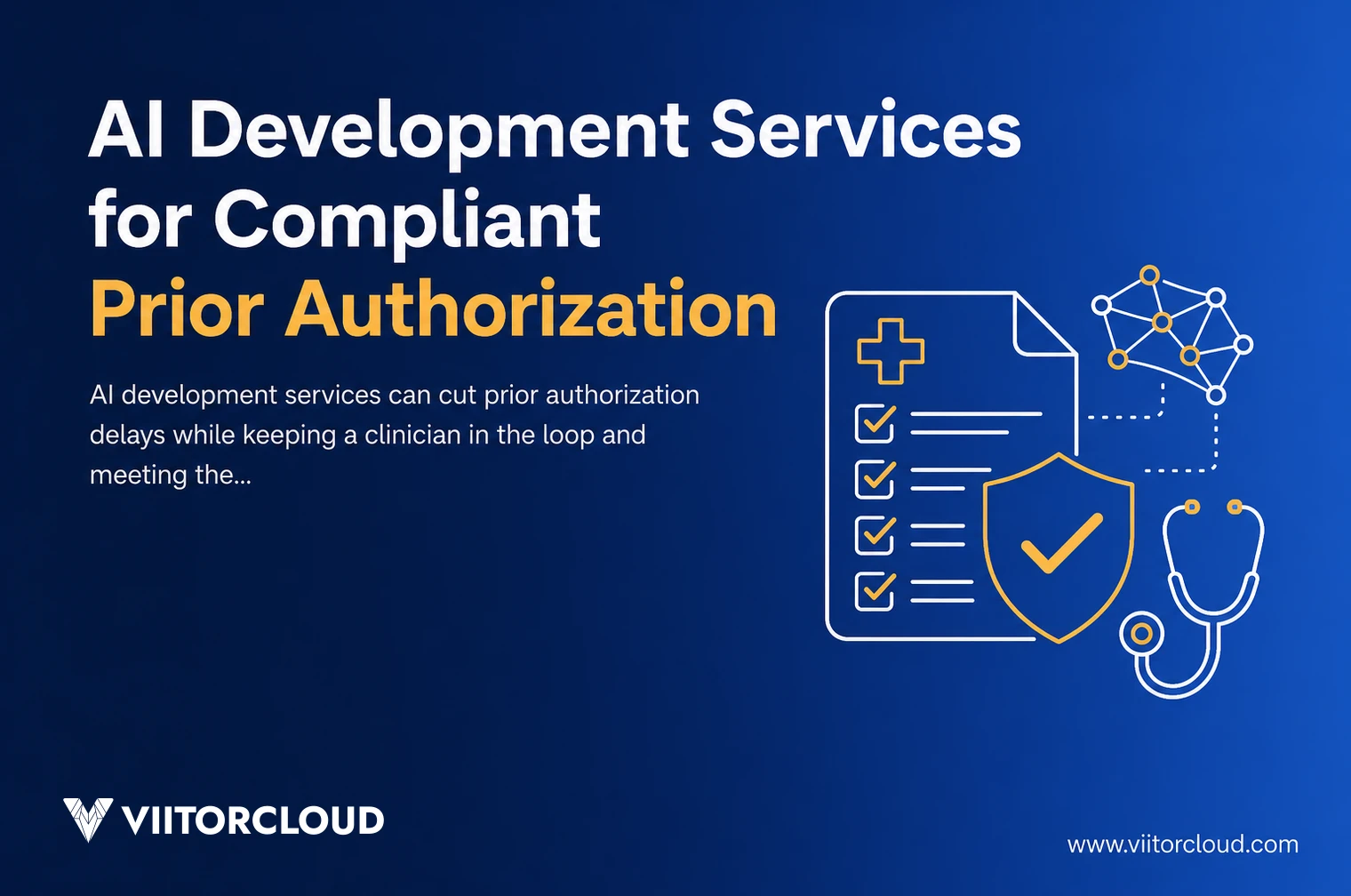
Custom AI development services can cut prior authorization approval times from days to minutes, and they can do it without breaking compliance, as long as a licensed clinician stays in control of every denial. That one design choice separates safe automation from the auto-denial engines now drawing regulatory attention.
I have spent years building healthcare AI systems that sit beside real clinical workflows, and prior authorization is one of the most requested projects I see today. The paperwork is heavy, the delays reach patients, and the 2026 rules are forcing payers and providers to rethink how these decisions get made.
This guide covers what AI prior authorization does, where generic tools cross a line that custom systems do not, and how to structure a compliant build that speeds approvals while keeping clinicians in charge. Every point here comes from delivery experience, not slideware. That is what strong AI development services are for.
Key Takeaways
- AI can assemble documentation, predict likely approvals, and flag missing evidence, cutting prior authorization turnaround from days to minutes.
- The 2026 CMS Interoperability and Prior Authorization Final Rule demands faster decisions, specific denial reasons, and FHIR-based data exchange.
- A growing number of states now require a licensed clinician, not an algorithm, to make the final medical necessity determination.
- Off-the-shelf prior authorization automation that auto-denies claims creates legal and clinical exposure that custom builds are designed to avoid.
- Custom AI development services give payers and providers audit trails, human review checkpoints, and clean integration with existing systems.
What AI Prior Authorization Actually Does
AI prior authorization uses machine learning to gather patient records, match them against payer rules, and predict whether a request will be approved, all before a human reads a single page. A healthcare AI system built for prior authorization does the assembly and the analysis, not the deciding. The clinician still decides.
In practice, a well-built system handles four jobs:
- Documentation assembly: It pulls the relevant notes, labs, and imaging from the record and packages them against the specific policy.
- Approval prediction: It scores the likelihood of approval so staff can fix weak submissions before sending them.
- Clinical decision support: It surfaces the guidelines and evidence a reviewer needs, which is where clinical decision support turns a slow manual task into a fast informed one.
- Gap detection: It flags missing evidence instead of letting a request fail days later.
Consider Dr. Elena Ruiz, a utilization management director I worked with on a scoping call. Her team of nine spent most of each morning copying records into payer portals by hand, and a single complex request took 40 minutes to compile. After we mapped a documentation assembly model to her top ten procedures, that 40 minutes dropped to under 5 minutes, and her nurses went back to reviewing cases instead of formatting them. Good clinical decision support does exactly that.
Scope a Compliant Prior Authorization Build
Talk with an engineer who has shipped HIPAA compliant healthcare AI, including a platform that processed $192.2M in healthcare revenue.
Why the 2026 CMS Rule Changes the Math
The 2026 CMS Interoperability and Prior Authorization Final Rule is the single biggest reason this topic is urgent. It sets hard deadlines and transparency requirements that most legacy workflows cannot meet by hand.
Under the rule, affected payers must do the following:
- Return decisions on urgent requests within 72 hours and standard requests within 7 calendar days.
- Give a specific reason for every denial, not a generic code.
- Build a FHIR-based Prior Authorization API so data moves between systems automatically.
- Report prior authorization metrics publicly each year.
You can read the specifics in the CMS final rule fact sheet. The practical takeaway is that speed and transparency are now legal obligations, and prior authorization automation is the only realistic way to hit those numbers at scale.
There is a second line that matters even more. A growing number of states now require a licensed clinician to make the final medical necessity call. An algorithm can recommend, but it cannot deny on its own. Any healthcare AI you deploy has to respect that boundary from day one.
Where Off-the-Shelf Tools Cross the Compliance Line
Most generic prior authorization products were built to maximize speed, not defensibility. Generic prior authorization automation optimizes for throughput alone, so it auto-approves and, more dangerously, auto-denies. That is exactly the behavior regulators are now targeting.
The American Medical Association reports that 94% of physicians say prior authorization delays patient care, and many tie it to serious harm. Vendors used that pain to sell full automation. The problem is that a denial issued by software, with no clinician and no audit trail, is now a liability in a growing list of jurisdictions. An AI development company that knows healthcare would never ship a denial engine without a clinician checkpoint.
I reviewed one case where a health-IT lead named Marcus had rolled out an off-the-shelf denial engine at a mid-size payer. It worked for a quarter. Then a new state law required a licensed reviewer on every adverse determination, and his tool had no way to insert one. The team had to freeze the system, reprocess a backlog of denials by hand, and explain the gap to their compliance officer. A generic tool created the exact risk it was meant to remove.
Three weaknesses show up again and again in these products:
- No clinician checkpoint. Denials fire automatically with no human review step.
- No audit trail. When a regulator asks why a request was denied, there is no defensible record.
- Generic training data. The model does not understand your policies, your specialties, or your patient mix.
Custom AI development services are built to remove that risk, not create it.
See Our Custom AI Development Work
Explore how custom AI development keeps a clinician in the loop while cutting approval time across regulated healthcare workflows.
How I Build Compliant Prior Authorization Automation
A compliant system starts from the workflow, not the model. Any AI development company worth hiring maps how a request moves from intake to decision before writing model code, and marks every point where a clinician must sign off. That map becomes the guardrail for the whole build.
The architecture I recommend has five layers:
- Data pipeline: Clean, structured ingestion from the EHR, claims systems, and payer policies through secure APIs.
- Documentation assembly: The model gathers and formats evidence against the exact policy being cited.
- Approval prediction and clinical decision support: Scores, guideline citations, and reasoning that give the reviewer everything needed to decide quickly.
- Clinician in the loop checkpoint: No adverse decision leaves the system without a licensed reviewer approving it.
- Audit logging: Every input, score, and human action is recorded for regulators and internal review.
Because healthcare AI touches patient care, the clinician checkpoint is non-negotiable. Prior authorization automation only pays off when the workflow map drives the model, not the other way around. This is where custom AI development earns its cost, because a generic tool cannot bend to your compliance map while a custom build treats that map as the specification. Delivered as end-to-end AI development services, these five layers ship as one system rather than five disconnected tools. I also push clients toward a think big, start small path, proving the model on two or three high-volume procedures before expanding.
This is not theory for my team. We engineered the platform behind LogixHealth, a healthcare revenue cycle system that has processed $192.2M in healthcare revenue, and we build every healthcare system to be HIPAA compliant by default. That same discipline in data handling and audit design is what makes custom AI development services safe to run inside a regulated prior authorization workflow.
What Custom AI Development Delivers That Platforms Cannot
The choice between a platform and a custom build comes down to control. In a regulated setting, control is not a luxury. It is the requirement.
Working with an experienced AI development company gives payers and providers four things a generic platform cannot.
- Compliance by design: Human review, retention rules, and denial logic are built to your jurisdiction, not a vendor average.
- Explainable output: Clinical decision support that shows its reasoning, so a reviewer and an auditor can both follow it.
- Real integration: The system connects to your EHR and claims stack instead of forcing a parallel process.
- Ownership: You own the code and the model, with no lock-in to a vendor roadmap or licensing tier.
For teams already modernizing their records systems, this work pairs naturally with AI integration in EHR and EMR systems, since prior authorization data lives in the same place. The right AI development company treats these as one connected problem, not two disconnected projects.
Start With a Focused Proof of Concept
Validate prior authorization automation on your highest volume procedures before you scale, using our think big start small approach.
Where a Compliant Healthcare AI Partner Changes the Outcome
The gap between a demo and a production system that survives an audit is enormous, and it is where most prior authorization projects stall. Closing it takes an AI development company that has shipped regulated healthcare AI before, not one learning on your data.
My team at ViitorCloud has delivered healthcare platforms for 14 years, from revenue cycle systems to patient monitoring, always building regulated healthcare AI with compliance and measurable outcomes as the baseline. If you are scoping a prior authorization build, our healthcare technology solutions and AI-driven automation work show how we keep a clinician in the loop while cutting approval time. That is the combination the 2026 rules reward.
The Path Forward for Prior Authorization
Prior authorization is being rebuilt in real time, and the winners will be the organizations that automate the busywork while keeping human judgment where the law and good medicine both demand it. The technology to do this well already exists.
Start by mapping your workflow and your compliance obligations, then pilot a narrow build on your highest volume procedures. The right AI development services turn a day-long process into a minutes-long one without ever removing the clinician from the decision. Speed and safety are not in conflict when the system is designed for both.

Vishal Shukla
Vishal Shukla is Vice President of Technology at ViitorCloud Technologies.
Frequently Asked Questions
What is AI prior authorization?
AI prior authorization uses software to assemble records, predict approvals, and support clinicians, while a licensed reviewer still makes the final decision.
What does the 2026 CMS prior authorization rule require?
Can AI legally deny a prior authorization request?
Why choose custom AI development over an off the shelf tool?