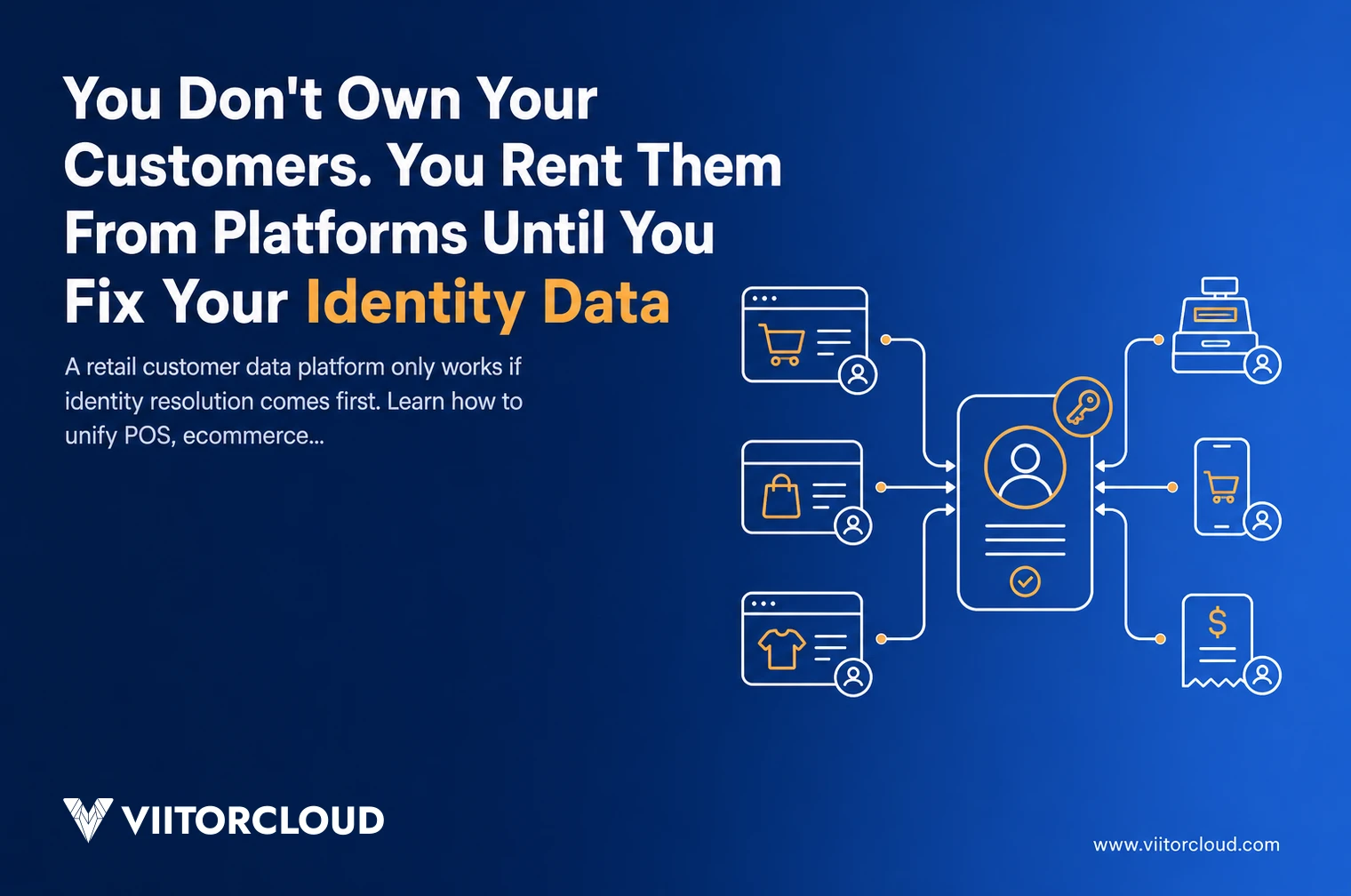
A retail customer data platform is only as valuable as the identity graph underneath it, and most retailers buy the platform before they fix the identity data. That sequence is why so many personalization programs underperform. If your POS, ecommerce, loyalty, and app systems each hold a different version of the same shopper, no tool will reconcile them for you.
Here is the uncomfortable part. Until you own a resolved view of who your customers actually are, you do not own the relationship. You rent it. You rent reach from ad platforms, you rent audience matching from their black boxes, and you rent attribution from whatever model they choose to report this quarter. When their rules change, your acquisition economics change with them, and you have no independent record to fall back on.
I have worked on retail and marketplace data pipelines where the same shopper existed as four separate customers across four systems. This article covers what identity resolution actually involves, how to sequence a CDP implementation so it does not stall, and how to build a first-party data strategy that survives the next platform policy update.
Key Takeaways
- A retail customer data platform without identity resolution is a storage cost, not a capability. Resolve identity first, then buy or build the activation layer.
- Most retail customer records fracture across four systems: POS, ecommerce, loyalty, and mobile app. Each one creates a duplicate profile with a partial history.
- Deterministic matching on verified identifiers such as email, phone, and loyalty ID should carry the majority of your matches. Probabilistic matching fills gaps and must be confidence scored.
- Broken identity data inflates paid acquisition costs because you re-target existing customers as prospects and mis-measure the channels that actually convert.
- Start with one high-value use case, prove the identity graph works against it, then expand. ViitorCloud built a platform handling 2.25M+ property listings and 112,560 active users on this phased model.
Why Retailers Keep Losing Ownership of Their Own Customers
Ownership is not about how many email addresses sit in your database. It is about whether you can identify a shopper across every touchpoint without asking a third party for help.
Consider what happens without that capability. A shopper buys in-store with a card, browses on mobile web, scans a loyalty barcode at checkout, and later installs your app. Four systems record four events. None of them agree on who did what.
The consequences show up in every downstream metric:
- Personalization misfires: You recommend a product the shopper bought in-store last week because your ecommerce system never saw the transaction.
- Attribution breaks: Store revenue is invisible to digital reporting, so channels that drive footfall look unprofitable and get defunded.
- Acquisition costs climb: You pay to acquire people you already have, because your prospecting audience is polluted with existing customers.
- Lifetime value is understated: A shopper worth $2,400 across four systems looks like four shoppers worth $600 each, so your bidding ceilings stay artificially low.
The deeper problem is dependency. When your only reliable customer graph lives inside an ad platform, that platform sets the terms. Browser and mobile privacy changes have already made third-party signal less dependable, and the FTC’s privacy and security guidance makes clear that consent and data handling obligations sit with the business collecting the data, not the platform reselling access to it.
Start With an Identity and Data Readiness Assessment
We measure what share of your POS, ecommerce, loyalty, and app records carry a matchable identifier, then map the pipeline work needed to resolve them into single customer profiles. It is the same first step we ran before building platforms handling 2.25M+ listings and $192.2M in processed revenue.
What Identity Resolution in Retail Actually Requires
Identity resolution is the process of matching records from separate systems to a single persistent customer profile, then maintaining that profile as new events arrive. In retail, it is harder than in most sectors because a meaningful share of transactions happen with no login at all.
Deterministic Matching Should Do Most of the Work
Deterministic matching links records using shared verified identifiers. Email address, hashed phone number, loyalty membership ID, and account ID are the strongest signals available.
This should account for the majority of your matches. It is auditable, explainable to a privacy officer, and stable over time. If deterministic matching is covering only a small fraction of your records, the problem is upstream collection, not the matching logic.
Probabilistic Matching Fills the Gaps and Needs Guardrails
Probabilistic matching infers a link from behavioral and contextual signals: device fingerprint, IP range, session timing, shipping address similarity, and purchase pattern overlap.
It is genuinely useful for anonymous browsing and guest checkout. It is also where identity graphs go wrong.
Two rules I apply on every build:
- Every probabilistic match carries a confidence score, and only high-confidence matches feed marketing activation.
- Deterministic evidence always overrides a probabilistic link. When a shopper logs in, the graph corrects itself immediately.
Household and Account Hierarchy Cannot Be an Afterthought
Retail identity has structure. A household shares a shipping address and sometimes a payment method. A business account has multiple purchasing users. A gift purchase points to someone who is not your customer at all.
Collapsing these into one profile produces recommendations that feel invasive and wrong. Model the hierarchy explicitly: individual, household, and account are separate layers with defined relationships.
The Data Engineering Work That Precedes Any CDP Purchase
Most failed CDP implementation projects I have reviewed failed before the vendor was even selected. The platform was expected to solve a data engineering problem it was never designed to solve.
A CDP resolves and activates data that arrives clean and consistent. It does not repair fractured schemas, reconcile conflicting field definitions, or invent the transaction history your POS never exported.
Here is the sequence that works:
- Source inventory: Catalog every system that creates or updates a customer record. Document the identifiers each one captures, update frequency, and retention rules.
- Identifier audit: Measure what percentage of records in each source carry an email, phone, or loyalty ID. This number sets a hard ceiling on your match rate.
- Schema standardization: Agree on one definition of a customer, one address format, one product taxonomy, and one event schema. Do this before writing pipeline code.
- Pipeline construction: Build ingestion with change data capture for transactional systems and streaming for behavioral events. Batch is acceptable for loyalty and returns.
- Identity graph: Implement matching logic with versioned rules and full lineage, so any profile merge can be traced and reversed.
- Activation layer: Only now connect the CDP, the campaign tools, and the analytics stack.
Skipping steps two and three is the most common failure I see. Teams sign a platform contract, discover during onboarding that only a minority of POS records carry a usable identifier, and spend the first two quarters doing the data engineering work that should have come first.
Anyone scoping this work should look at how retail data pipelines are built for AI workloads before committing to an architecture, because the ingestion design determines what identity resolution is even possible.
Build the Retail Data Pipeline Before the Platform
Our data engineering teams design the ingestion, standardization, and entity resolution layer that a customer data platform depends on. Cow Monitor extracts 1M+ data points daily from 15,000+ sensors on architecture built this way.
How a Unified Identity Graph Changes Retail Economics
Customer data unification is not a reporting improvement. It changes what you can bid, what you can predict, and what you can automate.
Paid Acquisition Stops Subsidizing Existing Customers
With resolved identity, you can suppress current customers from prospecting audiences with confidence. You can also build lookalike seeds from genuinely high-value cohorts instead of from whoever happened to convert on a trackable channel.
Suppression alone often recovers a meaningful share of prospecting spend, because the waste is invisible until identity is fixed.
Lifetime Value Modeling Becomes Possible
Lifetime value modeling requires a complete transaction history per person. Fragmented records make every LTV number wrong in the same direction: too low. That produces bidding caps below what the customer is actually worth, and you lose auctions you should win.
Personalization Works Without Third-Party Cookies
Cookieless personalization runs on your own resolved profiles rather than on borrowed signal. Once a shopper is identified by a logged-in session, a loyalty scan, or an email click, every recommendation can draw on their full history across store and digital.
The signal is more durable than any third-party identifier, because you own the collection point and the consent record.
Retention Programs Target the Right People
Churn signals are only visible against a full history. A shopper who stopped buying online but still shops in-store is not churning. Without identity resolution, you will send them a win-back discount they do not need, and cut margin on revenue you already had.
Why ViitorCloud Builds the Identity Layer Before the Retail Customer Data Platform
Across our retail and marketplace engagements, the pattern is consistent. Clients arrive at ViitorCloud wanting a retail customer data platform and leave with a working identity graph plus the pipelines that keep it accurate.
Some of the work behind that position:
- Flatmate Finders runs on a platform we built, handling 2,252,570+ property listings and 112,560 active users, with 50,000+ mobile app downloads feeding a single unified profile store.
- MariDeal processed 56,943 orders across 8,342 unique deals in 2024 and generated $46.4M in total revenue, including $7.1M in 72 hours during one Black Friday peak. That level of throughput requires identity and transaction data that reconcile in real time.
- LogixHealth processes $192.2M in revenue on a platform we engineered, with 150K total users under strict compliance requirements.
- Cow Monitor extracts 1M+ data points daily from 15,000+ sensors, which is the same streaming ingestion and entity resolution problem retail faces with in-store and app events.
The approach is phased by design. We scope an identity and data readiness assessment first, build the graph against one revenue-relevant use case, then expand. If your customer records are fractured across POS, ecommerce, loyalty, and app, the right starting point is a review of our data analytics capabilities and the system integration and modernization work that connects the systems holding your data today. For retailers who want to see the sector context first, our retail technology practice covers the full stack.
Unify Customer Data Across Store and Digital
From identity graph design through activation and lifetime-value modeling, ViitorCloud delivers the full first-party data foundation. Founded 2011, 300+ global clients, GDPR and HIPAA compliant delivery.
A Practical Sequence for the Next Two Quarters
You do not need a full transformation program to start. You need one use case that pays for the next phase.
- Weeks 1 to 4: Run the identifier audit. Establish what percentage of POS, ecommerce, loyalty, and app records carry a matchable identifier. This number is your baseline.
- Weeks 5 to 8: Fix collection at the weakest point. Usually this means capturing an identifier at store checkout, where the gap is widest.
- Weeks 9 to 16: Build the identity graph for one segment and one use case. Suppression of existing customers from prospecting is the fastest measurable win.
- Weeks 17 to 24: Extend to lifetime value modeling and cross-channel personalization. Only now evaluate CDP vendors, because you finally know what you need them to do.
Measure the result in acquisition cost and repeat purchase rate, not in records loaded. A platform that ingests everything and resolves nothing is worse than no platform, because it creates the appearance of progress. Independent analysis such as the Gartner research on retail customer data platforms consistently points to data readiness rather than tooling as the constraint on results.
Conclusion
A retail customer data platform is worth the investment only when the identity layer underneath it is solid. Fix identity resolution first, and the rest of the stack starts working: personalization draws on complete histories, attribution reflects store and digital together, lifetime value reads accurately, and paid acquisition stops paying twice for the same shopper.
Start with the identifier audit. It is cheap, it takes weeks, and it tells you exactly how much of your customer base you can currently recognize. Everything else in a first-party data strategy depends on that number.
Own the graph, and you own the relationship. Rent the graph, and every platform policy change is a revenue risk you cannot price.

Vishal Shukla
Vishal Shukla is Vice President of Technology at ViitorCloud Technologies.
Frequently Asked Questions
What is identity resolution in retail
It is matching customer records from POS, ecommerce, loyalty, and app systems into one persistent profile per shopper.
How is a retail customer data platform different from a CRM
What does a first-party data strategy start with
Can cookieless personalization work without third-party data
How long does a CDP implementation take