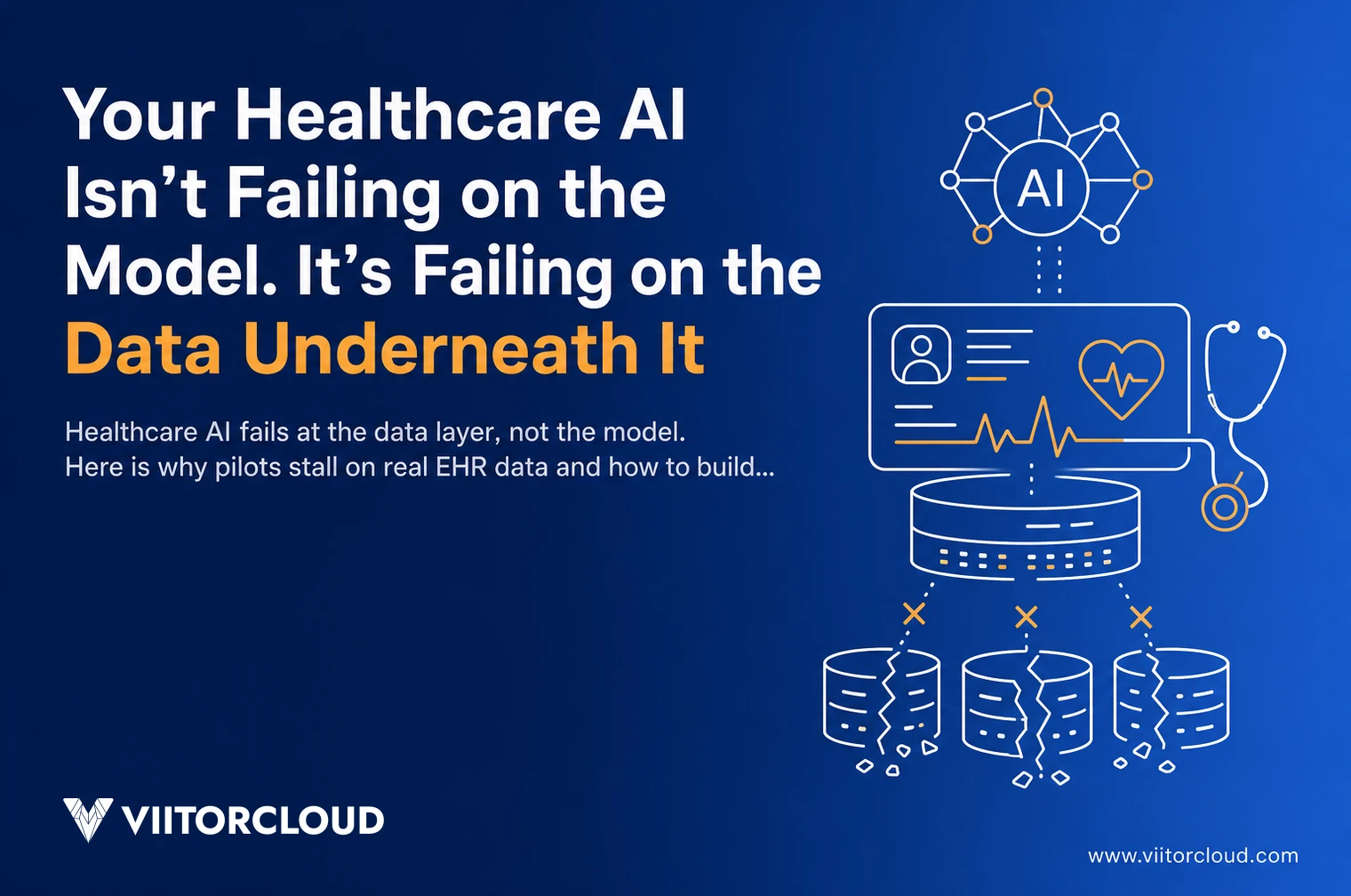
Healthcare AI does not fail because the model is wrong. It fails because the data underneath it was never built to support production.
The model performs well in the pilot because someone hand-curated the dataset. Then it meets real EHR data across three systems, four naming conventions, and a decade of free-text clinical notes, and the accuracy collapses.
I have watched this happen enough times to recognize the pattern before the pilot even starts. The board approves an AI initiative. The vendor demos something impressive. Six months later, the CEO is asked what changed clinically or financially, and there is no answer. Not because the AI was bad, but because the data pipeline feeding it was never engineered for the job.
Gartner attributes the majority of AI project failures to data quality and infrastructure issues, and industry research consistently puts the share of AI projects that never reach production above 80%. In healthcare, where data lives across EHR modules, lab systems, imaging archives, billing platforms, and vendor APIs, the problem is sharper. This article covers why that happens, what AI-ready data actually means, and the specific sequence I use to move healthcare AI from a pilot that looks good to a system that runs in production.
Key Takeaways
- Healthcare AI pilots pass on curated data and stall on production data because the pilot never tested the pipeline, only the model.
- AI-ready data means four things: standardized schemas, resolved patient identity, documented lineage, and monitored quality gates. Missing any one blocks production.
- The most common technical failure I see is entity resolution. The same patient exists three times under three identifiers, and the model silently trains on fragments.
- Clinical AI deployment needs MLOps from day one, including drift monitoring and retraining triggers, because clinical data distributions shift with every protocol change.
- Budget the data foundation as roughly 60 to 70% of the total build. Teams that fund the model first pay for the pipeline twice.
Why Healthcare AI Projects Die Between the Pilot and Production
A pilot and a production system are not the same engineering problem. Most teams treat them as though they are.
In a pilot, someone exports a clean dataset. A data scientist cleans it further. The model trains on data that has been implicitly curated by human judgment at every step. Accuracy looks excellent. The demo lands.
Production is different. The model now consumes live data with missing fields, delayed writes, duplicate records, inconsistent units, and clinical notes that vary by department and by physician. Nothing about the pilot tested for that.
The Four Failure Points I See Most Often
- Schema drift across source systems: The EHR defines a field one way, the lab system another, and the billing platform a third. No one reconciled them because the pilot used one export from one system.
- Unresolved patient identity: A single patient appears as three records across systems. The model trains on partial histories and produces confident, wrong outputs.
- No latency contract: The pilot ran on a batch file. Production needs a prediction within seconds of an encounter. The infrastructure was never designed for that gap.
- No ownership after handoff: The pilot team disbands. Nobody owns the pipeline. Data quality degrades quietly until someone notices the outputs stopped making sense.
Consider a mid-market revenue cycle platform I will call Meridian. Their denial-prediction model hit 91% accuracy in testing. In production, it dropped to 63% within eight weeks. The model had not changed. What changed was that two payer feeds started delivering claim status codes in a different format, and nothing in the pipeline caught it. That is a data engineering failure wearing a machine learning costume.
Find Out If Your Data Can Support the AI You Are Planning
Our AI readiness assessment maps your source systems, identity resolution gaps, and pipeline quality issues before any model work begins. You get a clear answer on what is production-ready and what is not.
What AI-Ready Data Actually Means in a Clinical Environment
AI-ready data is data that a model can consume in production without a human intervening to clean, reconcile, or interpret it first. In healthcare, that requires four things working together.
Standardization Through Real Interoperability Standards
FHIR for clinical records and DICOM for imaging are not optional formatting preferences. They are the mechanism that lets a model treat data from four source systems as one coherent input. Without a standardization layer, every new data source becomes a bespoke integration project that nobody budgeted for.
Patient Identity Resolution Before Anything Else
This is the single most underestimated problem in healthcare data infrastructure. Deterministic matching on identifiers catches the easy cases. Probabilistic matching on name, date of birth, address, and encounter patterns catches the rest. Get this wrong, and every downstream metric is wrong, including the ones you report to the board.
Lineage You Can Show a Regulator
Healthcare data governance means being able to answer where a specific value came from, who transformed it, and when. That is a technical requirement before it is a compliance requirement. When a clinician disputes an AI output, lineage is how you find out whether the model was wrong or the input was.
Quality Gates That Run Continuously
Five checkpoints belong in every clinical pipeline: ingestion validation, transformation verification, feature distribution monitoring, model input checks, and output observability with automated alerts. Gates catch problems before the model does. Without them, the first person to notice a broken pipeline is a clinician who no longer trusts the tool.
If your team is scoping this work now, the practical detail sits in our breakdown of data engineering in healthcare, which covers pipeline architecture at the level a technical lead needs.
The Sequence That Moves Healthcare AI From Pilot to Production
Order matters more than tooling. I have seen well-funded teams fail because they bought the platform before they mapped the data.
- Audit the sources, not the use case: Catalog every system that holds relevant data. Document format, update frequency, ownership, and known quality issues. This takes two to four weeks and saves months.
- Resolve identity and standardize schemas: Build the master patient index and the FHIR mapping layer before any model work. This is where most of the effort actually goes.
- Instrument quality gates: Add validation at every stage boundary. Set thresholds. Route failures to a human, not to a log file nobody reads.
- Build the model against production data, not an export: Train and validate on the same pipeline the production system will use. If accuracy drops here, you have found the problem early and cheaply.
- Deploy with MLOps in place: Versioned datasets and models, staged rollout using shadow or canary patterns, drift monitoring, and retraining triggers tied to real signals.
- Measure a clinical or financial outcome: Define the metric before deployment. Time saved per encounter, denial rate reduction, or diagnostic turnaround. If it is not measurable, the board will not fund the next phase.
Teams working through step five usually find custom AI solutions built around their own workflow behave very differently from platform tools retrofitted onto clinical operations, because the integration assumptions are baked in from the start rather than bolted on.
Your Pilot Passed. Production Stalled. We Can Tell You Why
We diagnose stalled healthcare AI deployments at the data layer, the same layer that carries $192.2M in processed healthcare revenue on the LogixHealth platform we engineered.
Why MLOps for Healthcare Is Different From Everywhere Else
Clinical data distributions shift constantly. A new documentation protocol, a payer policy change, a coding update, a seasonal patient mix change. Each one moves the ground under a deployed model.
In most industries, drift is a quarterly concern. In healthcare, it can be a weekly one. That changes what the deployment stack needs to do.
- Drift detection on inputs, not just outputs: By the time output quality drops, clinicians have already lost confidence.
- Shadow deployment as the default: Run the new model alongside the current one on live data before it influences a single decision.
- Retraining triggered by signal, not by calendar: Scheduled retraining wastes cycles when nothing changed and arrives too late when something did.
- Explainability retained in production: A clinician who cannot see why the system flagged something will route around it, and adoption dies quietly.
A digital health company I worked with had a triage model in shadow mode for eleven weeks before it touched a clinical workflow. The team found two data issues in that window that would have been invisible in testing. The eleven weeks were not caution. They were the cheapest possible way to find those bugs. The related risks are worth understanding in full, and I have covered them in more depth in this piece on AI implementation risks in healthcare and BFSI.
What This Costs and Where the Budget Actually Goes
The number that surprises most founders: the model is usually 20 to 30% of the total effort. The data foundation is the rest.
That ratio feels wrong when you are pitching an AI initiative to a board that wants to hear about the AI. It is also the reason projects run over. Teams budget for the visible part and discover the invisible part halfway through.
A Realistic Allocation
- Data audit and source mapping: 10% of effort, almost always underfunded
- Identity resolution and standardization: 30 to 35%, the largest single line item
- Pipeline build and quality gates: 20 to 25%
- Model development and validation: 20 to 30%
- MLOps and deployment infrastructure: 10 to 15%
Poor data quality is expensive before any AI project exists. Industry analysis from Gartner’s data and analytics research has consistently put the annual cost of poor data quality in the millions per organization. An AI project does not create that cost. It makes it visible and measurable, which is uncomfortable but useful.
Build the Data Foundation Before the Model
ViitorCloud delivers HIPAA and GDPR-compliant healthcare data pipelines, identity resolution, and MLOps, then ships the clinical AI on top of it. Phased delivery so you validate before you scale.
Where ViitorCloud Fits in a Healthcare AI Build
I lead with the data layer on healthcare engagements because that is where the risk concentrates. It is also where our track record is most relevant to what a HealthTech CEO is actually buying.
ViitorCloud engineered the platform behind LogixHealth, which processes $192.2M in healthcare revenue with 150K total users. That volume is only possible on a data architecture designed for it from the start. On the AI and IoT side, our Cow Monitor system processes 1M+ data points daily from 15,000+ sensors and delivered a 30% reduction in livestock mortality. Different domain, identical principle: the outcome came from the pipeline engineering, not from an exotic model.
We work under GDPR and HIPAA-compliant development practices, and the engagement model is phased by design. An AI readiness assessment maps your data sources and defines the roadmap before anyone writes model code. That means you find out whether your data can support the use case before you have spent the budget finding out the hard way.
If your pilot passed and production stalled, the diagnosis usually takes days, not months. Talk to our team about a data readiness assessment, and we will tell you what is actually blocking the deployment. For teams earlier in the process, our data analytics services cover the foundation work directly, and the healthcare technology solutions page shows the vertical work in full.
Conclusion
Healthcare AI succeeds or fails on the data layer, and that decision is made long before a model is selected. The pilots that pass and then stall are not evidence of a model problem. They are evidence that the pipeline was never engineered for real clinical data.
Three things to do next. Audit your data sources honestly, including the ones you know are messy. Budget the foundation at 60 to 70% of the project, not 20%. Define the clinical or financial outcome you will report to the board before deployment, not after.
Teams that fix the data layer first ship healthcare AI to production. Teams that skip it run another pilot. The difference is visible on the balance sheet within two quarters.

Vishal Shukla
Vishal Shukla is Vice President of Technology at ViitorCloud Technologies.
Frequently Asked Questions
Why do healthcare AI projects fail?
Healthcare AI projects fail primarily at the data layer, not the model layer. Pilots run on curated exports, then production meets fragmented EHR data with schema mismatches, duplicate patient records, and inconsistent formats. Gartner attributes most AI failures to data quality and infrastructure gaps rather than algorithm selection.
What is AI-ready data in healthcare?
How long does it take to move healthcare AI from pilot to production?
What percentage of an AI budget should go to data infrastructure?
Does clinical AI deployment need different MLOps than other industries?