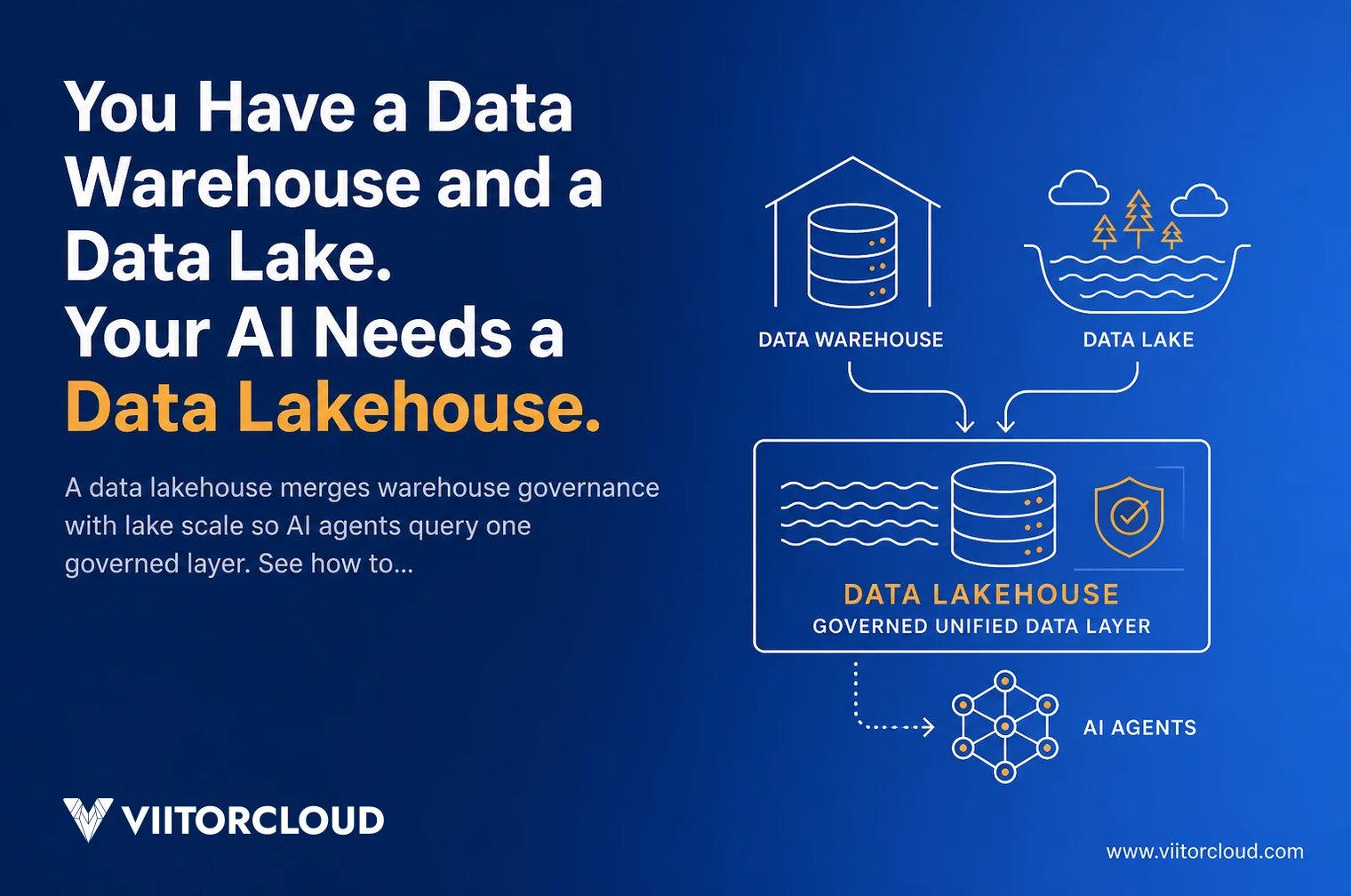
A data lakehouse is a single storage and governance layer that holds structured and unstructured data together, applying warehouse-grade transactions directly to open files in cloud object storage. It exists because AI workloads need one governed place to read from, and the warehouse plus lake model never gave them one.
You almost certainly run both systems today. A warehouse that finance and operations depend on for reporting. A lake holding raw files, logs, documents, and events for the data science team. Both are funded, staffed, and monitored.
Your AI agents can properly reach neither. The warehouse holds clean, governed records but will not take the PDFs, images, and event streams a model needs. The lake takes everything and enforces almost nothing. So teams copy data between the two, and every copy adds cost, latency, and one more place where governance quietly fails.
That gap is now the leading reason enterprise AI programs stall before production. In this article, I cover what changes when you consolidate onto a data lakehouse, how the three architectures actually compare, and the sequence I use to migrate without losing governance along the way.
Key Takeaways
- A data lakehouse replaces the warehouse plus lake split with one storage substrate and one governance layer, which is what agentic AI needs to read structured and unstructured data in a single authorization context.
- Research Cloudera ran with Harvard Business Review Analytic Services in March 2026, covering 1,574 IT leaders, found only 7% of organizations describe their data as completely ready for AI.
- Consolidating onto a unified lakehouse cuts total operational cost by 40% to 60%, almost entirely by removing redundant copies of the same data and the pipelines that maintain them.
- Open table formats, chiefly Apache Iceberg and Delta Lake, are the mechanism that makes the architecture work. They add ACID transactions, schema evolution, and time travel to plain object storage.
- Reported ROI reaches 10.3x on well-integrated lakehouse deployments against 3.7x on poorly integrated dual-system estates.
What a Data Lakehouse Is and Why AI Workloads Need One
A data lakehouse applies warehouse-grade table management, ACID transactions, schema enforcement, and fine-grained access control directly to files stored in cloud object storage. One copy of the data serves BI dashboards, model training, and agent retrieval under a single governance layer. No separate warehouse tier is required.
The architecture was formally defined in a 2021 CIDR research paper, which argued that the two-tier model was structurally unsound once machine learning entered the picture. The original lakehouse paper is worth reading if you want the architectural reasoning rather than the vendor version of it.
AI workloads break the two-tier assumption in three specific ways:
- Models need structured records and unstructured content in the same query context.
- Retrieval systems need vector indexes sitting next to the source records that produced them.
- Agents need write access, not only read access, because they update state as they work.
None of that fits a warehouse. None of it is safe on a bare lake. That is the practical case for building an enterprise data strategy around AI/ML development rather than around reporting cycles.
Data Lakehouse vs Data Warehouse vs Data Lake in Plain Terms
The data lakehouse vs data warehouse question comes down to what the storage layer will accept. The data lake vs data lakehouse question comes down to what it will enforce. Here is the comparison I walk data platform teams through.
- Data accepted: Warehouse takes structured and semi-structured records only. Lake takes anything. Lakehouse takes anything and registers it as a governed table.
- Transactions: Warehouse gives full ACID guarantees. Lake gives none. Lakehouse gives ACID on open files through the table format.
- Governance: Warehouse governs at row and column level. Lake governs at file or bucket level, which is far too coarse for regulated data. Lakehouse governs at row, column, and file level in one catalog.
- Cost profile: Warehouse charges for compute and proprietary storage. Lake is cheap to store and expensive to query well. Lakehouse separates storage from compute and removes the duplicate copies entirely.
- AI readiness: Warehouse serves BI. Lake serves notebooks. Lakehouse serves BI, notebooks, retrieval, and agents from the same tables.
- Vendor lock-in: Warehouse ties data to one engine. Lake is open but unmanaged. Lakehouse keeps data in an open table format that multiple engines can read.
Most enterprises I work with run the first two in parallel and pay for the same records three or four times over. If your team is still deciding at the engine layer, this comparison of data platforms for AI/ML development covers those trade-offs in detail.
Find the duplication before you fund the migration
Most estates carry 30% to 50% of stored data that no downstream system reads. We map every dataset that exists in both your warehouse and your lake, identify who reads which copy, and put a cost on the overlap before any architecture decision is made.
Why Your Dual System Model Quietly Breaks Agentic AI
The warehouse and lake split was designed for two audiences. Analysts running dashboards, and data scientists running notebooks. Both are human, both work in sessions, and both tolerate a copy that is a few hours stale.
Agents are neither. An agent resolving an insurance claim needs the policy document, the claim record, the adjuster notes, and the payment history in one authorization context, in seconds. In a dual-system estate, those four objects live in two systems, three copies, and two permission models.
The workaround most teams reach for is a pipeline that flattens everything into a vector store. That creates a fourth copy with no lineage back to the source, which is the exact thing compliance will stop in review.
Platform vendors have already moved on this. The Databricks lakehouse now ships serverless PostgreSQL for agent state and natural language query inside the platform, because the agent has become the primary consumer. Building AI integration services for agentic workflows on top of a split estate means constructing that access layer yourself, twice, and governing it twice.
How Open Table Formats Made the Data Lakehouse Practical
The idea existed years before it was buildable. What changed is the open table format layer. An open table format is a metadata specification that turns a directory of Parquet files into a real table with transactions, schema evolution, and point-in-time history.
Two formats matter in practice today.
Apache Iceberg:
Apache Iceberg handles hidden partitioning, schema evolution without file rewrites, and snapshot isolation across multiple engines. Its catalog neutrality is why most enterprises standardizing this year choose Apache Iceberg as the default.
Delta Lake:
Delta Lake keeps a transaction log alongside the data files, giving ACID writes, time travel, and a change data feed. Delta Lake remains the strongest option where Spark is already the primary processing engine.
The two now interoperate through catalog-level translation, so the format choice is no longer a one-way door. What matters more is that whichever open table format you pick becomes the single registration point for every dataset in the estate. That is the mechanic that makes a data lakehouse architecture governable at all.
Getting there takes real pipeline work. Ingestion has to write into governed tables rather than dropping files into a bucket, which usually means rebuilding parts of your data pipeline development approach before a single workload moves.
Consolidate your warehouse and lake into one governed layer
We sequence lakehouse migrations so regulated reporting never pauses. Lake data moves into Apache Iceberg or Delta Lake tables first, read workloads run in parallel for a full reporting cycle, and the warehouse is retired only once its queries are proven.
What Consolidation Actually Costs and What It Returns
The financial case is well documented now. Moving to a unified data lakehouse reduces total operational cost by 40% to 60%, almost entirely through eliminating redundant copies and the pipelines that keep them in sync. Reported ROI reaches 10.3x on well-integrated deployments against 3.7x on poorly integrated dual-system estates.
The market is moving accordingly. The global data lakehouse market is projected to grow from roughly $14 billion in 2025 to about $112.6 billion by 2035, at close to 25% a year. More than half of data teams are already implementing lakehouse patterns in some form.
Set against that, the Cloudera and Harvard Business Review Analytic Services study of 1,574 IT leaders found only 7% of organizations call their data completely ready for AI. Both figures are true at the same time. Spend is rising fast, and readiness is not moving with it.
The reason is sequencing. I have watched teams stand up Iceberg tables in a single quarter, then spend eighteen months arguing about who owns access policy. Consolidation is a governance project with a storage migration attached. Most teams plan it the other way around. A working data governance framework has to exist before the first table moves.
How I Sequence a Data Lakehouse Migration Without Breaking Governance
This is the order I use on enterprise estates that already run a mature warehouse alongside a large object store. It is deliberately conservative, because the warehouse is usually carrying regulated reporting that cannot pause.
- Inventory the duplication first: Map every dataset that exists in both systems, who reads each copy, and which one the business treats as authoritative. This step alone typically surfaces 30% to 50% of stored data that no downstream consumer reads at all.
- Choose the table format and the catalog together: The catalog is the governance boundary. Picking Apache Iceberg or Delta Lake without settling the catalog leaves you with tables nobody can permission properly.
- Move the lake before the warehouse: Registering existing lake files as governed tables is low risk, and it immediately improves the worst-governed part of the estate. Warehouse workloads keep running untouched.
- Port read workloads before write workloads: Dashboards and training jobs can run against lakehouse tables in parallel with the warehouse. Compare outputs across a full reporting cycle before cutting anything over.
- Retire the duplicate copies deliberately: Every redundant pipeline you leave running erases part of the 40% to 60% saving. Decommissioning is where the return actually lands.
- Add the AI access layer last: Vector indexes, retrieval endpoints, and agent state belong on top of governed tables, never beside them.
Timelines depend heavily on streaming volume. Estates with high event throughput need their real-time ingestion design settled before consolidation begins, because a batch-first lakehouse will not carry a business that runs on live data.
Make your data infrastructure ready for AI agents
We build the pipelines behind systems handling 1 million sensor readings a day, cargo operations across 14 global port sites, and $192.2 million in processed healthcare revenue. Bring us the estate blocking your AI roadmap and we will show you the sequence out of it.
Where an AI Native Delivery Partner Changes the Migration Math
At ViitorCloud, I have spent most of the last few years on the infrastructure side of AI projects rather than the model side, because that is where the failures happen. The pattern repeats across industries.
On a livestock health platform we built, the system pulls over 1 million data points a day from 15,000 sensors across 20 enterprise clients. The model that reduced cow mortality by 30% did not get smarter. The pipeline feeding it got reliable. On a global port management system, cargo operations now run across 14 active sites in more than 10 countries, with container and general cargo records that never sat cleanly inside a single warehouse schema. In healthcare, a revenue platform we engineered has processed $192.2 million, which only works when structured claims data and unstructured clinical documents are governed as one estate.
That is exactly what a data lakehouse consolidation delivers. If your warehouse and lake are running in parallel and your AI roadmap is stuck behind them, our data analytics services team can map the sequence against your current estate. You can also talk to our data engineering team about where the duplication is costing you most.
Fix the Storage Layer Before the Next AI Project Stalls
Three things are worth carrying out of this. A data lakehouse gives you one storage substrate and one governance layer, which is what agent workloads genuinely require. Open table formats, chiefly Apache Iceberg and Delta Lake, are the mechanism that makes it real rather than theoretical. And consolidation returns 40% to 60% of operational cost only if you retire the duplicate pipelines afterwards.
Start with the inventory. Find every dataset that exists twice, identify who reads which copy, and put a number on the duplication. That exercise settles the internal debate faster than any architecture deck, and it gives you the baseline needed to prove the migration worked. The teams building AI-ready data infrastructure this year are the ones whose agents reach production next year.

Vishal Shukla
Vishal Shukla is Vice President of Technology at ViitorCloud Technologies.
Frequently Asked Questions
What is the difference between a data lake and a data lakehouse?
A data lake stores raw files with almost no enforcement. A data lakehouse stores the same files but registers them as governed tables with ACID transactions, schema enforcement, and row-level access control. The data lake vs data lakehouse difference is enforcement, not storage. Both sit on the same cloud object storage.
What is Apache Iceberg and why does it matter?
What is Delta Lake used for?
Do I have to shut down my data warehouse to move to a data lakehouse?
How long does a data lakehouse migration take?