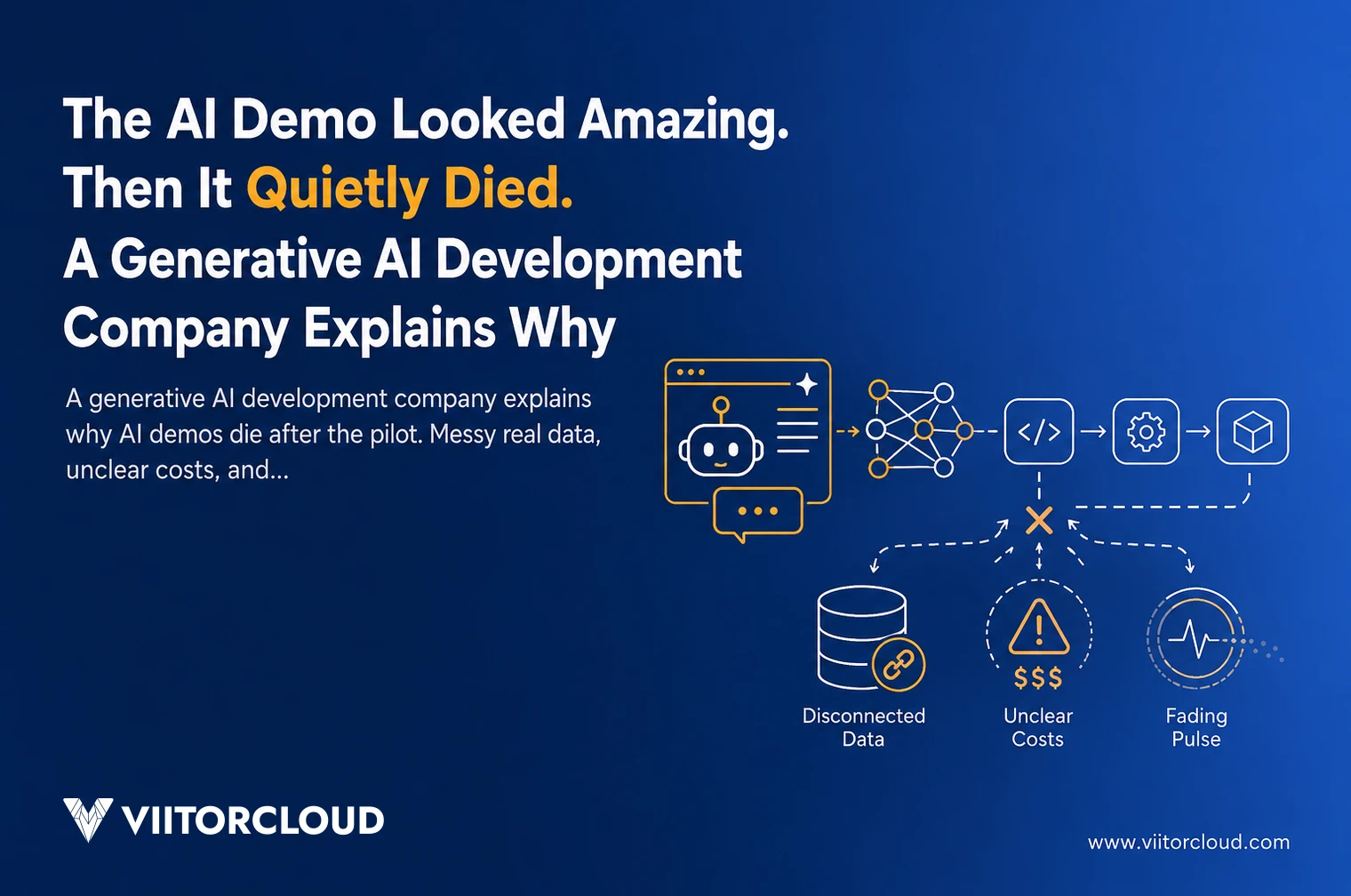
AI projects stop after the demo for three plain reasons. The demo ran on hand-picked examples, nobody priced what a year of daily use would cost, and nobody agreed on what happens when the model gets something wrong. Sort those three out, and most pilots ship.
I have had this conversation more times than I can count. A founder brings a generative AI development company a project that looked finished in March and was quietly dead by June. Nobody cancelled it. The internal champion moved teams, the finance question never got a real answer, and one day the demo link stopped working. Below is why AI pilots fail after a strong demo, what actually changes when you build for daily use, and the questions I would ask before another budget cycle goes into a prototype.
Key Takeaways
- Demos run on clean, hand-picked examples. Real archives are scanned, duplicated, expired, and full of documents that contradict each other.
- Cost per answer is a design decision made at the start, not a bill you discover in month four. Retrieval design and model choice move it by 10x.
- An AI that answers from your documents needs a citation on every answer. Without one, your team stops trusting it after the first bad response.
- A written evaluation set and safety checks are what let a pilot go live. They are not paperwork bolted on at the end.
- The real measure of success is not demo accuracy. It is how many people used the thing last Tuesday.
Why Do AI Projects Stop After the Demo
AI pilots fail after the demo because the demo tested the easiest fifth of the work. Daily use brings messy documents, unclear running costs, and unanswered safety questions. None of those three is a modelling problem. All three are engineering and governance problems, and all three can be settled before a single line of code is written.
Gartner predicted that at least 30% of generative AI projects would be abandoned after proof of concept by the end of 2025, pointing to poor data quality, weak risk controls, rising costs, and unclear business value as the causes (Gartner, 2024). Those four causes match what I see on the ground almost exactly.
So the demo is not the failure. The demo did its job. It proved the idea was possible. What it never proved was that the idea survives Monday morning.
The Data Your Demo Never Saw
Every stalled pilot I have reviewed was demonstrated on somewhere between 5 and 50 documents that a person chose by hand. Real content libraries look nothing like that.
- Scanned pages with no text layer at all
- Four versions of the same policy, three of them expired
- Tables that lose their meaning the moment they are flattened into plain text
- Internal codes and shorthand that appear nowhere in the base model’s training data
- Files nobody is cleared to see, sitting in the same folder as files everybody needs
An AI that answers from your documents is only ever as good as the pipeline feeding it. I worked on a livestock monitoring build where the model was fine, and the sensor data was not. Once ingestion was rebuilt to handle more than 1 million readings a day from 15,000 sensors reliably, accuracy improved without anyone touching the model. That system now supports a 30% reduction in cow mortality for the farms using it. Different industry, same lesson.
This is why credible custom AI development starts with data pipeline development, not prompt design.
Your Pilot Is Not Dead Yet
Most stalled AI projects fail on data preparation, cost per answer, and missing safety checks. We review all three against your existing pilot before recommending any new build.
What Generative AI Really Means Once It Leaves the Slide Deck
Generative AI writes an answer instead of looking one up. It predicts likely text based on what it has read, which is exactly why it will invent a confident answer when your documents do not contain one.
In practice, generative AI development services for a business are rarely about the model.
They come down to three jobs:
- Retrieval: Finding the right five paragraphs out of four hundred thousand before the model writes anything.
- Grounding: Forcing the answer to come from those paragraphs and to cite them by name and date.
- Refusal: Teaching the system to say it does not know.
That third job is where AI copilot development earns its trust. A copilot that admits uncertainty on 5% of questions keeps getting used. One that guesses confidently gets abandoned the week a wrong answer reaches a customer. If you are still weighing a build against a subscription, the trade-offs in custom AI solutions versus off-the-shelf AI are worth reading before you decide.
The Cost Question That Ends More Pilots Than Accuracy Does
Almost nobody kills an AI project in a meeting. They defer it, because no one in the room can say what it costs at 40,000 questions a month. Deferred twice is dead.
Design choices set cost per answer, and the range between a careless build and a careful one is enormous:
- How much text you send to the model on every single question
- Whether repeated questions are cached or paid for again
- Whether small models handle sorting and routing while large ones handle only the hard reasoning
- Whether work that nobody is waiting for runs overnight in batches
I put a cost per answer figure in the plan before the build begins, then hold the architecture to it. That number is what turns moving AI from demo to real use into a decision a finance lead can actually approve. A staged plan helps here too, and the sequence I use is close to the roadmap from proof of concept to production.
Built to Run, Not to Demo
Custom AI solutions engineered with grounded answers, citations, inherited access controls, and a cost per answer agreed before development starts. GDPR and HIPAA-compliant delivery included.
Safety Checks Are Why It Ships, Not Why It Stalls
Teams treat safety as the thing that slows a launch down. In my experience, it is the thing that permits one. Legal and compliance do not block AI because they dislike AI. They block it because nobody has shown them what happens on a bad day.
Four artifacts change that conversation:
- An evaluation set of 200 to 300 real questions with known correct answers, scored on every release.
- Access controls that inherit the permissions of the source systems, so the AI cannot answer from a file the person asking is not allowed to open.
- A full log of every question, every answer, and every document cited.
- A named human who reviews wrong answers weekly.
The NIST AI Risk Management Framework is a practical structure for organising this without turning it into a committee. We build these controls into GDPR and HIPAA-compliant delivery by default, which is also what makes AI copilot use cases viable in regulated environments rather than theoretical.
Questions to Ask Before You Hire a Generative AI Development Company
Use this before the first build meeting. If a partner cannot answer these, the demo will be the high point of the project.
- Which 200 real questions must this answer, and who wrote them down?
- Where does the source content live today, and who controls access to it?
- What is the cost per answer at expected volume, and who has approved that number?
- What does the system do when it does not know something?
- Who reviews wrong answers, how often, and what happens next?
- What is the written go-live plan after the pilot, with a date and an owner?
- Who operates and retrains this in month seven?
Start Small, Then Scale What Works
A focused proof of concept validates one high-value workflow with a written evaluation set and a production plan attached, so the decision to scale is based on evidence rather than a demo.
Where a Generative AI Development Company Earns Its Keep
A demo proves capability. Production proves engineering. Over 15 years and 300+ client engagements, the systems we built at ViitorCloud that are still running share the same traits described above. A healthcare platform we engineered has processed $192.2M in revenue. A museum search tool we built scans more than 1 million paintings and returns results in a fraction of a second. Neither number came from a clever prompt. Both came from the pipeline, cost, and safety work under it.
If your pilot is sitting in the same silence, the useful next step is a short review of the three failure points rather than a new prototype. Our custom AI solutions team starts every engagement with that assessment, and it is often the cheapest week of the whole project.
The Demo Was Never the Hard Part
Great demos are now easy to produce, which is exactly why so many of them die alone. The work that gets an AI into daily use is unglamorous: cleaning the documents, pricing the queries, writing the evaluation set, and naming the person who owns the wrong answers. A generative AI development company that starts there will show you a less impressive demo and a system your team is still using next year. Pick the second one. Then hold the build to the seven questions above, and ask for the cost per answer in writing before anyone starts coding.

Vishal Shukla
Vishal Shukla is Vice President of Technology at ViitorCloud Technologies.
Frequently Asked Questions
Why do AI pilots fail after a successful demo?
Because demos are built on hand-picked data, unpriced usage, and unresolved safety questions. Real documents are messy and contradictory, running costs surface only at volume, and compliance has seen no evidence of what happens when the model is wrong. All three are fixable before the build starts.
How long does moving AI from demo to real use usually take?
How do I choose a generative AI development company?
What does an AI that answers from your documents actually need?
Is custom AI development worth it compared to off-the-shelf tools?