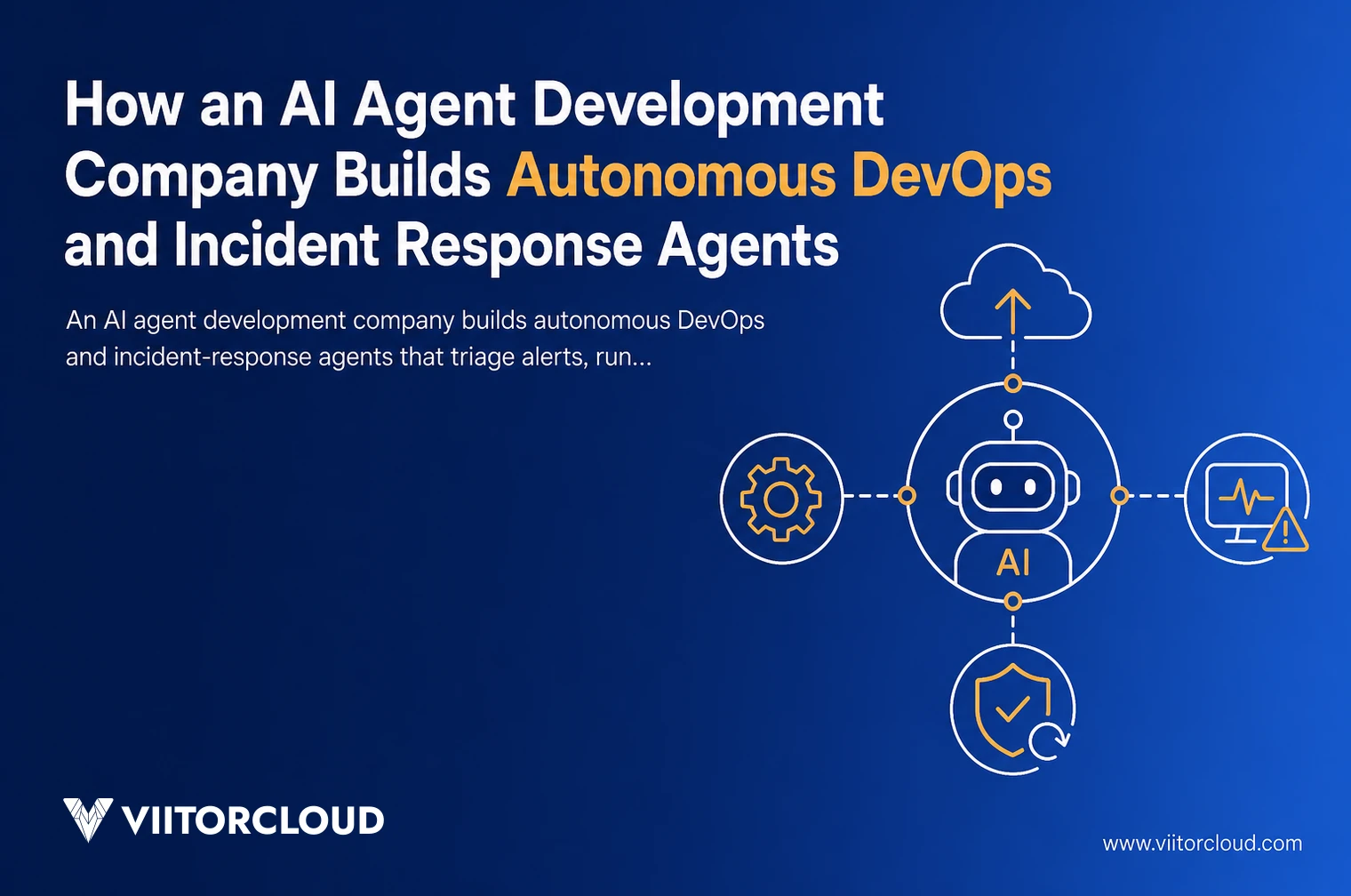
An AI agent development company builds autonomous DevOps and incident-response agents that triage alerts, diagnose root causes, and run approved fixes on their own. The result is fewer 3 a.m. pages and far less manual toil for your engineers. That is the short answer. The useful answer is knowing what separates a real agentic AI system from a chatbot bolted onto your monitoring stack.
If you lead engineering, you already feel the problem. Alert volume keeps climbing, on-call rotations burn out your best people, and most AI tools still only suggest what a human should do next. I have spent years building custom AI systems for operations-heavy environments. I will show you how autonomous DevOps and incident-response agents work, where they help, and how to build them without handing production to a black box.
Key Takeaways
- An AI agent for DevOps goes past suggestions and executes triage, diagnostics, and remediation inside approved guardrails.
- Agentic AI differs from an AI copilot because it acts autonomously across multi-step workflows, not one prompt at a time.
- Incident-response agents use AIOps signals to detect, correlate, and resolve issues, which cuts alert noise and on-call fatigue.
- DevOps automation agents need human approvals, rollback paths, and audit logs before they touch production.
- Choosing an AI agent development company comes down to integration depth, guardrail design, and proof of delivery, not demos.
What an AI Agent for DevOps Actually Does
An AI agent for DevOps is autonomous software that watches your systems, decides what an incident needs, and takes action within limits you set. It reads telemetry, correlates signals, runs diagnostics, and either resolves the issue or hands a scoped recommendation to a human. This is the core of agentic AI applied to operations.
A traditional script follows fixed rules. An agent reasons over context. When a service degrades, it can pull recent deploys, read logs, compare against normal baselines, and choose the next step. That decision loop is what makes DevOps automation with agents different from the static runbooks your team already maintains.
Most production agents combine three parts:
- Perception: The agent ingests metrics, logs, traces, and alerts from your observability stack.
- Reasoning: A language model plans steps, calls tools, and checks results against the goal.
- Action: The agent restarts services, scales resources, or opens a ticket, with approvals where they are required.
I build these systems as custom AI solutions tuned to a client’s real stack, because generic tools rarely understand your services, your data, or your escalation rules.
Scope Your First Incident-Response Agent
Start with one noisy incident type, wrap it in guardrails, and prove the toil it removes in production.
Why Suggest-Only AI Copilots Still Leave the Toil Behind
An AI copilot is useful, but it stops at advice. It drafts a query, proposes a command, or summarizes an alert, then waits for a human to act. Your engineers still do the repetitive work, one click at a time.
Google’s site reliability engineers have a word for that repetitive, automatable work. They call it toil. When toil grows, senior people spend their hours on manual recovery instead of building. Google’s own guidance on eliminating toil matches what I see on most on-call rotations.
Here is the practical gap. An AI copilot might tell an on-call engineer to restart the payment worker and clear the queue. An agent restarts the worker, clears the queue, confirms recovery, and logs the sequence, then pings the engineer only if something still looks wrong. One saves a few seconds. The other removes the task.
I worked through this with an on-call lead I will call Dana. Her team ran a fintech platform and averaged dozens of alerts a night, most of them the same three noisy failures. We built an incident-response agent to own those three. Within a few weeks, those failures stopped waking anyone up, and her senior engineers got their mornings back.
This is why the difference between AI copilots and agents matters for engineering teams. An AI copilot raises the ceiling on individual productivity. An agentic AI system raises the floor by handling the routine incidents nobody wants at 3 a.m.
How Autonomous Incident Response Agents Work
Autonomous incident-response agents sit on top of your AIOps layer. AIOps means applying AI to the flood of operational data your systems produce. The agent uses those signals to detect a problem, understand it, and resolve it before a human even notices.
A typical response loop runs in five steps:
- Detect: The agent spots an anomaly across metrics and logs, not just a single threshold breach.
- Correlate: It links related alerts into one incident, so five pages become one clear signal.
- Diagnose: It checks recent deploys, config changes, and dependencies to find the likely cause.
- Act: It runs the approved remediation, then verifies the system is healthy again.
- Report: It writes a timeline and posts it to your incident channel for review.
That loop is DevOps automation with judgment layered on top of a fixed script. The AIOps foundation is what stops the agent from chasing noise, because good correlation turns a storm of alerts into a single actionable incident. Most on-call fatigue comes from volume, not difficulty, so that alone changes the job.
These agents build directly on AI-driven automation patterns, connecting language-model reasoning to the tools and APIs that actually run your environment.
Build Autonomous DevOps Agents Your Team Trusts
We design agents with approvals, rollback paths, and audit logs so autonomy never means losing control of production.
Building DevOps Automation Agents With Guardrails and Approvals
Autonomy without control is a liability. Many engineering leaders hesitate because they fear an agent running a destructive command in production. That fear is valid, and it is exactly why guardrails come first in any serious build.
Strong DevOps automation agents include a few non-negotiable controls:
- Scoped permissions: The agent can only touch the services and actions you allow.
- Approval gates: High-risk actions pause for a human yes before they run.
- Rollback paths: Every change has a defined way to undo it.
- Audit logs: Every decision and action is recorded for review and compliance.
Consider a scenario I see often. A platform engineer, I will call him Raj, wants an agent to auto-scale a cluster during traffic spikes but never to delete nodes on its own. We let the agent scale up freely, scale down only within limits, and require approval for anything that removes capacity. Raj gets speed where it is safe and a human checkpoint where it matters.
This staged, controlled approach is how I have always shipped production AI. At ViitorCloud, we design agents the same way we built a livestock monitoring system that acts on more than 1 million sensor readings a day and helped cut mortality by 30%. Autonomous action at that scale only works because the guardrails and the data pipeline underneath it are solid. You can see more of how we build custom AI agents across industries.
How to Choose an AI Agent Development Company
Agentic AI is moving from experiment to standard practice. Gartner projects that by 2028, about a third of enterprise software will include agentic AI, up from less than 1% in 2024. Picking the right partner now is a competitive decision, not a research project.
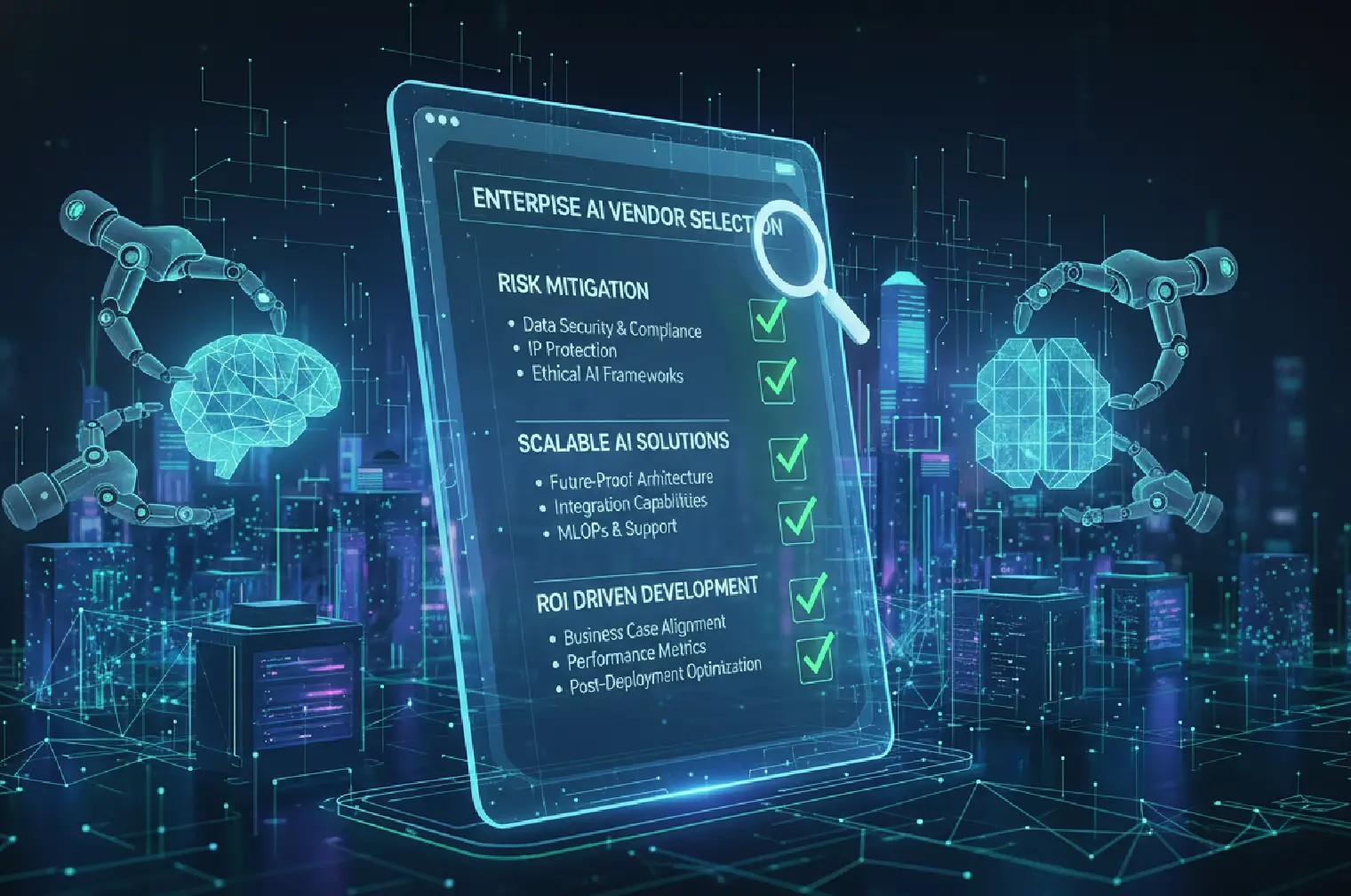
When you evaluate an AI agent development company, look past the demo. A polished demo proves nothing about whether an agent survives contact with your real systems. Ask about the parts that decide success in production.
Four questions I would ask any partner:
- How do you integrate with our stack?
The agent has to work with your observability, CI/CD, and cloud tools, not a sandbox. - How do you design guardrails?
Ask for their approach to approvals, permissions, and rollback before they write code. - How do you handle model reliability?
Agents drift and fail, so you want monitoring and retraining built in from day one. - What have you shipped to production?
Real outcomes beat slideware every time.
A strong AI agent development company answers all four without hesitation. The right AI agent development partner treats your workflow as the starting point, not an afterthought, because generic agents trained on generic data will misread your services and escalation rules. This matters most for fast-moving software and technology teams, where downtime is expensive and engineering time is scarce. My work across technology and IT organizations has taught me that the teams who win start small, prove one agent in production, then expand.
Map Your Agentic AI Roadmap
Talk through where agents fit your stack with engineers who have shipped custom AI across 300+ client engagements since 2011.
Where to Start Your Agentic AI Build
Analysts expect the agentic AI market to compound more than 50% a year toward roughly $45 billion by 2030, which means your competitors are scoping these systems right now. You do not need a giant program to begin. You need one well-chosen agent, built safely, that removes real toil.
That is how I recommend starting. Pick your noisiest, most repetitive incident type and build a single incident-response agent with full guardrails around it. Prove it in production, measure the hours it gives back, then expand. ViitorCloud has delivered this think big, start small approach across more than 300 client engagements since 2011, from real-time monitoring systems to enterprise-scale operations. When you are ready to build agentic AI that your engineers actually trust, that is the work we do.
The Move From Alerts to Autonomous Operations
Autonomous DevOps and incident-response agents solve a problem your team feels every week. They move past suggestions, handle the repetitive incidents, and give your engineers their focus back. Agentic AI does the toil so people can do the work that needs judgment.
Start with one agent, wrap it in real guardrails, and prove the value in production before you scale. The right AI agent development company will build for your stack and your risk tolerance, not a generic template. That is how autonomy becomes something your team trusts, and the engineering leaders who start now will spend 2026 building while others are still triaging alerts by hand.

Vishal Shukla
Vishal Shukla is Vice President of Technology at ViitorCloud Technologies.
Frequently Asked Questions
What is an AI agent for DevOps?
An AI agent for DevOps is autonomous software that triages alerts, runs diagnostics, and executes fixes within approved guardrails.
How is agentic AI different from an AI copilot?
What is AIOps and how do incident-response agents use it?
How much does AI agent development cost?