


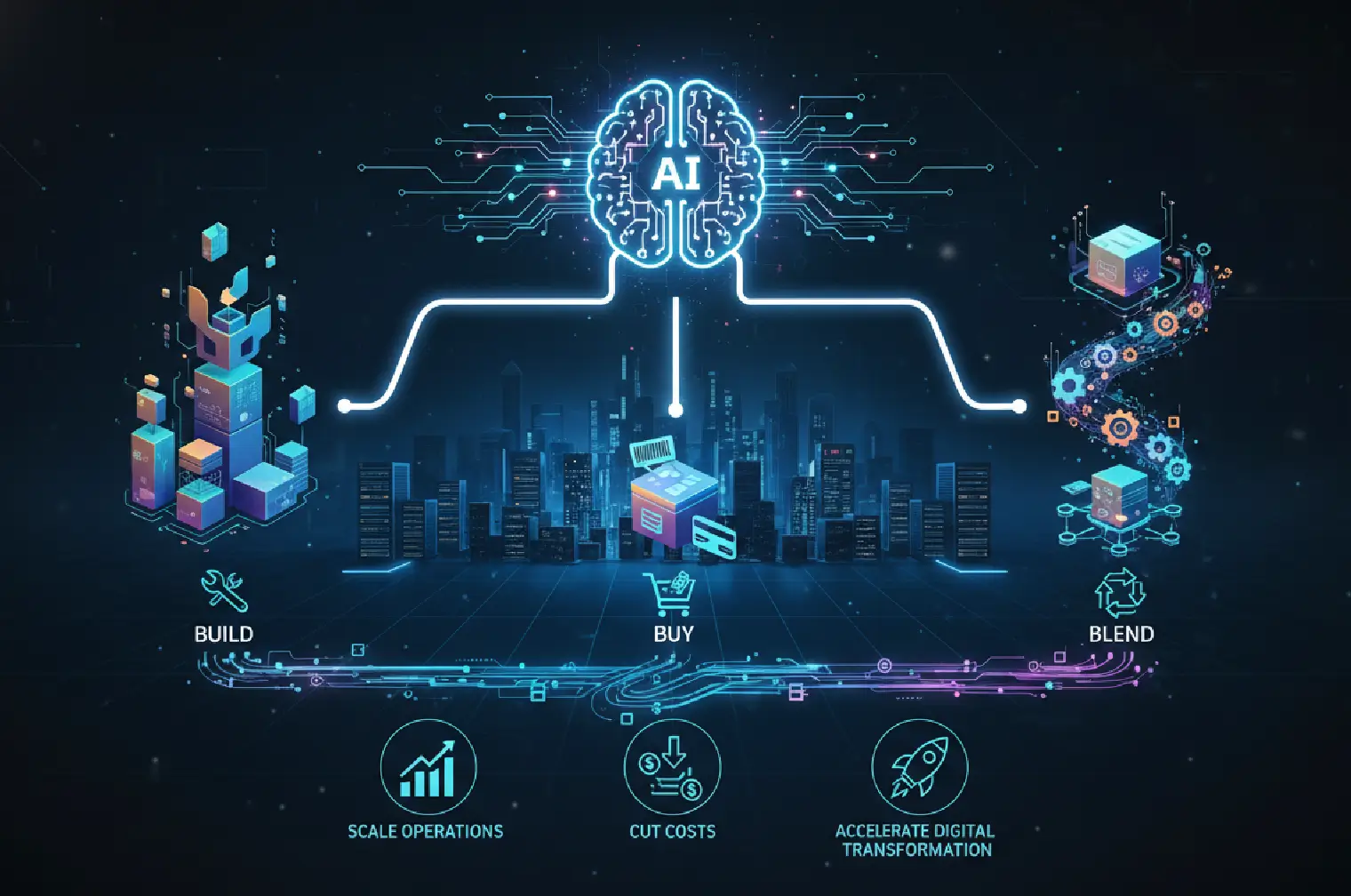
Enterprise operations teams face a direct choice when implementing artificial intelligence. They must decide whether to build software internally, buy commercial products, or hire an AI automation agency. This decision impacts operational efficiency, data security, and long-term costs.
Here, we have discussed a framework to evaluate these options. We focus on high-intent workflows across the USA and Europe. The goal is to establish systems that generate measurable returns on investment.
Why Do Enterprise Operations Struggle with AI Deployment?
Enterprise leaders often miscalculate the resources required for AI integration. Standard software packages lack the specific configurations needed for complex workflows. Conversely, internal teams often lack the specialized skills required for custom AI development.
Research from Gartner indicates that organizations achieve the best results by blending embedded SaaS features with enterprise-crafted components. This blended approach requires technical oversight.
An AI automation agency provides this oversight. They align technical execution with business objectives. They manage the transition from legacy systems to modern architectures. This prevents costly delays and ensures the software functions correctly upon deployment.
What Are the True Costs of Buying Off-The-Shelf Software?
Purchasing pre-built software appears cost-effective initially. Vendors offer immediate deployment and standardized features. However, commercial software creates limitations for enterprise operations.
- Vendor Lock-in: Companies become dependent on external product roadmaps and pricing structures.
- Integration Failures: Pre-built tools often fail to connect seamlessly with existing legacy systems.
- Generic Outputs: Standard machine learning models do not process specific company data accurately.
- Security Vulnerabilities: Publicly shared multi-tenant clouds pose risks for sensitive enterprise data.
These limitations force companies to adapt their workflows to the software. True AI-driven automation adapts the software to the workflow. Our analysis of AI-driven automation and digital transformation shows that off-the-shelf products often function merely as basic digital tools rather than autonomous execution systems. Enterprises require custom AI solutions to gain a competitive advantage and maintain strict data privacy.
Choose the Right Path with an AI Automation Agency
Evaluate build, buy, or blend strategies with expert AI Integration and Custom AI Solutions tailored for enterprise operations.
When Does In-House Construction Become a Liability?
Internal IT teams attempt custom AI development to maintain control over data and intellectual property. This approach presents different structural challenges. Developing custom AI solutions requires hiring specialized data scientists and machine learning engineers. These roles command high salaries and require extensive recruitment periods.
The internal development cycle often takes 12 to 18 months. During this period, the base technology frequently changes. This renders early work obsolete before deployment.
Furthermore, initial deployment is only the first step. Long-term AI integration requires continuous model training, server maintenance, and security patching. Internal teams often struggle to manage this technical debt while supporting daily operations. Partnering with an AI automation agency shifts this maintenance burden away from your internal staff.
How Do You Evaluate the Hybrid Approach?
The hybrid model combines internal business knowledge with external technical execution. Companies retain ownership of their data and custom models. They outsource the technical build to an AI automation agency.
A Forbes Tech Council report states that working with an external partner allows companies to build proprietary assets without the steep internal learning curve. This method protects intellectual property while accelerating deployment timelines.
This approach delivers custom AI development at a predictable cost. The table below compares the three primary deployment methods across key metrics.
| Deployment Method | Upfront Capital | Deployment Speed | Customization Level | Maintenance Burden |
| Buy (Off-the-shelf) | Low | Fast | Low | Low |
| Build (In-house) | High | Slow | High | High |
| Blend (Agency) | Medium | Medium | High | Low |
Which Workflows Require Immediate Attention?
Enterprise operations leaders must identify the correct processes for AI-driven automation. Different departments have varying requirements for security and speed.
Supply Chain and Logistics
Supply chains generate massive amounts of unstructured data. Standard tools cannot process this data efficiently across global networks. Custom AI solutions analyze shipping routes, predict inventory shortages, and manage supplier communications automatically. We detail this specific application in our article on AI automation services for bank supply chains, highlighting how structured data improves forecasting.
Human Resources and Onboarding
Large organizations process thousands of applications monthly. AI integration streamlines background checks, document verification, and training schedules. The system automatically routes exceptions to human managers. This reduces administrative hours and standardizes the hiring process.
Financial Operations
Finance teams spend hundreds of hours reconciling accounts manually. AI-driven automation handles invoice processing and fraud detection. Custom AI development ensures these systems comply with regional financial regulations across the USA, Europe, and APAC markets.
Accelerate Enterprise Ops with Custom AI Development
Partner with a proven AI Automation Agency to implement scalable AI Integration and deploy Custom AI Solutions with confidence.
How Can Enterprise Operations Ensure Successful Deployment?
Success depends on structured implementation. Companies must follow strict protocols when deploying custom AI solutions at scale.
- Data Auditing: Clean, categorize, and structure existing data before building machine learning models.
- Security Compliance: Ensure systems meet SOC 2, GDPR, and regional compliance standards.
- Infrastructure Testing: Stress-test servers to handle increased computational loads.
- Change Management: Train employees to use the new systems effectively.
An experienced AI automation agency manages these protocols. They establish clear timelines and set definitive performance metrics. They execute the AI integration carefully to prevent disruptions to current operations.
How Does ViitorCloud Deliver Measurable Results?
ViitorCloud designs and implements custom AI development for enterprise operations. We operate as your dedicated AI automation agency. Our process focuses entirely on measurable operational improvements.
We provide complete transparency regarding system architecture, data usage, and intellectual property ownership. Review our AI-driven automation services to see how we structure our technical deployments.
We offer technical consultations to evaluate your current infrastructure. We will determine the exact requirements for your project and provide a clear execution roadmap.
Contact us at [email protected] to discuss how AI can accelerate your growth.
Blend Systems Seamlessly with AI Integration
Modernize enterprise workflows through Custom AI Development and end-to-end solutions from a trusted AI Automation Agency.
Conclusion
Enterprise operations require systems that match their specific workflows. Buying generic software limits capabilities and creates vendor dependence. Building from scratch consumes excess time and capital. The most effective strategy utilizes an external partner for precise technical execution. This blended approach minimizes operational risk, controls costs, and maximizes your control over the final product.

Vishal Shukla
Vishal Shukla is Vice President of Technology at ViitorCloud Technologies.
Frequently Asked Questions
What does an AI automation agency do?
<!-- wp:heading {"level":3} --> They design, build, and deploy specific artificial intelligence systems to improve business workflows and efficiency. <!-- /wp:paragraph -->
Is it cheaper to build or buy AI solutions?
What is a blended AI integration approach?
Why do enterprises need custom AI development?