


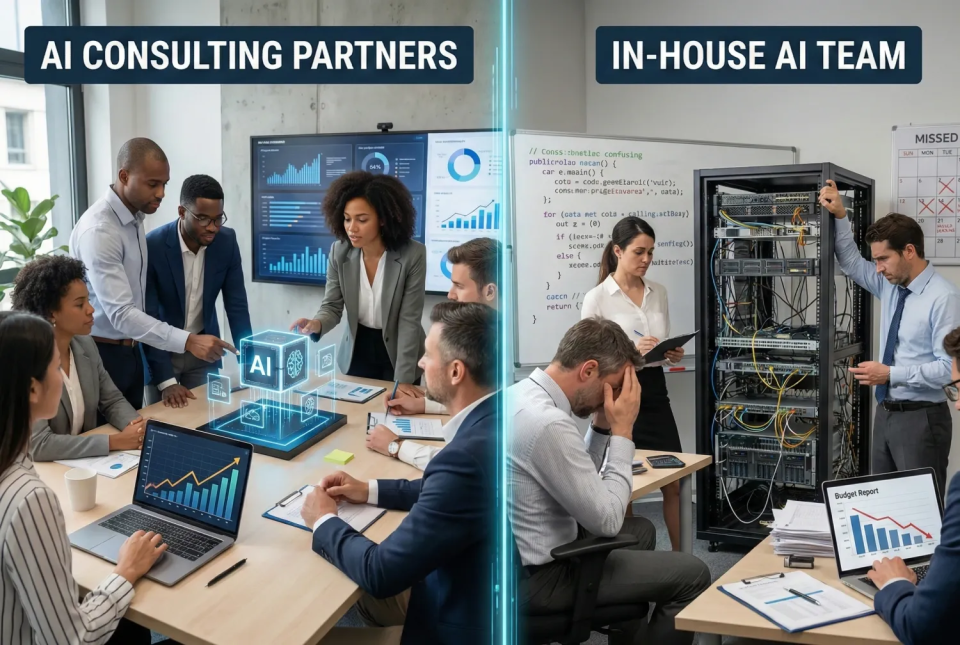
Today, every small to big company has already adopted AI or is planning its adoption. However, the choice between AI consulting vs in-house AI team hiring creates a dilemma for small companies as it impacts financial stability, technical scalability, and long-term competitiveness.
Professional AI consulting services offer a structured alternative to the complexities of internal hiring. An AI consulting company provides immediate access to technical frameworks and specialized talent that are difficult to secure in a competitive labor market.
Let’s discuss the operational and financial factors that make custom AI solutions more viable through external partnerships rather than internal team construction.
The Financial Reality of AI Talent Acquisition
Building an internal AI department requires a significant capital commitment. In 2026, the salary for a senior machine learning engineer in major tech hubs ranges from $150,000 to over $300,000 annually. For a small IT business, these fixed costs create a high financial threshold before any code is written.
Recruitment and Retention Challenges
Recruiting for AI roles is a time-consuming process. The specialized nature of the field means that talent is scarce. Small businesses often compete with large tech firms for the same pool of experts.
When a small business manages to hire a specialist, the risk of “talent churn” remains high. If a key engineer leaves, the project often stalls, leading to a loss of momentum and sunk costs.
By contrast, an AI consulting company manages the recruitment and retention of its engineers. Small businesses pay for the output and expertise rather than the overhead of maintaining a full-time staff.
This transit from capital expenditure (CapEx) to operational expenditure (OpEx) provides greater financial predictability.
Infrastructure and Tooling Costs
An in-house team requires more than just personnel. It requires an investment in high-performance computing (HPC) infrastructure, specialized software licenses, and MLOps (Machine Learning Operations) pipelines.
Managing these assets increases the complexity of the IT department. AI consulting services typically include access to established tech stacks and pre-configured environments, allowing projects to start immediately without additional infrastructure procurement.
Strategic Comparison: AI Consulting vs In-House AI
The following table summarizes the primary differences between maintaining an internal team and partnering with a specialized consultant.
| Feature | In-House AI Team | AI Consulting Partner |
| Setup Time | 4–9 Months (Recruitment & Onboarding) | 2–4 Weeks (Discovery & Kickoff) |
| Cost Structure | High Fixed Salaries & Benefits | Variable Project-Based Fees |
| Expertise Range | Limited to the specific hires’ skills | Access to diverse specialists (NLP, CV, LLM) |
| Scalability | Difficult to scale down after project completion | Highly flexible based on project phases |
| Tech Stack | Must be built and maintained internally | Pre-built frameworks and MLOps pipelines |
| Risk Management | High (Talent churn, tech debt) | Low (SLA-driven results and accountability) |
Small businesses must evaluate AI consulting vs in-house AI based on their specific project roadmap. For a singular implementation or a series of targeted upgrades, the consulting model offers a clearer path to ROI.
Choose AI Consulting Over Costly In-House AI Teams
Discover how AI consulting vs in-house AI helps your small business reduce risk, control costs, and scale faster with expert guidance.
Speed to Market and Implementation Efficiency
In the IT industry, the speed of deployment is a critical factor for market relevance. An internal team often faces a steep learning curve during the initial stages of a project. They must research frameworks, establish data protocols, and test architectures from scratch.
Immediate Project Kickoff
When a business utilizes AI consulting services, the partner brings a library of established models and deployment patterns. For example, ViitorCloud’s AI consulting and strategy framework focuses on identifying “quick wins” that demonstrate value within weeks. This approach avoids the months of preparation typical of in-house initiatives.
Specialized Niche Expertise
AI is not a monolithic field. It includes sub-disciplines like Natural Language Processing (NLP), Computer Vision, Predictive Analytics, and Generative AI. An in-house team of two or three people cannot possess deep expertise in every area. A partnership with an AI consulting company provides access to a broad talent pool. If a project requires a specific type of fine-tuning for a Large Language Model (LLM), the consultant assigns a specialist for that phase without the business needing to hire a new employee.
Increase Your Competitive Edge with Custom AI Solutions
Generic, off-the-shelf AI tools often fail to address the specific operational bottlenecks of an IT business. These tools are designed for broad market appeal and lack the integration depth required for complex workflows. Custom AI solutions are built to align with proprietary data and existing business processes.
Data Sovereignty and Security
Developing custom solutions through a consulting partner ensures that the business retains control over its data. Unlike public AI APIs that may use input data for training, a custom-built system can be hosted in a private environment. This is essential for IT companies handling sensitive client information.
Integration with Existing Ecosystems
Small businesses rely on a variety of software for project management, CRM, and ERP. An external partner specialized in AI Integration ensures that the AI model communicates effectively with these systems. This creates a unified data flow rather than a siloed application.
According to research by McKinsey & Company, organizations that successfully scale AI are those that integrate it deeply into existing business functions rather than treating it as a standalone experiment. This integration is a core deliverable of professional consulting.
Scalability and Risk Mitigation
The AI landscape changes rapidly. A model that is state-of-the-art today may be obsolete in twelve months. This rapid evolution presents a significant risk to in-house teams who may become “overfitted” to a specific technology.
Technical Debt and Maintenance
AI systems require continuous monitoring and retraining. Data distributions shift over time, leading to “model drift.” An internal team must dedicate a portion of its time to maintenance rather than new development.
An AI consulting company provides ongoing support and optimization as part of their service agreement. This prevents the accumulation of technical debt and ensures the system remains accurate.
Flexibility for Growth
When a small business experiences a period of rapid growth, it may need to scale its AI capabilities quickly. Hiring new staff to meet this demand is slow. Conversely, if the business needs to reduce spending, it cannot easily “un-hire” a specialized AI team without significant organizational disruption.
Comparing AI consulting vs in-house AI reveals that the consulting model offers superior elasticity. A business can increase or decrease the level of service based on its current budget and goals.
Turn Strategy into Impact with AI Consulting
Partner with experts in AI Consulting who design Custom AI Solutions tailored to your business goals—without building an in-house AI team.
Operational Impact of Custom AI Solutions in the IT Sector
For small businesses in IT, the primary goal of AI is often the automation of routine technical tasks. This allows the human workforce to focus on high-level architecture and client relationships.
Efficiency Gains in Development
Custom AI solutions can be designed to automate code reviews, predict server load, or manage ticket triage in customer support. These applications provide measurable improvements in productivity. For instance, ViitorCloud’s work with custom AI agents demonstrates how automated systems can handle high-volume interactions with 98% accuracy.
Practical Use Cases for SMBs
Small IT firms can leverage AI consulting services for several high-impact areas:
- Predictive Maintenance for Infrastructure: Analyzing server logs to predict hardware failures before they occur.
- Automated Quality Assurance: Using machine learning to identify bugs in software builds more efficiently than manual testing.
- Client Behavior Analytics: Identifying patterns in client usage to predict churn and optimize service delivery.
These targeted applications provide a clear path to ROI, which is often lost in the broader, less defined goals of an in-house AI department.
Strategic Guidance from an AI Consulting Company
A reputable AI consulting company provides a strategic roadmap rather than just writing code. Many AI projects fail because they lack a clear business objective.
Gartner predicts that through 2026, a significant percentage of AI projects will be abandoned due to escalating costs and a lack of clear value.
Define KPIs and Success Metrics
An AI consulting company begins by defining Key Performance Indicators (KPIs). They assess the business’s data readiness and identify which processes will benefit most from automation. This strategic oversight ensures that the investment in custom AI solutions translates into business growth.
Navigate Regulatory Compliance
As AI regulations like the EU AI Act and local data privacy laws evolve, compliance becomes a technical challenge. Professional AI consulting services include expertise in building compliant systems. They implement guardrails for data privacy, bias mitigation, and algorithm transparency, reducing the legal risk for the small business.
Why the Hybrid Model Often Fails Small Businesses
Some businesses attempt a hybrid model, where they hire one or two internal experts to manage a team of external consultants. While this seems balanced, it often creates friction.
The internal hires may feel their roles are threatened by the consultants, or they may lack the broad technical oversight needed to manage a specialized external team effectively.
When evaluating AI consulting vs in-house AI, the evidence suggests that for small businesses, a full partnership with an AI consulting company is more efficient.
This allows the business to remain focused on its core IT services while the partner handles the specialized AI lifecycle.
Trust ViitorCloud for AI Consulting Services
ViitorCloud delivers custom AI solutions that solve specific operational challenges for small and mid-sized businesses. Our approach focuses on building intelligent systems that integrate seamlessly with your current workflows.
By choosing our AI consulting services, businesses gain access to over a decade of engineering expertise without the overhead of internal hiring. We provide the technical architecture and the strategic roadmap necessary to turn AI from a theoretical concept into a functional business asset.
Conclusion
Thus, the decision between AI consulting vs in-house AI is a choice between flexibility and fixed overhead. For small businesses in the IT sector, the partnership model provides superior access to talent, faster deployment times, and a more sustainable cost structure. Custom AI solutions developed by a dedicated AI consulting company ensure that the technology is tailored to the business’s unique data and objectives. By leveraging professional AI consulting services, small businesses can compete with larger organizations, maintaining their agility while adopting the most advanced tools in the market.
Contact us at [email protected] for a complimentary consultation meeting with our experts.
Invest Smart with AI Consulting, Not In-House AI
Explore AI consulting vs in-house AI and implement Custom AI Solutions that deliver measurable results for your small business.

Vishal Shukla
Vishal Shukla is Vice President of Technology at ViitorCloud Technologies.