


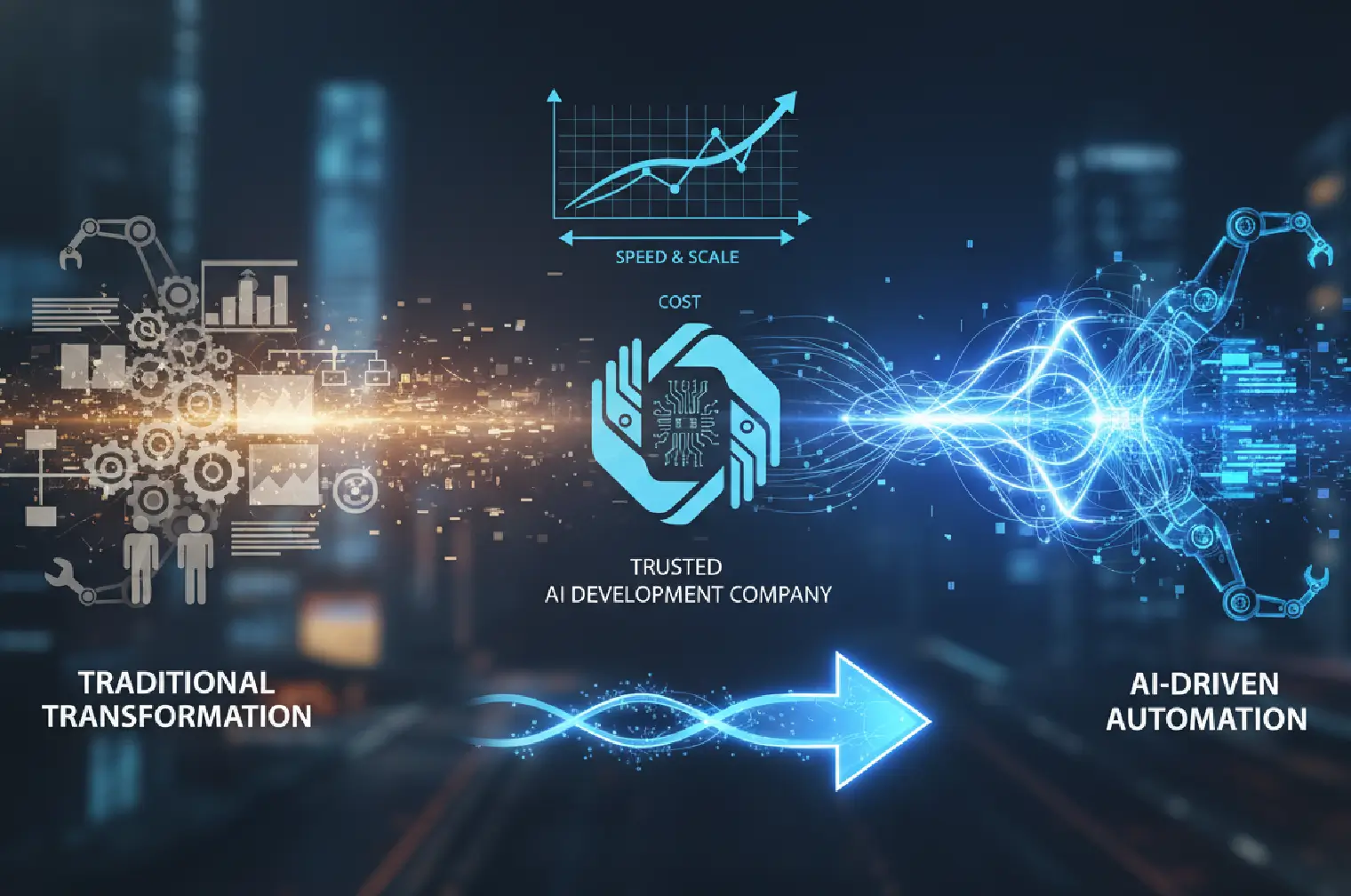
Digital transformation traditionally refers to the integration of digital technology into all areas of a business.
For the past decade, small and medium businesses (SMBs) in logistics, IT, and healthcare focused on digitizing paper records and moving data to the cloud.
While these efforts improved accessibility, they often resulted in static digital environments that still required significant human intervention.
In 2026, the industry shift has moved toward AI-driven automation.
Unlike traditional digital transformation, which prioritizes the digitization of existing processes, AI-driven automation focuses on creating systems that act independently based on data insights.
This evolution allows companies to move from reactive management to an automated operation model.
The Transition from Traditional Digital Transformation to AI-Driven Automation
Traditional digital transformation created a foundation of data.
However, many organizations found that digital tools alone did not solve the problem of high operational costs or human error.
AI automation addresses these limitations by adding a layer of intelligence to digital systems.
Instead of a human checking a dashboard to make a decision, AI-driven automation analyzes the data and executes the necessary action directly.
The following table outlines the functional differences between these two approaches:
| Feature | Traditional Digital Transformation | AI-Driven Automation |
| Primary Goal | Digitization and connectivity | Autonomous execution and intelligence |
| Data Usage | Historical reporting | Predictive and real-time action |
| Human Role | Constant monitoring and decision-making | Oversight and strategic management |
| Operational State | Reactive | Automated operation |
| Scalability | Limited by human headcount | Decoupled from labor hours |
Businesses that implement AI-driven automation often see a direct increase in automation service leads, as the efficiency gains allow for faster response times to market demands.
According to research from Gartner, hyper-automation, the combination of AI and RPA, is now a requirement for organizations to remain competitive in high-volume sectors.
Lead Change with AI-Driven Automation
Replace outdated systems and accelerate growth using ViitorCloud’s AI-Driven Automation and Custom AI Solutions.
Automation in Healthcare
The healthcare sector has moved beyond the simple adoption of Electronic Health Records (EHR).
Modern automation in healthcare now focuses on clinical and administrative intelligence.
AI automation allows hospitals and clinics to process patient data without manual entry, reducing the administrative burden on medical staff.
ViitorCloud provides specialized healthcare tech consulting services that focus on integrating these intelligent systems.
For example, AI-driven automation can now analyze medical imaging to flag abnormalities before a radiologist reviews the file.
This application of automation in healthcare improves diagnostic speed and accuracy.
Specific applications of AI automation in this field include:
- Automated patient triage based on symptoms and history.
- AI-powered medical billing and claims adjudication.
- Predictive analytics for patient admission rates.
Implementing automation in healthcare reduces errors in insurance claims, which prevents financial losses.
As clinics adopt these systems, they generate more automation service leads by demonstrating superior patient outcomes and operational reliability.
You can learn more about how these technologies are applied in our detailed guide on intelligent automation in healthcare.
Supply Chain Automation for Logistics SMBs
Logistics companies face increasing pressure to deliver goods faster while maintaining low costs.
Traditional digital systems allowed for package tracking, but supply chain automation now enables autonomous decision-making in routing and inventory management.
In a typical automated operation, AI algorithms monitor weather patterns, traffic data, and fuel consumption in real-time.
The supply chain automation system then re-routes vehicles without dispatcher intervention.
This level of AI-driven automation ensures that shipments arrive on time despite external disruptions.
ViitorCloud’s expertise in AI-driven automation for SMEs helps logistics providers transition to these models.
Supply chain automation also optimizes warehouse storage by predicting which items will have high demand. This prevents overstocking and reduces storage fees.
When logistics firms stabilize their costs through AI automation, they attract more automation service leads from larger enterprises looking for reliable shipping partners.
A study by McKinsey & Company indicates that companies using AI-driven automation in their supply chains can reduce logistics costs by 15% to 30%. This efficiency is critical for SMBs that do not have the capital to absorb the waste associated with manual processes.
Upgrade Digital Transformation with AI
Drive smarter decisions and efficiency with AI-Driven Automation powered by Custom AI Solutions.
Automated Operation in Information Technology
In the IT sector, the focus has shifted from managing infrastructure to overseeing an automated operation.
Developers and IT managers now use AI-driven automation to handle routine maintenance, such as software updates, security patching, and server scaling.
Our AI-driven automation services enable IT departments to focus on product innovation rather than system maintenance.
For instance, AI automation can detect a security anomaly and isolate the affected segment of a network instantly.
This proactive automated operation prevents data breaches that traditional systems might only report after the damage occurs.
The integration of AI-driven automation into the development lifecycle, often referred to as AI product engineering, shortens the time-to-market for new software.
By using end-to-end AI product engineering, businesses ensure that their digital tools are built with automation as a core feature rather than an afterthought.
This approach consistently generates high-quality automation service leads as clients seek out modernized, self-sustaining platforms.
The Impact on Business Growth and Lead Generation
The primary objective of moving to an AI-driven automation model is to achieve measurable business outcomes.
For many organizations, the most significant impact is the increase in automation service leads.
When a business operates with high efficiency and low error rates, its market reputation improves, leading to more inquiries for its services.
Furthermore, AI automation allows companies to scale without a linear increase in employees.
This capability is vital for SMBs in logistics and healthcare, where labor shortages are common.
An automated operation can handle a 50% increase in workload with the same number of staff members.
Key benefits of this shift include:
- Operational Resilience: Supply chain automation identifies risks before they become disruptions.
- Cost Reduction: Automation in healthcare minimizes the need for clerical staff for data entry.
- Enhanced Precision: AI-driven automation eliminates the “human factor” in repetitive data tasks.
Companies looking to begin this transition can review our digital transformation consulting to identify which manual processes are the best candidates for AI automation.
Build Future-Ready Systems with AI
Scale operations faster using AI-Driven Automation and tailored Custom AI Solutions.
The Bottom Line
Traditional digital transformation is no longer sufficient to maintain a competitive edge. The complexity of modern data requires an automated operation that can process information and act in real-time.
Whether it is through supply chain automation in logistics or automation in healthcare to improve patient care, AI-driven automation is the technology that delivers tangible results.
By partnering with an experienced provider like ViitorCloud, businesses can implement AI automation that aligns with their specific industry needs.
Contact us: [email protected]
This transition creates a robust framework that generates automation service leads and ensures long-term sustainability.
For more insights on how to future-proof your organization, explore our research on AI agents in healthcare services and our broader AI capabilities.

Vishal Shukla
Vishal Shukla is Vice President of Technology at ViitorCloud Technologies.