


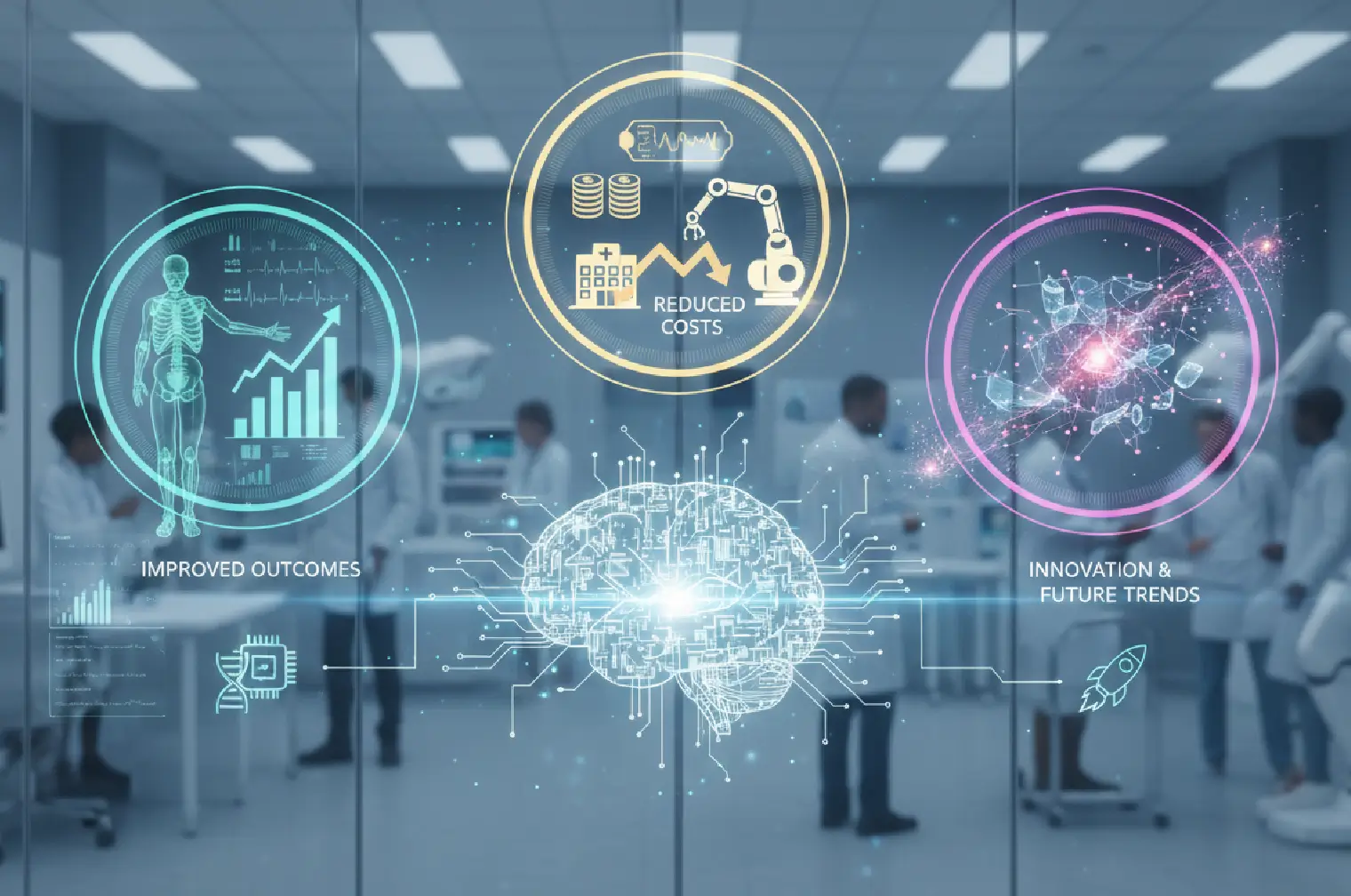
Healthcare facilities face increasing patient loads and administrative demands. Administrators in the USA, Europe, and APAC seek healthcare technology services to manage these requirements. Healthcare systems in the USA experience high administrative costs. European facilities address aging populations and staff shortages. APAC regions require scalable solutions to serve dense populations.
Traditional software systems fail to meet these demands. They operate in silos and require manual data transfer. AI integration in healthcare provides a direct method to reduce manual workloads. Medical institutions use AI integration services to connect predictive models with existing hospital networks.
This connection reduces data silos. It allows staff to access patient history quickly. Data flows directly between the laboratory, the pharmacy, and the billing department. This continuous data flow eliminates redundant data entry. It ensures all departments operate using the same information.
Benefits of Implementing AI in Medical Facilities
Hospitals implement AI integration in healthcare to improve diagnostic speed and accuracy. AI algorithms process medical images faster than manual review. This capability supports clinicians in making faster decisions. Early disease detection improves patient survival rates.
- Faster Image Processing: AI tools scan MRIs and CT scans to highlight anomalies. They detect structural patterns invisible to the human eye.
- Reduced Administrative Burden: AI automation services handle billing and scheduling. Staff members redirect their time to direct patient care.
- Improved Resource Allocation: Algorithms predict patient admission rates to optimize staff schedules. Hospitals avoid understaffing during peak admission hours.
- Cost Reduction: AI integration in healthcare lowers operational costs by preventing billing errors. The system audits claims before submission.
- Continuous Patient Monitoring: Wearable devices send real-time data to hospital servers. AI models analyze this data and alert staff to sudden vital sign changes.
Advance Care Delivery with AI Integration in Healthcare
Implement secure and scalable AI Integration Services with Custom AI Solutions designed for real clinical impact.
Primary Applications and Industry Use Cases
Specialists Adopt AI For Precision Diagnostics
Specialists require precise data for accurate treatment planning. A professional with an MDS in pediatric dentistry from AIIMS uses AI integration in healthcare to analyze pediatric panoramic X-rays. The AI highlights early signs of malocclusion or hidden caries. The dentist initiates preventive treatments based on these precise findings.
These AI applications in healthcare apply across various medical fields. Oncologists use AI to track tumor growth over multiple scans. The software calculates exact volume changes. Radiologists use AI to detect micro-fractures in emergency trauma cases. The algorithm prioritizes critical scans in the work queue. A 2024 study published by the National Institutes of Health indicates that clinical decision support systems reduce physician burnout by automating diagnostic code selection. The system provides immediate, evidence-based recommendations.
Natural Language Tools Streamline Electronic Medical Records
Doctors spend hours daily updating patient files. AI integration in EHR solves this problem. Natural language processing tools listen to doctor-patient conversations. These tools automatically transcribe notes into the medical record. They categorize symptoms, diagnoses, and treatment plans accurately.
AI integration in EHR also extracts relevant data from past visits. This process gives doctors a clear summary of the patient’s health history. Facilities deploy AI integration services to ensure these transcription tools meet strict privacy regulations. Proper AI integration in EHR prevents data leaks. It restricts data access based on staff roles. It ensures accurate medical coding for billing purposes. AI integration in EHR reduces the time doctors spend on manual data entry. Clinicians see more patients each day.
Software Bots Automate Hospital Administrative Workflows
Hospital administration involves extensive paperwork. AI automation services manage these repetitive tasks. Software bots handle insurance claims processing. They verify patient eligibility and flag errors before submission. This verification speeds up the reimbursement process. It reduces the number of rejected claims.
AI automation services also manage supply chain logistics. The system tracks inventory levels and orders medical supplies automatically. It prevents shortages of critical equipment like PPE and surgical tools. Hospitals rely on AI automation services to maintain efficient operations. The software schedules patient appointments and sends automated text reminders. This reduces patient no-show rates.
Traditional Methods vs. AI Automation Services
| Administrative Task | Traditional Manual Method | AI Automation Services |
| Claims Processing | Manual data entry and visual verification. | Automated coding and instant error flagging. |
| Patient Scheduling | Phone calls and manual calendar updates. | Intelligent booking systems and automated reminders. |
| Inventory Management | Physical counts and manual purchase orders. | Real-time tracking and automated restocking. |
| Document Extraction | Manual reading and data input. | Intelligent document processing extracts text instantly. |
Turn Innovation into Outcomes with AI Integration Services
Adopt AI Integration in Healthcare with Custom AI Solutions that optimize workflows, decisions, and patient experiences.
Security Protocols Protect Patient Health Information
Integrating AI requires strict adherence to security protocols. Healthcare organizations handle sensitive personal data. AI systems must comply with local and international privacy laws.
Engineers build secure environments for AI models to operate. They use end-to-end encryption to protect data in transit and at rest. Role-based access controls ensure only authorized personnel view specific patient records.
Regular security audits detect vulnerabilities in the network. Institutions run continuous tests to prevent data breaches. The architecture logs all user activity for compliance reporting. This detailed logging simplifies the auditing process.
Future Trends Shaping the Medical Sector
Generative Models Drive Predictive Analytics In Medicine
The medical sector continues to adopt new AI tools. Facilities must develop a clear digital transformation roadmap for healthcare to adopt these tools systematically. Predictive analytics will become standard in patient care.
These tools analyze historical data to predict disease outbreaks. They identify patients at high risk for chronic conditions. Generative AI models will create synthetic patient data. Researchers use this synthetic data to conduct clinical trials without compromising patient privacy.
A March 2025 report by McKinsey & Company states that 85% of healthcare leaders use or explore generative AI to improve administrative efficiency.
Cloud Architectures Enable Medical Data Interoperability
Legacy systems block efficient data transfer. Future upgrades will focus on cloud-native architectures. Medical institutions will use AI integration services to build interoperable systems. These systems allow different hospital departments to share data seamlessly.
For example, the emergency department accesses a patient’s primary care records instantly. AI integration in healthcare requires secure data pipelines. Engineers build these pipelines to connect medical devices directly to central databases. The Internet of Medical Things expands this network.
Smart beds and wearable heart monitors feed continuous data into the predictive models. This infrastructure supports remote patient monitoring and telemedicine platforms. Patients receive care from their homes while doctors monitor their progress in real-time.
Secure Implementation for Healthcare Facilities
Integrating AI requires precise engineering and regulatory compliance. ViitorCloud provides comprehensive AI integration services for the medical sector. We design and deploy AI automation services that align with your operational goals. Our engineers connect predictive models to your core systems securely.
We ensure your AI integration in EHR complies with all medical data regulations. ViitorCloud builds secure data pipelines and cloud-native architectures. We convert pilot AI programs into production-grade systems.
For example, our custom implementations process complex medical data with high accuracy, reducing clinical documentation time and optimizing hospital resource allocation. Contact ViitorCloud to discuss your infrastructure requirements and schedule a technical assessment.
Build Future-Ready Systems with AI Integration in Healthcare
Leverage AI Integration Services and Custom AI Solutions to modernize healthcare operations with confidence.
ViitorCloud Capabilities for Medical Infrastructure
Integrating artificial intelligence requires precise engineering and strict regulatory compliance. ViitorCloud provides comprehensive AI integration services for the medical sector.
We design and deploy AI automation services that align directly with hospital operational goals. Our engineers connect predictive models to core systems securely. Our past medical implementations process complex health data with high accuracy, demonstrating measurable reductions in clinical documentation time.
We ensure your AI integration in EHR complies completely with HIPAA and GDPR data regulations. ViitorCloud builds secure data pipelines and converts pilot AI programs into production-grade, enterprise-wide systems.
Contact ViitorCloud to discuss your infrastructure requirements and review our technical case studies.

Vishal Shukla
Vishal Shukla is Vice President of Technology at ViitorCloud Technologies.
Frequently Asked Questions
What is AI integration in healthcare?
AI integration in healthcare connects artificial intelligence models with medical systems to automate tasks and improve patient care.
How does AI integration in EHR help doctors?
What are the main AI integration services for hospitals?
Can AI automation services reduce healthcare costs?
What is the future of AI in healthcare?