


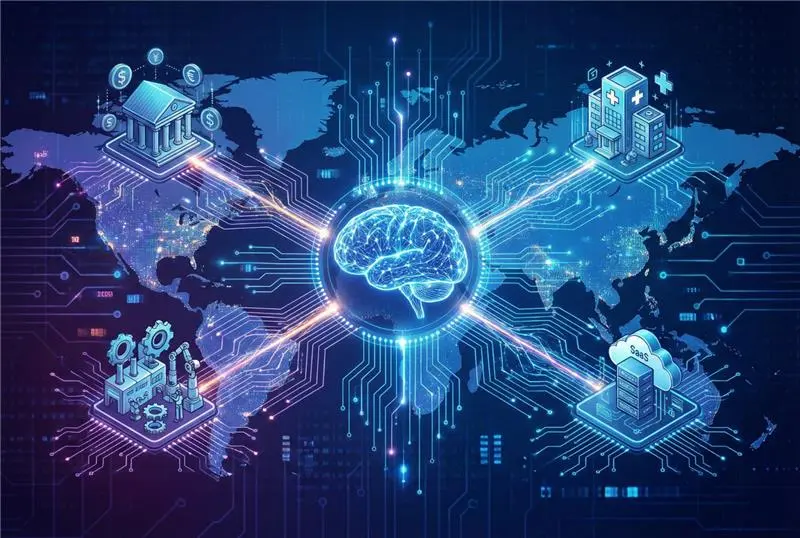
AI integration services help enterprises connect AI models and AI agents to real systems, real data, and real workflows so teams can run AI safely in production across regions and business units.
ViitorCloud’s AI integration services focus on integrating AI into existing systems to improve efficiency and decision-making through connected data and automation paths.
What AI integration services include
Enterprises usually buy AI integration services when AI value stays stuck in pilots, because the model never reaches the ERP, CRM, data lake, or operational tooling where work happens. At ViitorCloud, our experts seamlessly integrate AI into your systems so your organization can operationalize AI across workflows.
Our enterprise AI integration covers three integration surfaces that drive scope and risk.
- Application integration: APIs and event flows that connect AI to systems of record (core banking, claims, EHR, MES, CRM, ticketing).
- Data integration: ingestion, harmonization, data quality checks, and governance so models get consistent inputs.
- Workflow integration: human-in-the-loop reviews, approvals, exception handling, and audit trails so teams can trust outputs.
If you also need platform modernization to make AI feasible, ViitorCloud’s system integration and modernization offering describes work such as moving from monoliths to microservices, containers, or serverless as part of modernization programs.
For a service-led scope, place AI implementation services into clear deliverables: architecture, integration build, security controls, evaluation and testing, deployment automation, and ongoing monitoring.
When you plan enterprise AI integration, align AI implementation services to measurable workflow outcomes such as reduced handling time, improved routing accuracy, or fewer manual reconciliations.
Enterprise strategy for AI integration
Start enterprise AI integration with a short strategy cycle that ends in a buildable backlog. Our AI consulting and strategy perspective is built around avoiding common enterprise pitfalls and moving from intent to execution with clearer priorities and governance.
Define “integration-ready” use cases
Pick use cases where integration changes a workflow, not cases where AI only generates content.
- In SaaS, this often means embedding AI into product flows
- In BFSI, it often means underwriting, fraud, collections, or service ops
- In healthcare, it often means operations, coding, scheduling, and clinical documentation support
- In manufacturing, it often means quality, maintenance, and planning.
Build an integration runway
A practical strategy step is to standardize how teams connect systems before scaling AI across regions. Our enterprise integration strategies emphasize the value of starting with an “integration runway” (reference architecture, platform guardrails, and data governance) before workloads move.
Use a governance framework you can apply
For multi-region programs in the USA, Europe, and APAC, governance needs a shared language across legal, security, product, and engineering teams. NIST’s AI Risk Management Framework (AI RMF 1.0) defines core functions (GOVERN, MAP, MEASURE, MANAGE) that organizations can use to structure AI risk practices across the lifecycle.
When you package AI implementation services, map each workstream to an owner and an artifact. That keeps enterprise AI integration reviewable during audits and vendor governance.
Accelerate Growth with AI Integration Services for Enterprises
Implement secure and scalable AI Integration Services with tailored Custom AI Solutions that align with your enterprise strategy and budget.
Cost and commercial model (what changes the budget)
Enterprises usually ask for cost early because integration touches many teams and systems. In practice, AI integration services cost depends on the number of systems, the quality of data, the security bar, and the operating model you need after go-live.
Use this table to estimate effort drivers without forcing a single price number.
| Cost driver | What it means in enterprise AI integration | Typical signal you will see |
| Integration surface area | How many apps, APIs, queues, and data stores AI must read/write | Many system owners; multiple integration patterns (REST + events + ETL) |
| Data readiness | Data quality, lineage, and permissioning for training and inference | Data definitions vary by region; missing fields; inconsistent identifiers |
| Security and privacy | Controls for identity, secrets, logging, and data handling | Strict approval gates; regulated data; separation of duties |
| Model operations | Monitoring, drift detection, evaluation, and rollback paths | Multiple models; frequent releases; high uptime requirements |
| Compliance scope | Region and industry obligations | EU market exposure; healthcare data; BFSI controls; audit requirements |
| Change management | Human workflow changes and training | Data definitions vary by region, missing fields; inconsistent identifiers |
To keep cost controlled, structure AI implementation services into phases with decision gates. This approach keeps enterprise AI integration from expanding without clear outcomes.
Internal planning note for buyers: if you need foundational integration work, you can align AI integration services with system integration services so modernization and integration sequencing stay consistent. We describe our system integration services as unifying applications, data, and processes, paired with modernization to support cloud-native evolution.
Implementation plan and timeline (USA, Europe, APAC)
A practical enterprise AI integration plan should show what gets delivered each month and who signs off. We also emphasize establishing a security fabric early (identity, secrets, API security policies, and telemetry) and using incremental cutovers to reduce downtime risk.
Deploy AI Integration Services with Confidence
Transform operations using enterprise-grade AI Integration Services for Enterprises backed by robust Custom AI Solutions.
Delivery phases you can use
This timeline works for SaaS, BFSI, healthcare, and manufacturing, with changes based on data and compliance scope.
| Phase | Typical duration | Outputs (examples) |
| 1) Discovery and architecture | 2–4 weeks | Use-case shortlist, target-state architecture, integration inventory, risk register, KPI definitions |
| 2) Data and integration foundation | 4–8 weeks | Data contracts, pipelines, API/event patterns, access controls, test environments |
| 3) Model and workflow integration | 6–12 weeks | Deployed model endpoint(s), workflow hooks, human review steps, audit logging, evaluation harness |
| 4) Production hardening | 4–8 weeks | Observability, incident runbooks, rollback plan, performance tests, security sign-offs |
| 5) Scale to more workflows/regions | Ongoing | Reusable templates, shared governance, cost controls, model portfolio management |
Implementation checklist (what to prepare)
Use this checklist to keep AI implementation services moving without waiting on approvals late in the cycle.
- Confirm systems of record and system owners for each workflow that AI will touch.
- Define data access rules per region, including retention and logging requirements.
- Decide how humans will review and override AI outputs for high-impact steps.
- Set baseline metrics before go-live so you can measure improvement.
- Create an integration test plan that covers retries, partial failures, and idempotency.
Compliance timing for Europe
If you operate in Europe or sell to EU customers, plan compliance work early because it affects documentation, controls, and release processes. The European Commission’s AI Act policy page provides the staged approach for the EU’s AI regulatory framework and helps teams plan compliance readiness against applicability milestones.
For regulated industries, treat compliance as part of enterprise AI integration design, not a final review item. This keeps AI integration services aligned with controls from the first integration sprint.
Schedule a Call Now
If you want a scoped plan that fits your systems, target, and needs, you can book an AI integration consultation with our experts now at [email protected]. We bring over 14 years of experience and have completed hundreds of projects, which can help buyers who need an established delivery partner for enterprise AI integration across SaaS, BFSI, healthcare, and manufacturing.
Optimize Enterprise Systems with AI Integration Services
Streamline workflows and reduce implementation risks with AI Integration Services for Enterprises designed around your Custom AI Solutions roadmap.

Vishal Shukla
Vishal Shukla is Vice President of Technology at ViitorCloud Technologies.