


AI/ML development for domain-heavy enterprises has moved past the proof-of-concept stage. The real problem is making large language models reliable in specific professional domains.
A generic LLM can cite a legal case that does not exist. It can produce plausible but incorrect financial figures. It can misinterpret clinical terminology in a patient summary. These failures are consistent and predictable when you apply general-purpose models to specialized enterprise work.
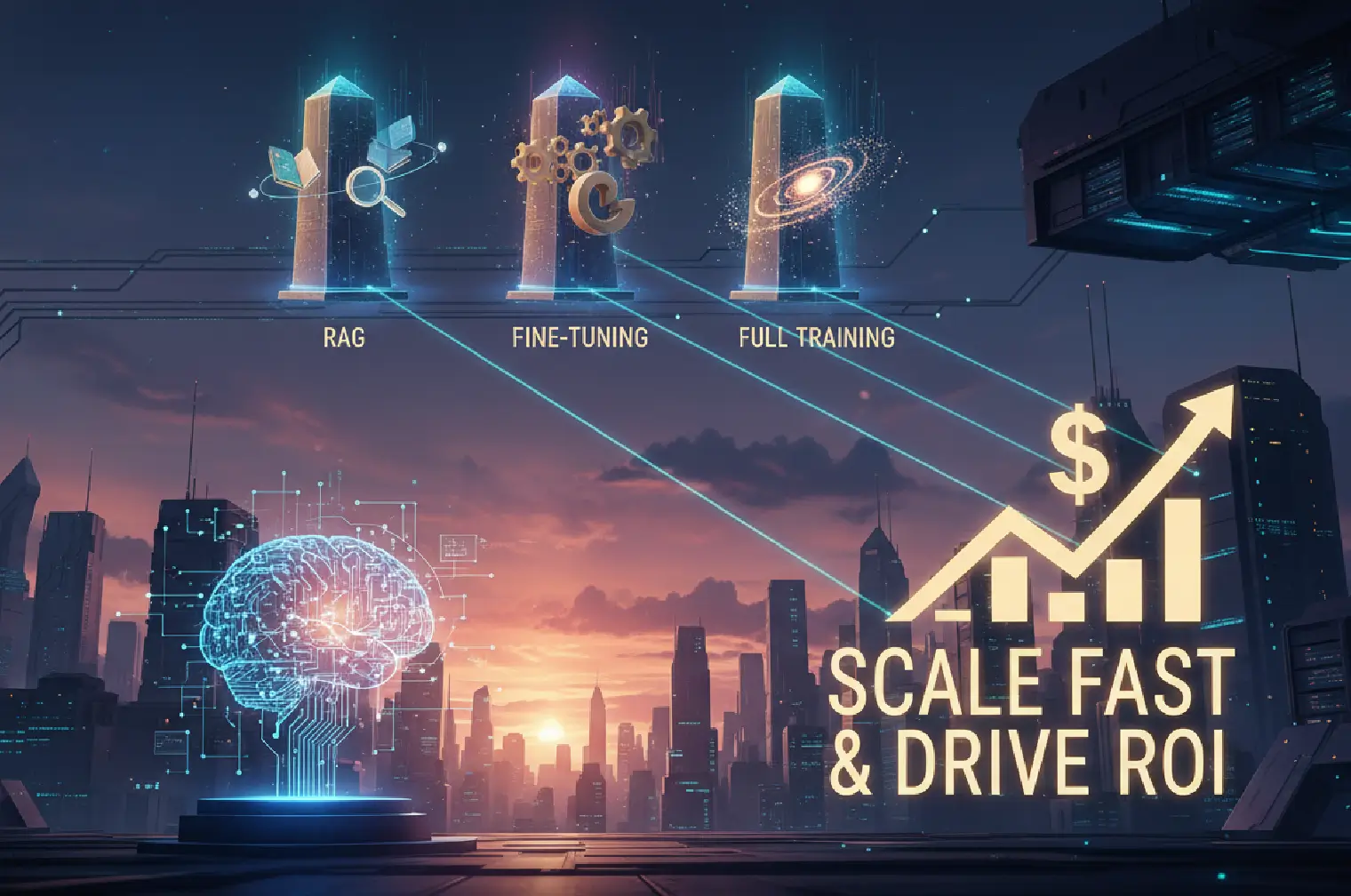
The decision that separates accurate vertical AI deployments from expensive failures is architecture. Should your team use RAG, fine-tuning, or full training? The right answer depends on your data, your compliance environment, and your operational goals.
Let us discuss a framework to make that decision correctly.
Generic LLMs Are Failing Enterprise Teams. Here Is Why.
Foundation models are trained on broad internet data. They handle general tasks well and domain-specific accuracy poorly.
The core reasons are straightforward:
- Domain terminology shifts meaning across industries. “Margin” means something different in finance, manufacturing, and healthcare.
- Proprietary documents, internal policies, and recent regulatory updates are absent from training data.
- Generic models have no mechanism to signal low confidence on specialized queries.
Research shows that domain-specific AI models reduce hallucinations by 20 to 50 percent compared to generic LLMs. In a regulated industry, that gap is not a performance footnote. It is a compliance and liability issue.
Read: AI/ML Development Roadmap: Scaling from PoC to Production
The $18.7 Billion Case for Vertical LLM Development
Vertical LLM development is among the fastest-growing segments in enterprise AI. The market was valued at $2.9 billion in 2025 and is projected to reach $18.7 billion by 2033, growing at a 26 percent CAGR.
This growth reflects a clear enterprise need. General models are not accurate enough for high-stakes domain work.
Three real-world examples show what domain-specific architecture achieves:
- BloombergGPT: Trained on decades of financial data, it delivers 30 percent higher accuracy on finance-specific NLP tasks than general models.
- Med-PaLM 2: Fine-tuned by Google on clinical guidelines, it matched physician-level accuracy on medical licensing exam questions.
- Hippocratic AI Polaris: A healthcare-focused model that reached 99.38 percent clinical accuracy in structured evaluation.
Each of these models was built with a different architecture decision. Understanding which decision fits your use case is the core of responsible AI/ML development.
Stop feeding your enterprise data into generic AI models
Off-the-shelf tools miss the mark and expose your data. We execute elite AI/ML development to solve your exact industry problems. Leverage precise RAG and fine-tuning to build a highly profitable domain-specific AI model. Start your vertical LLM development and launch a custom LLM for enterprise today.
Three Architecture Paths in AI/ML Development for Domain AI
RAG: Ground the Model in Your Current Knowledge
Retrieval-Augmented Generation pulls relevant documents from an external knowledge base at query time and feeds them to the model as context before generating a response.
RAG changes what the model can see, not how it behaves.
It works well when:
- Enterprise knowledge updates frequently (regulatory changes, client records, product documentation)
- Traceability and citation in outputs are required
- Retraining the model every time data changes is not feasible
In 2024, 51 percent of enterprise AI deployments used RAG in production, according to Menlo Ventures research. Anthropic’s contextual retrieval work demonstrated a 49 percent reduction in retrieval failures, and up to 67 percent with reranking. These numbers show why RAG is the fastest path from a general-purpose LLM to a grounded enterprise tool.
Fine-Tuning: Embed Domain Behavior into the Model
Fine-tuning continues training a foundation model on your labeled, domain-specific dataset. It updates the model’s parameters so it understands your terminology, follows your output format, and applies domain reasoning consistently.
Fine-tuning changes how the model behaves, not just what it can access.
Use it when:
- Output structure must be consistent (legal briefs, clinical notes, financial reports)
- Domain vocabulary and specialized jargon are central to task accuracy
- The model needs to perform reliably at inference time without external retrieval
Parameter-efficient methods like LoRA and QLoRA have reduced fine-tuning costs significantly. A task-specific fine-tuned model now costs between $500 and $5,000 to train and delivers 85 to 95 percent of the accuracy of a fully custom model. That makes fine-tuning a practical option for most enterprise AI/ML development budgets.
Check: AI/ML Development: Top Enterprise ROI Use Cases 2026
Full Training: Own the Foundation Entirely
Training an LLM from scratch means building model parameters from zero using proprietary data. You get full control over the architecture and full IP ownership.
The cost is substantial. Training at GPT-4 scale costs between $78 million and $100 million in compute alone. Smaller models in the 1 to 20 billion parameter range still cost between $50,000 and $6 million.
Full training applies in limited scenarios:
- Your domain data is entirely proprietary with no public analog
- Sovereign model control is a hard regulatory requirement
- Your organization has a long-term strategic goal around owning the model IP
For most enterprises in legal, finance, or healthcare, full training is not the right first step. It is a strategic endpoint, not a starting architecture.
The Architecture Mistake That Quietly Drains AI Budgets
The most common mistake in enterprise AI/ML development is treating RAG and fine-tuning as competing choices. They solve different problems.
| Factor | RAG | Fine-Tuning | Full Training |
| Data changes frequently | Best fit | Not ideal | Not ideal |
| Domain behavior consistency | Limited | Best fit | Best fit |
| Cost | Low to medium | Low to medium | Very high |
| Compliance and data sovereignty | Moderate | Strong | Full control |
| Time to production | Days to weeks | Days to weeks | Months |
IBM’s technical research on RAG versus fine-tuning frames the principle clearly: put volatile knowledge in retrieval and put stable behavior in fine-tuning. The 2026 production standard for high-accuracy vertical AI is a hybrid of both approaches.
Dominate your industry with AI built exclusively for your business
Generic AI hands your competitive edge directly to your rivals. Take control with expert AI/ML development that builds a secure LLM for enterprise. We drive aggressive vertical LLM development using proven RAG and fine-tuning. Deploy a high-performing domain-specific AI model and multiply your revenue instantly.
What Legal, Finance, and Healthcare Teams Need to Know About LLM for Enterprise
Legal
Generic models hallucinate case citations. Over 45 percent of AmLaw 200 firms are now exploring domain-tuned models for legal research. Fine-tuning on legal corpora reduces output errors and improves document structure. RAG handles real-time regulatory lookup. GDPR compliance for EU legal AI deployments must be built into the architecture from the start, not added after deployment.
Finance
Hallucinated financial figures create direct regulatory exposure under SEC and SOX frameworks. AI applications in finance, including fraud detection, compliance monitoring, and automated reporting, now require vertical LLM development to maintain accuracy at scale. Over 70 percent of major financial institutions use ML for risk management today, and that number continues to grow.
Healthcare
HIPAA means patient data often cannot leave the enterprise boundary. Fine-tuned models deployed on-premises or in a private cloud environment provide the strongest compliance posture. AI in healthcare demands clinical accuracy that generic models cannot consistently deliver. Vertical models trained on medical literature and institutional records are the practical path forward for health systems that operate under strict data governance rules.
Manufacturing
Generic LLMs cannot reliably interpret equipment sensor logs or OEM documentation. Fine-tuning on maintenance records and product specifications enables fault diagnosis and predictive maintenance at production scale, with outputs that domain engineers can act on directly.
How ViitorCloud Handles AI/ML Development for Regulated Industries
ViitorCloud has delivered custom AI solutions for clients including KPMG, Biocon, and Logix Health across healthcare, finance, logistics, and enterprise technology. The work spans intelligent document processing, AI integration for enterprise platforms, and machine learning model development aligned to HIPAA, GDPR, and SOC 2 compliance requirements.
Engagements begin with an architecture assessment that maps your domain data type, update cadence, and compliance constraints to the right technical approach before any model development starts. Whether the answer is RAG, fine-tuning, a hybrid pipeline, or a phased path toward a proprietary model, the decision is grounded in data, not defaults.
If your team is evaluating the right architecture for a domain-specific AI model, connect with ViitorCloud’s AI and ML team to begin with that assessment.
Turn your proprietary data into an unstoppable enterprise asset
Stop guessing which AI approach actually drives profit. We lead top-tier AI/ML development and handle your complex vertical LLM development seamlessly. Skip the costly trial and error with strategic RAG and fine-tuning. Deploy an accurate domain-specific AI model and launch the ultimate LLM for enterprise to crush your competition.
Conclusion
The right architecture for vertical LLM development comes down to three variables: how often your domain data changes, what level of behavioral consistency your use case requires, and what your compliance environment allows.
RAG grounds the model in current knowledge. Fine-tuning embeds domain behavior. Full training delivers full IP ownership when the use case demands it. In production systems today, most high-accuracy domain AI models combine RAG and fine-tuning to achieve both stability and currency.
Choosing the wrong architecture wastes budget, delays delivery, and produces inaccurate outputs. The decision framework in this article gives your AI/ML development team a clear starting point for the right call.

Vishal Shukla
Vishal Shukla is Vice President of Technology at ViitorCloud Technologies.
Frequently Asked Questions
What is the main difference between RAG and fine-tuning in enterprise AI?
RAG retrieves external knowledge at query time. Fine-tuning embeds domain behavior permanently into model parameters for consistent, reliable output.
When should an enterprise train an LLM from scratch?
How much does fine-tuning an LLM cost for enterprise use?
Which AI/ML development approach works best for HIPAA-compliant healthcare AI?