


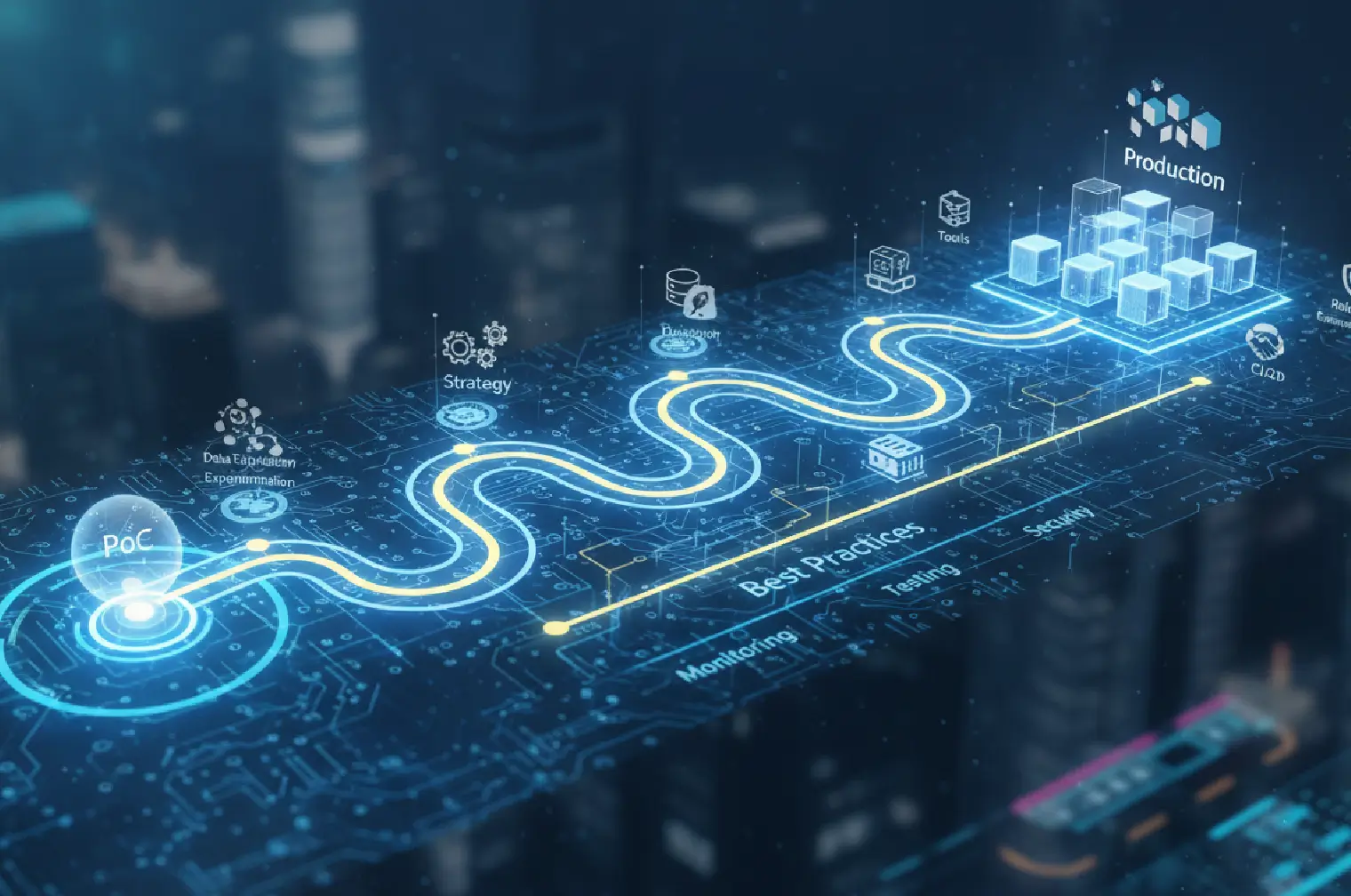
The transition from a proof of concept to a live application represents the most complex phase of AI/ML development. According to a 2025 McKinsey Global Survey, while 88% of organizations report using artificial intelligence in some capacity, only 7% have fully scaled these technologies across their enterprise. This statistical gap indicates a direct operational discrepancy between initial experimental implementation and full enterprise-wide deployment.
Moving a predictive model from an isolated testing environment to a high-volume production environment requires a strict, standardized operational framework. Technology leaders must implement formal machine learning development services to ensure their algorithmic models function reliably under real-world data loads and user demands.
Why Do Enterprise AI Projects Fail Before Reaching Production?
Many organizations build accurate models in isolated laboratory settings but fail to integrate them into their core business workflows. Industry data supports this observation. Gartner predicts that over 40% of agentic AI projects will face cancellation by 2027 due to escalating infrastructure costs, inadequate risk controls, and unclear business value. This high failure rate occurs primarily because product teams treat AI/ML development as a traditional software engineering task rather than a specialized data engineering operation.
Common systemic reasons for failure at scale include:
- Inconsistent data pipelines that feed outdated or inaccurate information into live algorithms.
- Misalignment between the technical model outputs and the required business workflow actions.
- The absence of a dedicated Machine Learning Operations (MLOps) infrastructure to manage updates.
- Insufficient distributed computing resources to process real-time inference requests.
- Lack of version control for the datasets used during the initial training phases.
To resolve these technical bottlenecks, product teams must partner with experienced providers of machine learning development services who understand enterprise-grade architecture and latency requirements.
Scale from PoC to Production with Expert AI/ML Development
Turn your proof of concept into real business impact with ViitorCloud’s AI/ML Development and AI Development Services designed for scalable production systems.
How Does the Data Foundation Impact AI/ML Development?
A production-ready model requires continuous, uninterrupted access to clean and structured data. Static datasets function adequately for a basic proof of concept. However, live applications require dynamic data ingestion systems.
The Role of Automated Data Pipelines
Data engineering serves as the strict prerequisite for successful AI development. Engineers must construct automated pipelines that extract, clean, and format incoming data before it reaches the predictive model. This specific process prevents data pollution and ensures the algorithm makes operational decisions based on accurate, standardized information. Establishing these pipelines requires extensive testing to confirm data integrity.
Integrating with Legacy IT Infrastructure
Older corporate IT infrastructure often isolates data in separate, unconnected silos. Engineering teams must modernize these legacy systems to allow continuous, real-time data flow. Implementing modernized AI in Information Technology operations automates routine backend processes and reduces human interference during data preparation phases. This modernization step is a mandatory component of professional machine learning development services.
Version Control for Data and Models
Software engineers use version control for code. Machine learning engineers must use version control for both the training data and the algorithmic models. Tracking changes in the dataset allows engineers to reproduce past results and audit the system for compliance purposes.
What Are the Core Phases of Machine Learning Development Services?
Scaling an artificial intelligence project requires a linear, highly structured execution approach. The table below outlines the specific technical stages required to move a project from a basic concept to a fully operational system using standard AI/ML development practices.
| Development Phase | Primary Objective | Technical Requirements |
| Proof of Concept | Validate mathematical and technical feasibility. | Static datasets, isolated local compute environment, baseline accuracy metrics. |
| Data Engineering | Build continuous, automated data pipelines. | Cloud storage buckets, automated ETL (Extract, Transform, Load) processes. |
| Model Training | Optimize the algorithm for specific business metrics. | Distributed cloud computing hardware, automated hyperparameter tuning. |
| Productionization | Deploy the validated model to live user servers. | Containerization (Docker), orchestration (Kubernetes), API gateways. |
| Continuous Monitoring | Prevent algorithmic degradation over time. | MLOps dashboards, automated retraining loops, latency tracking. |
How Do Organizations Deploy Models into Live Environments?
Deployment represents the physical engineering process of integrating the machine learning model into the end-user application. This step requires a definitive transition from experimental data science tools to production-grade software architecture.
Engineers package the finished model using containerization tools such as Docker. This packaging process ensures the model runs identically on a developer’s local machine and on the live production server. The containers are subsequently managed by orchestration platforms like Kubernetes. Kubernetes automatically scales the active computing resources based on fluctuating user demand and server loads.
Effective AI development also requires building secure, low-latency APIs (Application Programming Interfaces). These APIs allow the front-end software application to send raw data to the model and receive calculated predictions in milliseconds. Organizations executing high-ROI AI/ML development enterprise use cases prioritize this specific API architecture. It allows them to process millions of data points daily without system failure or software crashes.
Launch Production-Ready Custom AI Solutions
Move beyond experiments and deploy scalable Custom AI Developments with an experienced AI Development Company that builds enterprise-ready AI systems.
What Post-Deployment Monitoring Strategies Maintain AI Performance?
A deployed model requires continuous observation. Machine learning models degrade mathematically over time as real-world data patterns change. This phenomenon, known as model drift, actively reduces the predictive accuracy of the live system.
Maintaining baseline accuracy requires continuous monitoring protocols. Operations teams must mathematically track both the input data distribution and the final prediction outputs. If the system’s accuracy drops below a predefined numerical threshold, the architecture must trigger an automated retraining pipeline using fresh data.
Leading machine learning development services utilize comprehensive MLOps frameworks to automate this entire lifecycle. MLOps combines machine learning, traditional software engineering, and data engineering into a single discipline. This ensures the model remains reliable months and years after the initial deployment date. This constant, measured iteration remains the defining characteristic of mature AI development.
How Can Real-World Data Validate AI/ML Development Solutions?
Theoretical frameworks require real-world validation to prove their commercial viability. Organizations need measurable numerical outcomes to justify the financial investment required for transitioning from a pilot program to enterprise deployment. Proper execution directly and measurably impacts operational efficiency and resource allocation.
Applying rigorous standards generates exact results. For example, implementing robust custom AI solutions for enterprise document ingestion demonstrates clear operational shifts. In manual corporate environments, employees process standard documents in 15 to 20 minutes with error rates reaching up to 7%. By deploying a fully productionized machine learning architecture, ViitorCloud automated this specific workflow.
The system can reduce the processing time to 2 to 3 seconds per document while simultaneously dropping the error rate below 0.5%. This specific data point illustrates the exact technical impact of applying standardized AI/ML development protocols to active production environments.
Accelerate Growth with Advanced AI Development Services
Partner with a trusted AI Development Company to scale your PoC into production using robust AI/ML Development and tailored Custom AI Solutions.
What Are the Final Steps in the AI Development Roadmap?
The journey from a localized proof of concept to a globally available production system requires strict adherence to engineering principles. Organizations must prioritize data pipeline stability, scalable deployment architecture, and continuous MLOps monitoring systems.
By treating artificial intelligence as a core software engineering discipline rather than a standalone experiment, technology leaders successfully cross the scaling gap. Engaging professional machine learning development services ensures the final software product delivers consistent, measurable value to the business operations.
The functional success of AI/ML development depends entirely on this disciplined, step-by-step execution. Executing correct AI development procedures transforms static algorithmic models into active, integrated enterprise assets.

Vishal Shukla
Vishal Shukla is Vice President of Technology at ViitorCloud Technologies.
Frequently Asked Questions
What is MLOps in AI systems?
<!-- wp:heading {"level":3} --> MLOps represents engineering practices that automate the continuous deployment and maintenance of machine learning models. <!-- /wp:paragraph -->
Why do AI proof of concepts fail?
What causes model drift in production?
How does containerization help AI deployment?
What is the role of data engineering?