


Today, small and medium-sized businesses (SMBs) in the US and UK have shifted from “digital exploration” to “digital dominance.”
For organizations in healthcare, logistics, finance, and IT, the cloud is now the foundation of survival.
However, a critical question remains for decision-makers: should you simply move your existing workloads, or should you transform them entirely?
The debate of cloud modernization vs migration has evolved. In 2026, with the rise of Agentic AI and hyper-automated supply chains, the choice you make today will determine your operational elasticity for the next decade.
While many companies initially sought out cloud migration services to escape the high maintenance of on-premise servers, they are now realizing that a “lift and shift” approach might not be enough to leverage modern AI capabilities.
This is where cloud modernization services come into play, offering a path to true digital agility.
Migration vs. Modernization 101
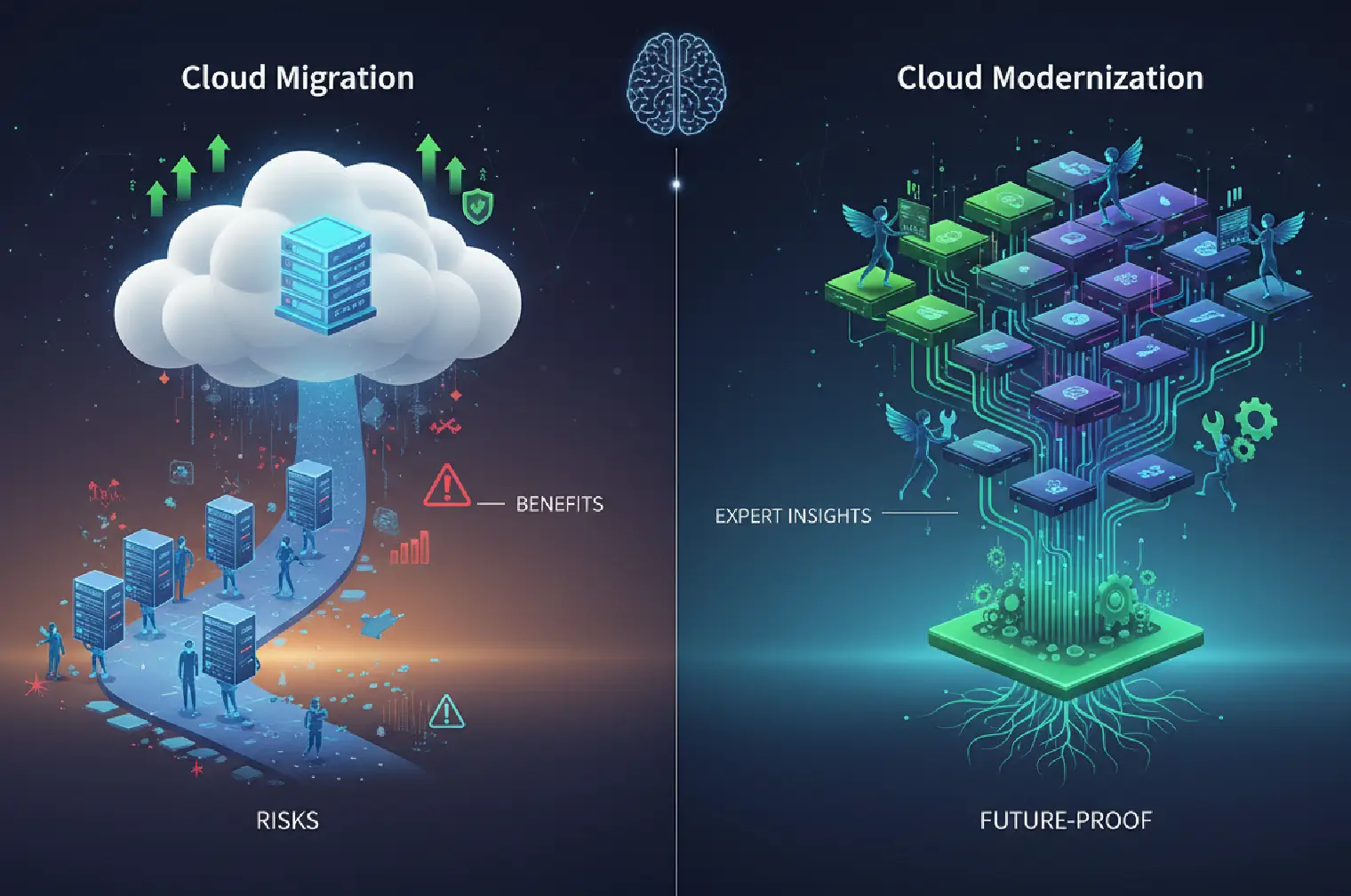
Before choosing a path, it is essential to understand the fundamental differences. Cloud migration is primarily about the “where,” moving data and applications from local servers to a cloud provider like AWS, Azure, or Google Cloud.
Conversely, modernization is about the “how,” changing the architecture of the application to take full advantage of cloud-native features.
When evaluating cloud modernization vs migration, think of migration as moving your office to a new building, while modernization is redesigning the entire workflow of your office to be automated and paperless.
Many SMBs start with cloud migration services to achieve immediate cost savings, but eventually require legacy system modernization to stay competitive in a market that demands real-time data processing.
ViitorCloud helps businesses navigate this transition through our comprehensive cloud computing services, ensuring that the infrastructure aligns with long-term business goals rather than just immediate IT needs.
Plan the Right Cloud Migration Strategy for 2026
Assess your applications, risks, and ROI with ViitorCloud’s expert-led Cloud Migration approach.
Why 2026 is the Year of Modernization for SMBs
By 2026, the maturity of cloud-native technologies will have made modernization more accessible for SMBs. In previous years, only enterprises could afford to re-architect their systems.
Today, the democratization of microservices and serverless computing means that legacy system modernization is within reach for mid-market players in logistics and healthcare.
According to research by Gartner, more than 85% of organizations will embrace a cloud-first principle by 2025, and by 2026, the focus will have shifted entirely toward cloud-native platforms that provide higher scalability.
For an SMB, choosing cloud modernization vs migration is a strategic decision. If your goal is to integrate AI-driven diagnostics in healthcare or real-time route optimization in logistics, a simple migration won’t suffice. You need the modularity provided by cloud modernization services.
Comparison: Cloud Migration vs. Cloud Modernization
| Feature | Cloud Migration (Rehosting) | Cloud Modernization (Refactoring) |
| Speed to Cloud | Very Fast | Moderate to Slow |
| Upfront Cost | Lower | Higher |
| Long-term ROI | Moderate | Very High |
| Scalability | Limited by original architecture | Virtually Unlimited |
| AI Readiness | Low | High |
| Operational Effort | High (Manual patching) | Low (Automated/Serverless) |
The Industry-Specific Impact
1. Healthcare: Security and Interoperability
In the US and UK, healthcare providers are under immense pressure to provide seamless patient experiences while maintaining HIPAA and GDPR compliance. Cloud migration services can help move patient records to a secure cloud environment, but legacy system modernization allows these systems to communicate with wearable devices and AI diagnostic tools. Modernizing your healthcare suite ensures that data is not just stored, but is “active” and accessible.
2. Logistics: Real-time Agility
Logistics firms in 2026 deal with massive volatility in global trade. A standard migration might move your tracking software to the cloud, but it won’t help you process millions of IoT sensor inputs per second. By utilizing cloud modernization services, logistics companies can adopt event-driven architectures that respond to delays or fuel price changes instantly.
3. Finance: Compliance and FinOps
For finance SMBs, the transition involves moving away from monolithic banking cores. Legacy system modernization is critical here to meet the stringent requirements of PCI DSS 4.0. When comparing cloud modernization vs migration, finance leaders often find that modernization allows for better “FinOps”—the ability to track and optimize cloud spend at a granular level.
You can learn more about these shifts in our blog on Legacy Modernization to Cloud-Native Architecture.
Modernize Your Cloud for Agility and Scale
Upgrade legacy systems with Cloud Modernization to improve performance, security, and scalability.
When to Choose Cloud Migration Services
Despite the benefits of modernization, cloud migration services remain a vital tool for many SMBs.
Migration is the ideal choice when:
- Data Center Leases are Expiring: If you need to exit a physical facility within weeks, a “lift and shift” migration is the only viable path.
- Budget Constraints: If immediate capital is limited, migrating allows you to shift from CapEx to OpEx without the heavy engineering costs of a rebuild.
- Low-Complexity Apps: Not every application needs to be modernized. Internal tools that perform basic tasks are perfect candidates for simple migration.
However, even after a successful migration, the technical debt of a legacy system remains. This is why many of our clients at ViitorCloud eventually transition from rehosting to legacy application modernization to unlock the full performance potential of the cloud.
When to Invest in Cloud Modernization Services
Investment in cloud modernization services is no longer optional for businesses aiming for high-value growth in 2026.
You should choose modernization if:
- Your Software is Slowing Down Innovation: If it takes months to deploy a new feature because the code is “spaghetti,” you need legacy system modernization.
- Competitive Pressure: If your competitors are using AI agents to handle customer service or supply chain forecasting, you cannot compete using a migrated legacy app.
- Scalability Issues: If your application crashes every time traffic spikes, the monolithic architecture is the bottleneck.
The debate of cloud modernization vs migration often resolves itself when companies look at their 3-year growth targets. Modernization builds a “future-proof” foundation that supports the latest innovations in AI and Data Analytics.
Choose Between Cloud Migration and Cloud Modernization
Get clear guidance on what fits your business goals with ViitorCloud’s Digital Transformation expertise.
The Strategic Roadmap for 2026
For SMBs in the UK and the US, the roadmap to the cloud should be a hybrid approach. It is rarely an “all or nothing” scenario.
A well-researched strategy often involves:
- Assessment: Identifying which workloads are business-critical and which are supporting.
- Migration: Moving non-critical or stable legacy apps using cloud migration services to reduce immediate overhead.
- Modernization: Prioritizing customer-facing or data-heavy applications for cloud modernization services.
Deloitte’s analysis on digital transformation highlights that companies that prioritize modernizing their core systems see a significantly higher return on investment compared to those that only focus on incremental infrastructure shifts. This supports the argument that legacy system modernization is the primary driver of value in the current economic climate.
Total Cost of Ownership (TCO) in 2026
When SMBs evaluate cloud modernization vs migration, they often focus on the initial price tag. However, the Total Cost of Ownership (TCO) tells a different story. A migrated application requires constant patching, manual scaling, and higher consumption of cloud resources because it wasn’t “built” for the cloud.
By contrast, legacy system modernization utilizes serverless and containerized environments. This means you only pay for the exact milliseconds of computing power you use. Over a 5-year period, the cost of cloud modernization services is often lower than the cumulative cost of maintaining a poorly optimized migrated system.
Unify Systems with Modern Cloud Architecture
Eliminate silos and streamline operations using our System Integration and Modernization Services.
Conclusion: Making the “Cloud-Right” Choice
As we look toward the remainder of 2026, the distinction between cloud modernization vs migration will become even more pronounced. For SMBs in logistics, healthcare, and finance, the cloud is the engine of innovation.
If your priority is speed and immediate cost relief, cloud migration services will get you to the starting line. However, if your goal is to lead your industry, reduce technical debt, and harness the power of AI, then cloud modernization services and a commitment to legacy system modernization are your only paths forward.
At ViitorCloud, we specialize in helping SMBs make this transition seamlessly. Whether you are looking to move your first workload or re-architect a complex legacy environment, our team is here to ensure your cloud journey delivers high-value outcomes.
Don’t let your legacy systems hold back your future growth; choose the “cloud-right” strategy today.

Vishal Shukla
Vishal Shukla is Vice President of Technology at ViitorCloud Technologies.