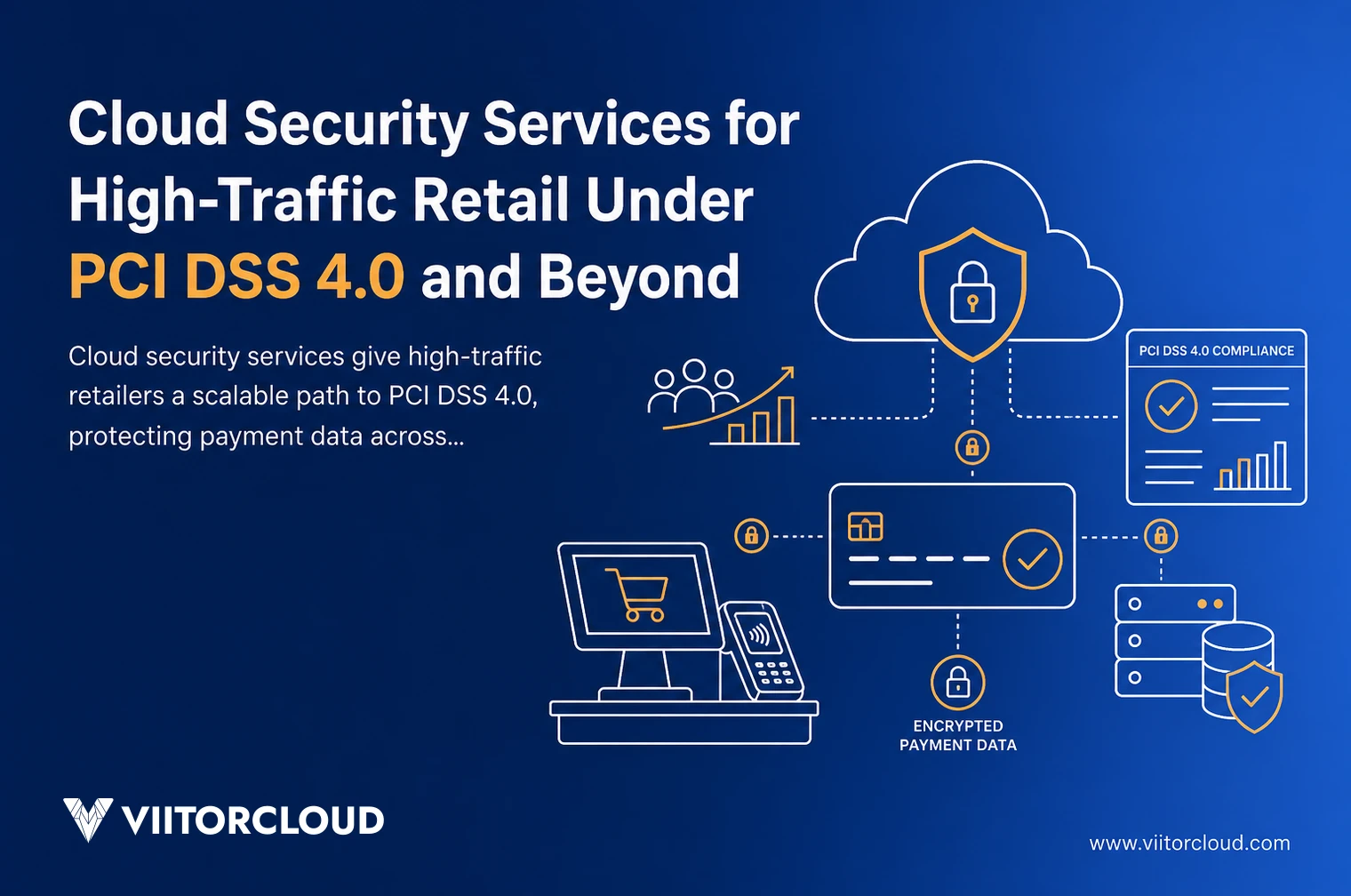
Cloud security services give high-traffic retailers the most reliable path to PCI DSS compliance under version 4.0. One engagement combines hardened infrastructure, continuous monitoring, and the security expertise most teams cannot hire fast enough. The deadlines that made version 4.0 feel optional are gone, and every new sales channel widens the surface an assessor will examine.
I have spent years securing commerce platforms that take millions of dollars in payments during peak-sale weekends. The pattern repeats across retail engagements. Channels multiply faster than controls, and payment data quietly spreads across a cloud estate that was scoped for a smaller business.
This guide covers the hardening checklist I use for cloud and infrastructure security under PCI DSS 4.0, plus the criteria I recommend when you evaluate cloud security services.
Key Takeaways
- PCI DSS 4.0 is fully enforceable, and the final future-dated requirements became mandatory on March 31, 2025.
- Shrinking the cardholder data environment through segmentation and tokenization cuts breach risk and audit effort at the same time.
- Payment page script inventory and tamper detection are the controls retail teams miss most often.
- Security must scale with traffic. A commerce platform ViitorCloud engineered held its payment pipeline through $7.1M in sales inside 72 hours.
- Judge cloud security services on peak-traffic references, named compliance coverage, and automation rather than tool lists.
Why PCI DSS 4.0 Changes the Math for Retail Security Teams
The PCI Security Standards Council retired version 3.2.1 on March 31, 2024, and the last group of future-dated version 4.0 requirements became mandatory on March 31, 2025. The transition period is over. Assessors now expect the new controls to be running, documented, and generating evidence.
Several changes hit retail cybersecurity programs harder than most industries.
- MFA everywhere. Multi-factor authentication now applies to all access into the cardholder data environment, and passwords must be at least 12 characters.
- Payment page script control. Requirements 6.4.3 and 11.6.1 demand script inventories, integrity checks, and tamper detection on payment pages.
- Continuous evidence. Automated log review, authenticated internal vulnerability scans, and annual scope confirmation replace once-a-year preparation.
- Targeted risk analyses. Teams must document how often periodic controls run and defend that frequency with written analysis.
Version 4.0.1 has already refined the wording, and further updates will follow the same pattern. PCI DSS compliance is now a continuous operating state rather than an annual project, and that is the real cost shift for retail security teams.
Harden Your Retail Cloud Before Peak Season
Get a scoped assessment of your cloud and infrastructure security against PCI DSS 4.0, mapped to the channels where payment data actually flows.
Where Payment Data Spreads Across a Modern Retail Cloud
Most retail teams I assess cannot name every system that touches payment or customer data. The storefront, mobile app, in-store point-of-sale systems, marketplace integrations, and AI personalization engines all copy or reference transaction records. That sprawl is the core retail cybersecurity problem, because GDPR and CCPA extend protection duties to the customer data sitting beside the card data.
A common scenario makes the risk concrete. A data team exports transaction files to a storage bucket for a one-off campaign analysis; the campaign ends, and the bucket stays. It never appears in the PCI scope document, and that single forgotten export can pull an entire cloud estate back into scope.
Payment data protection starts with an honest data-flow map across every channel. That is why discovery is the first deliverable in the retail technology solutions work we run. Effective cloud security depends on that map, because infrastructure security controls only protect systems you know exist.
The Cloud and Infrastructure Security Hardening Checklist I Use for Retail
This is the sequence I follow when hardening a retail cloud estate for PCI DSS compliance, whether the work is done in-house or through cloud security services. Each step reduces scope, risk, or manual effort before the next begins.
- Segment and shrink the cardholder data environment. Isolate payment systems on their own network segments, confirm scope every 12 months, and remove card data from systems that do not need it.
- Tokenize and encrypt payment data end to end. Use tokenization to keep primary account numbers out of applications, enforce TLS 1.2 or higher in transit, and apply keyed hashing to any stored card numbers.
- Enforce identity controls that match version 4.0. Apply MFA to every route into the cardholder data environment and review access rights at least every six months.
- Lock down payment page scripts. Maintain an authorized script inventory, verify integrity, and deploy tamper detection that alerts on unauthorized changes.
- Automate logging, scanning, and response. Automated log review, authenticated internal scans, and quarterly external scans keep evidence flowing without consuming analyst hours.
- Run targeted risk analyses and keep evidence current. Document control frequencies, store assessor-ready evidence centrally, and treat every architecture change as a scope question.
Infrastructure security at this level is unglamorous, and it is what separates retailers that pass assessments quietly from those that scramble every year. I covered the trust side of this work in our perspective on building digital trust through cloud security.
Talk to a Cloud Security Architect
Review segmentation, encryption, and monitoring gaps with engineers who kept a commerce platform stable through $7.1M in Black Friday sales inside 72 hours.
How to Keep Security Controls Standing at Black Friday Scale
Peak events are where retail cybersecurity gets tested. Traffic multiplies, fraud attempts spike while attention is on uptime, and someone always proposes loosening a firewall rule because latency is climbing. If a control gets disabled under load, it was never a real control.
ViitorCloud engineered the commerce platform behind MariDeal, a travel deals business that processed 56,943 orders in 2024. Its Black Friday peak generated $7.1M in revenue inside 72 hours. The payment pipeline held because scaling rules and security rules were designed together from the first sprint.
Four practices keep controls standing at that volume.
- Scale web application firewall capacity, rate limits, and bot defenses with the same automation that scales your application tier, so infrastructure security grows with demand.
- Load test with security controls switched on, so peak performance numbers reflect production reality.
- Isolate payment services so catalog and search traffic never widens the cardholder data environment, an approach I detailed in microservices architecture for retail.
- Baseline fraud and anomaly monitoring before the event, because a breach discovered during peak is handled at the worst possible time.
The stakes justify the discipline. IBM’s Cost of a Data Breach Report put the global average breach cost at $4.44M in 2025, before counting the customer trust a retailer loses with it.
What to Look for in Cloud Security Services Before You Sign
Security hiring stays slow and expensive, which is why most teams evaluate cloud security services instead of building every retail cybersecurity capability in-house. The evaluation matters more than the decision to buy. I recommend five criteria.
- Peak-traffic references. Ask for evidence that the provider has kept controls running through real high-volume sales events, with numbers attached.
- Named compliance coverage. Deliverables should map to PCI DSS compliance requirements, GDPR, and CCPA rather than promising generic hardening.
- Automation first. Evidence collection, log review, and vulnerability management should run inside your existing DevOps and cloud automation pipeline rather than a parallel toolchain your team must maintain.
- Shared-responsibility clarity. Your cloud provider secures the infrastructure layer. Cloud security services must state in writing which configurations, identities, and payment data protection duties they cover.
- Post-deployment support. PCI DSS 4.0 rewards continuous operation, so a partner that exits after go-live leaves your team holding the evidence burden alone.
Automate Compliance Evidence in Your Pipeline
Move log review, scanning, and assessor-ready reporting into your existing DevOps workflow with ViitorCloud’s cloud consulting team.
Where ViitorCloud Fits in Your Retail Security Roadmap
I work at ViitorCloud, where we have engineered and secured commerce platforms for over a decade. MariDeal has generated $46.4M in revenue on infrastructure we built, and Bluefinch has handled 1M+ visits and 20,000+ orders. Our enterprise client list includes KPMG, DP World, and the Royal Navy, and our delivery practice is GDPR and HIPAA-aligned, so regulated data handling is routine for our engineers.
If PCI DSS 4.0 has exposed gaps in your estate, our cloud consulting team scopes cloud security services around an assessment of your payment data flows before any build begins. You get an assessor-ready picture of your environment in weeks, plus a phased hardening plan sized to your traffic.
The Bottom Line for Retail Security Leaders
PCI DSS 4.0 turned payment security into a continuous discipline. The retailers handling it well shrink their cardholder data environment, control their payment page scripts, and scale security with traffic instead of around it.
Start with a data-flow map, work through the hardening checklist above, and hold any provider of cloud security services to the five criteria before you sign. Retail cybersecurity gets easier when infrastructure security, compliance evidence, and peak-scale engineering are designed as one system. Payment data protection is the outcome, and the standard is only the minimum.

Vishal Shukla
Vishal Shukla is Vice President of Technology at ViitorCloud Technologies.
Frequently Asked Questions
What is PCI DSS 4.0?
PCI DSS 4.0 is the current payment card security standard, mandating stronger authentication, payment page script control, and continuous evidence.
Do cloud providers handle PCI DSS compliance for retailers?
What do cloud security services include for retail?
How often should retailers confirm PCI DSS scope?