


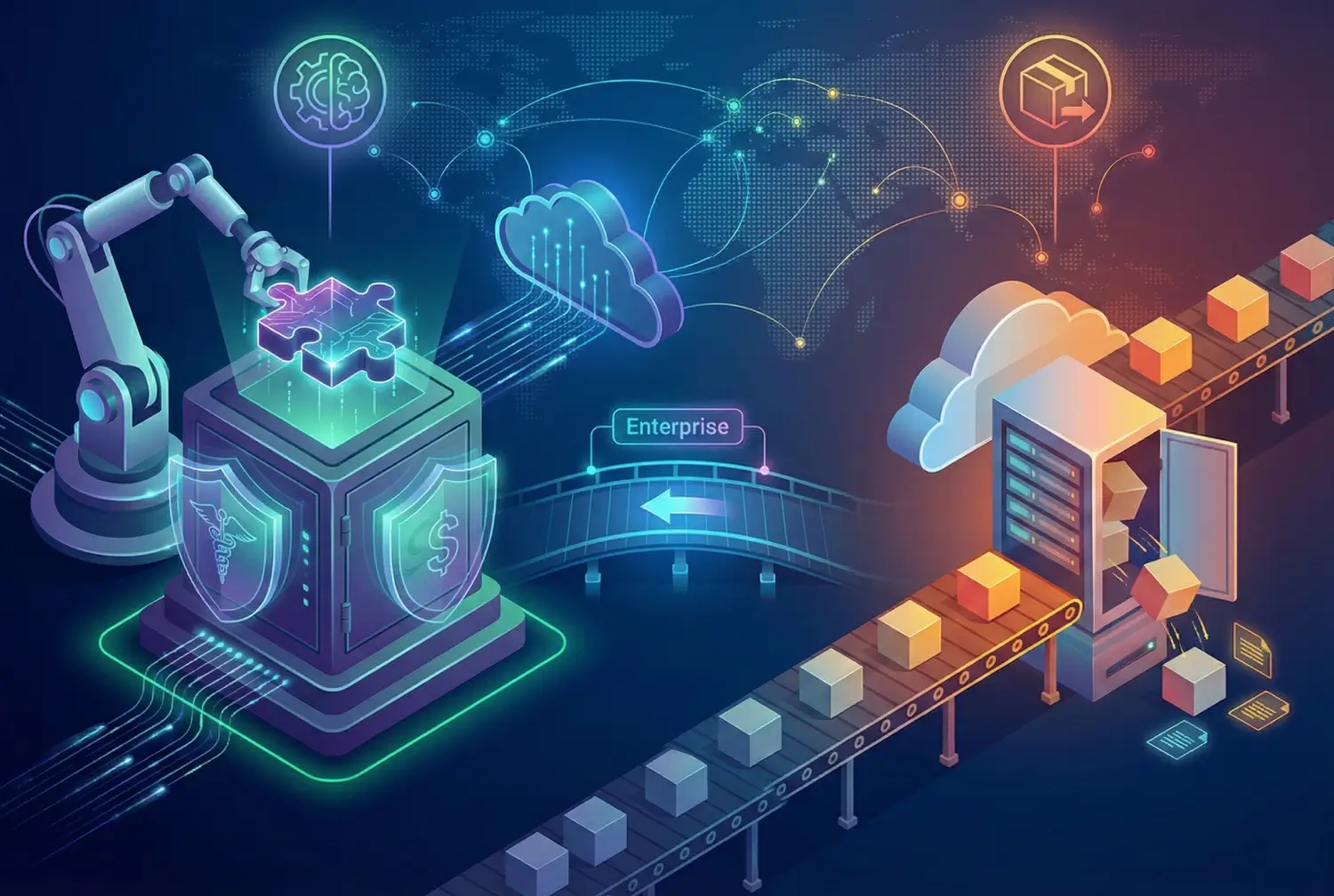
Enterprises face a clear choice when upgrading their technology infrastructure. They can purchase pre-packaged software, or they can invest in custom AI solutions. The banking, financial services, and insurance (BFSI) sector, along with the healthcare industry, require highly specific tools.
Off-the-shelf software provides immediate access to basic functions. It works well for simple data entry or standard customer service chatbots. Many leaders initially look for standard AI automation services to handle basic tasks.
However, generic tools fail to handle proprietary data sets, complex security requirements, and strict regional regulations across the USA, Europe, and the APAC region. The penalties for non-compliance in these regions are severe, ranging from heavy financial fines to complete operational shutdowns.
BFSI and healthcare operations deal with sensitive personal information daily. They cannot risk data leaks or inaccurate algorithmic outputs that could compromise patient health or financial stability.
Let’s discuss why enterprise decision-makers must evaluate their artificial intelligence investments based on data sovereignty, long-term scalability, and strict regulatory compliance.
The Shift to Proprietary Intelligence: How Banks and Hospitals Buy Software
Large organizations require absolute control over their operational data. Healthcare providers must secure patient records. Financial institutions must process millions of transactions daily without exposing client information to third-party vendors. This operational reality makes custom AI development a necessity rather than a preference.
When a hospital deploys generic automation, the software processes data on external servers. This creates severe vulnerabilities regarding HIPAA compliance in the USA. Medical professionals cannot input Protected Health Information (PHI) into public machine learning models.
A dedicated AI development agency builds the infrastructure directly within the enterprise’s private cloud or on-premise servers. This architecture ensures the data remains under the organization’s control. The enterprise dictates the data flow, the access permissions, and the security protocols.
Choose Custom AI Solutions That Fit Your Enterprise
Solve complex business challenges with tailored AI built around your workflows, data, and growth goals.
Generic Automation Reaches Its Limit in Regulated Markets
Pre-packaged AI tools operate on generalized models. Developers train these models on broad internet data to serve the largest possible user base. Therefore, they lack the specific vocabulary required for complex medical coding, diagnostic imaging, or intricate financial derivatives.
Enterprises deploying off-the-shelf tools often alter their internal workflows to match the software limitations. Implementing custom AI automation services ensures that the technology aligns with the exact operational guidelines of the business instead of forcing the business to adapt to the software.
Custom AI solutions adapt to the enterprise. A bank uses custom AI development to train models specifically on its historical transaction data. This targeted training reduces false positives in fraud detection and accelerates loan processing times. According to the NIST AI Risk Management Framework, organizations must understand and control their AI models to mitigate operational risks effectively.
Generic models act as black boxes. They do not offer the transparency required for enterprise-grade risk management or external audits. When an algorithm makes a decision regarding a loan approval or a medical diagnosis, the enterprise must possess the ability to explain exactly how the model reached that conclusion. Off-the-shelf software rarely provides this level of detailed auditability.
Securing the BFSI Sector Against Advanced Fraud
In the BFSI sector, rigid rules-based software flags legitimate transactions and causes customer frustration. A custom model learns the specific spending behaviors of the bank’s customer base. It detects anomalies in real-time. This precision requires custom AI development tailored to the exact data architecture of the financial institution. By deploying targeted AI automation services, financial firms reduce their reliance on manual data entry and increase overall processing accuracy.
Maintaining Patient Privacy in Modern Healthcare
Healthcare organizations use custom algorithms to predict patient readmission rates based on local demographic data and historical hospital records. Generic software cannot account for regional health trends. Custom models provide diagnostic support by analyzing MRI and CT scans using the specific clinical protocols of the hospital network.
Data Sovereignty Dictates the Technology Infrastructure
Data residency laws dictate exactly where companies can store and process information. Global enterprises cannot use software that routes data through non-compliant geographic regions.
- Europe: The EU AI Act imposes strict governance on high-risk AI applications. Software used in healthcare and finance falls under this high-risk category, requiring mandatory human oversight and detailed technical documentation.
- USA: Sector-specific regulations demand localized data storage, end-to-end encryption, and strict audit trails for all automated decisions.
- APAC: Highly fragmented privacy laws require adaptable systems. A system compliant in Singapore may violate data handling laws in Australia.
An experienced AI development agency engineers compliance directly into the data pipeline. The agency builds role-based access controls and automatic data redaction features. This prevents regulatory fines and secures the enterprise against catastrophic data breaches.
The Financial Math: Upfront Investment Against Recurring Fees
Many executives choose generic tools due to low initial deployment costs. This approach creates high long-term expenses. SaaS vendors charge recurring licensing fees based on the number of users, the volume of API calls, or the amount of data processed. As the enterprise scales its operations, the cost of the generic software increases exponentially.
Investing in custom AI development requires a higher upfront capital allocation. The enterprise must pay for data engineering, model training, and system integration. However, the enterprise owns the final product and the underlying intellectual property. There are no recurring user licensing fees. The organization scales its operations, adds new employees, and processes more data without paying penalties for growth. Furthermore, the enterprise dictates the product roadmap.
If the market changes, the internal team modifies the software immediately. They do not wait for a third-party vendor to release a generalized update. To manage this technical process, companies hire an AI development agency to handle the architecture, deployment, and ongoing maintenance. Firms seeking to modernize their legacy systems often rely on expert AI automation services to streamline the transition and reduce the total cost of ownership across the entire IT department.
Move Beyond Off-the-Shelf Tools with Custom AI Solutions
Gain competitive advantage with scalable AI designed specifically for your enterprise operations.
Feature Breakdown: Proprietary Infrastructure vs Generic Platforms
Enterprise decision-makers must evaluate specific operational metrics before deploying artificial intelligence across their departments. The table below outlines the primary differences between the two approaches.
| Operational Metric | Custom AI Solutions | Off-the-Shelf AI |
| Data Security Architecture | Keeps sensitive data on-premise or strictly within private enterprise clouds. | Processes data on third-party public servers, increasing exposure risks. |
| Workflow Integration | Adapts seamlessly to existing enterprise systems, CRM, and ERP platforms. | Forces internal teams to change established processes to fit the software. |
| Regulatory Compliance | Built to meet specific regional laws and industry mandates (GDPR, HIPAA, SOC2). | Relies on generalized, vendor-managed compliance that may fall short. |
| Scalability Costs | Zero recurring user licensing fees; predictable infrastructure costs. | Costs increase rapidly and unpredictably with data volume and user count. |
| Model Accuracy | Trained on proprietary company data for highly accurate, domain-specific outputs. | Trained on generic public data, leading to broad and less precise outputs. |
Metrics from Enterprise Deployments with ViitorCloud
Theoretical technological benefits require real-world validation. ViitorCloud operates as a specialized AI development agency for global enterprises. We design, build, and deploy software that replaces manual effort with intelligent processing. We base our custom AI development processes on strict data security protocols and measurable operational speed. We do not use generic wrappers; we build core infrastructure.
Our engineering teams build custom AI solutions that deliver exact outcomes for our clients based on their proprietary data. We implemented an AI-driven detection technology for livestock health monitoring that achieved 90% accuracy in the field.
For the BFSI and logistics sectors, our AI automation services decrease manual document review times and lower fuel consumption through predictive route optimization. We engineer the infrastructure so your enterprise owns the intelligence and controls the data completely.
Build Smarter Systems with Custom AI Solutions
Transform decision-making and efficiency with enterprise-grade AI developed for your unique needs.
Conclusion
Off-the-shelf software serves basic administrative needs. However, enterprise operations in the BFSI and healthcare sectors demand strict security, highly specific system integrations, and absolute data control. Custom AI solutions provide the exact architecture required to meet these rigorous demands.
Partnering with a proven AI development agency like ViitorCloud allows enterprises to scale efficiently, maintain mandatory regulatory compliance, and control their long-term technology costs. Custom AI development secures the operational future of the organization and turns proprietary data into a permanent competitive advantage.

Vishal Shukla
Vishal Shukla is Vice President of Technology at ViitorCloud Technologies.
Frequently Asked Questions
What is the main difference between custom and off-the-shelf AI?
Off-the-shelf AI offers generic tasks, while custom AI is built specifically for your exact enterprise workflows and data sets.
Why do healthcare enterprises prefer custom AI solutions?
Are off-the-shelf AI tools secure for BFSI companies?
How do custom AI solutions improve long-term ROI?
Should I hire an AI development agency for enterprise automation?