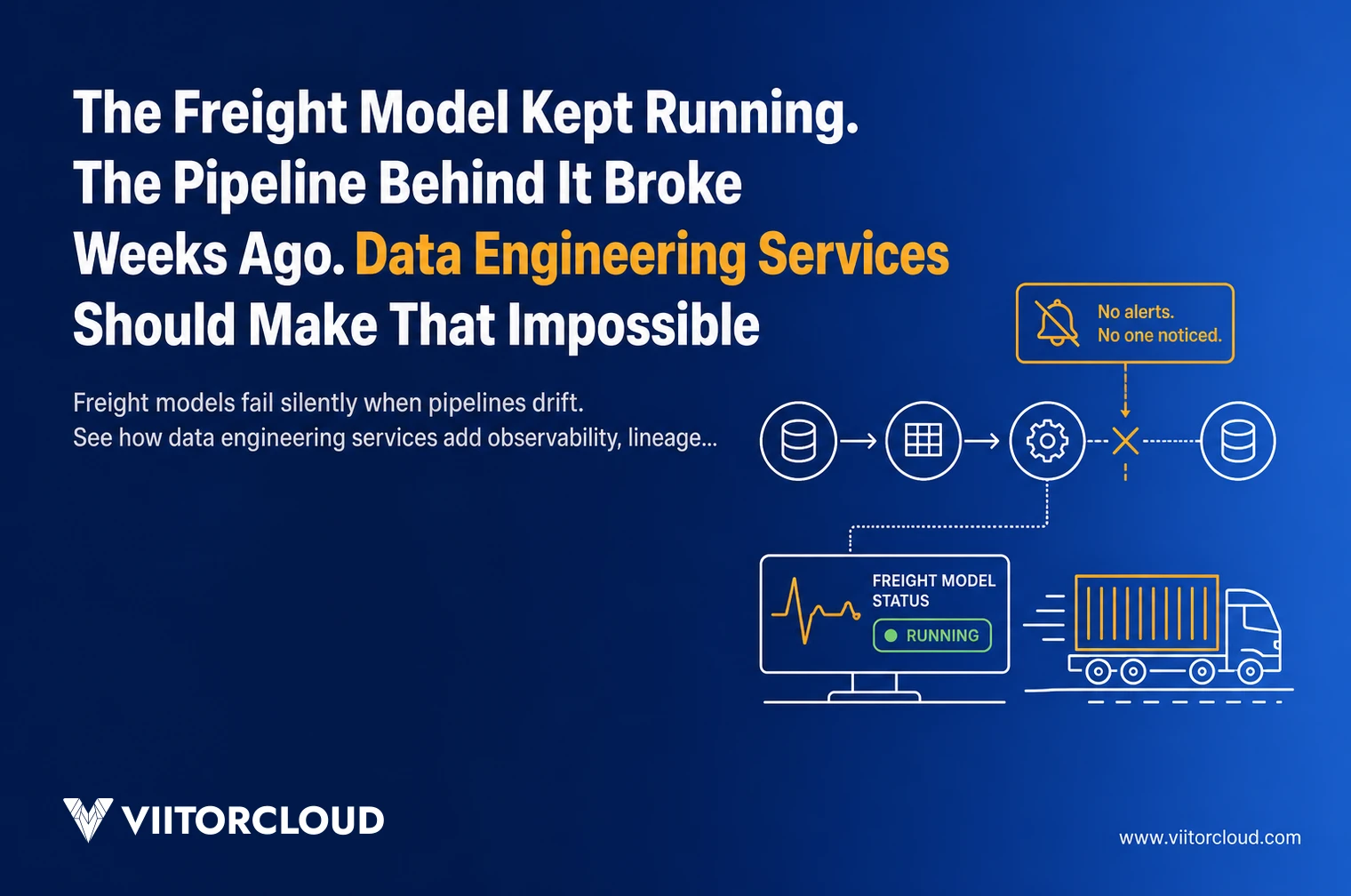
A freight ETA model will keep scoring shipments for weeks after the pipeline feeding it breaks. Nothing crashes, the dashboards stay green, and predictions keep arriving on schedule. The model has no idea anything changed.
AI pipelines fail silently because prediction and validation are separate systems. A model scores whatever reaches it, fresh or stale, complete or half empty, and the output still looks like a number you can plan against. Closing that gap is now the core job of data engineering services, and it decides whether you find a break in hours or in a quarterly review.
I lead data and AI engineering work for logistics platforms at ViitorCloud. This article covers why silent failure is the default state of production AI, what an AI-ready data pipeline looks like when it is built to fail loudly, and where data observability, data lineage, and pipeline testing fit.
Key Takeaways
- Freight models rarely crash when data breaks. They keep predicting on stale or drifted inputs until business metrics expose the damage weeks later.
- Only 12% of organizations report data of sufficient quality and accessibility for AI, per Informatica’s 2025 CDO Insights survey, and BARC ranks data quality management the top data and analytics priority for 2026.
- Modern data engineering services deliver an AI-ready data pipeline that validates inputs first, pairing streaming data ingestion with pipeline testing, a feature store, and a vector database.
- Data observability watches freshness, volume, schema, and distribution. Data lineage tells you which models consumed bad data, and since when.
Why AI Pipelines Fail Silently in Production
AI pipelines fail silently because models never validate their own inputs. Scoring succeeds on schema drift, stale feeds, and null-filled records exactly as it does on clean data, so accuracy decays without a single error. Infrastructure monitoring stays green because the jobs still run. Only the data inside them has stopped being true.
A head of data I will call Dana ran ETA models at a freight visibility platform. In March, a carrier changed its status codes. Ingestion accepted the new feed, a transformation step quietly mapped the unknown codes to null, and imputation filled the gaps with defaults. The model kept scoring every shipment.
Then, 23 days later, a major shipper escalated 400 missed ETAs from a single week. On-time prediction accuracy had slid from 92% to 74% with no alert firing. The fix took two hours. Finding what to fix took 11 days, because nothing recorded which inputs had changed.
Four failure modes cause most of these incidents:
- Schema drift, where an upstream system renames or retypes a field and downstream jobs coerce it into something wrong
- Freshness decay, where a feed stops updating, but consumers keep reading the last snapshot
- Distribution shift, where values stay valid but their statistical shape moves away from the training data
- Silent volume loss, where record counts drop because a source truncates or throttles
Streaming data compounds the problem, since bad records arrive continuously instead of in one auditable batch. The cost is measurable. Research published in MIT Sloan Management Review estimates bad data costs most companies 15% to 25% of revenue, and freight margins cannot absorb that quietly.
Find the Silent Failures Before the Quarter Does
A pipeline observability audit maps freshness, volume, schema, and lineage risk across every feed your models consume. ViitorCloud runs this discipline on systems ingesting 1M+ sensor readings a day.
What Data Engineering Services Actually Cover Now
Data engineering services design, build, and operate the systems that collect, transform, and serve data for analytics and AI. The modern scope goes well past moving data. It includes pipeline testing, data observability, data lineage, and the feature store and vector database layers that keep model inputs trustworthy in production.
The market data explains the expanded scope. Only 12% of organizations report data of sufficient quality and accessibility for AI, according to Informatica’s 2025 CDO Insights survey, and BARC’s Data, BI and Analytics Trend Monitor puts data quality management at the top of the priority list for 2026. Teams are not short of models. They are short of inputs their models can trust.
That reality changes how I evaluate data engineering services. Ask how a partner proves correctness, not how fast they move records. I covered the delivery patterns that work for carriers and 3PLs in our breakdown of data engineering in logistics, and the short version is that validation ships with the pipeline or the pipeline is not done.
The Anatomy of an AI-Ready Data Pipeline for Freight
An AI-ready data pipeline treats every stage as a checkpoint where data is validated before it moves on. Many data engineering services stop once records land in a warehouse. The build I recommend goes three layers further, following the approach in our guide to AI-powered data pipeline development.
Ingestion Is Where Streaming Data Goes Wrong First
Freight data arrives as streaming data from telematics, carrier APIs, EDI messages, and warehouse scans. I put contract checks at the edge, so every record is validated against an expected schema on arrival. Records that fail route to a quarantine topic for review instead of flowing downstream.
A rejected message at ingestion costs minutes. The same message inside a trained model costs an investigation.
Transformation Needs Pipeline Testing Built In
Pipeline testing applies software engineering discipline to data logic. Every transformation carries assertions on nulls, ranges, uniqueness, and referential integrity, and the suite runs in CI before any change deploys. When an incident slips through, it becomes a new regression test the same day.
Most teams I audit have zero tests on the SQL behind their most important features. They would never ship application code that way.
The Serving Layer Pairs a Feature Store with a Vector Database
A feature store serves identical validated features to training and inference, which removes the skew that appears when two code paths compute the same value differently. It also enforces freshness rules, so a model cannot silently read a dwell-time feature that stopped updating last Tuesday.
A vector database plays the same role for unstructured freight data. Embeddings of disruption notes, customs documents, and customer emails power retrieval, and the vector database needs the same refresh monitoring and pipeline testing as any table. Skip that, and search quality drifts as silently as any feature.
Build an AI-Ready Data Pipeline for Freight
Streaming ingestion, pipeline testing, feature stores, and lineage, engineered by the team behind a port platform handling 2.2M+ freight tons across 14 active sites.
Data Observability Turns Silent Failures into Loud Ones
Data observability is continuous monitoring of the data itself rather than the infrastructure that moves it. It tracks freshness, volume, schema, and distribution against learned baselines, then alerts when a table stops updating, a field changes type, or record counts fall outside expected ranges.
The distinction matters because infrastructure monitoring answers the wrong question. An orchestrator can report every task green while the data inside those tasks is three weeks stale. Gartner estimates poor data quality costs the average organization $12.9 million a year, and much of that spend hides in exactly this gap.
A senior engineer I will call Rohan learned this after a warehouse firmware update halved his scan-event volume. The pipeline ran, the model scored, and dock scheduling degraded for nine days before anyone connected the complaints to the data. Once his team deployed data observability, a comparable freshness breach paged the on-call engineer in 14 minutes.
This is also the layer logistics teams ask ViitorCloud to retrofit first. Our data analytics and engineering capability usually starts an engagement here, because observability produces results before any model changes.
Data Lineage Shortens the Worst Hour of an Incident
Data lineage maps every field from its source system through each transformation to the models, reports, and decisions that consume it. When an alert fires, lineage answers the first operational questions in minutes. Which models read the bad data, since when, and which forecasts shipped during the exposure window.
Without data lineage, that scoping work means manually tracing notebooks, DAGs, and undocumented dependencies. Dana’s team spent 11 days on it. Column-level data lineage would have produced the impact list in an afternoon, along with the evidence for a retrain-or-rollback decision.
Two details determine whether lineage holds up in production:
- It must reach the serving layer, covering what the feature store computed and what the vector database indexed, or the final hop before the model stays unmapped
- It must feed pipeline testing, so every incident converts into a lineage-scoped regression test that prevents a repeat
For fleet, port, and 3PL operators, this is the discipline that makes AI dependable enough to commit trucks, crews, and dock slots against. It is the standard behind our logistics technology solutions on every engagement.
Make Your Next Model Accountable to Its Data
ViitorCloud scopes data engineering services with observability and lineage written into the statement of work, backed by 14+ years of delivery and 300+ global clients.
The Pipelines I Build for Logistics Teams Fail Loudly by Design
I have watched versions of Dana’s story repeat across freight, parcel, and port operations, and the pattern never varies. The model takes the blame while the pipeline holds the fault. So ViitorCloud scopes data engineering services with data observability, data lineage, and pipeline testing written into the statement of work, not deferred to a later phase.
That discipline already runs at scale. The port management platform we engineered handles 2.2M+ freight tons across 14 active sites in more than 10 countries, and our livestock monitoring system ingests 1M+ sensor readings daily from 15,000+ devices, where pipeline reliability supported a 30% reduction in mortality. Our IoT waste management platform for Live Track applies the same streaming data validation to city-scale fleet operations.
If your freight models are scoring on inputs nobody validated this week, start with an assessment before the quarter closes. Talk to our data engineering team about a pipeline observability audit. You will know your exposure within days, not after the next escalation.
Make the Pipeline Fail Loudly Before the Forecast Fails Quietly
The freight model that keeps running is not reassurance. It is the risk. Models score whatever arrives, so the only durable safeguard is an AI-ready data pipeline that validates inputs, monitors its own freshness, and records what consumed what.
Start with data observability on your highest-value model, add pipeline testing to the transformations behind it, and extend data lineage until any incident can be scoped in minutes. Treat data engineering services as the discipline that makes AI accountable. In logistics, the forecast is only as good as the feed behind it.

Vishal Shukla
Vishal Shukla is Vice President of Technology at ViitorCloud Technologies.
Frequently Asked Questions
What are data engineering services?
Data engineering services cover the design, build, and operation of the systems that collect, transform, and serve data for analytics and AI. Modern engagements include streaming ingestion, pipeline testing, feature stores, data observability, and data lineage, so the data reaching models is validated, fresh, and traceable in production.
What is data observability?
Why do AI pipelines fail silently in production?
What is data lineage and why does it matter in logistics?
What does a feature store do in an AI-ready data pipeline?