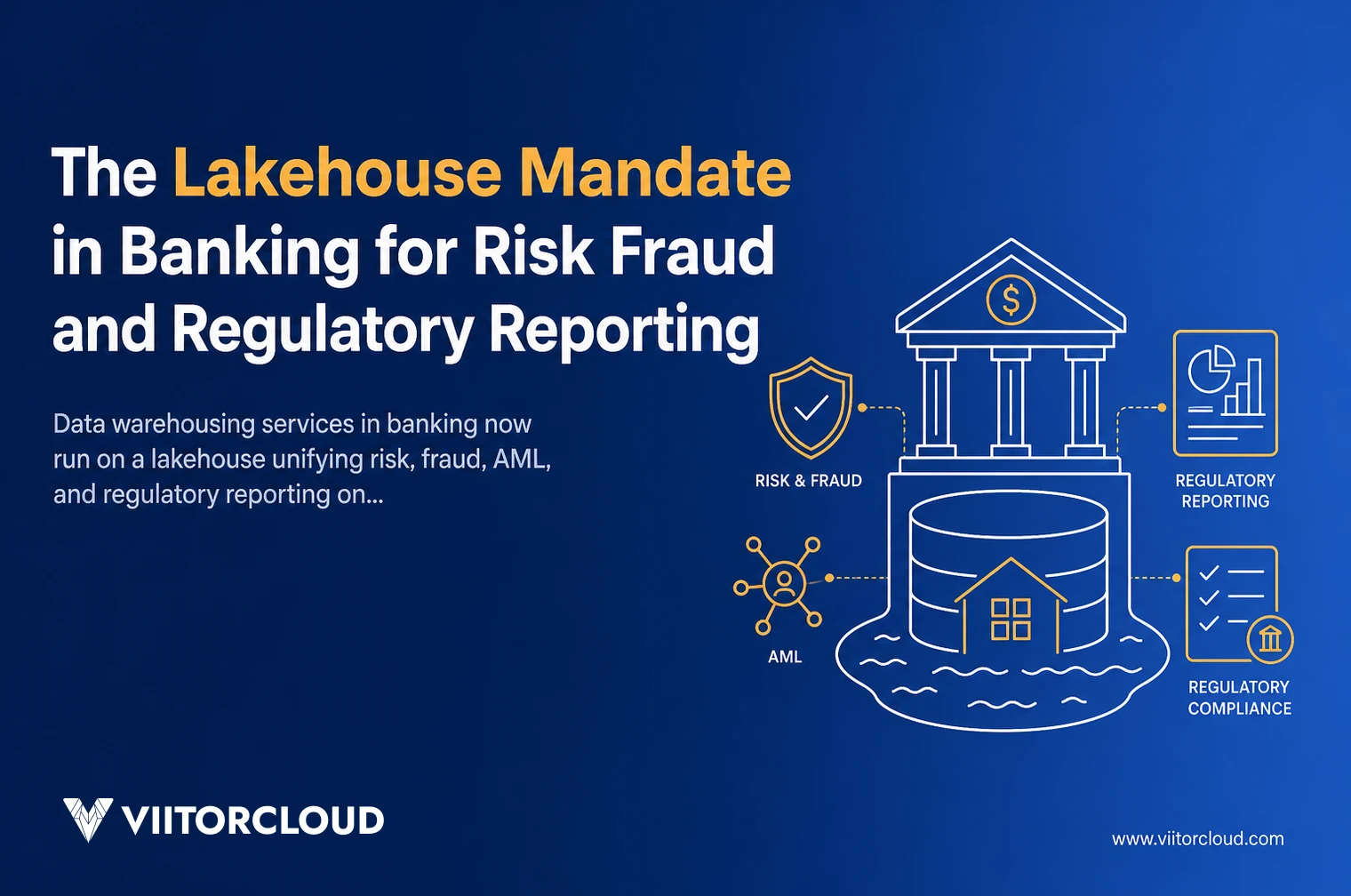
For banks and lenders, data warehousing services now decide how fast you can catch fraud, price risk, and file a clean regulatory report. The most effective way to fix slow, stale banking data is a lakehouse, a single platform that combines the reliability of a data warehouse with the scale of a data lake.
Here is the problem I see in almost every bank I work with. The core banking system updates positions overnight in a batch, so risk models, fraud checks, and regulatory reports all run on yesterday’s numbers. By the time a suspicious pattern surfaces in a report, the money has already moved.
I have spent years building governed data platforms for regulated industries, and the pattern is consistent. The bank doesn’t have a model problem. It has a data foundation problem. This guide explains what a banking lakehouse is, how it compares to a warehouse and a lake, and the four workloads it unifies on one set of real-time, governed data.
Key Takeaways
- A banking lakehouse merges a cloud data warehouse and a data lake into one platform, so risk, fraud, AML, and regulatory reporting read from the same governed data.
- Overnight batch processing leaves fraud and risk teams working on stale positions, and industry surveys suggest only around 18% of AML teams run fully operational AI tooling.
- Lakehouse architecture supports real time analytics on live transactions, so fraud can be scored as it happens instead of the next morning.
- The hardest part isn’t storage, it is governance, lineage, and data quality, which is where experienced data warehousing services and data engineering matter most.
- Start with one high-value workload, prove it on real transaction data, then expand across the bank.
Why Overnight Batch Data Is Now a Liability
Most banking cores were built for accounting accuracy, not real-time analytics. They close the books overnight and post updated balances in the morning. That design was fine when reporting was monthly. It fails when fraud moves in seconds.
Consider a fraud analyst who starts her day reviewing alerts generated from last night’s batch. A card-testing attack that began at 2 a.m. doesn’t reach her queue until the next cycle. The gap between the event and the alert is exactly the window a fraudster needs. That isn’t a staffing gap. It is a data latency gap.
The same lag undermines risk and compliance. Monitoring that runs on batch data cannot connect a fast sequence of transfers until after they settle. Industry surveys suggest only about 18% of AML teams have fully operational AI tooling, which leaves most suspicious activity invisible between cycles. For banks still running on an aging core, this usually points back to a deeper need to modernize the banking core itself.
Unify Risk and Fraud Data on One Platform
See how a governed lakehouse replaces overnight batch feeds with real-time data your risk, fraud, and reporting teams can all trust.
What a Data Lakehouse Actually Is in Banking
A data lakehouse is a single platform that stores raw and structured data together and applies warehouse-style management on top of low-cost lake storage. In banking terms, it holds everything from live transaction streams to customer records and market feeds, and it lets risk, fraud, and reporting teams query the same governed copy.
Traditional data warehousing services gave banks clean, reliable tables for reporting, but they struggled with volume and semi-structured data. Data lake services gave banks cheap storage for everything, but without structure the lake often turned into a swamp no one trusted. Lakehouse architecture closes that gap.
Three properties make it work for regulated data:
- One copy of the truth: Teams stop exporting data into separate marts, so numbers reconcile across risk, finance, and compliance.
- Transactional reliability: The platform supports updates, deletes, and schema control, which regulators expect from a system of record.
- Real time analytics: Streaming ingestion means a transaction can be scored for fraud as it happens, not the next morning.
A modern cloud data warehouse and a lake are no longer separate purchases. The lakehouse delivers both from one architecture, which is why our data analytics team treats it as the default foundation for regulated workloads.
Data Warehouse vs Data Lake and Why Banks Stopped Choosing
The old debate was data warehouse versus data lake. A cloud data warehouse is optimized for fast, governed queries on structured data, which suits regulatory reporting. A data lake, delivered through data lake services, is optimized for cheap storage of any data type, which suits model training and exploration. Each solves half the problem.
Banks used to run both and copy data between them. That created duplicate pipelines, reconciliation headaches, and a governance blind spot every time data moved. The lakehouse removes the copy step.
Here’s the practical difference for a data leader:
- Warehouse only. Strong reporting, weak on real-time and unstructured data, expensive at scale.
- Lake only. Cheap and flexible, weak on governance and query performance, hard to audit.
- Lakehouse. Governed reporting and real time analytics on one copy, with lake economics underneath.
For a regulated bank, the deciding factor is auditability. When an examiner asks how a number was produced, you need clear lineage from source to report. That’s far easier to prove when there is one platform instead of three.
Build a Lakehouse That Passes an Audit
Our data engineering services bring lineage, quality gates, and BCBS 239-aligned governance to your regulated banking data from the first pipeline.
The Four Workloads a Banking Lakehouse Unifies
The reason to consolidate isn’t tidiness. It is that risk, fraud, AML, and regulatory reporting all depend on the same underlying transaction data. When they share one governed source, they stop contradicting each other.
Real-Time Risk and Exposure
Market and credit risk models need current positions, not overnight snapshots. On a lakehouse, exposure updates as trades and payments land, so a risk desk sees intraday concentration before it becomes a problem. This is where real time analytics changes the risk picture.
Fraud Detection as It Happens
Fraud scoring works best on streaming data. When transactions flow into the lakehouse live, a model can flag a card-testing pattern or account takeover in the moment rather than after settlement. The Financial Action Task Force sets the global standards these controls are measured against.
Anti-Money-Laundering Monitoring
AML depends on connecting activity across accounts, products, and time. A unified platform lets monitoring see the full customer graph instead of siloed slices, which is how you catch structuring that batch systems miss between cycles.
Regulatory Reporting Without the Fire Drill
When reporting reads from the same governed data as risk and finance, submissions reconcile by design. Our work on system integration for finance compliance and risk shows that reconciliation, not calculation, is where reporting teams lose the most time.
How I Build a Governed Lakehouse for Regulated Data
The storage layer is the easy part. The hard part, and where most projects stall, is governance, lineage, and data quality. A lakehouse that no one trusts is just an expensive lake.
My approach follows a few principles I have learned the hard way across regulated builds:
- Model the data contracts first. Define what each field means across risk, fraud, and finance before writing pipelines, so the platform reconciles instead of arguing.
- Build lineage in from day one. Every value should trace back to its source. The Basel Committee’s principles for risk data aggregation, known as BCBS 239, are a useful blueprint even outside their strict scope.
- Treat ingestion as the main event. Reliable streaming and batch pipelines are most of the work, and strong data engineering services here decide whether the platform holds up under load.
- Add quality gates. Validate data at ingestion, transformation, and output, so a bad feed is caught before it reaches a model or a report.
The lakehouse architecture only earns trust when that discipline is in place. It is the same data engineering services discipline behind the large-scale platforms we deliver. For a government records program with KPMG, we consolidated data for more than 70 million citizens onto one platform, and for an IoT deployment we run pipelines that ingest over 1 million data points a day from 15,000 sensors. Banking is a different domain, but the engineering problem, trustworthy data at scale, is the same.
Start With One High-Value Workload
We help banks and fintechs prove a lakehouse on real transaction data before committing to a full platform. Explore our BFSI data work.
Where to Start Before You Commit to a Platform
Don’t start by selecting a vendor. Start by picking the one workload where stale data costs you the most, usually fraud or intraday risk, and prove the lakehouse on real transaction data. That is the fastest way to build internal confidence and a business case.
This is where our data and analytics team adds value. We, at ViitorCloud, have built regulated, high-throughput platforms for enterprise clients, including revenue systems that have processed more than $192 million and transaction platforms that handled $7.1 million in 72 hours during a single peak. If you are weighing a lakehouse for banking, our data engineering services and BFSI experience are worth a conversation before you lock in an architecture.
The Data Foundation Decides Everything Downstream
Banking runs on trust, and trust now depends on timely, governed data. As long as risk, fraud, and reporting run on overnight batch feeds, teams will keep reacting to problems after the money moves. A lakehouse changes that by giving every function one real-time, governed source.
The move is less about new technology and more about discipline in how data is modeled, governed, and delivered. Get the foundation right and the risk models, fraud checks, and reports built on top of it get faster and more reliable. Modern data warehousing services for banking start with that foundation, not with the dashboard on top.

Vishal Shukla
Vishal Shukla is Vice President of Technology at ViitorCloud Technologies.
Frequently Asked Questions
What is a data lakehouse in banking?
A banking data lakehouse is one platform that unifies warehouse-grade reporting and lake-scale storage, so risk, fraud, and reporting teams share the same governed data.
What is the difference between a data warehouse and a data lake?
Do banks still need data warehousing services with a lakehouse?
How long does a banking lakehouse project take?