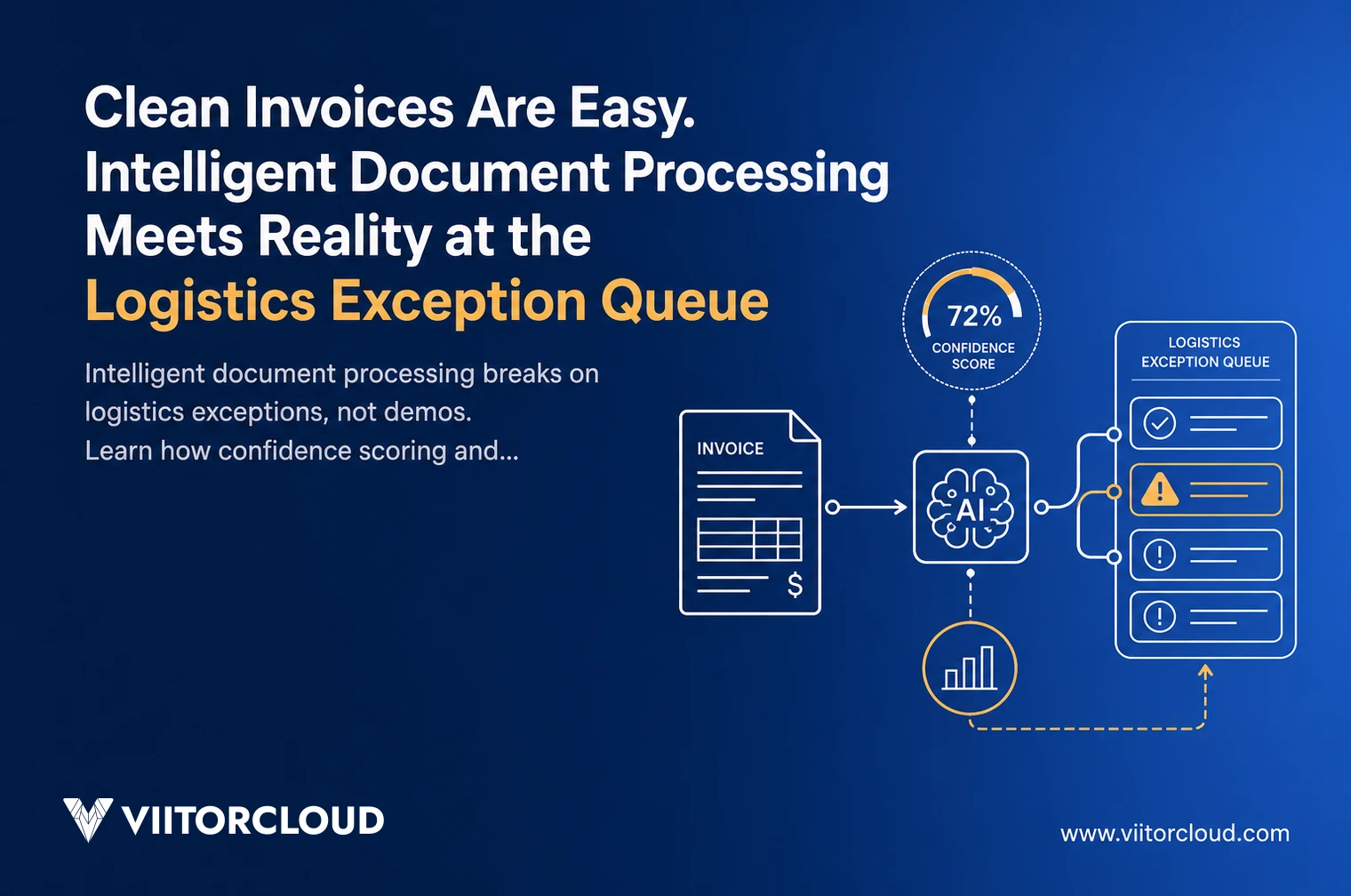
Intelligent document processing (IDP) fails in logistics for one specific reason. The models are demoed on clean invoices, and the business runs on exceptions. Extraction accuracy is decided at the queue of mismatched bills of lading, skewed customs scans, and rate confirmations that contradict the carrier invoice, which is exactly what a demo never shows.
I have sat through those demos. The vendor uploads a crisp PDF, every field populates in seconds, and everyone nods. A few weeks into a live pilot, the picture changes. Plausible but wrong values flow into the transportation management system (TMS), and nobody notices until a carrier disputes an invoice.
This article covers why clean-document accuracy proves so little, and how confidence scoring, exception handling, and human-in-the-loop validation turn intelligent document processing into something you can defend in production.
Key Takeaways
- Demo accuracy on clean invoices predicts almost nothing. The exception queue is where intelligent document processing earns or loses trust in logistics.
- Precedence Research puts the IDP market at $4.31 billion in 2026, rising toward $43.92 billion by 2034, yet many deployments still ship without calibrated confidence scoring.
- A May 2026 Gartner survey of 140 supply chain leaders found 83% applying AI incrementally. Exception handling is the most measurable increment available.
- Human-in-the-loop validation is an architecture decision. Route low-confidence fields to reviewers and feed every correction back into the model.
Why Intelligent Document Processing Breaks at the Logistics Exception Queue
Intelligent document processing fails on logistics exceptions because extraction models are built and benchmarked on clean, well-structured documents. Real freight paperwork arrives mismatched, incomplete, and badly scanned. Without field-level confidence scoring and human-in-the-loop validation, the system publishes wrong values instead of flagging them, and errors flow silently into TMS, ERP, and billing records.
The failure is structural, and I see it repeat across logistics technology stacks. Freight documents are three hard problems at once.
- Multi-format. Bills of lading, proof of delivery, customs declarations, rate confirmations, and accessorial invoices all carry different structures.
- Multi-party. The shipper, carrier, and broker versions of one shipment routinely disagree on weights, charges, and references.
- Multi-quality. Thermal printer output, dock phone photos, and faxed customs entries defeat optical character recognition (OCR) before any model reasons about meaning.
A clean invoice avoids all three problems simultaneously. That is why it demos well and proves nothing.
Scope a Production-Grade IDP Build
We design intelligent document processing with confidence thresholds, validation rules, and human-in-the-loop review from day one, the same engineering discipline behind logistics platforms handling 2.2M+ freight tons across 14 active sites.
The Demo Was Never Designed to Fail
Buying pressure makes this worse. Precedence Research values the intelligent document processing market at $4.31 billion in 2026, heading toward $43.92 billion by 2034. Growth like that funds polished demos, and polished demos are curated by definition.
Two things hide inside the polish. First, OCR character accuracy is not field accuracy. A single misread digit in a container number is a 0.1% character error and a 100% field error. Second, LLM document extraction fails differently than OCR ever did.
When a large language model (LLM) meets an ambiguous customs entry, it does not return garbage. It returns a plausible value pulled from the wrong line.
An operations lead at a mid-market freight forwarder I worked with learned this three weeks into a pilot. Duty amounts had been posting from the wrong section of customs entries straight into the TMS. Every value looked reasonable, so no one questioned them. The team spent a month unwinding invoices that had already gone out.
This is the honest definition of the problem. LLM document extraction without validation does not make fewer errors than people. It makes quieter ones.
Exception Handling Is Where Incremental AI Wins
Most supply chain leaders already sense this. A May 2026 Gartner survey of 140 supply chain leaders found 83% applying AI incrementally rather than through transformational redesign. For document AI, that instinct is correct, and the exception queue is the best increment available.
Exception handling is bounded, measurable, and expensive today. Every mismatched bill of lading or failed customs code already costs someone 10-30 minutes of cross-checking. Automating the clean majority while instrumenting the messy remainder gives you a controlled surface to prove accuracy before scope expands. Prove the queue before you reach for agentic IDP or full RAG document processing pipelines.
The queue also feeds everything downstream. Extracted fields drive the AI-driven decision systems for logistics that plan routes, approve payments, and trigger detention disputes. If extraction is wrong, every decision built on it inherits the error.
Automate the Clean Majority, Instrument the Exceptions
Our AI-driven automation team has cut document processing from 15-20 minutes to 2-3 seconds on live workflows by pairing extraction with exception handling that catches silent errors before they post.
Confidence Scoring Decides What Humans See
Confidence scoring separates a production intelligent document processing system from a demo. Every extracted field gets a score, the score gets calibrated against measured accuracy, and a threshold decides whether the value auto-posts or routes to review. Document-level scores are not enough. A 99% accurate document with one wrong freight charge is still a wrong invoice.
Calibration is the step most teams skip. A model reporting 0.95 confidence should be correct roughly 95 times in 100 on your documents, not on a vendor benchmark. Thresholds then vary by business risk. Container numbers and duty amounts earn strict thresholds, while a remit-to address can tolerate more.
This is where LLM document extraction gets governed instead of trusted. Cross-check extracted values against rate tables, shipment records, and contract terms – the same grounding principle behind RAG document processing. In the AI-driven automation systems my team builds, four numbers get instrumented from day one.
- Auto-approve rate, the share of fields posted without human touch.
- Exception rate, the share routed to review.
- Correction rate, how often reviewers change a routed value.
- Reversal rate, how often auto-approved values get fixed later downstream. This number catches silent errors.
Agentic IDP Still Needs a Human Gate
Agentic IDP is the next step most vendors are now pitching. Instead of extracting fields and stopping, agents decide next steps. They re-request a missing page, pull the rate confirmation to resolve a charge dispute, or escalate a three-way mismatch with full context attached. Retrieval-augmented generation (RAG) makes this workable, because RAG document processing grounds the agent in your contracts, tariffs, and shipment history instead of letting it guess.
None of that removes the human gate. Human-in-the-loop validation is an architecture decision made at design time. It means a review interface built for speed, corrections captured as structured data, and retraining focused on exactly the documents that failed. The same pattern holds outside freight, and I covered it in intelligent document processing in healthcare data pipelines, where claim denials play the role carrier disputes play here.
Handled this way, the exception queue stops being overhead and becomes training data. One customs brokerage team I advised routed every sub-threshold field to two senior reviewers and fed corrections back weekly. Reviewer workload fell quarter over quarter, and the fields corrected most often became the roadmap for the next model iteration. That correction loop is also how vertical AI agents in logistics earn enough trust to act on their own.
Bring Us Your Ugliest Customs File
A working session against your real document mix tells you more than any demo. ViitorCloud has delivered for 300+ clients across logistics, healthcare, and finance since 2011.
Where ViitorCloud Fits in Your Exception Queue
My team at ViitorCloud has built logistics and document platforms since 2011, including a port management system running across 14 active sites in 10+ countries and handling 2.2M+ freight tons. On document workflows specifically, we have cut processing time from 15-20 minutes per document to 2-3 seconds by pairing extraction with validation rules and human review rather than trusting the model alone.
If you are scoping an intelligent document processing build, ask any partner four questions before you commit.
- How is confidence scoring calibrated against our documents rather than a benchmark set?
- Which fields carry which thresholds, and who owns changing them?
- What does the reviewer workflow look like at 500 exceptions a day?
- How do corrections flow back into the model?
If you want to work through those against your real document mix, talk to our engineers. Bring your ugliest customs file rather than your cleanest invoice.
The Bottom Line
Clean invoices were never the test. Intelligent document processing proves itself at the exception queue, where mismatched bills of lading and ambiguous customs entries either get caught or get posted. The teams getting durable results treat exception handling as the product, calibrate confidence thresholds field by field, and build the correction loop before go-live.
Start there. Instrument the four rates, ground extraction in operational data the way RAG document processing does, and keep people on the gate until your reversal rate says otherwise. Agentic IDP will keep advancing. The fundamentals that make it safe will not change.

Vishal Shukla
Vishal Shukla is Vice President of Technology at ViitorCloud Technologies.
Frequently Asked Questions
What is intelligent document processing?
Intelligent document processing is the automated extraction of structured data from business documents using OCR, machine learning, and LLM-based models. In logistics, it converts bills of lading, invoices, and customs paperwork into system-ready fields, ideally with confidence scores that route uncertain values to human reviewers instead of posting them blindly.
Why does intelligent document processing fail on logistics exceptions?
How should a logistics team handle document exceptions with AI?
What confidence threshold should IDP use in logistics?
What is the difference between OCR and LLM document extraction?