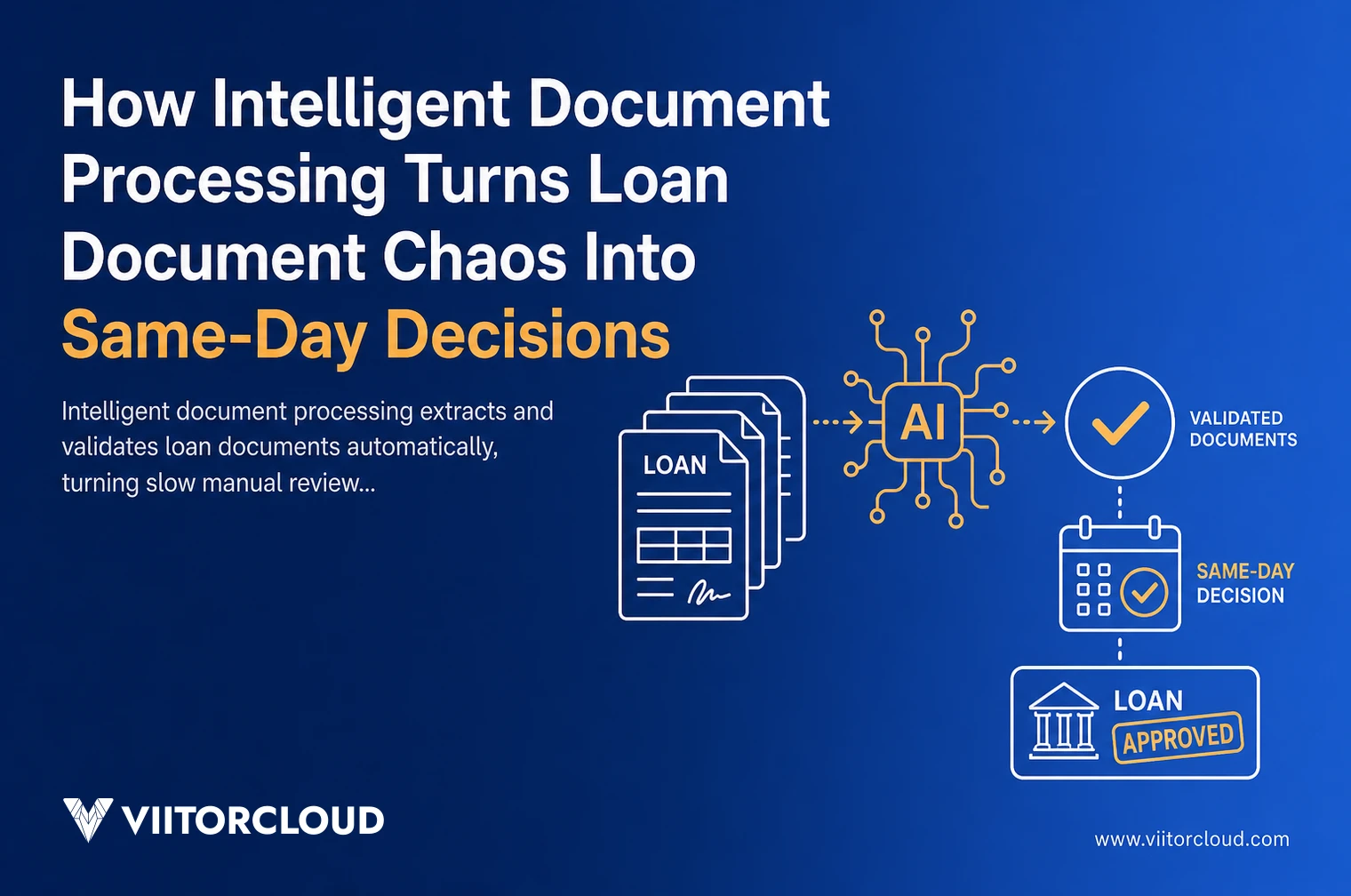
Intelligent document processing is AI software that reads, extracts, validates, and routes every document in a loan file automatically, so lending teams can reach a decision in hours instead of days. It replaces the manual keying of pay stubs, bank statements, tax forms, and identity documents with a system that understands messy real-world paperwork and feeds clean data straight into your decisioning.
I have sat with lending operations teams who still print applications, sort them into paper trays, and rekey the same borrower details into four systems. The bottleneck is almost never the credit decision. It is the days spent turning documents into data before anyone can decide.
This guide explains how intelligent document processing works in lending, why GenAI document extraction beats older template-based tools, and what loan document automation actually requires to deliver same-day decisions. You will leave with a practical view of where to start and how to keep it audit-ready.
Key Takeaways
- Intelligent document processing extracts, validates, and routes loan documents automatically, cutting decision times from days to the same day.
- GenAI document extraction reads unstructured files like bank statements and tax forms that template-based OCR cannot handle reliably.
- Document processing automation lowers cost per file, reduces keying errors, and improves the borrower experience at the same time.
- Loan document automation only works at scale when validation, human review, and a clean data pipeline are built in from the start.
- A focused proof-of-concept on one document type is the fastest, lowest-risk way to prove the return before scaling.
Why Lending Still Drowns in Paperwork
A single mortgage file can run past 500 pages. One application pulls together pay stubs, tax forms, bank statements, identity documents, appraisals, and dozens of disclosures. Most of it arrives as scans, phone photos, and email attachments in no fixed order.
Consider Priya, who leads loan operations at a mid-size lender. Her team receives around 400 applications a week. Each one is opened, sorted, and keyed by hand into the origination system. A skilled processor spends 15 to 20 minutes per file just moving numbers from documents into fields.
Manual handling creates three problems at once:
- Speed. Files sit in queues for days, and borrowers drop out while they wait.
- Cost. Skilled staff spend their hours on data entry instead of judgment.
- Errors. A mistyped income figure or a missed document sends a file back to the start, or past a compliance line.
Industry research supports what I see on the ground. According to McKinsey, automation technologies can perform a large share of the activities in banking operations, and document handling is one of the heaviest. Intelligent document processing exists to remove that drag, not to add another tool nobody uses.
Turn Loan Document Chaos Into Same-Day Decisions
See how ViitorCloud builds GenAI-powered intelligent document processing that extracts, validates, and routes lending documents for faster, accurate approvals.
What Intelligent Document Processing Actually Does in Lending
Intelligent document processing is the combination of AI models that turn unstructured documents into structured, validated data with little or no human keying. In a lending workflow, intelligent document processing services run four steps on every file.
- Classify. The system identifies each document, a bank statement, a tax form, a pay stub, or an ID, even when they arrive jumbled in one PDF.
- Extract. It pulls the specific fields that matter, such as name, income, account balances, and dates.
- Validate. It checks values against rules and cross-references documents, flagging a pay stub that does not match the stated income.
- Route. It sends clean data to the origination or decisioning system and pushes exceptions to a person.
The difference from older tools matters. Traditional optical character recognition reads text but does not understand it, and it leans on fixed templates, so a new bank format or a skewed photo breaks it. Modern IDP adds machine learning and language models that read documents the way an experienced processor does, by context rather than by coordinates. If you want proof of range, look at how GenAI-powered IDP is already working across industries.
How GenAI Document Extraction Handles Messy Loan Files
The hard part of lending documents is not reading text. It is understanding files that never look the same twice. This is where GenAI document extraction, the reading engine inside modern IDP, changes the math.
Older tools rely on templates and fixed coordinates. When a borrower uploads a bank statement in a new layout, or a pay stub photographed at an angle, template systems fail and kick the file to a human. Generative models read a document’s meaning, so they handle variety the way a seasoned processor does.
In practice, GenAI document extraction lets the system do three things reliably:
- Read a bank statement it has never seen before and still find the balances and transactions.
- Pull income from a pay stub whether the fields are labeled one way or another.
- Use context, so it knows a date near a signature is a signing date, not a birth date.
Extraction is only as good as the data feeding your models, though. Reliable results depend on a clean data pipeline that standardizes and checks documents before and after extraction. Get that foundation right, and accuracy on messy real-world files climbs sharply.
Start With a Scoped IDP Proof-of-Concept
Pick one high-volume document type, prove the return on real files, then scale the pipeline. A low-risk first step before any full build.
From Weeks to Same-Day, the Document Processing Automation Payoff
When document processing automation is done well, the numbers move fast. On one document-heavy workflow, my team cut processing time from 15 to 20 minutes per file down to 2 to 3 seconds. That is the difference between a borrower waiting a week and a borrower getting an answer the same day.
The gains show up in three places at once. Speed rises because clean data lands in the decisioning system in seconds. Cost falls because staff stop keying and start reviewing exceptions. Accuracy improves because good IDP applies the same checks to every file, which is what document processing automation delivers, consistency at volume.
Take Marcus, who runs process design at a digital lender. After moving three document types to automated extraction, his processors stopped typing and started handling only the exceptions the system flagged. Throughput climbed sharply without new headcount, and application drop-off fell because approvals came back while borrowers were still interested.
Analysts at Deloitte have made the same point about financial services, that automating document-heavy work lowers operating cost and shortens the customer journey at the same time. For a wider view of the pattern, these AI-driven automation use cases in finance show where it pays off first.
Building Loan Document Automation That Survives an Audit
Speed means nothing if the file cannot survive a regulator’s review. Lending is one of the most governed processes in any bank, and automated extraction has to respect that from day one.
Three controls make loan document automation audit-ready:
- Validation and cross-checks, so a figure is confirmed against source documents before it moves.
- Human-in-the-loop review, where low-confidence extractions route to a person instead of flowing through silently.
- Full traceability, so every field can be traced back to the exact document and page it came from.
This is where our banking and financial services work matters. I build these systems to be compliant by design, with GDPR-aligned data handling, role-based access, and encryption in transit and at rest. The goal is a system an auditor trusts, not one that quietly guesses. Good intelligent document processing services build these controls in from the start rather than bolting them on later.
The most common objection I hear is that a lender’s data is too messy for AI. That is backwards. Messy, varied documents are exactly what modern IDP is built for, and turning them into clean structured data is the first value it delivers.
Automate Document-Heavy Lending Workflows
From extraction to audit-ready validation, ViitorCloud engineers AI-driven automation for banks, lenders, and fintechs. Talk to us about your workflow.
Where to Start With Intelligent Document Processing Services
You do not need to automate every document on day one. The fastest path I recommend is a focused IDP proof-of-concept on a single high-volume document type, such as bank statements or pay stubs.
Pick one document, measure the current cost and cycle time, and prove the model on real files rather than synthetic samples. Real files carry the edge cases that decide whether a system works. Once the return is clear on one type, the same pipeline extends to the rest of the file.
At ViitorCloud, this is the model behind intelligent document processing services and broader AI-driven automation work. We have built document-heavy platforms at real scale, including a healthcare revenue platform that has processed $192.2M and a government records system that consolidated 70M+ records into one searchable source. The engineering discipline that handles those volumes is the same discipline lending needs.
If loan documents are slowing your decisions, a scoped assessment is a low-risk first step. It defines the roadmap before any build begins.
Turning Document Chaos Into Same-Day Decisions
Lending does not have to run at the speed of manual data entry. Intelligent document processing turns the document chaos at the front of every loan file into clean, validated data that decisioning systems can act on in hours.
The pattern is consistent. GenAI document extraction reads the messy files that template tools cannot. Document processing automation cuts cost and error at the same time. Loan document automation, built with validation and traceability, keeps the whole thing audit-ready.
Start small, prove it on one document type, and scale what works. Modern intelligent document processing services make same-day lending routine, not exceptional. The lenders who move now will approve faster, spend less per file, and win the borrowers who refuse to wait. The technology is ready. The real question is how quickly your operation decides to use it.

Vishal Shukla
Vishal Shukla is Vice President of Technology at ViitorCloud Technologies.
Frequently Asked Questions
What is intelligent document processing in lending?
Intelligent document processing uses AI to read, extract, validate, and route loan documents automatically, turning manual paperwork into decision-ready data.
How does IDP speed up loan approvals?
Is GenAI document extraction accurate enough for regulated lending?
How should a lender start with document processing automation?