


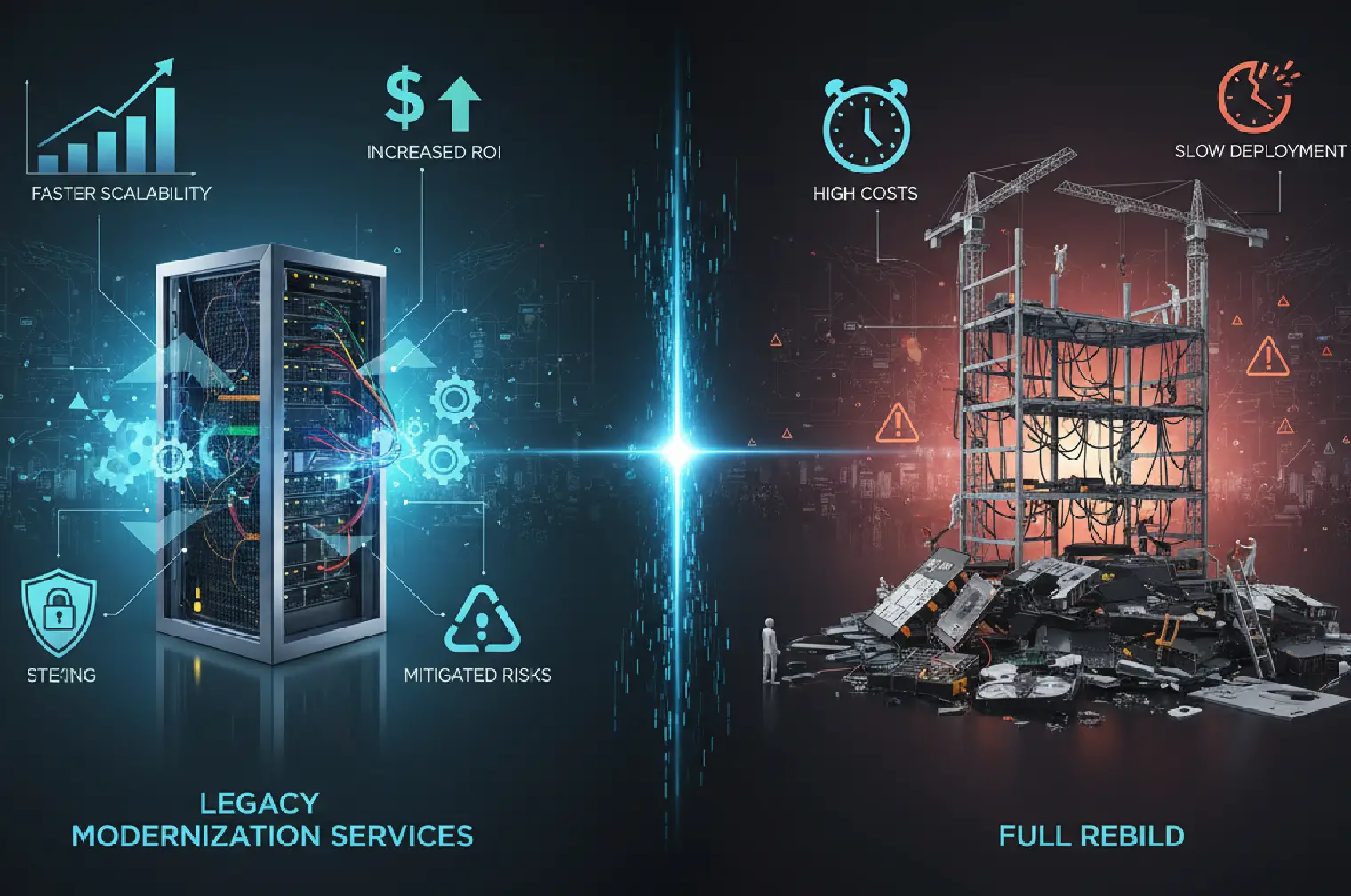
Enterprise IT leaders face budget confusion when updating outdated infrastructure. Evaluating legacy modernization services against a complete system rebuild requires precise cost planning. Companies must decide whether to replace their entire architecture at once or upgrade it in phases. With our experience and expertise in this area, we have prepared this article that analyzes the financial data, operational impact, and strategic value of both approaches to help leaders secure their infrastructure.
The Severe Financial Toll of Accumulated Technical Debt
Maintaining outdated software consumes capital. Companies allocate significant funds to patch old code, maintain security, and pay for specialized developer talent to manage obsolete systems.
- Maintenance Expenses: Gartner reports that technical debt affects approximately 40% of infrastructure systems across asset classes. Companies spend millions keeping these systems running instead of funding new initiatives.
- Security Penalties: Older systems lack modern encryption standards. Security breaches result in severe financial penalties and lost consumer trust.
- Productivity Loss: Developers spend hours troubleshooting legacy systems. This constant maintenance increases the overall modernization cost as product innovation stalls.
Global Compliance and Data Governance
Enterprises operating across multiple global regions must adhere to strict data privacy laws. Systems processing data for users globally must comply with GDPR, CCPA, and stringent cross-border financial regulations. Legacy systems often lack the dynamic data masking and automated reporting required for this compliance. Multi-region cloud deployments solve these privacy requirements by keeping data localized and secure across global operating zones, ensuring uninterrupted international operations.
Stop bleeding money on outdated enterprise systems
High maintenance drains your budget and kills your competitive edge. We slash your modernization cost for Enterprise IT with aggressive system integration and modernization. Rely on our proven legacy modernization services to secure your digital transformation and maximize your ROI right now.
System Rebuilds Demand Massive Upfront Capital
A complete system rebuild means discarding the existing software and developing a new solution from scratch. This approach demands a high initial investment and extensive planning.
- Capital Expenditure: Rebuilding requires significant upfront funding. Companies must pay for new architecture design, extensive coding, and rigorous testing phases before seeing any return.
- Timeline Extensions: Developing a new enterprise system takes years. During this period, the company must continue paying to maintain the old system.
- Operational Disruption: Deploying a completely new system carries high execution risk. Employees require retraining, and data migration errors halt daily operations.
Business leaders must calculate these parallel factors when forecasting their total modernization cost. High upfront expenses and extended timelines often deter enterprises from choosing a complete rebuild.
Read this: Why You Cannot Scale AI Automation Without Legacy System Modernization
The Anatomy of Modernization Cost
Enterprise IT leaders must understand the specific components that dictate total expenditure. Accurate cost planning requires a breakdown of every technical phase.
Infrastructure Audit and Assessment
Engineers begin by auditing the existing software architecture. They identify brittle code, undocumented dependencies, and redundant databases. This assessment dictates the project scope. Companies pay for diagnostic tools and expert analysis during this phase. Thorough audits prevent unexpected expenses later in the project.
Code Refactoring and Re-architecting
Refactoring involves altering the internal structure of the code without changing its external behavior. Engineers clean up inefficient logic and remove obsolete functions. Re-architecting shifts the application to a new structural framework, such as moving from a monolithic structure to microservices. Both actions require specialized engineering hours. The complexity of the original codebase directly influences this segment of the modernization cost.
Data Migration and Testing
Moving historical data from legacy on-premise servers to modern cloud databases constitutes a critical step. Engineers write scripts to clean, map, and transfer data securely. Following migration, quality assurance teams execute automated testing protocols. They verify that the new system processes data accurately and securely. Investing in rigorous testing reduces the risk of post-launch critical failures.
Evaluate Legacy Modernization Services: A Financial Breakdown
Legacy modernization services upgrade existing software through progressive, manageable phases. Engineers re-platform applications to the cloud, rewrite specific code segments, and integrate modern APIs to connect siloed databases.
Phased Budget Control
This phased approach allows IT departments to control their budgets tightly. Companies upgrade critical components first and defer less urgent updates. This strategy spreads the modernization cost over several fiscal quarters.
- Cloud Re-platforming: Engineers move applications to cloud infrastructure. This action eliminates on-premise server maintenance fees. Implementing cloud-native modernization through API enablement accelerates deployment and connects data effectively.
- Microservices Architecture: Developers break monolithic applications into smaller, independent services. This structure reduces the time required to test and release new features.
- Automated Workflows: Engineers integrate automation tools to handle manual data entry. This reduces human error and lowers administrative overhead.
A Forrester Total Economic Impact analysis demonstrates that deploying modern, cloud-native solutions yields rapid return on investment by reducing infrastructure management effort and accelerating delivery timelines.
Check this: How Cloud Migration Consulting Services Drive Legacy System Modernization
End the rebuild debate and start scaling your infrastructure
Guesswork skyrockets your modernization cost for Enterprise IT and stalls your growth. We deliver elite legacy modernization services that clearly map your path forward. Partner with us for seamless system integration and modernization to upgrade your tech stack without any operational downtime.
Cost Comparison: Modernization vs Rebuild
Enterprise IT leaders require concrete metrics to make procurement decisions. Both strategies impact the financial sheet differently.
Upfront vs Ongoing Expenses
Rebuilding creates a massive initial spike in capital expenditure. The company pays for two parallel systems during the development phase. Alternatively, legacy modernization services require lower initial capital. The company funds specific upgrade sprints, reducing the immediate financial burden and maintaining predictable cash flow.
Return on Investment Timeline
A full rebuild delays the return on investment until the new system launches. This process takes 18 to 36 months. Modernization delivers value immediately after each phase completes. When engineers update a specific workflow, the business benefits from faster processing speeds and reduced error rates within weeks.
Sector-Specific Financial Impact
Highly regulated industries face unique challenges during system upgrades. Executing legacy system modernization in finance requires zero downtime. Banks must process transactions continuously. Progressive modernization allows financial institutions to update core banking modules without interrupting customer access. This mitigates the risk of lost revenue during the transition.
ViitorCloud Capabilities for Enterprise IT
ViitorCloud provides engineered solutions for organizations facing high technical debt. Our teams execute structured upgrades that align with strict IT budgets. We deploy API-first patterns, data interoperability, and controlled migration techniques.
Our engineers perform comprehensive system integration and modernization for enterprise architectures. ViitorCloud’s legacy modernization services have successfully reduced IT maintenance costs by 40% and improved system uptime to 99.99% for leading enterprise clients.
We containerize applications using Docker, automate infrastructure with Terraform, and configure API gateways. These direct actions stabilize legacy environments and lower the long-term modernization cost. We ensure your business maintains continuous operations while the technology stack evolves securely.
Connect with us at [email protected] and discuss your requirements for modernizing your system.
Turn your legacy bottlenecks into a massive revenue engine
Outdated architecture hands your market share directly to your competitors. We control your modernization cost for Enterprise IT while executing flawless system integration and modernization. Leverage our top-tier legacy modernization services to rebuild your operational core and dominate your industry.
Conclusion
Enterprise IT departments must resolve budget confusion by comparing total expenditure against operational risk. A complete system rebuild demands massive capital and halts innovation during the multi-year development cycle. Alternatively, legacy modernization services offer a controlled, phased approach to eliminating technical debt. By updating software incrementally, companies distribute the modernization cost over time and realize immediate performance improvements. Enterprises that modernize their core systems achieve regulatory compliance, reduce security vulnerabilities, and establish a scalable foundation for future growth.

Vishal Shukla
Vishal Shukla is Vice President of Technology at ViitorCloud Technologies.
Frequently Asked Questions
What is the main advantage of legacy modernization services?
They allow businesses to upgrade systems in phases, reducing upfront costs and preventing major operational disruptions.
How do enterprise IT leaders calculate modernization cost?
Why do complete system rebuilds cause budget confusion?
How quickly do legacy modernization services deliver ROI?