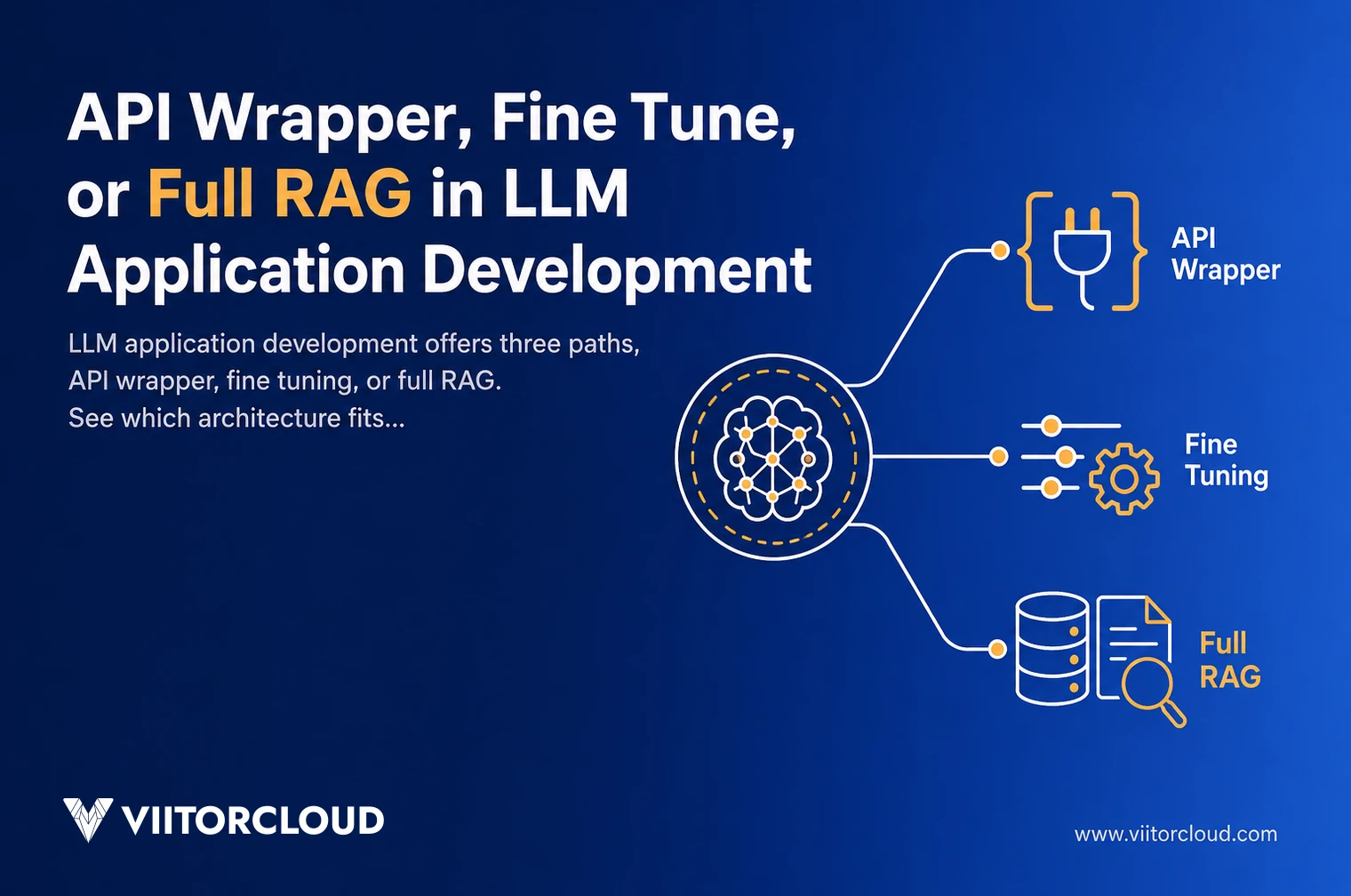
Fine-tune an LLM when you need a behaviour the base model does not have, such as a strict output format, a domain reasoning pattern, or a house style. Use RAG when the knowledge changes faster than you can retrain. In LLM application development, three inputs settle the argument: knowledge update frequency, latency budget, and feedback loop ownership.
Of the three architectures, one is usually the wrong first answer. Fine-tuning is the one most teams reach for, because owning the weights feels like owning the product. It is also the one that fails quietest. By the time anyone notices, the eval set that would have caught it does not exist.
You already suspect the API wrapper will not hold forever. Below is the LLM application development decision I make with technical teams before anyone picks a vector database, a model provider, or an orchestration library, including the matrix that maps your three constraints to one architecture.
Key Takeaways
- An API wrapper is a launch tactic, not an LLM application architecture. Prefill cost and tail latency climb with every document you push into the prompt.
- Fine-tuning changes behaviour, not knowledge. A model tuned on a few hundred examples looks confident and then degrades without raising an alert.
- RAG is the correct default for enterprise LLM development where policies, prices, clinical guidance, or rate tables change weekly.
- Three axes decide every LLM application development choice: how often the knowledge updates, how strict the latency budget is, and who owns the feedback loop after launch.
- Most production LLM applications end up hybrid, with retrieval for facts, a tuned or tightly constrained model for format, and an evaluation loop the client owns.
Why LLM Application Development Hits a Ceiling With API Wrappers
The wrapper path is right for a first release and wrong as a destination. You call a hosted model, paste context into the prompt, and ship in days. Most LLM application development starts here, and that is a reasonable place to start. The ceiling then shows up in three ways, and all three arrive together once real usage begins.
- Latency scales with context: Prefill work grows with the tokens you send, so tail latency worsens every time the knowledge base grows.
- Cost scales with load: Per-token pricing ties your unit economics to usage rather than value, which breaks the moment the feature succeeds.
- Knowledge goes stale: The model has no route to your proprietary data unless a human keeps pasting it into the prompt.
I worked with a mid-market SaaS team whose support assistant launched with a handful of policy documents in the system prompt. Nine months later that prompt carried several hundred pages of policy, pricing, and integration notes. Response times drifted past what their in-app widget could tolerate, and the token bill grew faster than seat revenue. Nothing had broken. The architecture had run out of room, which is how most production LLM application rewrites begin.
Map Your LLM Architecture Before You Build
A scoped architecture assessment reviews your data sources, latency targets, and evaluation needs, then returns a mapped decision across API wrapper, fine-tuning, and RAG with cost and latency numbers attached.
Fine-Tuning Is the Wrong Answer to a Knowledge Freshness Problem
Fine-tuning teaches a model how to behave. It does not keep the model current. That single distinction resolves most API wrapper vs fine-tuning debates I sit in, and it is the point teams skip fastest.
What Fine-Tuning Genuinely Fixes
- Output format discipline, when a JSON schema or a clinical note template has to hold every time.
- Domain language and reasoning patterns that generic instruction tuning handles poorly.
- Latency and cost at volume, because a small tuned model can replace a large model carrying a long instruction block.
- Classification and extraction tasks with stable label sets and plenty of labelled history.
What Fine-Tuning Quietly Breaks
- Data volume: A few hundred examples produce an overfit model that answers narrowly and confidently outside its range.
- Silent decay: Weights do not know your product changed, so accuracy erodes between releases with no error to page anyone.
- Retraining cost: Every knowledge change becomes a data pipeline and a training run instead of a document upload.
- Evaluation debt: Without a held-out eval set, you cannot prove the tuned model beats the prompt it replaced.
A FinTech team I advised tuned a model on a few hundred annotated underwriting notes. Accuracy on their own sample looked strong enough to ship. Two quarters later, the credit policy changed, the model kept applying the old thresholds with full confidence, and a human reviewer caught it before an auditor did. Their fix was retrieval over the current policy set, with the tuned model kept only for note formatting.
In enterprise LLM development, that gap is where budgets disappear. If your case genuinely needs weight level control, treat it as private LLM development work with a data pipeline behind it, not a weekend experiment.
When Retrieval Beats Retraining in Enterprise LLM Development
RAG puts the knowledge outside the model, where it can be updated, permissioned, and audited. The approach was formalised in 2020 research on retrieval-augmented generation for knowledge-intensive tasks, and it remains the shortest path to a system that cites current sources. That is why the RAG vs fine-tuning LLM debate rarely ends in favour of tuning when the underlying facts move.
In regulated work, retrieval wins for reasons that have little to do with benchmark accuracy.
- Access control lives in the retrieval layer, so a user only sees the chunks they are entitled to see.
- Citations make answers reviewable, which matters when a clinician or an underwriter has to sign off.
- Corrections ship at document speed, so a policy update takes minutes instead of a training cycle.
- Customer data stays out of model weights, which shortens every HIPAA and GDPR conversation.
The trade is latency and engineering surface. You add a retrieval hop, an embedding pipeline, a chunking strategy, and a reranker, and any one of them can be the reason an answer is wrong. Retrieval quality, not model quality, is where most LLM application development teams lose. I treat data pipeline development as the first deliverable on any retrieval build, ahead of prompt work.
Building a Custom LLM Application This Quarter
ViitorCloud has delivered AI and data platforms for 300+ clients, including document workflows that moved from 15 to 20 minutes down to 2 to 3 seconds once the retrieval layer was designed first.
Three Axes That Decide Your LLM Application Architecture
Every LLM application architecture argument I have joined collapses into three questions. Answer them honestly, and the choice makes itself.
How Often Does the Knowledge Change
Weekly or daily change rules out fine-tuning as the knowledge mechanism. Monthly change is arguable. Stable reference material that shifts once a year can live in weights or in a cached prompt.
How Strict Is the Latency Budget
Above two seconds, a wrapper with prompt caching survives. Between 500 ms and two seconds, retrieval fits comfortably. Below 500 ms at volume, you need pre-computed embeddings, cached retrieval, and often a smaller tuned generator.
Who Owns the Feedback Loop After Launch
Someone has to own evaluation, corrections, and retraining triggers by name. Fine-tuning without an owner is technical debt with a training bill attached. If no one owns the loop, choose the architecture with the fewest moving parts.
The Decision Matrix
- Static knowledge, relaxed latency, vendor-owned loop: API wrapper with prompt caching. Keep it and spend the effort elsewhere.
- Weekly or daily knowledge, one-to-two second budget, your team owns the loop: RAG with citations. This is the common answer in enterprise LLM development.
- Static knowledge, under 300 ms at high volume, your team owns the loop: Fine-tuned small model with no retrieval hop.
- Daily knowledge, under 500 ms budget, your team owns the loop: Hybrid, with cached retrieval feeding a small tuned generator.
- Daily knowledge, audit trail required, regulated domain: RAG with access-filtered retrieval and no customer data in the weights.
- Stable facts but strict output format: Fine-tune for format, retrieve nothing, and validate the schema in code.
Read the matrix twice before you argue about frameworks. The API wrapper vs fine-tuning question is rarely the first question, because the axes above decide it for you.
How to Sequence a Production LLM Application Without Rebuilding It Twice
Sequence matters more than the architecture label. This is the order I use on a custom LLM application build, and it holds across SaaS, healthcare, and financial services work.
- Write the eval set first: Fifty to two hundred real inputs with agreed-upon correct outputs, before any code exists.
- Build the data and retrieval layer: Sources, permissions, chunking, and refresh cadence, all decided before the model.
- Ship the thinnest wrapper as a baseline: Score it against the eval set so every later change has a number to beat.
- Add retrieval and measure: Most accuracy gaps close here, and you learn your real latency profile under load.
- Fine-tune only for the residual gap: Tune when the eval set shows a behaviour problem that retrieval cannot fix.
- Instrument the loop: Log inputs, monitor drift, and name the owner. Governance guidance such as the NIST AI Risk Management Framework treats continuous monitoring as part of the system rather than a closing phase.
Teams that follow this order rarely rebuild. Teams that pick a framework first usually rebuild twice, once when latency fails and once when the knowledge goes stale. For staging that work across phases, the sequence maps closely to the AI/ML development roadmap from proof of concept to production.
Add Retrieval to a Product You Already Ship
Our AI integration work layers retrieval, evaluation, and drift monitoring onto existing SaaS, healthcare, and financial platforms, with GDPR and HIPAA aligned data handling throughout.
How I Map LLM Application Development Architecture With Client Teams
Every LLM engagement at ViitorCloud starts with the three axes, not with a framework preference. On a document-heavy workflow build, that mapping took processing time from 15 to 20 minutes down to 2 to 3 seconds, because the retrieval and extraction layer was designed before the model was selected. On an IoT monitoring platform, the same discipline held at 15,000 sensors and more than 1 million data points a day.
We build custom AI solutions across healthcare, financial services, logistics, and SaaS, with GDPR and HIPAA-aligned data handling and 300+ delivered client projects behind the approach. A custom LLM application inherits that engineering discipline from the first sprint.
If you are choosing between an API wrapper, fine-tuning, and RAG this quarter, a scoped architecture assessment costs less than the rebuild. Our AI integration services team can run that assessment against your existing stack and return a mapped decision with cost and latency numbers attached.
Decide the LLM Architecture Before You Pick the Framework
The three paths are not equal, and none of them is permanent. An API wrapper buys you a launch. Fine-tuning buys behaviour you cannot prompt into a model. RAG buys knowledge freshness, access control, and citations, which is why it anchors most production LLM application work in regulated industries.
Run the three axes before your next sprint plan: knowledge update frequency, latency budget, and feedback loop ownership. Write the eval set, build the data layer, then choose the architecture. Do that, and LLM application development stops being a framework debate and becomes an engineering decision you can defend to a CFO and an auditor on the same day.

Vishal Shukla
Vishal Shukla is Vice President of Technology at ViitorCloud Technologies.
Frequently Asked Questions
When should you fine-tune an LLM instead of using RAG?
Fine-tune when you need behaviour the base model lacks, such as a strict output format, a domain reasoning pattern, or lower latency from a smaller model. Use RAG when the knowledge changes faster than you can retrain. If the answer has to cite a current source, retrieval wins.
Is an API wrapper enough for a production LLM application?
How much data do you need to fine-tune an LLM properly?
Does RAG cost more than fine-tuning over time?
Who should own the feedback loop after an LLM feature launches?