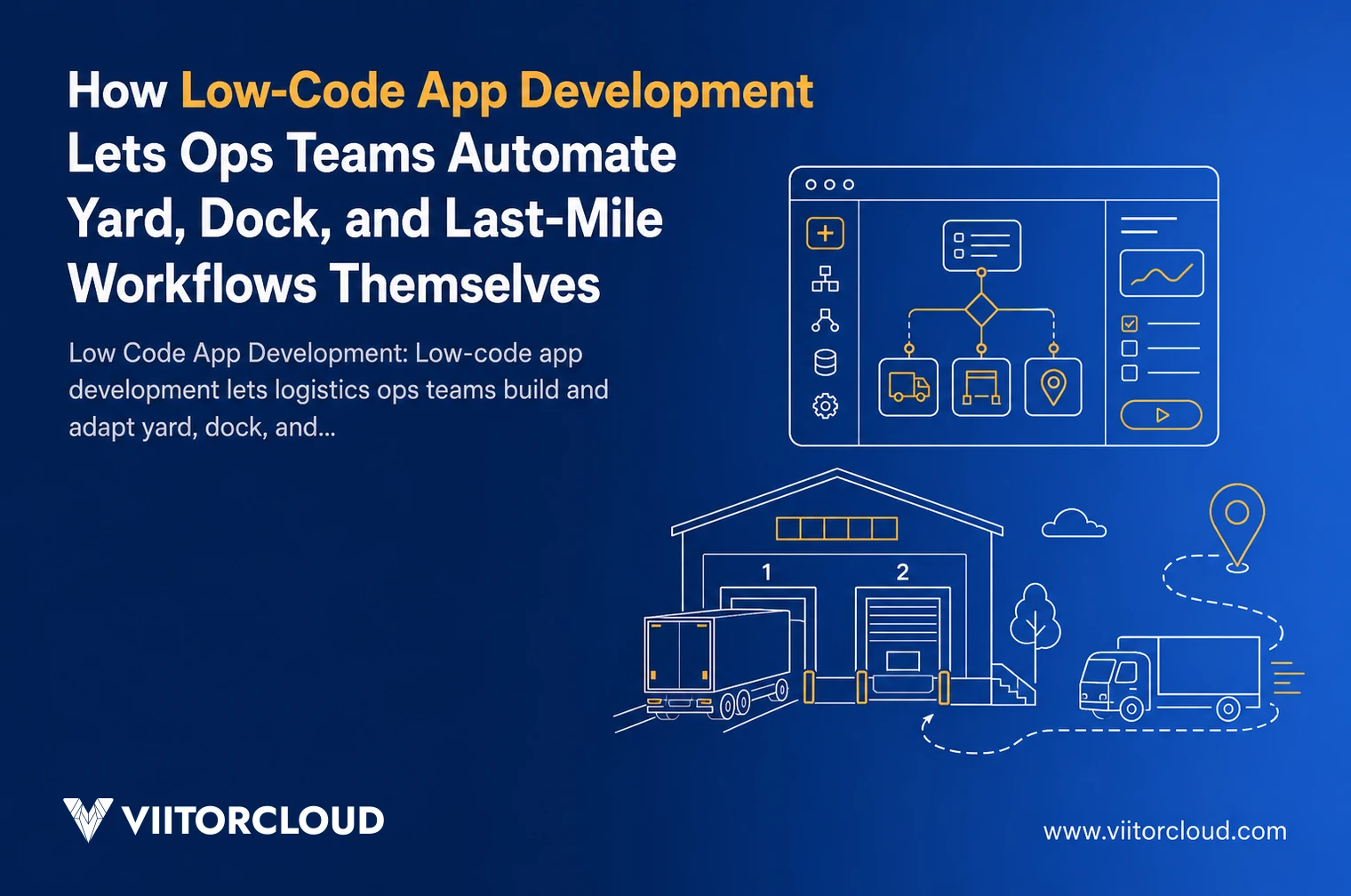
Low-code app development lets logistics operations teams build and change their own yard, dock, and last-mile workflow apps in days, without waiting months for an IT backlog to clear. Ops staff configure the tools they need on a governed platform that IT still controls.
I have spent years building logistics and port systems, and the same bottleneck shows up on almost every site. The people who understand the workflow cannot change the software, and the people who can change the software do not run the yard. Low-code closes that gap.
In this guide, I will explain what low-code app development means in logistics, which yard, dock, and last-mile workflows to automate first, and how to roll it out without creating shadow IT.
Key Takeaways
- Low-code app development lets logistics ops teams build and adapt yard, dock, and last-mile apps themselves, cutting IT wait times from months to days.
- Citizen development works only when IT sets the guardrails, so governance is the difference between speed and shadow IT.
- Start with high-friction, spreadsheet-and-radio workflows such as yard check-in, dock scheduling, and last-mile proof of delivery.
- Gartner projects 70% of new enterprise apps will use low-code by 2025, so the tooling and talent are ready now.
- IT keeps control of security and integrations while ops owns everyday workflow changes, which frees developers for complex builds.
Why Yard, Dock, and Last-Mile Teams Are Still Stuck on Spreadsheets and Radios
Walk into most yards or docks, and you will still find operations running on whiteboards, radios, and a shared spreadsheet that one person guards. The software that runs the warehouse rarely reaches the gate, the trailer, or the delivery van.
Two things cause this. First, logistics is short on people. Some industry estimates put open supply chain and warehouse roles as high as 600,000, so no team has spare hands to manage clunky tools. Second, the data these teams need is trapped in disconnected systems.
That second problem is really a system integration and modernization issue. Yard data sits in one system, the transport management platform holds another slice, and the last-mile app is a third island. When ops asks IT to connect them, the request joins a backlog that can take months to clear.
So teams improvise. They patch the gap with spreadsheets and radios, and logistics automation stays stuck while the workflows that matter most stay manual, error-prone, and invisible to the rest of the business.
See Governed Low-Code Built for Your Operation
We set the data and governance foundation, then train your ops team to build yard, dock, and last-mile apps themselves.
What Low-Code App Development Actually Means for Logistics
Low-code app development is a way to build working business apps mostly by configuring visual components, drag-and-drop forms, and prebuilt logic, with only small amounts of hand-written code. In practice, a yard supervisor can turn a paper gate process into a mobile check-in app without writing software from scratch.
The distinction that matters for logistics is control. A low-code platform sits between rigid off-the-shelf tools and slow custom builds, so you configure and adjust apps as the operation changes.
This is a mainstream shift, not a fringe one. Gartner projects that by 2025, 70% of new applications built by enterprises will use low-code or no-code technology, up from less than a quarter in 2020. The platforms and the low-code development skills to run them are mature and available today.
The companion idea is citizen development. A citizen developer is an operations person, not a professional coder, who builds governed apps on an approved platform. Paired with proper low-code business apps and AI-driven automation, citizen development is how ops teams stop waiting and start shipping their own tools.
The Yard, Dock, and Last-Mile Workflows to Automate First
Start where the pain is sharpest, and the rules are clearest. These three areas almost always give ops teams a fast, visible win and a foothold for broader logistics automation.
Yard management. Replace the gate whiteboard with a check-in app that logs trailers, assigns spots, and shows real-time yard status on any phone. Drivers stop guessing, and gate staff stop radioing around for space.
Dock scheduling. Turn the dock door spreadsheet into a booking app that lets carriers reserve slots, flags late arrivals, and balances labor across doors. I worked with a dock team that ran three shifts off one laminated sheet, and a simple scheduling app removed most of the daily arguments about who loaded where.
Last-mile execution. Give drivers a proof-of-delivery app that captures signatures, photos, and exceptions, then feeds them to dispatch instantly. This is the kind of AI automation for logistics that pays for itself in fewer disputes and faster cash collection.
Notice the pattern. Each app targets one workflow, one owner, and one clear rule set. That focus is what makes low-code development safe to hand to an ops team, and it keeps the first projects small enough to finish in weeks.
McKinsey has found that companies using automation across their supply chains cut logistics costs by 15 to 30 percent. That logistics automation only pays off once these frontline workflows leave the spreadsheet.
Automate Yard, Dock, and Last-Mile Workflows
Turn spreadsheets and radios into governed low-code business apps your team can adapt as the operation changes.
How to Roll Out Low-Code Business Apps Without Creating Shadow IT
The worry I hear from every warehouse IT lead is fair. Hand ops a build-it-yourself tool, and you can end up with hundreds of ungoverned apps, duplicated data, and fresh security holes. Governed low-code business apps prevent that, and the model is straightforward.
- IT sets the guardrails first. Define approved data sources, security rules, integrations, and who can publish an app before anyone builds one.
- Pick two or three starter workflows. Choose high-friction yard, dock, or last-mile tasks with clear rules and obvious owners.
- Train a small group of citizen developers. Give ops leads the platform, templates, and a review process rather than a blank canvas.
- Review, then scale. IT checks each app against the guardrails, promotes what works, and retires what does not.
Done this way, citizen development speeds up the business instead of fracturing it. Most teams do not have time to design this governance layer alone, and this is where experienced low-code development services earn their keep, standing up the platform, guardrails, and starter templates so your first apps are safe by design.
Explore AI-Driven Automation for Logistics
See how ViitorCloud delivers low-code business apps and AI-driven automation across yard, dock, and last-mile operations.
Where ViitorCloud Fits in Your Low-Code Logistics Rollout
At ViitorCloud, I have built logistics systems at the scale where governance really matters. My logistics platforms team has delivered a port management system now running across 14 active sites in more than 10 countries, tracking millions of freight tons in container and general cargo.
That experience shapes how we approach low-code app development for operations teams. We set the data and governance foundation and connect the systems your yard, dock, and last-mile apps depend on. Then we train your people to build and adapt workflows themselves. If your team is caught between rigid systems and spreadsheets, our low-code development services are worth reviewing before you lock in a technology roadmap.
The Bottom Line on Low-Code for Logistics Operations
Low-code app development gives logistics operations teams something they have wanted for years, which is the ability to fix their own yard, dock, and last-mile workflows without a months-long IT queue. The technology is ready, the talent gap makes it necessary, and the results show up fast.
Start small. Pick two or three painful workflows, put governance in place first, and let a trained group of citizen developers build. Keep IT in control of data and security, then expand from there.
Do that, and the whiteboards and radios start to disappear, replaced by tools your own people built and can change whenever the operation does.

Vishal Shukla
Vishal Shukla is Vice President of Technology at ViitorCloud Technologies.
Frequently Asked Questions
What is low-code app development in logistics?
Low-code app development lets logistics teams build workflow apps visually, replacing spreadsheets and radios across yard, dock, and last-mile operations.
What is citizen development in supply chain operations?
Can logistics ops teams build apps without coding?
Is low-code app development secure enough for logistics?