


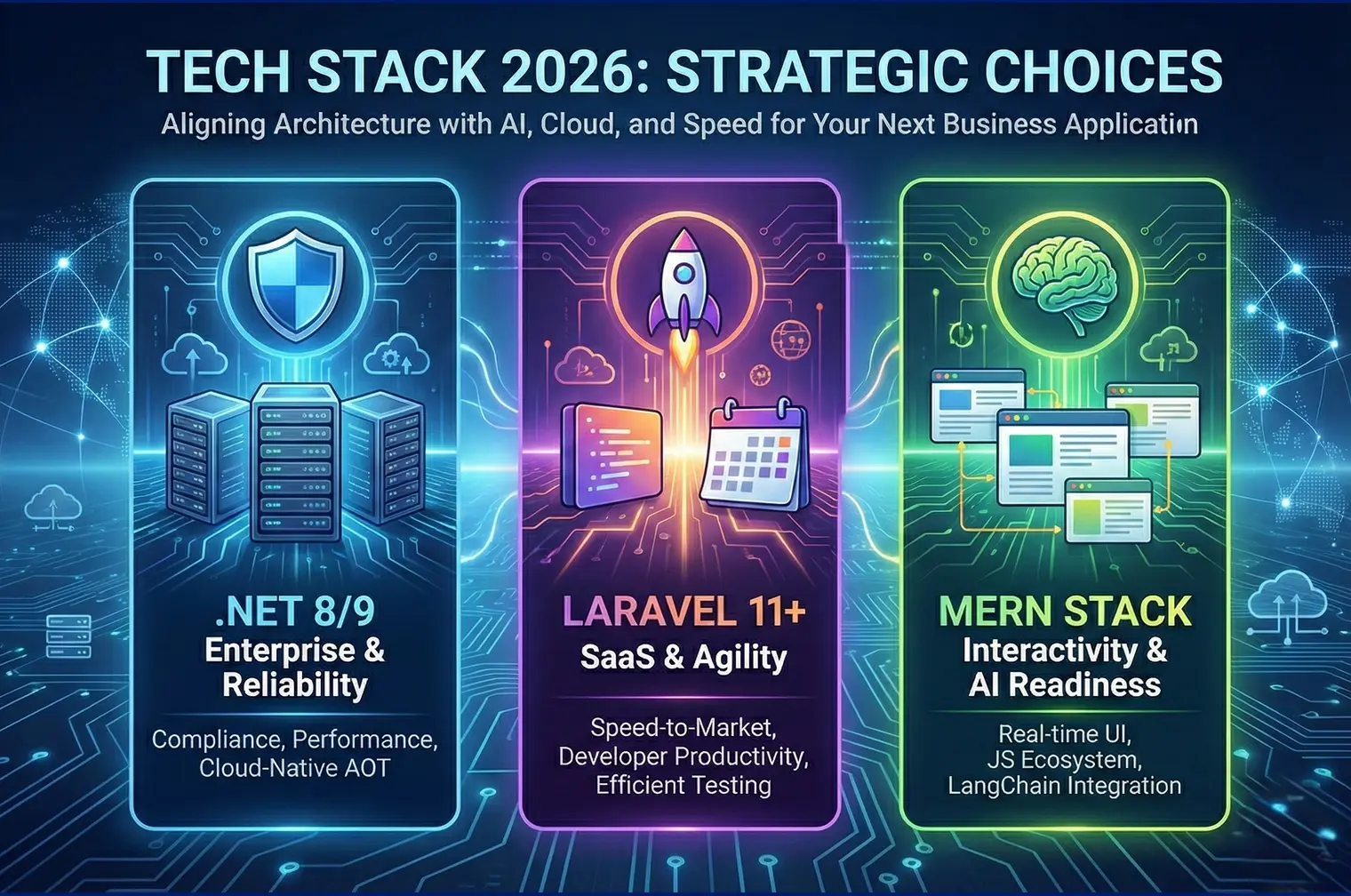
Choosing between .NET vs Laravel vs MERN in 2026 is less about chasing a “best” stack and more about aligning architecture with AI readiness, cloud economics, and delivery speed under real-world constraints. The 2025 Stack Overflow Developer Survey (49,000+ respondents) reinforces what most CTOs already feel: the talent market is broad, but the “right” skills mix depends heavily on your product shape and operating model.
In 2026, the pressure is higher because LLM features are moving from “nice-to-have” to default expectations in search, support, analytics, and internal ops, while scalability and compliance demands keep tightening. There is no universal winner—only the right technology choice for specific business goals and risk profiles.
What are the key selection criteria for 2026?
Cloud spend is no longer a back-office concern; it is a product decision, and infrastructure efficiency can be a competitive advantage when usage spikes. AWS continues to position Arm-based Graviton instances as a cost lever, citing up to 40% better price-performance versus equivalent non-Graviton EC2 instances for cloud workloads.
Beyond cost, selection in 2026 typically comes down to a few repeatable decision axes. The strongest outcomes come when these criteria are evaluated together rather than in isolation.
- Economics: Compute efficiency (runtime + hosting model) directly affects scaling cost, and Graviton guidance emphasizes price-performance improvements as a core optimization path.
- Availability: Generalist hiring is easier when your stack matches mainstream developer preferences captured in large surveys like Stack Overflow’s annual report.
- Readiness: Mature AI tooling matters; Microsoft positions Semantic Kernel as a lightweight, open-source kit to integrate AI models into C#, Python, or Java applications.
- Assurance: Regulated industries often need a predictable security posture and maintainability, which is strongly influenced by framework maturity and platform governance.
- Velocity: Your “idea-to-prod” time is constrained by scaffolding, conventions, and integration ecosystem—not just raw coding speed.
Choose the Right Technology Stack for Your Business Application
Compare .NET, Laravel, and MERN with expert guidance and select a future-ready Technology Stack for scalable Business App Development.
How do .NET, Laravel, and MERN differ in practice?
Microsoft .NET for enterprise buildouts
.NET 8/9 is a strong fit when reliability, maintainability, and deep platform support matter as much as feature speed, particularly for multi-service backends and high-traffic APIs. Microsoft’s own release performance notes highlight the scale of ongoing optimization work, with “Performance Improvements in .NET 8” covering 500+ PRs and “Performance Improvements in .NET 9” covering 350+ PRs.
For cloud-native architectures, AOT can shift the cost-and-latency curve in serverless and container environments because native AOT deployments are explicitly documented as having faster startup and smaller memory footprints.
In our experience at ViitorCloud, regulated programs (FinTech workflows, healthcare data processing, audit-heavy systems) often choose .NET when they want a stable long-term platform story plus strong engineering guardrails for compliance-driven delivery.
Laravel can really power modern SaaS in 2026
Laravel 11+ remains a practical choice when speed-to-market and developer productivity are the center of gravity, especially for SaaS platforms where the domain evolves weekly. Laravel’s official 11.x release notes emphasize a streamlined application structure and platform-level improvements (for example, reusing PDO connections to speed up SQLite in-memory testing), often cutting total test run time in half in that testing scenario.
AI enablement in Laravel is also straightforward because established integration packages exist; for example, openai-php/laravel documents PHP 8.2+ support and provides a Laravel facade for calling OpenAI APIs.
In our experience at ViitorCloud, Laravel is frequently the fastest path to a credible MVP when startups need to validate pricing, onboarding, and billing flows before investing in deeper platform engineering.
MERN is still the best choice for interactivity
MERN (MongoDB, Express, React, Node.js) stays compelling when product value is tied to real-time UI behavior, rich dashboards, and “always-on” collaboration patterns. Stack Overflow’s 2025 technology survey is a useful signal here because it continues to track strong usage across the JavaScript ecosystem that MERN depends on.
For LLM features, MERN benefits from fast-moving JS-first orchestration libraries; LangChain’s JavaScript docs position it as a low-friction way to build LLM-powered apps and agents, with quickstarts that get teams from setup to working agents rapidly.
This is why MERN is often favored for customer-facing SPAs, interactive admin portals, and event-driven products where JSON-native data flow reduces translation overhead across tiers.
How do they stack up against each other?
The most “correct” answer depends on your constraints, but a structured comparison helps prevent decisions based only on familiarity. TechEmpower’s Web Framework Benchmarks remain a widely referenced place to sanity-check raw framework performance discussions (they publish recurring benchmark rounds, including Round 23 dated 2025-02-24).
| Dimension | .NET 8/9 | Laravel 11+ | MERN |
| Speed to market | Strong for large teams with stable patterns; great tooling depth. | Often fastest for CRUD-heavy SaaS and MVPs with strong conventions. | Fast for UI-heavy products due to shared JS and rich frontend ecosystem. |
| Performance posture | Continuous runtime optimization work across releases; AOT can improve startup/memory in some deployments. | Solid for many SaaS workloads; performance tuning is usually app + DB + caching discipline. | Great for IO-heavy and real-time use cases; performance depends heavily on architecture and Node patterns. |
| AI integration | Semantic Kernel supports integrating AI models into .NET apps and provides connectors (including OpenAI connectors). | OpenAI integration is well-supported via community packages (e.g., openai-php/laravel). | LangChain JS ecosystem accelerates agent workflows and LLM integrations in Node/React. |
| Cost control | Strong levers via AOT + efficient hosting; Graviton guidance includes optimizing Microsoft workloads on Arm for cost/perf. | Often cost-efficient for early-stage scale; biggest wins come from caching/queues and DB tuning. | Cost-effective when you consolidate skills and runtime; cloud cost still tied to traffic + architecture. |
Build a High-Performance Business Application in 2026
Turn the right Technology Stack into real results with ViitorCloud’s end-to-end Business App Development expertise.
Which stack is best for AI & legacy modernization?
For custom AI development, the “best” stack is the one that makes model orchestration, tool calling, evaluation, and secure deployment easy for your team—not just the one with the most hype. Semantic Kernel is explicitly designed to help teams build AI agents and integrate models into applications, which can be a strong fit when your core platform is already C#-centric or your governance favors Microsoft-aligned tooling.
For JavaScript-heavy organizations, LangChain’s JS ecosystem can reduce time-to-first-agent and keep AI logic close to the product surface area (e.g., dashboards, copilots, and workflow automation UIs).
For legacy system modernization, .NET is often chosen when modernization includes rewriting critical services with strict contracts and long-lived maintainability, while Laravel can modernize internal portals and line-of-business systems quickly when the main need is cleaner workflows, better UX, and faster iteration. Microsoft and AWS also publish explicit guidance on using Graviton and containers to optimize Microsoft workloads, which matters if modernization is paired with cloud cost reduction goals.
Final verdict: what should you choose?
Pick .NET 8/9 when the application is mission-critical, compliance-heavy, or built to run for years with evolving teams, and when you want a platform with deep investment in performance and runtime capabilities. Microsoft’s ongoing .NET 8 and .NET 9 performance work is documented in official posts that reflect the maturity and momentum of the ecosystem.
Pick Laravel 11+ when speed-to-market and total delivery cost dominate early decision-making, especially for SaaS MVPs that need fast iteration and strong developer ergonomics, with official 11.x notes showing continued framework streamlining and productivity wins (including faster in-memory testing scenarios).
Pick MERN when interactivity is the product, you want a unified JavaScript mental model, and your roadmap includes real-time experiences plus rapid AI feature experimentation supported by mature JS libraries like LangChain.
Plan Your Business Application with the Right Technology Stack
Align performance, scalability, and cost by choosing the best Technology Stack for long-term Business App Development.
Conclusion
We recommend treating the stack decision as a strategic architecture choice, not a popularity contest, because the “right” technology in 2026 is the one that keeps delivery fast while protecting reliability, security, and cloud economics. At ViitorCloud, we architect futures. Whether you need the security of .NET or the agility of MERN, our team is ready to help you build for 2026. Contact us today at [email protected].

Niketan Shah
Niketan Shah is a professional in the field of Project Management with over 8 years of extensive experience in Quality Assurance and Project Management.