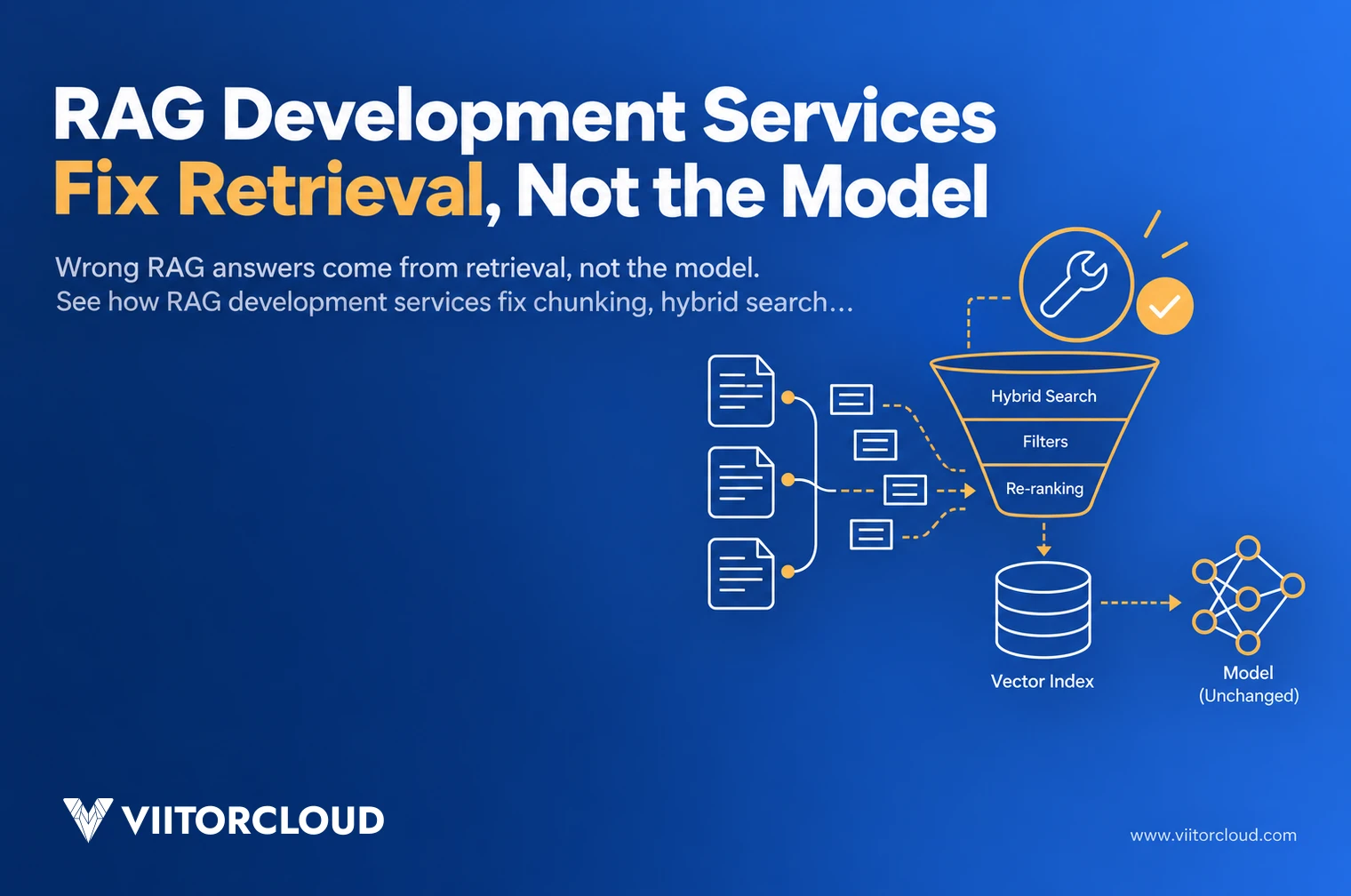
Your RAG system returns confidently wrong answers because the passage that held the correct answer was never retrieved. The model is not inventing things in a vacuum. It is writing a fluent summary of the wrong evidence. That is why teams who buy RAG development services hoping for a smarter model stay stuck, and teams who rebuild the retrieval layer see accuracy move within weeks.
I have watched architects swap models twice, rewrite the system prompt, and land in the same place. The failure sits earlier in the pipeline. Chunk boundaries split a rule from its condition, ranking rewards keyword overlap over meaning, and access filters run after ranking instead of before.
Key Takeaways
- Most wrong RAG answers are retrieval failures. The correct passage never entered the context window, so no model swap can recover it.
- Three causes account for the majority of them. Chunk boundaries separate a rule from its exception, ranking matches topic instead of entity, and access filters are applied after ranking.
- Hybrid search that combines vector and keyword scoring outperforms either method alone on domain language such as drug names, billing codes, and policy identifiers.
- Permission-aware retrieval has to filter the candidate pool before ranking. Filtering afterwards silently truncates the context, and the model answers from whatever survives.
- An evaluation set of 50 to 100 real user questions tells you more than any public benchmark. Measure recall in your retrieval infrastructure before you measure answer quality.
Why Does RAG Give Wrong Answers
RAG gives wrong answers when retrieval hands the model the wrong passages. Three causes account for most of it. Chunking separates a statement from the condition that qualifies it. Ranking favors topical overlap over the specific entity in the question. Permission filters run after ranking and quietly remove the best results.
The model then does its job on incomplete evidence, and it sounds certain because nothing in the context contradicts it. Accuracy stops being a property of the model at that point. It becomes a property of your retrieval infrastructure.
How to Diagnose a Retrieval Failure Before You Touch the Model
Before any model change, log the chunk IDs returned for a failing question and read them. In most cases, the answer simply is not in there. Every retrieval audit I run inside a RAG development services engagement starts with this list, which maps the symptoms I see most often to the likely cause and the first fix worth testing.
- Symptom: The answer is confidently wrong and cites a real but unrelated document.
Likely cause: Embedding-only ranking matched the topic instead of the specific entity.
Fix to test first: Add keyword scoring alongside the vector index and fuse both result sets. - Symptom: The answer is correct but drops the exception or the condition.
Likely cause: A chunk boundary separated the rule from its qualifier.
Fix to test first: Move to a structure-aware chunking strategy and expand each hit to its parent section. - Symptom: The assistant says the information is unavailable when the document clearly exists.
Likely cause: Access filtering ran after ranking and removed the top results.
Fix to test first: Apply permission-aware retrieval to the candidate pool before scoring. - Symptom: Answers get worse as the corpus grows.
Likely cause: Top-k stayed fixed while the number of near-matching passages rose.
Fix to test first: Retrieve a wider candidate set, then rerank it with a cross-encoder. - Symptom: The same question returns different answers on different days.
Likely cause: Duplicate and near-duplicate versions of one document compete for the same slot.
Fix to test first: Deduplicate at ingestion and weight results by version or effective date.
Audit your retrieval layer before the next model upgrade
We score recall at the retrieval step against a set of your real user questions, then show which failures come from chunking, ranking, or access filters.
Your Chunking Strategy Decides What the Model Can See
Fixed windows of 500 tokens with a little overlap are the default in every tutorial, and they are the largest source of silent failure in enterprise content. Clinical policies, contracts, and standard operating procedures carry meaning across section boundaries. Split one at the wrong point, and you keep the rule while losing the exclusion that governs it.
Take a prior authorization assistant. The coverage rule sits under one heading, and the exclusion for patients under 18 sits three paragraphs later under another. Retrieve the first chunk alone, and the assistant says the procedure is covered. The answer is fluent, it is sourced, and it is wrong.
A chunking strategy that survives production usually does four things:
- Splits on structural boundaries such as headings, clauses, and table rows rather than on token counts.
- Carries the heading path into the chunk text so the passage keeps its context.
- Stores parent and sibling links so a single hit can expand to the full section at answer time.
- Keeps document type, department, effective date, and version in metadata for filtering.
Getting this right depends on the ingestion pipeline far more than the vector database. The same discipline that governs intelligent document processing in healthcare data pipelines applies here, because a chunk is only ever as good as the parsing that produced it.
Why Hybrid Search Beats Vector Search on Its Own
Embeddings are good at meaning and poor at identifiers. Ask about ICD-10 code J45.909 or policy MED-114, and a dense retriever will return passages about asthma in general or about a different policy with similar wording.
This is measured, not anecdotal. The BEIR benchmark study found that BM25 remains a strong baseline and that many dense retrievers lose ground to it once they move outside the data they were trained on. Enterprise corpora are almost always outside that data.
Hybrid search across vector and keyword indexes closes most of the gap. Run both, fuse the ranked lists, then rerank the merged candidates with a cross-encoder that scores each passage against the actual question. That sequence moves recall further in one sprint than any model upgrade I have shipped on an enterprise RAG implementation.
Build permission-aware retrieval into your clinical assistant
ViitorCloud has engineered HIPAA-compliant healthcare platforms, including a revenue cycle system that has processed $192.2M, with access control enforced in the data layer rather than the prompt.
Permission-Aware Retrieval Belongs Before Ranking, Not After
Most teams bolt access control on at the end. They retrieve the top 10, drop whatever the user is not cleared to see, and pass the remainder to the model. The result is a truncated context the model answers from anyway, so a nurse and a billing analyst get different answers to the same question and neither is told why.
Permission-aware retrieval inverts that order. Entitlements resolve at query time into a filter on the candidate pool, so ranking only competes over records the user may legitimately read. In healthcare, this is also a compliance control, because the HIPAA minimum necessary standard limits use of protected health information to the smallest amount needed for the task.
Three implementation details decide whether it holds up:
- Store access metadata on the chunk, not only on the source document, because sections of one record often carry different sensitivity.
- Resolve group membership at query time rather than at ingestion, so a role change takes effect on the next question.
- Log every retrieved chunk ID against the user and the query, which gives auditors the evidence trail they will eventually ask for.
Teams already running clinical integrations know this ground. The access model that governs AI integration in EHR and EMR systems should also govern the retrieval layer of the assistant sitting on top of it.
How RAG Development Services Rebuild the Retrieval Layer
Serious RAG development services start with measurement, not architecture. Before anyone touches the stack, I build an evaluation set of 50 to 100 real user questions, each tagged with the passage that should have been retrieved. That set produces recall at the retrieval step, which is the number that actually predicts answer quality.
From there, the sequence stays consistent across almost every enterprise RAG implementation:
- Rebuild ingestion with structure-aware parsing, deduplication, and a chunking strategy matched to each document type.
- Index for hybrid search so vector and keyword retrieval both contribute candidates.
- Add a reranking stage that scores the merged candidates against the question.
- Enforce permission-aware retrieval on the candidate pool before ranking.
- Instrument everything, logging retrieved chunk IDs, scores, and latency with every answer.
The last step is the one teams skip and later regret. Without retrieval logs, every accuracy complaint turns into an argument about the model. With them, you can prove in an afternoon whether the passage was retrieved and ranked, which is where the retrieval infrastructure conversation should have started. This is engineering work that sits closer to AI integration services and data plumbing than to model research.
Start with a scoped RAG proof of concept
Think big, start small. We validate the retrieval layer on one document set and one user group, and prove recall improves before any enterprise RAG implementation is scaled.
Where ViitorCloud Starts on an Enterprise RAG Implementation
ViitorCloud has spent 14+ years building the systems that sit underneath assistants like this. On the healthcare side, that includes a revenue cycle platform that has processed $192.2M and HIPAA-compliant data pipelines for clinical workloads. On the scale side, it includes a government identity platform with 70M+ registered citizens, where entitlement filtering at query time was a hard requirement rather than a feature.
Our custom RAG development services follow the same phased model we apply to every AI build. Start with one document set, one user group, and a measured retrieval baseline. Prove recall improves before scaling to the rest of the corpus. If you run an internal assistant over clinical or regulated content, our healthcare technology work shows how we build the access and data layers underneath it.
Fix Retrieval Before You Swap Another Model
Wrong answers in a production assistant are almost always evidence problems. The chunk boundary, the ranking function, and the permission filter decide what the model is allowed to know, and no model on the market can recover a passage it never received. Read your retrieval logs, build a small evaluation set, and measure recall before you plan the next upgrade.
Teams that treat retrieval as the product ship assistants people trust. Teams that treat it as plumbing keep buying larger models to solve a search problem. RAG development services earn their place by closing that gap, and the work starts with the retrieval layer you already have.

Vishal Shukla
Vishal Shukla is Vice President of Technology at ViitorCloud Technologies.
Frequently Asked Questions
Why does my RAG system give confident wrong answers?
Because retrieval passed the wrong passages and the model summarized them faithfully. The usual causes are chunk boundaries that separate a rule from its exception, ranking that matches topic instead of entity, and access filters applied after ranking. Log the retrieved chunk IDs for a failing question and the cause is usually obvious.
Will a bigger model or a longer context window fix RAG accuracy?
What is the best chunking strategy for enterprise documents?
Do I need hybrid search or is vector search enough?
How does permission-aware retrieval work in a healthcare RAG system?