


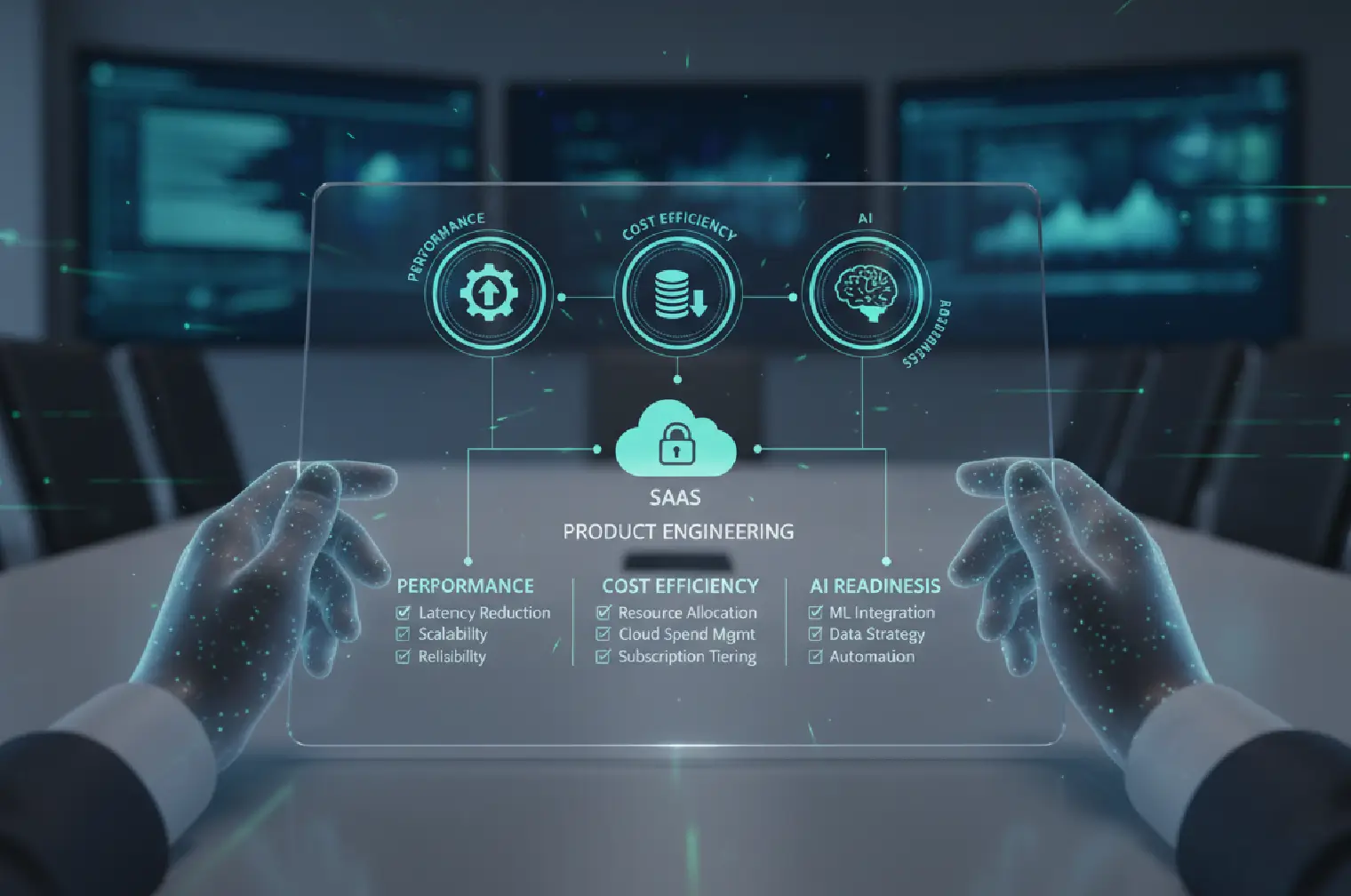
As we enter 2026, the software-as-a-service landscape has shifted from a “growth-at-all-costs” mentality to a refined focus on operational excellence and intelligent automation.
For modern enterprises, staying competitive no longer depends solely on feature richness; it depends on how lean, fast, and AI-integrated your platform is.
A comprehensive SaaS optimization checklist is now a survival manual for CTOs and product owners who want to maintain high margins while delivering superior user experiences.
At ViitorCloud, we have observed that the most successful platforms are those that treat SaaS optimization as a continuous engineering discipline rather than a one-time event.
This year, the focus is squarely on three pillars:
- technical performance,
- financial sustainability (FinOps),
- “Agentic” AI readiness.
By prioritizing SaaS product engineering that aligns with these trends, businesses can ensure their platforms remain resilient in an increasingly crowded global market.
Optimize Your SaaS for 2026 Growth
Apply our SaaS Optimization Checklist to improve performance, control costs, and strengthen AI readiness with expert SaaS Product Engineering.
The 2026 Paradigm Shift in SaaS Engineering
The year 2026 marks the end of the “AI hype” cycle and the beginning of the “AI ROI” era. Customers are no longer impressed by a simple chatbot integrated into a dashboard.
They expect agentic workflows where the software anticipates needs and executes complex tasks autonomously.
This shift requires a fundamental rethink of SaaS product engineering to support high-frequency data processing and low-latency AI inferences.
When we look at SaaS optimization, we must consider the underlying architecture. Modern platforms are moving away from bloated microservices toward “composable” architectures.
This allows for specific modules to be scaled or updated without affecting the entire ecosystem. For companies looking to lead their niche, following a structured SaaS optimization checklist ensures that no stone is left unturned in the pursuit of a high-performance product.
Pillar 1: High-Velocity Performance Optimization
In 2026, performance is measured in milliseconds of “time-to-insight.” Users expect AI-driven features to respond as quickly as static data.
According to Gartner’s 2026 Strategic Trends, enterprises are increasingly prioritizing “Sovereign AI” and localized data processing to reduce latency.
This is where specialized SaaS product engineering becomes critical.
To achieve this, your team should focus on:
- Edge Inference: Moving AI model execution closer to the user to eliminate round-trip delays to central servers.
- Database Refactoring: Transitioning to vector databases that can handle the massive unstructured data loads required for modern RAG (Retrieval-Augmented Generation) systems.
- API Efficiency: Implementing GraphQL or specialized gRPC protocols to ensure that data transfer between the front-end and back-end is as lean as possible.
Integrating these elements into your SaaS product engineering roadmap allows for a platform that doesn’t just work but excels under heavy load.
Pillar 2: Cost Management and Unit Economics (FinOps 2.0)
Effective SaaS optimization in 2026 requires a deep dive into “Unit Economics.” It is no longer enough to track your total AWS or Azure bill.
You must understand the “Cost per AI Inference” or the “Cost per Active User Feature.”
Without this visibility, the overhead of running advanced LLMs can quickly erode your profit margins.
Many businesses are now adopting usage-based pricing models, which require the backend to be incredibly efficient.
You can explore more about these financial transitions in our guide on SaaS optimization strategies for business.
A key item on your SaaS optimization checklist should be the implementation of “Scale-to-Zero” architecture. By utilizing serverless functions and ARM-based processors (like AWS Graviton), engineering teams can reduce compute costs by up to 40%.
Automated “Zombie Hunting” agents should also be deployed to identify and terminate idle resources or unattached storage volumes that contribute to “cloud sprawl.”
| Optimization Category | Traditional Approach (2023-2024) | 2026 Optimized Approach |
| Compute | Always-on Microservices | Serverless & Scale-to-Zero |
| AI Integration | Third-party API wrappers | Native Agentic Workflows |
| Cost Tracking | Monthly Cloud Bill Review | Real-time Cost-per-Token Tracking |
| Data Storage | Standard Relational DBs | Vector-hybrid Databases |
| Latency | Centralized Data Centers | Global Edge Distribution |
Pillar 3: AI Readiness and Agentic Workflows
AI readiness is the most significant addition to the SaaS optimization checklist for 2026. We are moving beyond “Co-pilots” that assist users to “Agents” that work on behalf of users.
To support this, your SaaS optimization efforts must focus on data hygiene and model governance.
If your data is siloed or messy, your AI agents will be ineffective. Engineering teams must build robust data pipelines that include real-time PII (Personally Identifiable Information) masking and data cleaning.
This ensures that the information being fed into your models is both safe and accurate. For a deeper look at how this integration is evolving, see our insights on AI Co-pilots in SaaS product roadmaps.
Furthermore, SaaS product engineering now involves “Model Observability.” This means having tools in place to detect “model drift,” where an AI’s performance degrades over time, and “hallucination rates.”
Ensuring your infrastructure can handle the orchestration of multiple AI agents working in tandem is a vital competitive advantage.
Build AI-Ready SaaS with Confidence
Drive Digital Transformation with modern SaaS Product Engineering aligned to the SaaS Optimization Checklist for 2026.
The Definitive SaaS Optimization Checklist for 2026
To help your team stay on track, we have compiled the essential tasks for the coming year. This checklist should be reviewed quarterly to ensure alignment with evolving market demands.
- Audit AI Unit Economics: Calculate the exact cost of every AI-driven interaction to ensure your pricing tiers remain profitable.
- Transition to Composable Architecture: Break down any remaining monoliths into interchangeable services to improve agility.
- Implement Post-Quantum Cryptography: Start the migration to quantum-resistant encryption to protect sensitive B2B data.
- Deploy GreenOps Protocols: Optimize code and resource usage to meet new 2026 sustainability reporting requirements.
- Enable Multi-Agent Orchestration: Ensure your backend can support multiple AI agents collaborating on a single user request.
- Optimize for Global Sovereignty: Ensure data residency compliance by architecting regional stacks for different geographic markets.
- Refine Vector Search Capabilities: Tune your databases to provide lightning-fast retrieval for RAG-based AI features.
As predicted in Forrester’s 2026 Outlook, the winners in the SaaS space will be those who prioritize “Trust-as-a-Service.” This means your SaaS optimization must include transparent AI logging, so users know exactly why an AI agent made a specific decision.
Strategic SaaS Product Engineering for Long-Term Success
At its core, SaaS product engineering is about building for the future while solving today’s problems.
In 2026, this means creating a platform that is elastic enough to adopt new AI models as they emerge without requiring a total rewrite of the codebase. It’s about building a foundation where SaaS optimization is baked into the CI/CD pipeline.
By focusing on SaaS product engineering for business success, companies can move away from reactive bug-fixing and toward proactive innovation. This involves adopting “low-code” internal tools to speed up feature deployment and using AI-assisted coding to maintain high-quality documentation.
The role of the developer has changed. In 2026, SaaS product engineering is as much about managing data flows and AI tokens as it is about writing logic. This evolution is detailed in our recent research on the top 8 AI trends for 2026, which highlights how “Agentic AI” is becoming the standard for B2B platforms.
Scale Smarter with SaaS Product Engineering
Modernize your platform using a proven SaaS Optimization Checklist and accelerate Digital Transformation with ViitorCloud.
Conclusion: Master the 2026 SaaS Landscape
The journey toward a fully optimized platform is ongoing. By following this SaaS optimization checklist, you position your company to handle the technical and financial rigors of the modern era. Whether it is through reducing latency, slashing unnecessary cloud costs, or ensuring your data is ready for the next generation of AI agents, SaaS optimization is the key to maintaining a competitive edge.
The complexity of modern SaaS product engineering requires a partner who understands the nuances of 2026’s technological landscape. At ViitorCloud, we specialize in transforming legacy SaaS platforms into lean, AI-first powerhouses. By integrating these optimization strategies today, you are future-proofing your business.
Contact ViitorCloud today for a comprehensive performance and AI readiness audit to see how we can elevate your SaaS offerings.

Vishal Shukla
Vishal Shukla is Vice President of Technology at ViitorCloud Technologies.