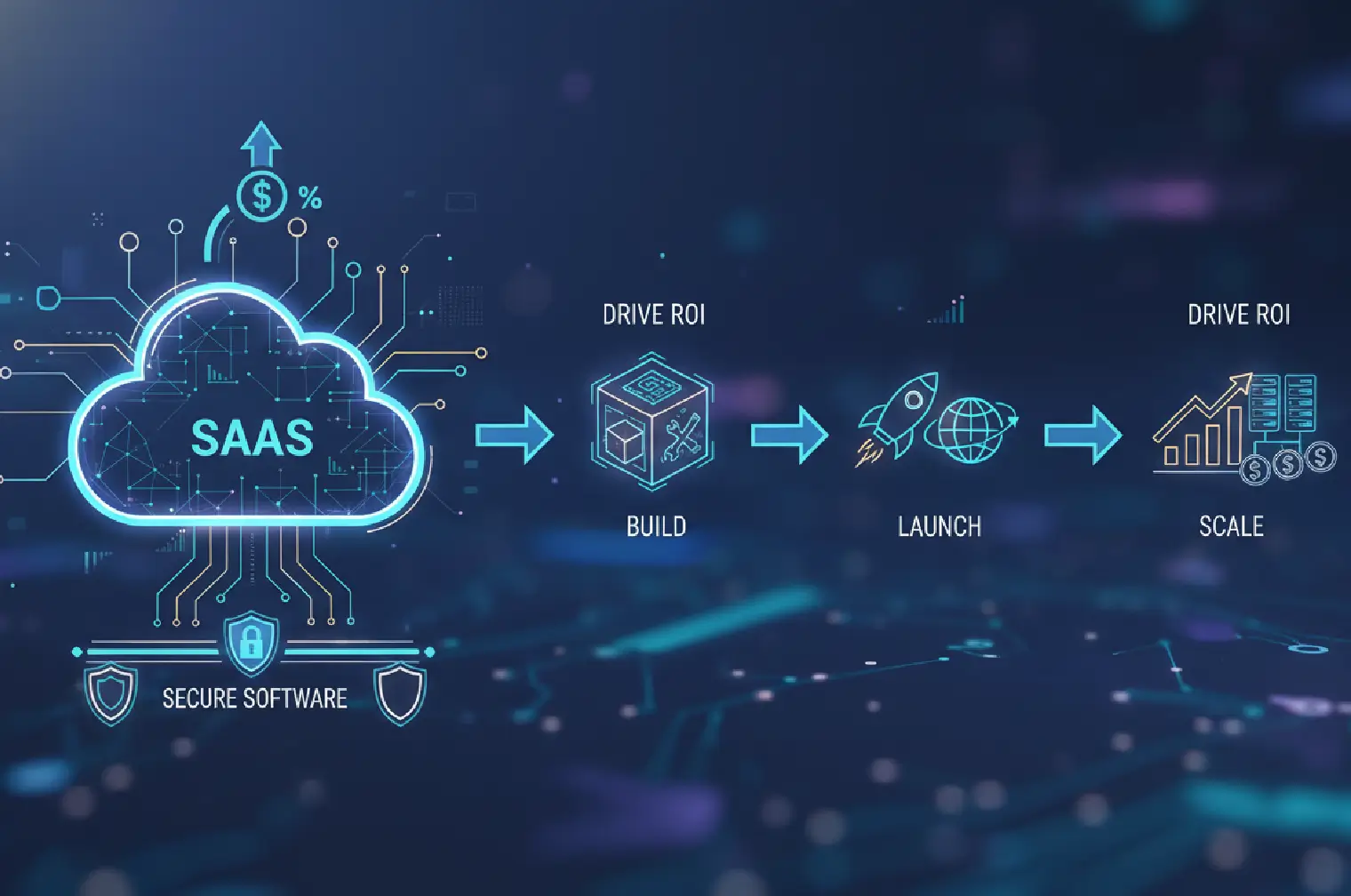
SaaS software development in 2026 operates in a market projected to reach $375.57 billion this year, with 99% of organizations now using at least one SaaS application. The market does not lack products. It lacks products built to last.
The stack you choose at the start determines how fast you ship, how much you spend scaling, and how easily you hire engineers. Industry research is clear: changing your architecture mid-project costs 3 to 5 times more than making the right SaaS technology choices from the beginning.
This guide covers the best tech stack for SaaS in 2026 across every product layer, using developer survey data and current production architecture patterns. Each section maps to a real decision technical founders and engineering leaders face when starting or scaling SaaS software development.
The Real Price of a Wrong Stack Decision
Poor SaaS technology choices follow a predictable pattern. Performance degrades during traffic spikes. Security gaps appear during enterprise sales cycles. Onboarding new engineers takes weeks instead of days. A niche stack narrows the hiring pool faster than most teams anticipate.
These outcomes are avoidable. The evidence-based approach evaluates five layers independently: frontend, backend, database, cloud infrastructure, and the DevOps and AI layer. Getting all five right as a system separates resilient SaaS platforms from ones that demand costly re-architecture at scale.
Five Layers That Define Every SaaS Stack
A SaaS software development stack is five interconnected decisions, not one.
- Frontend – the interface users interact with daily
- Backend – business logic, APIs, and data processing
- Database – storage, retrieval, and consistency
- Cloud infrastructure – where the application runs and scales
- DevOps and AI layer – deployment pipelines, automation, and intelligence
Each layer constrains the next. Choosing a Python-first backend while building a React Node SaaS team creates friction from day one. The decisions compound into either a competitive advantage or compounding technical debt.
Stop building outdated platforms on obsolete infrastructure
Choosing the wrong architecture severely limits your growth and burns your enterprise capital. We map out the best tech stack for SaaS software to guarantee your market dominance. Leverage our elite saas software development services and cutting-edge SaaS software development technology. We execute flawless SaaS development services and deploy secure cloud-native SaaS services that scale your recurring revenue instantly.
React and Next.js Lead the Frontend for Measurable Reasons
React is the most widely used frontend framework globally. According to the Stack Overflow Developer Survey 2025, 44.7% of professional developers use React and Next.js powers 2.4% of all websites worldwide.
For React Node SaaS products, Next.js 15 with the App Router reduces time-to-interactive on data-heavy dashboards. That matters in SaaS applications where users spend hours inside the product every day. TypeScript accompanies this stack at 43.6% professional developer adoption, overtaking both Python and JavaScript as the most active language on GitHub in 2025. Tailwind CSS sits at 51% developer adoption.
When a Different Frontend Fits Better
- Svelte or SvelteKit – for smaller teams where bundle size and load speed are priorities
- Vue with Nuxt – for teams already experienced in Vue who need full-stack capability
- Pure React with Vite – for highly interactive single-page applications without server-side rendering requirements
Node.js Leads the Backend. Python Is Closing the Gap.
Node.js holds 48.7% developer adoption globally. For React Node SaaS architectures, running JavaScript across both frontend and backend means engineers work across the full product without switching languages, which accelerates delivery and simplifies hiring. React Node SaaS development also benefits from the largest JavaScript package ecosystem available.
Python grew 7 percentage points year over year in the Stack Overflow 2025 survey, the largest single-year jump since 2013. FastAPI added 5 points in the same period. For SaaS products that embed machine learning, run data pipelines, or require intelligent workflows, Python with FastAPI or Django is the stronger backend choice. For real-time, API-heavy SaaS with unified codebases, Node.js remains the practical default.
ViitorCloud’s Node.js and DevOps expertise covers why this combination continues to underpin scalable, production-grade SaaS platforms.
PostgreSQL Leads Databases. Redis Handles the Performance Layer.
PostgreSQL holds 55.6% developer adoption and is the clear database default for most SaaS products. It handles structured transactional data, supports row-level security for multi-tenant architectures, and integrates with pgvector for AI-powered search.
Redis surged 8 percentage points in the Stack Overflow 2025 survey. SaaS teams use it as a caching layer to reduce database load at peak traffic. Multi-tenancy design is one of the most consequential early SaaS technology choices. Starting multi-tenant with a tenant ID on every table and row-level security enforced at the database level is the correct default for 90% of SaaS products.
Cloud Provider Selection Follows Workload, Not Preference
AWS holds approximately 30% global cloud market share, Azure 20%, and GCP 13%, according to Synergy Research Group Q3 2025 data. Each platform serves different SaaS use cases.
- AWS – best for e-commerce, logistics, and media SaaS requiring elastic infrastructure
- GCP – best for AI-driven SaaS products built around Google’s machine learning tooling
- Azure – best for enterprise SaaS serving Microsoft-heavy organizations
ViitorCloud’s cloud migration consulting guide for AWS, Azure, and GCP covers workload-specific selection, compliance considerations, and cost governance across all three platforms.
Dominate the 2026 market with bulletproof software architecture
Rigid code and slow load times hand your paying users directly to your rivals. You need the best tech stack for SaaS software to outpace the competition. We provide top-tier saas software development services using advanced SaaS software development technology. Partner with us for complete SaaS development services and robust cloud-native SaaS services that turn your platform into an unstoppable revenue engine today.
Cloud-Native SaaS Architecture Is Now the Baseline Standard
Cloud-native SaaS means building applications with containers, microservices, and orchestration from the start, not retrofitting legacy systems after scaling problems surface. Docker adoption jumped 17 percentage points between 2024 and 2025, the largest single-year increase of any technology in the Stack Overflow survey. Kubernetes runs in production at over 90% of enterprises, per the Cloud Native Computing Foundation.
Monolith vs. Microservices: A Data-Backed Starting Point
- Start with a modular monolith for MVPs. Building monolith-first is three times faster than microservices-first for early-stage SaaS software development.
- Transition to microservices at approximately 10,000 active users, when billing, authentication, or notifications need to scale independently.
- Use containers from the start, even with a monolith. This keeps the architecture portable and ready for decomposition.
Many SaaS teams add microservices complexity too early and pay for it with slower delivery and higher operational overhead. ViitorCloud’s legacy modernization to cloud-native guide covers how to manage this transition without disrupting live systems.
AI Is a Required Stack Layer in 2026
Gartner projects that 40% of enterprise applications will include task-specific AI agents by the end of 2026, up from less than 5% in 2025. SaaS products without an AI layer are already behind in enterprise sales cycles. 75% of SaaS companies have shipped AI features as of 2026, and AI-native SaaS companies are growing at double the rate of traditional providers.
Building AI into SaaS software development requires four components working together:
- Vector databases (pgvector, Pinecone) for semantic search and retrieval-augmented generation
- LLM API connections (OpenAI, Anthropic) through structured middleware
- Orchestration tools (n8n, LangChain) for multi-step AI workflows
- Observability tooling (Datadog, Prometheus) to monitor model performance and compute costs
ViitorCloud’s experience building AI co-pilot assistants for SaaS products shows how this layer integrates into production SaaS without requiring teams to build model infrastructure from scratch.
The SaaS Technology Choices Framework That Actually Works
These six criteria should govern every SaaS technology decision before any commitment is made:
- Scale projection: Will this stack handle 100,000 users without a rewrite?
- Team fluency: Can your current team build and maintain it without full retraining?
- Hiring depth: Does the stack have a large enough talent pool in your market?
- AI readiness: Does the architecture support embedding ML models and pipelines?
- Compliance: Does the configuration meet GDPR, HIPAA, or data residency requirements?
- Total cost of ownership: What are the infrastructure costs at 10x current scale?
React, Node.js, TypeScript, PostgreSQL, and AWS represent the intersection of the widest talent pool, the most extensive documentation, and the strongest ecosystem for SaaS software development in 2026. This combination is the best tech stack for SaaS products that need to scale, hire, and iterate without costly mid-project rebuilds.
Common Stacks by SaaS Product Type
Startup SaaS or MVP – TypeScript, Next.js, Supabase (PostgreSQL), Vercel, Stripe. Scales to significant MRR without a rewrite.
AI-First SaaS – Python, FastAPI, PostgreSQL with pgvector, AWS or GCP. Built for ML pipelines and intelligent workflow automation.
Subscription Billing SaaS – Laravel, PostgreSQL, AWS. Built-in authentication and a development cycle optimized for recurring revenue.
Enterprise SaaS at Scale – React, Node.js or Go, PostgreSQL, Kubernetes on AWS or Azure. A full React Node SaaS architecture with microservices orchestration and zero-trust security. This is cloud-native SaaS at production grade.
How ViitorCloud Approaches SaaS Software Development
At ViitorCloud, we have delivered SaaS product engineering for over 500 startups, SMBs, and enterprises. Projects include the Co4 Cloud energy management portal, a cloud-native SaaS platform integrating IoT and real-time analytics for building sustainability, and a port management system that automated scheduling across 2.2 million freight tons annually. Both are production systems with measurable commercial outcomes, not prototypes.
For technical founders and engineering leaders evaluating SaaS technology choices, ViitorCloud’s system integration and modernization services cover vendor-neutral cloud selection, architecture assessment, API-first design, and full-stack SaaS development aligned with compliance requirements.
Turn your software vision into massive monthly recurring revenue
A weak technical foundation crashes when your user base actually scales. Eliminate the guesswork and let us select the best tech stack for SaaS software for your exact business goals. Rely on our premium saas software development services and proven SaaS software development technology. We drive aggressive SaaS development services and engineer powerful cloud-native SaaS services so you capture your true market share right now.
Conclusion
SaaS software development in 2026 demands stack decisions backed by data. React, Node.js, TypeScript, PostgreSQL, and AWS represent the best tech stack for SaaS products that need wide talent depth and a proven production track record. Cloud-native SaaS architecture built on containers and Kubernetes removes the most common scaling bottlenecks before they become expensive. Adding AI as a deliberate stack layer positions SaaS products for the enterprise buying cycles where intelligent automation is now a baseline expectation.

Vishal Shukla
Vishal Shukla is Vice President of Technology at ViitorCloud Technologies.
Frequently Asked Questions
What is the best tech stack for SaaS in 2026?
The best tech stack for SaaS combines React, Node.js, TypeScript, PostgreSQL, and AWS with the widest talent pool and ecosystem.
How does cloud-native SaaS differ from traditional SaaS development?
When should a SaaS product move from monolith to microservices?
How important is AI in SaaS software development today?