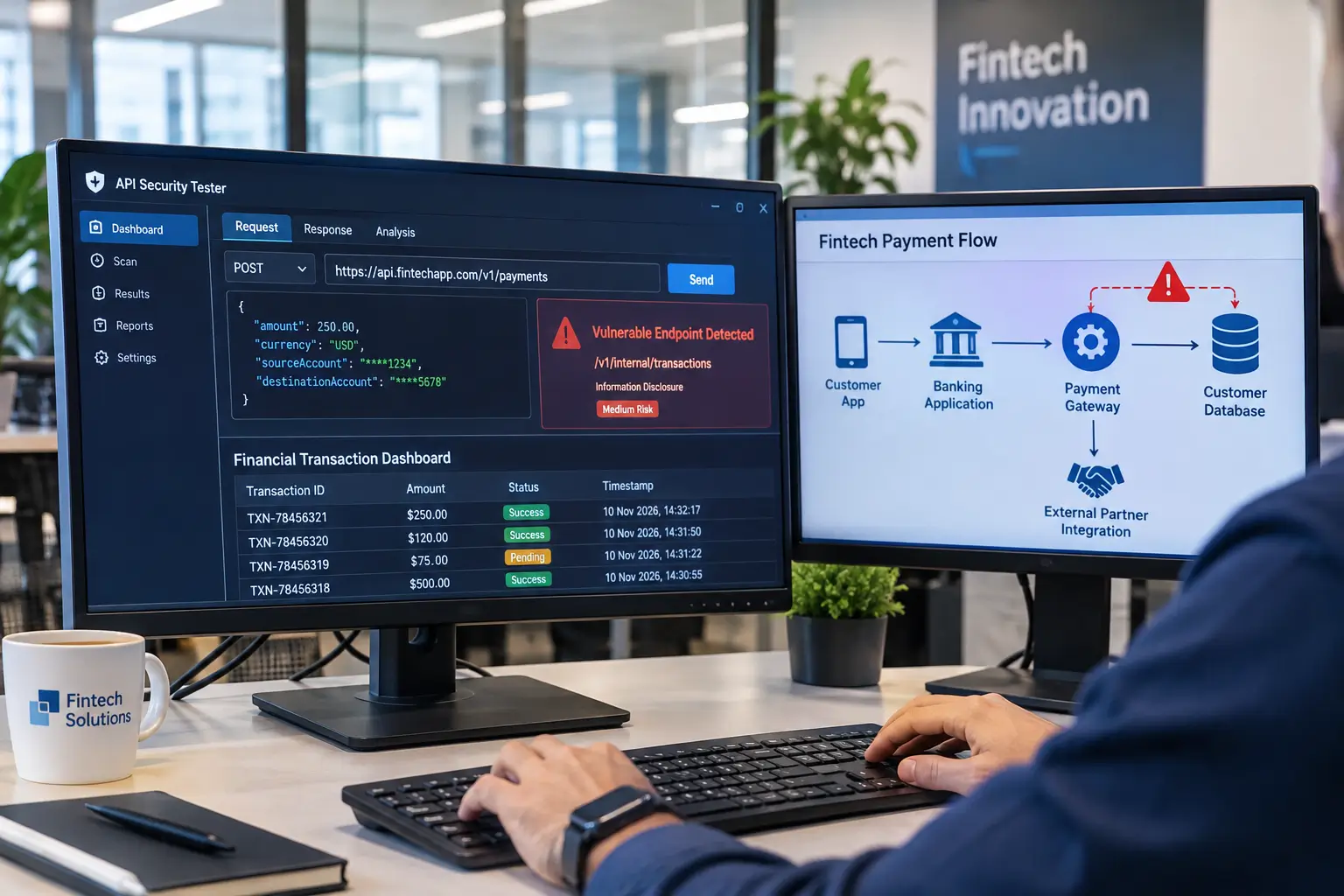
VAPT services exist for one uncomfortable reason. Somebody outside your company is already probing your fintech app, and they won’t send you a report when they find a way in. VAPT, short for vulnerability assessment and penetration testing, puts a friendly team in that seat first. They scan your systems for known weaknesses, then try to break in the way a real attacker would, and hand you a ranked list of what to fix.
Here’s the part most security pages skip. In fintech, the scary findings rarely look like movie hacking. They look like a logged-in user changing one number in an API request and seeing someone else’s loan balance. Or a mobile app that hides a “premium” check on the phone instead of the server. Small gaps, sitting in normal-looking features, where money moves.
This guide is for CISOs and heads of security at banks, lenders and payment firms. We’ll cover what VAPT services should include for a fintech, what regulators in the US, UK and India expect, and why we think the product release calendar should drive testing more than the audit calendar.
Key takeaways
- VAPT services combine automated scanning for known weaknesses with manual attack attempts, and should end in fixes your engineers can act on.
- The riskiest fintech gaps sit in payment and open banking APIs, mobile apps, admin panels, partner integrations and new AI features.
- Financial services breaches cost an average of $6.3 million in IBM’s 2026 study, against a $4.99 million global average.
- PCI DSS, NYDFS, SEBI and RBI rules set a minimum testing cadence. Your release pace usually calls for more.
- A test only pays off when someone retests the fixes and keeps proof for the auditor.
What are VAPT services, and how is VA different from PT?
VAPT services pair two jobs. A vulnerability assessment uses scanners and configuration checks to list known weaknesses across your apps, APIs, servers and cloud accounts. A penetration test has skilled testers try to exploit those weaknesses, chain them together and prove what an attacker could reach. You need both, because each misses what the other finds.
Think of the split this way:
- Vulnerability assessment (VA): covers a lot of ground quickly. It flags outdated libraries, open ports, weak TLS settings and missing patches. Good vulnerability assessment services run it on every release, or at least weekly. It can’t tell you whether a flaw in your transfer logic lets one customer move another customer’s money.
- Penetration testing (PT): goes deep on fewer areas. A tester logs in as a normal user, studies how your app behaves, and tries to do what that user shouldn’t be allowed to do. This is where business logic flaws show up.
A fair share of what’s sold as penetration testing services is a scanner report with a new cover page. You’ll spot it quickly. The findings list CVE numbers and severity scores, but nobody explains how a tester moved from one weakness to the next. For a fintech, that’s the half of the job you’re paying for.
Where do attackers test a fintech app first?
Attackers go where money and personal data sit behind the thinnest checks. In fintech that usually means five areas: payment and open banking APIs, mobile apps, internal admin panels, partner integrations, and newer AI features such as support chatbots. A good scope covers all five, weighted by how much each one can move or expose.
Payment and open banking APIs
APIs carry almost every transaction in a modern fintech, and they’re the first place a good tester looks. The OWASP API Security Top 10 (2023) ranks broken object level authorization first. In plain words, the API doesn’t check that the record you asked for belongs to you.
Picture a lending app with an endpoint like /loans/48213. A tester logs in, changes the number to 48214, and checks what comes back. If it’s another borrower’s repayment schedule, that’s a reportable breach waiting to happen. Good API security testing repeats that check across every endpoint that takes an ID, including the old versions your team forgot to switch off. It also checks rate limits on login and OTP endpoints, and whether one partner’s API key can read another partner’s data.
Mobile apps that trust the phone
Mobile app penetration testing looks at what your Android and iOS apps store, send and assume. Testers check whether tokens sit in plain storage, whether the app can be tampered with to skip a check, and whether hidden screens still call live endpoints. The rule we push hard: the server makes every money decision, never the phone.
Admin panels and back-office tools
Internal tools tend to receive the least security attention while holding the most power. A support dashboard that can reset passwords, raise credit limits or reverse payments is a prize. Testers check role separation, session timeouts and whether a support agent’s login can reach finance-only functions.
Partner integrations and third-party SDKs
KYC providers, card processors, credit bureaus and analytics SDKs all connect into your stack. Each connection means stored keys, webhooks and trust. A tester asks simple questions. Can a forged webhook mark a payment as settled? Are partner API keys sitting in a mobile build or a public code repository?
AI chatbots and agents: the newest scope item for VAPT services
More fintechs now run AI assistants that read account data or start actions. The OWASP Top 10 for LLM Applications (2025) lists prompt injection as LLM01, its top risk. That’s where a user types instructions that make the model ignore its rules. If your chatbot can look up a balance, someone will try to make it look up the wrong one.
Most VAPT services still leave AI features out of scope by default. Ask for them by name.
Find the Weak Endpoint in Your Payment APIs First
Book a fintech VAPT scope review. We map your APIs, mobile apps, admin panels and AI features, then show you which ones carry the most risk before any test starts.
What does a missed security gap cost a fintech in 2026?
A breach costs a financial services firm more than most industries. IBM’s Cost of a Data Breach Report 2026 puts the financial services average at about $6.3 million, well above the $4.99 million global figure. The average breach also took 247 days to identify and contain. That’s about eight months between a breach starting and the door finally being shut.
In the words of IBM’s July 2026 release, “Financial services breaches were reported to cost on average $6.3 million.” The study covered 602 organizations breached between March 2025 and February 2026.
Two more findings from the same report matter for fintech teams:
- AI-enabled attacks are rising. One in four malicious breaches was AI-enabled, a 56% jump on the year before, and those breaches averaged $6 million.
- APIs are the soft spot for AI systems. Compromised APIs, applications or plug-ins caused 27% of breaches that targeted AI systems.
India shows the same pattern. IBM’s India data puts the national average at INR 25.5 crore, with financial services the highest of any sector at INR 40.9 crore.
Our view: the useful response to these numbers is to stop treating fintech cybersecurity as a once-a-year audit item. A planned round of testing tells you where those 247 days would have started, at a cost you set in advance.
Test Your AI Features Before Attackers Test Them for You
Download the AI Evals in Production eBook to see how fintech teams check chatbots and AI agents for prompt injection, data leaks and wrong answers before and after each release.
How often do regulators expect VAPT in the US, UK and India?
Most financial regulators expect penetration testing at least once a year, plus testing after major changes. Vulnerability scans usually run more often. Exact rules depend on your license, your country and whether you handle card data. Treat the table below as a starting map and confirm details with your compliance team.
| Rule or framework | Where it applies | What it expects |
| PCI DSS v4.0.1, Requirement 11.4 | Any firm that stores, processes or transmits card data | Internal and external penetration tests at least every 12 months and after significant changes; segmentation tests every six months for service providers |
| NYDFS 23 NYCRR 500.5 | Banks, insurers and other firms licensed in New York | Penetration testing at least annually; automated scans at a risk-based frequency and after material changes |
| SEBI CSCRF (August 2024) | Brokers, exchanges, depositories, mutual funds and other SEBI-regulated entities in India | VAPT once or twice each financial year, depending on entity category |
| RBI Master Direction on IT governance (in force April 2024) | Banks, NBFCs and other RBI-regulated entities | Regular VA and PT of critical systems, including before go-live and after major changes |
| CBEST (Bank of England) | UK firms and financial market infrastructures, when the regulator calls for it | Intelligence-led testing of important business services against realistic attack scenarios |
The New York rule shows how specific these requirements can be. Section 500.5 asks for penetration testing from inside and outside system boundaries, run by a qualified internal or external party, at least annually.
Ask your provider to map each finding to the rules in this table, so your compliance team doesn’t redo the paperwork. Then read the table as a minimum. These rules can’t account for a team that ships a new build every two weeks, and that release pace is where fresh gaps appear.
Which product changes should trigger a fresh round of VAPT?
Test whenever a change touches money movement, identity or customer data, even if your annual test was last month. The seven release triggers below are an editorial framework for this article, not an industry standard. They point testing at the changes most likely to open a new gap between two scheduled audits.
- A new payment rail or partner API. UPI AutoPay, a new card processor, an open banking connection. New money paths deserve fresh eyes.
- Any change to login, sessions or authorization. New MFA flow, SSO, biometric login, token changes. A small edit here can expose every account.
- A new mobile app release with changed permissions or storage. Especially one that adds offline features.
- A new admin or support capability. Refunds, limit changes, account merges.
- An AI feature that reads or acts on customer data. A chatbot, an underwriting assistant, an agent that files disputes.
- A cloud or infrastructure move. New VPCs, new Kubernetes clusters, changed network segmentation.
- A major SDK or library upgrade. Particularly libraries that handle encryption, payments or identity.
You don’t need a full VAPT services engagement for each trigger. A focused test on the changed area, plus a retest of the fixes, usually does the job. This approach also makes your security audit services cheaper over time, because the annual test stops being the first time anyone looks at a year’s worth of changes.
What should VAPT services hand back to your engineers?
A useful report gives every finding a clear proof of the attack, the business impact in plain terms, a risk rating, a specific fix, and a retest result. If a report only lists scanner output and severity scores, your engineers will spend weeks working out what to do. That’s where a VAPT budget quietly goes to waste.
Here’s what each finding should carry:
- Proof of exploit: the exact request, screen or steps a tester used, so your team can reproduce it.
- Business impact: “any logged-in user can read other customers’ KYC documents” beats “CVSS 8.1”.
- Affected assets: endpoint, app version, environment.
- Fix guidance: a code-level or configuration change, not a generic “validate input”.
- Retest status: closed, partly closed or open, with the retest date.
Before you request quotes from penetration testing or vulnerability assessment services providers, send a one-page scope sheet. It should list your public endpoints and API versions, your mobile apps and their latest build numbers, admin tools, partner integrations, AI features, the environments testers may touch, and any regulator or card-scheme rules you need evidence for. A vendor that doesn’t ask for this kind of detail is guessing at your price.
Turn Your Next VAPT Report Into Closed Findings
Share your scope sheet and last report. Our security and engineering teams rank each finding by business risk, fix the code and retest it, so your auditor sees closed items with proof.
Who fixes the gaps after the testers leave?
A lot of VAPT reports stall at the hand-off. The testers leave, the PDF lands in a shared folder, and the engineers who could fix the findings are busy with the next sprint. Closing gaps is engineering work. It needs people who understand your code, your release process and your regulators.
That’s where our work sits. ViitorCloud’s security team reviews applications, APIs and cloud setups, ranks findings by risk, and our engineers help fix them. ViitorCloud is ISO 27001 certified. For fintech and financial services work, we keep testing and fixing inside one team, so findings move from report to fix to retest without a hand-off between companies.
Access control has mattered in our past builds too, even where the project wasn’t labeled as security work:
- For KPMG, our dedicated team took over the data ingestion module of a stalled State Family Database holding resident data for welfare schemes, a project where data security was non-negotiable.
- The Verify Chain identity platform stores user credentials under controls meant to stop unauthorized changes or access, and lets users share credentials only with verified connections.
- For the Royal Navy, we built the front end and admin panel of a digital asset portal with controlled sharing, where external parties reach only approved content and permissions stay with the organization.
Fixes also have to survive the next release, which is where a lot of fintech cybersecurity work slips. Our product engineering teams build the fix into the code itself, with a test that fails if the gap reopens.
On the pipeline side, our DevOps and cloud automation practice adds dependency and configuration scanning to each build, so a closed finding doesn’t quietly come back before your next round of VAPT services.
ViitorCloud has built and supported software since 2011 for clients that include KPMG and the Royal Navy, and shares its security and engineering work as projects ship.
Which endpoint would you least like a stranger to test tonight?
Start there. Pick the one API, app screen or admin function you’d worry about most, and scope a focused test around it before the next release. Good VAPT services keep that first round small and easy to act on. The annual test then becomes a check on a system you already know, and your security audit services evidence builds up release by release.
Want a second opinion on your fintech attack surface? Talk to our security team about a scoped review of your APIs, mobile apps and AI features.

Vishal Shukla
Vishal Shukla is Vice President of Technology at ViitorCloud Technologies.
Frequently Asked Questions
What do VAPT services include for a fintech company?
For a fintech, VAPT services should cover payment and open banking APIs, Android and iOS apps, web portals, admin panels, partner integrations, cloud setup and any AI features that touch customer data. The work combines automated vulnerability scans, API security testing and mobile app penetration testing with manual attack attempts, and ends with a ranked report, fix guidance and a retest of every closed finding.
How often should a fintech run VAPT?
What is the difference between vulnerability assessment and penetration testing?
How much do VAPT services cost?
Can VAPT test AI chatbots and agents?