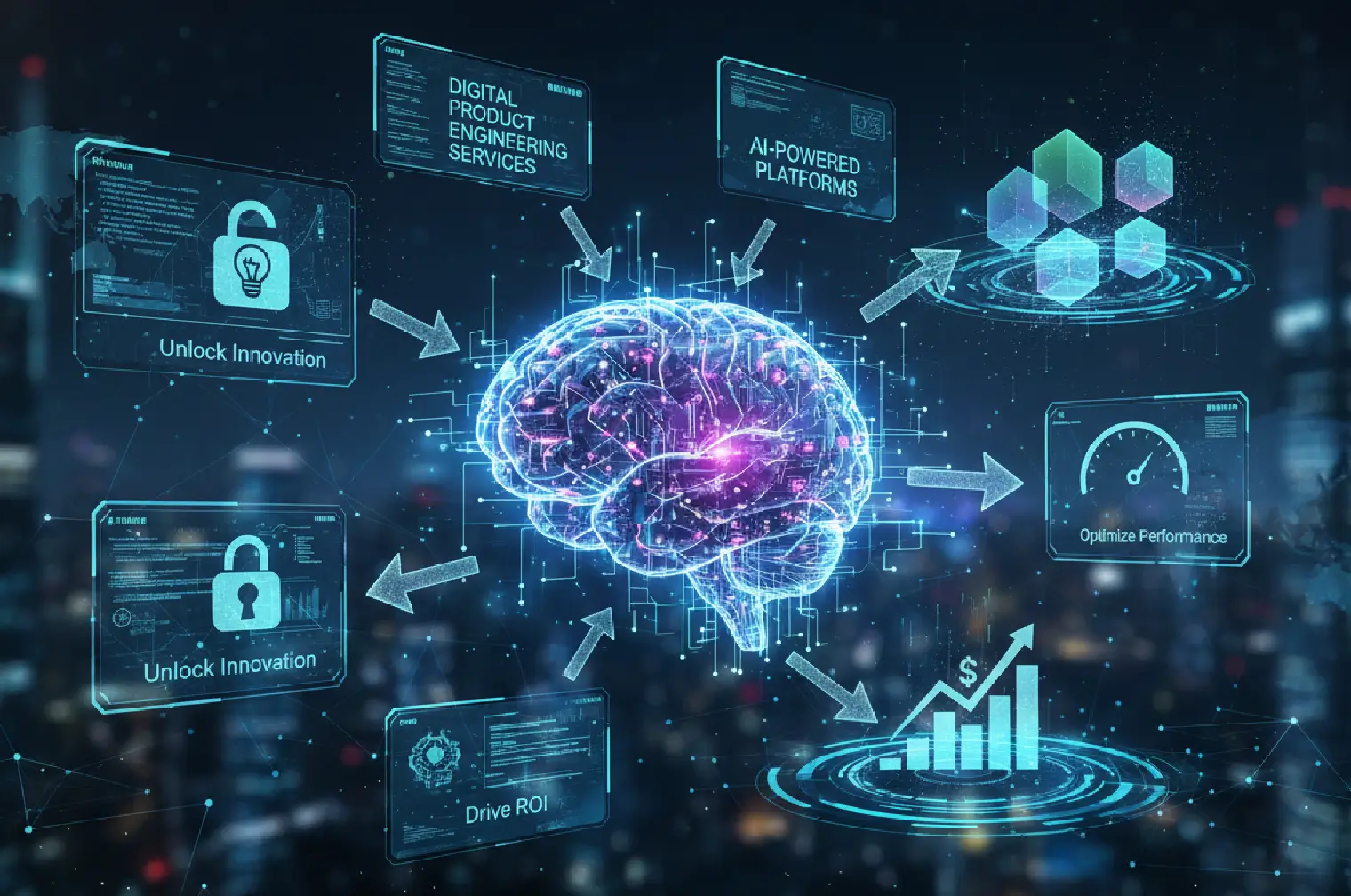
It is natural for product leaders to face a technical challenge when transitioning artificial intelligence from a controlled prototype to a commercial enterprise product. The underlying software architecture requires specific digital product engineering services to handle unpredictable computing loads, massive data pipelines, and strict security mandates. Traditional software development lifecycles fail when applied directly to artificial intelligence models.
According to research by McKinsey & Company, nearly two-thirds of organizations remain stuck in the experimentation phase. They lack the technical infrastructure to scale artificial intelligence across the enterprise. Bridging this gap requires specialized AI product engineering. This discipline focuses on building resilient systems that surround the machine learning model. It ensures continuous operation, accurate data retrieval, and secure user access.
Enterprise customers demand reliability. A commercial artificial intelligence platform must deliver consistent performance regardless of user volume. Achieving this requires a fundamental shift in how engineering teams build, deploy, and maintain software applications. Teams must account for model drift, where an artificial intelligence system loses accuracy over time as real-world data changes. Addressing this requires continuous retraining pipelines built directly into the core software infrastructure.
Why Do AI Platforms Fail During the Scaling Phase?
Normally, artificial intelligence platforms fail at production scale because their infrastructure cannot process sudden spikes in computational demand. A prototype works perfectly for ten internal testers. It crashes when ten thousand enterprise users query the system simultaneously. This happens because the initial system lacks robust SaaS product engineering protocols.
Scaling artificial intelligence requires decoupling the machine learning models from the user interface and the core database. Gartner research highlights that successful scaling mandates a composable architecture. This approach prevents vendor lock-in and eliminates system bottlenecks. Engineers must design microservices that operate entirely independently of one another.
If a specific language model requires more processing power, the cloud infrastructure must allocate resources to that exact service. It must do this without slowing down the entire application or degrading the user experience.
This level of architectural planning represents the core function of digital product engineering services. Engineers utilize digital product engineering services to build auto-scaling GPU clusters and FinOps-aligned cloud environments. This ensures the product handles high traffic volumes without generating unsustainable server costs.
Many platforms fail because the cost of inference exceeds the revenue generated by the user. Proper engineering prevents this profit loss. Engineers optimize the computational requests by implementing caching layers so the system does not need to recompute identical queries. This reduces the load on the graphical processing units and speeds up the response time for the end user.
Stop letting legacy architecture choke your growth
Poor infrastructure breaks when your user base scales. We provide elite digital product engineering services that build resilient, high-performance systems. Upgrade your software with our proven SaaS product engineering and secure a permanent edge over your competitors today.
How Does SaaS Product Engineering Support High-Volume AI Workloads?
Building an enterprise artificial intelligence platform requires a specific approach to software architecture. Standard web applications manage predictable, structured data within fixed parameters. Artificial intelligence applications process massive volumes of unstructured data in real time. SaaS product engineering provides the technical framework necessary to manage these complex data flows efficiently.
The application architecture must support multi-tenant environments. In these environments, thousands of enterprise clients access the same core intelligent model securely. This setup requires stringent data isolation. A well-executed SaaS product engineering strategy ensures that one client’s proprietary data never bleeds into another client’s instance.
| Architectural Requirement | Traditional Software Model | AI-Powered Platform Model |
| Compute Allocation | Fixed server capacity | Dynamic, auto-scaling GPU clusters |
| Data Processing | Batch processing overnight | Real-time streaming and vectorization |
| System Integration | Point-to-point connections | API-first composable architecture |
| Release Cycle | Monthly deployment schedule | Continuous integration for model updates |
| Telemetry Focus | Application uptime | Model accuracy and latency |
Applying SaaS product engineering principles ensures the platform remains stable during concurrent user requests. Engineers build robust API integration hubs. These hubs allow the artificial intelligence platform to connect securely with existing enterprise resource planning and customer relationship management systems. Secure webhook implementations ensure data synchronizes instantly across all connected platforms without manual intervention.
What Are the Core Components of End-to-End Development for AI?
Creating a reliable artificial intelligence product requires comprehensive oversight from the initial data architecture to the final deployment. End-to-end development eliminates the operational friction caused by handing off incomplete software between disconnected engineering teams.
Product leaders rely on end-to-end AI product engineering to compress the time-to-market while maintaining high quality standards. This rigorous process requires execution across several distinct engineering phases.
Data Pipeline Construction
End-to-end development starts with the data infrastructure. Engineers build automated pipelines to clean, structure, and vectorize the raw data. The machine learning model requires constant access to high-quality, governed data to produce accurate outputs. Poor data pipelines result in inaccurate artificial intelligence responses. Engineers utilize advanced ETL (Extract, Transform, Load) protocols to guarantee data integrity before it reaches the language model.
Automated Software Development Lifecycle
Engineers apply AI product engineering to automate code reviews, risk-based testing, and system monitoring. This reduces technical debt and accelerates the release schedule. Continuous integration pipelines deploy model updates without causing system downtime. Testing focuses heavily on model hallucination rates and response latency. Engineers build automated guardrails that prevent the system from generating harmful or off-brand content.
User Experience Architecture
The interface must present complex data clearly to the end user. End-to-end development ensures the frontend application communicates efficiently with the backend language models. This reduces system latency and provides a seamless user experience. Engineers design interfaces that guide the user to input highly specific prompts, yielding better system outputs.
Security and Infrastructure Monitoring
The final component involves continuous telemetry. Engineers deploy monitoring tools to track cloud costs, application security, and model performance. This data informs future updates and ensures the platform remains financially viable over time. Automated alerts notify the engineering team immediately if the model exceeds its designated compute budget or response time thresholds.
Through this highly structured approach, AI product engineering delivers a complete, market-ready solution that drives commercial enterprise deals.
Read: The Definitive Guide to Digital Product Engineering for AI Products in 2026
Dominate your industry with an AI-powered platform
Falling behind on AI innovation costs you serious market share. We execute aggressive AI product engineering that transforms your standard application into a smart, market-leading powerhouse. Leverage our digital product engineering services to launch faster and capture new revenue immediately.
How Do Digital Product Engineering Services Guarantee Data Security and Compliance?
Enterprise buyers require strict proof of security before purchasing new software. An artificial intelligence platform must comply with complex global regulations. Digital product engineering services build compliance directly into the platform’s core architecture.
Engineers configure the infrastructure to meet specific regional requirements without creating separate software versions. They design centralized systems that align with strict data privacy mandates across different global markets.
- Data Residency Controls: Engineers build localized cloud deployments. This ensures data generated in regions with strict citizen privacy laws remains on local servers, fully complying with sovereign data directives.
- Audit Logging: Digital product engineering services automate the generation of immutable compliance reports. This satisfies the regulatory requirements of highly regulated Western financial and healthcare institutions.
- Access Management: Systems incorporate zero-trust architectures and role-based access controls. This secures proprietary enterprise data from unauthorized internal and external access.
- Cultural Localization: Systems deployed in fast-growing eastern markets include localized natural language processing models. This AI product engineering approach ensures accurate interactions across diverse languages, dialects, and regulatory environments.
- Encryption Standards: Engineers implement AES-256 encryption for data at rest and TLS 1.3 for data in transit. This prevents data interception during complex model inferences.
These security features are non-negotiable for product leaders securing enterprise contracts. Proper architecture builds trust and accelerates the procurement process for large-scale deals.
Why Choose ViitorCloud for Your Next Engineering Project?
Executing a complex software build requires an experienced technical partner. ViitorCloud provides comprehensive digital product engineering services designed specifically for high-growth technology companies. We transition theoretical concepts into stable, enterprise-grade software.
Our engineering teams utilize established SaaS product engineering frameworks to construct secure, scalable architectures. We manage the entire lifecycle through our structured digital product engineering for AI products methodology. This ensures your platform handles high computational loads efficiently.
ViitorCloud delivers measurable results based on actual deployment data. We eliminate technical debt and build products that drive commercial growth. Contact our team today to map your product architecture and secure your next enterprise deployment.
Turn your product vision into aggressive revenue
Generic software templates kill your conversion rates. We design powerful custom AI solutions that perfectly align with your exact business demands. Rely on our elite SaaS product engineering to deliver a flawless user experience that converts free trials into loyal, paying customers.

Vishal Shukla
Vishal Shukla is Vice President of Technology at ViitorCloud Technologies.
Frequently Asked Questions
What are digital product engineering services?
They involve designing, building, and scaling software applications using modern cloud infrastructure and automated deployment pipelines.
How does AI product engineering differ from standard development?
Why is SaaS product engineering critical for artificial intelligence?
What does end-to-end development include?
How do you reduce cloud costs for AI platforms?