System integration services are no longer optional for enterprises managing multiple SaaS tools, cloud platforms, and legacy applications. The average enterprise today runs nearly 900 applications.
Yet 71% of those applications remain unintegrated, a figure that has held unchanged for three consecutive years. The result is fragmented data, manual re-entry, and reporting gaps that slow down every department.
This article explains what system integration services are, why enterprises need them, and what a sound integration approach looks like across key industries.
Your Business Is Adding Tools Faster Than Those Tools Can Talk to Each Other
Every new platform your team adopts stores its own data. Your CRM holds customer and sales records. Your ERP manages finance, procurement, and inventory. Your WMS tracks warehouse operations. Your e-commerce platform processes orders. Without enterprise system integration, none of these systems share data automatically.
Teams compensate by exporting spreadsheets, copying data between platforms, and reconciling records manually. IBM research estimates that data silos cost businesses $3.1 trillion annually in productivity and revenue. That figure reflects what happens when systems are isolated at scale.
What Are System Integration Services?
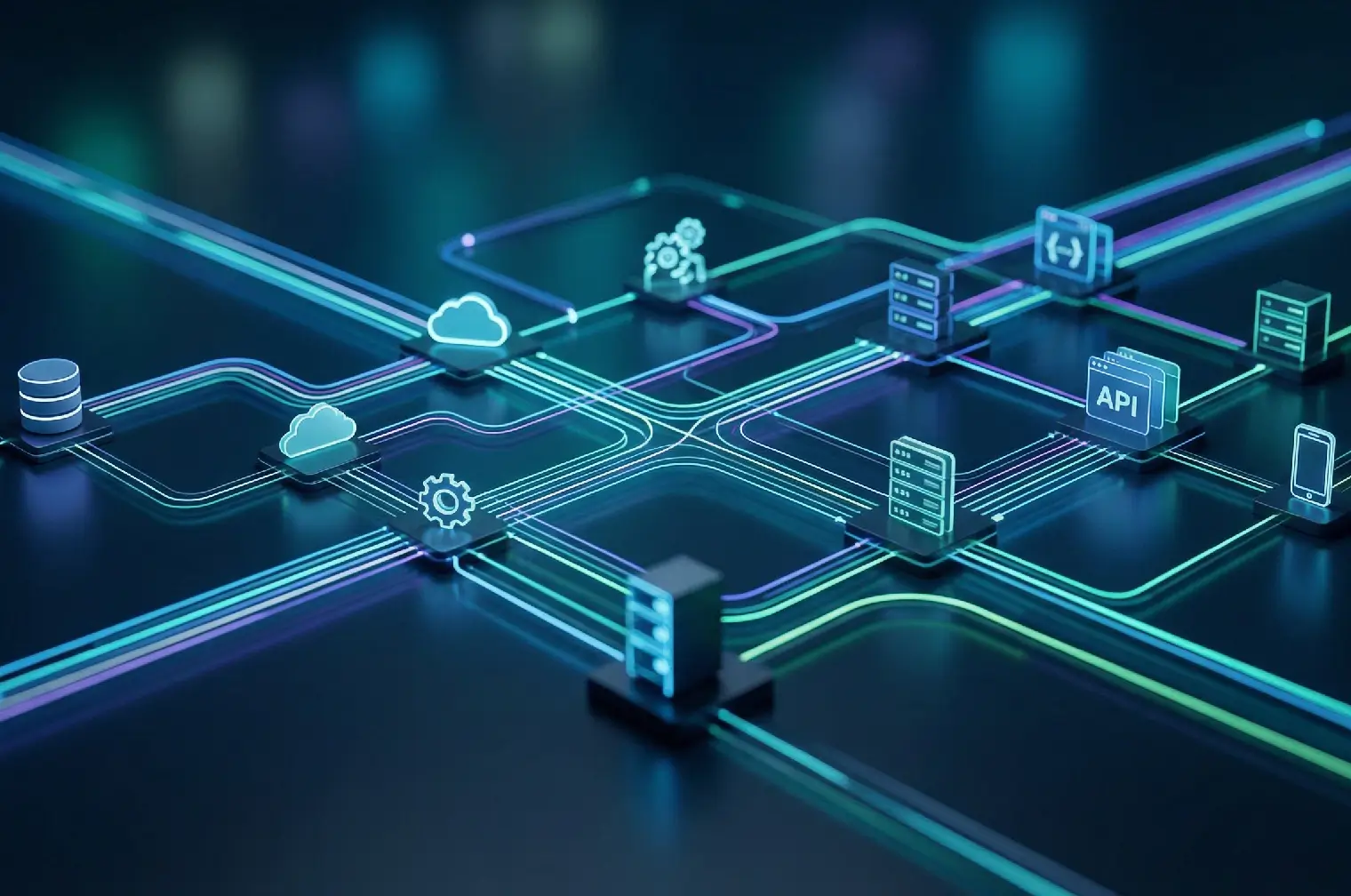
System integration services are technical solutions that connect separate software applications, databases, and IT infrastructure so they operate as a single, communicating environment. This covers cloud applications, on-premises platforms, legacy systems, third-party tools, and data pipelines.
A complete enterprise system integration engagement typically covers:
- Audit of existing systems and identification of integration gaps
- Selection of the appropriate integration method (API gateway, ESB, iPaaS, point-to-point)
- Definition of data synchronization rules and governance policies
- Implementation, testing, and post-deployment monitoring
ViitorCloud’s system integration and modernization capability covers this full cycle, from initial assessment through long-term optimization.
Stop losing enterprise revenue to disconnected software chaos
Data silos kill your profit margins and frustrate your teams. We deliver elite system integration services that unify your tech stack instantly. Leverage our robust middleware and seamless API integration to connect your vital platforms. Execute flawless enterprise system integration, including complex ERP-CRM integration, to turn your chaotic operations into a high-speed revenue engine right now.
71% of Enterprise Apps Are Unintegrated. The Numbers Explain Why That Is Expensive.
According to a Dataversity survey, 68% of organizations named data silos as their top concern, up 7% from the previous year. The downstream effects are measurable:
- 95% of IT leaders cite integration as the primary barrier to seamless AI implementation
- 39% of developer time goes toward designing, building, and testing custom integrations
- $131,000 is the average annual cost of delayed integration projects
- 47% of C-suite executives say data readiness is their biggest obstacle to applying generative AI
These numbers reflect a structural issue, not a tooling shortfall. The tools exist. The connections between them do not.
Four Core Approaches to Enterprise System Integration
There is no single method that applies to every organization. The right choice depends on system complexity, data volume, and how much of the existing stack needs to be preserved.
1. Point-to-Point Integration
Directly connects two systems with custom code. Fast to deploy for simple use cases. As the number of connected systems grows, this approach becomes fragile and expensive to maintain.
2. Enterprise Service Bus (ESB)
A centralized message routing layer connects multiple systems through a shared bus. The ESB handles protocol translation, routing logic, and error management. This works well for high-volume transaction environments.
3. API Integration
APIs define how systems request and share data. API integration creates reusable interfaces that multiple systems can call in real time. This is now the standard approach for modern enterprise environments. The global API management market was valued at $6.89 billion in 2025 and is projected to reach $37.43 billion by 2034.
4. iPaaS (Integration Platform as a Service)
A cloud-hosted platform with pre-built connectors, workflow automation, and centralized visibility. iPaaS reduces custom development effort and scales across hybrid and multi-cloud environments.
ERP and CRM Data Should Move Together. In Most Enterprises, It Does Not.
ERP-CRM integration addresses one of the most common and costly data gaps in enterprise IT. ERP systems manage back-office processes: finance, inventory, procurement, and supply chain. CRM systems manage front-office functions: sales pipelines, customer records, and service interactions. When these two platforms operate separately, problems compound quickly.
Sales reps quote prices without knowing actual stock levels. Finance processes invoices without full customer context. Operations teams forecast demand without pipeline data. Leadership reports reflect only a partial view of the business.
ERP-CRM integration connects these platforms so data flows automatically. When a deal closes in the CRM, the ERP creates the sales order, checks credit, and updates inventory. Customer data stays consistent across both systems without manual reconciliation.
ERP-CRM integration typically requires middleware when the two platforms use different data formats or were built on different architecture generations.
API Integration Is Now the Operating Standard for Connected Enterprises
API integration has become the default method for linking enterprise systems because it supports real-time data exchange, reusable interfaces, and clear governance over data access.
ViitorCloud’s API development and integration work for logistics demonstrates this directly: ERP, WMS, TMS, and carrier platforms are connected through standardized APIs to remove manual rekeying across the full supply chain.
An API-first approach to enterprise system integration delivers:
- Real-time data exchange across systems
- Reusable interfaces that reduce development time on future integrations
- Clear audit trails for data access and movement
- Faster onboarding of new partners and platforms
For organizations where AI adoption is a priority, API integration is the prerequisite. AI models require continuous access to clean, structured data from CRM, ERP, and operational systems. Without API integration, that data remains isolated.
Dominate your market with a perfectly synchronized tech stack
Manual data transfers between fragmented apps drain your budget every single day. We execute aggressive enterprise system integration that completely eliminates your operational bottlenecks. Utilize our custom middleware and precise API integration to ensure your data flows flawlessly. Partner with us for top-tier system integration services and seamless ERP-CRM integration to scale your business effortlessly.
Why Middleware Still Matters in Legacy-Heavy Environments
Middleware is software that sits between two systems and handles data translation, message routing, and format conversion. For enterprises running legacy ERP or proprietary platforms, middleware is frequently the bridge that makes API integration possible without replacing core systems.
Legacy platforms often use batch processing, older communication protocols, or proprietary data formats that modern APIs cannot interface with directly. Middleware adapts these to a format that current systems can read and write in real time.
The management overhead of middleware is a real consideration. It adds architectural complexity and requires specialized skills to maintain and update. This is why legacy system modernization planning should assess middleware dependencies early: some legacy systems are worth bridging, others are better replaced before integration begins.
How Integration Requirements Differ Across Key Industries
System integration services are shaped by industry-specific systems, data types, and compliance requirements.
Retail needs integration across inventory, POS, e-commerce, CRM, and fulfillment systems. Real-time stock visibility prevents overselling and improves delivery accuracy.
Logistics requires connecting TMS, WMS, ERP, and carrier APIs so that shipment visibility, exception alerts, and documentation flow without manual intervention. ViitorCloud’s cloud-native modernization for logistics outlines how this integration is structured for high-volume operations.
Manufacturing is moving toward Industry 4.0 environments where IoT devices, MES platforms, and ERP systems must share operational data. According to MarketsandMarkets, 70% of OT systems in manufacturing are expected to connect to corporate IT networks by 2025, requiring structured IT-OT integration.
Finance relies on real-time API integration for transaction processing, fraud detection, and open banking compliance. ERP-CRM integration in financial services ensures that client account records, compliance data, and operational history remain synchronized.
ViitorCloud Delivers System Integration Backed by Real Enterprise Deployments
ViitorCloud provides enterprise system integration across all major integration patterns including point-to-point, ESB, API-led, and iPaaS. Engagements cover system audit, architecture design, implementation, and ongoing monitoring.
Clients including KPMG, DP World, and Adani have relied on ViitorCloud for integrated, data-connected environments across logistics, energy management, and enterprise operations. The Royal Navy engagement involved Fotoware DAM platform integration with a complete UI overhaul, centralizing digital assets and enabling structured access across a secure environment.
The Co4 Cloud energy management portal shows how integration work translated into real-time resource monitoring, emission tracking, and operational visibility for an enterprise energy platform.
If you are working through a disconnected tech stack and need a structured path to a unified data layer, ViitorCloud’s system integration and modernization services cover assessment through execution.
For organizations where AI readiness is a parallel objective, system integration for AI enterprises explains how the integration layer directly enables AI deployment across CRM, ERP, and operational data.
Connect with us at [email protected].
Turn your fragmented data into a massive competitive advantage
Outdated architecture and isolated applications severely limit your enterprise growth. Take control with expert system integration services that guarantee zero operational downtime. We deploy intelligent middleware and secure API integration to bridge the gap between your crucial tools. Implement a comprehensive ERP-CRM integration and full enterprise system integration to maximize your daily profit and crush your competition.
Final Thoughts
Disconnected systems produce measurable business costs: delayed decisions, failed AI rollouts, duplicate data entry, and reporting that does not reflect operational reality. System integration services provide the infrastructure that makes enterprise data shared, accurate, and available in real time.
Whether the priority is ERP-CRM integration, API integration across a multi-tool SaaS stack, or middleware modernization for legacy platforms, the starting point is the same: map what exists, identify the gaps, and build connections that serve business operations.

Vishal Shukla
Vishal Shukla is Vice President of Technology at ViitorCloud Technologies.
Frequently Asked Questions
What are system integration services?
System integration services connect separate software systems and databases into one unified environment that enables real-time, automated data flow.
How does API integration work in enterprise environments?
What is middleware in the context of system integration?
How does ERP CRM integration improve business operations?