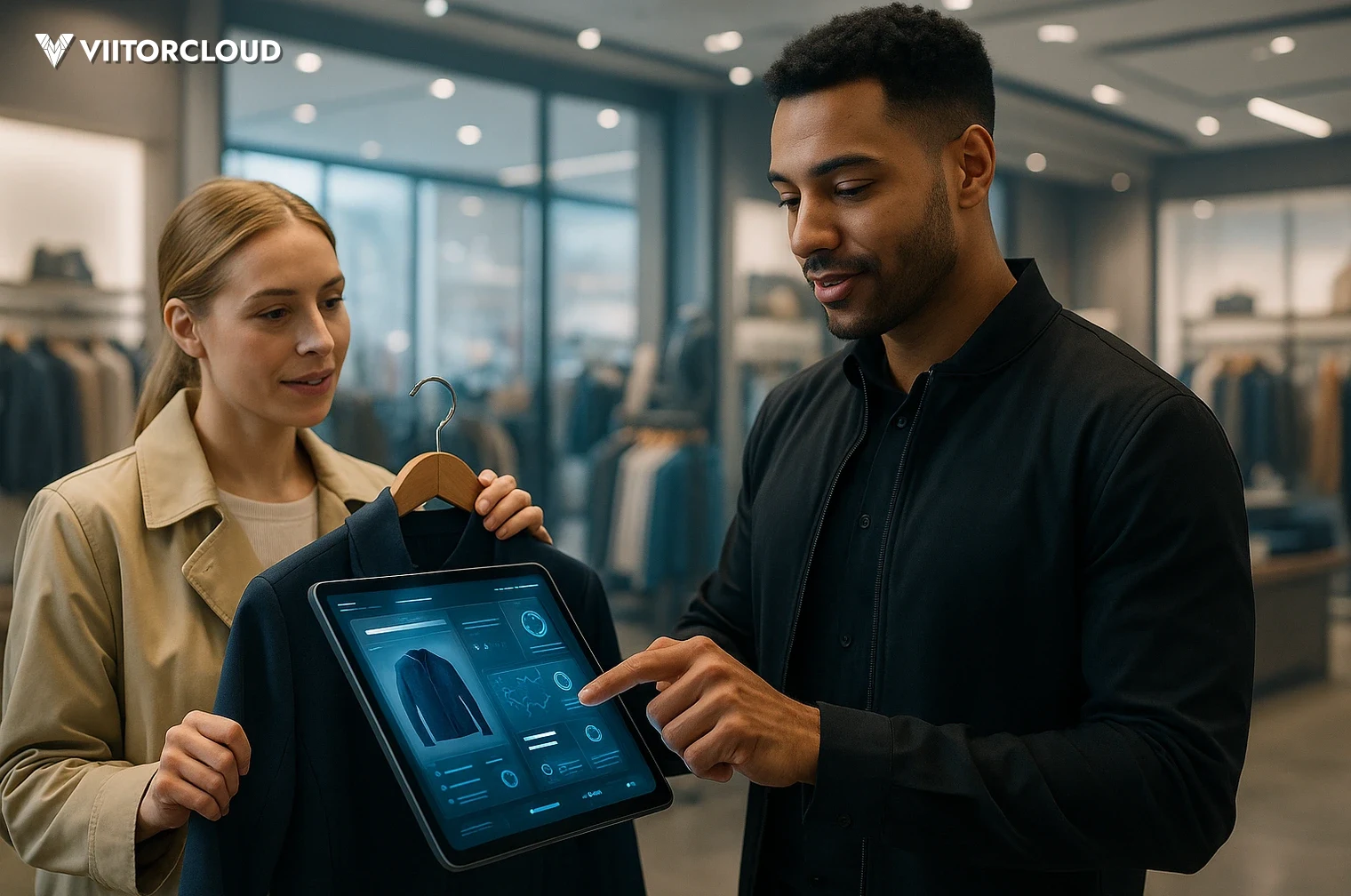
A retail associate copilot is an AI assistant that gives frontline store staff instant, conversational access to product details, live inventory, and customer history, so they can close more sales and serve shoppers better. AI copilot development is how you build one: you connect a large language model to your retail systems so any associate can answer a tough question in seconds.
Picture a Saturday rush. A shopper holds up a jacket and asks, ‘Do you have this in medium, and does it run small?’ The associate nods, then vanishes into the stockroom for five minutes. By the time they are back, the shopper is gone. That was not a people problem. It was an information problem.
You already know your associates are the face of your brand. The catch is that they often work half-blind, juggling a handful of systems that refuse to talk to each other. This guide lays out a practical path: what a retail copilot actually does, how to approach AI copilot development step by step, how to measure its effect on store-level sales, and which mistakes quietly sink these projects.
We design conversational AI and AI-first products for retailers, so this blueprint comes from what works on real sales floors, not from a slide deck. Curious how an associate copilot might fit your stores? Explore our AI copilot development services as you read.
Key Takeaways
- A retail associate copilot is a conversational AI assistant that puts product, inventory, and customer answers in an associate’s hand within seconds.
- AI copilot development for retail rests on three pillars: clean connected data, a retrieval layer over your systems, and tight guardrails.
- The strongest use cases are real-time stock checks, guided selling, personalized recommendations, and instant policy answers.
- Track impact with conversion rate, average transaction value, time-to-answer, and associate confidence, not vanity usage stats.
- Most pilots fail on messy data and weak adoption, not the model, so start with one store and real associate feedback.
What Is a Retail Associate Copilot?
A retail associate copilot is an AI assistant, usually opened on a store tablet or handheld device, that lets associates ask questions in plain language and get instant, accurate answers pulled from your product catalog, inventory system, and customer records. Think of it as a colleague who has memorized every spec, stock level, and store policy, and never needs a coffee break.
This is different from a customer-facing chatbot. A store associate AI is built for the people serving shoppers, not the shoppers themselves. It speaks the team’s language, connects to back-office systems, and is tuned for speed during a chaotic shift.
A copilot, not an autopilot
The word ‘copilot’ matters. The associate stays in command and brings the human warmth, while the AI simply erases the gap between a question and a confident answer. Good frontline AI makes people better at their jobs instead of trying to replace them, which is exactly why associates adopt it.
Build a Retail Associate Copilot
Turn this blueprint into a working pilot tuned to your stores, data, and goals with our AI copilot development team.
Why Store Associate AI Is Now a Competitive Necessity
Today’s shopper often walks in knowing more about your catalog than the person on the floor. They have read the reviews, compared specs, and checked stock online before they ever arrive. When an associate cannot keep up, trust slips away and the sale drifts to a competitor or a screen.
The opportunity is hard to ignore. McKinsey estimates that generative AI could add the equivalent of $400 billion to $660 billion a year across retail and consumer packaged goods. A real slice of that value sits on the sales floor, where questions get answered and buying decisions get made.
Frontline teams also turn over quickly, and the National Retail Federation regularly documents just how large and fast-moving that workforce is. Every new hire starts from zero, and research in Harvard Business Review has long tied the speed and quality of in-store service to whether customers come back. A copilot shortens the distance between a brand-new associate and a genuinely helpful one.
Take Maria, a new associate at a busy footwear store. In her second week, a customer asked whether a running shoe suited flat feet. Maria froze, guessed, and the customer left empty-handed. Six weeks later, with a copilot on her tablet, she typed the same question, got a clear fit guide and two alternatives in seconds, and walked the shopper straight to the right pair. Same associate, very different outcome.
Core Capabilities: What a Retail AI Copilot Does on the Floor
The best retail copilots focus on a handful of high-frequency moments that happen thousands of times a day. Nail these, and everything else follows.
Real-time inventory and product answers
‘Is this in stock in blue, size 9, anywhere nearby?’ A copilot checks live inventory across the floor, the back room, and other locations, then offers to ship or hold the item. No stockroom safari required.
Guided selling and recommendations
When an associate is unsure which model fits a customer’s needs, the copilot asks a few clarifying questions and suggests the right product, plus natural add-ons. This is conversational AI retail at its most useful, turning hesitation into a confident recommendation.
Personalized service from customer history
With the right permissions, a copilot can surface a loyalty member’s past purchases, sizes, and preferences, so the associate greets them like a regular rather than a stranger. That is the kind of personal touch shoppers remember and reward.
Instant policy, returns, and how-to answers
Return windows, price-match rules, warranty terms, promotion details: a copilot answers these in one tap, so associates stop digging through binders or radioing a manager. Consistency climbs, and customer trust climbs with it.
Tie these capabilities to your own systems and you get a tool associates reach for every shift. See how we design conversational AI that fits the way teams actually work.
Explore Conversational AI for Retail
See how we design conversational AI and frontline assistants that store associates actually reach for on every shift.
How to Approach AI Copilot Development: A Build Blueprint
Strong AI copilot development for retail follows a clear sequence. Skip a step and the cracks show up fast on the floor. Here is the path we use.
Step 1: Unify and clean your retail data
Your copilot is only as good as the data behind it. Product specs, inventory feeds, pricing, and customer records need to be accurate and reachable through APIs. Most of the real work in any AI assistant development project lives here, not in the model.
Step 2: Build a retrieval layer over your systems
Rather than hoping a model already knows your catalog, you ground it in your data using generative AI techniques like retrieval-augmented generation. The copilot looks up the live answer, then phrases it naturally. That is how you keep responses current and cut down on confident-sounding mistakes.
Step 3: Design the conversation for the floor
A sales floor is loud and fast. Responses must be short, scannable, and one tap away, with voice input for hands-busy moments. Design for a 20-second interaction, not a leisurely chat.
Step 4: Add guardrails, security, and human oversight
Customer data demands strict access controls, clear privacy rules, and audit trails. Guardrails keep the copilot on-brand and on-policy, while a human-in-the-loop design means the associate always makes the final call.
Step 5: Pilot in one store, then scale
Launch in a single location, observe real shifts, and gather associate feedback every week. Fix what is awkward, prove the lift, then roll out. This is where AI-first product thinking earns its keep.
David, a head of retail innovation at a mid-size electronics chain, learned this the patient way. His team launched a copilot pilot in one flagship store, sat with associates for two weeks, and found the top request was not fancy recommendations, it was faster stock checks. They reprioritized, shipped a leaner version, and only then expanded to ten more stores. Starting small saved them from scaling the wrong thing.
Ready to map your own build? Our team can turn this blueprint into a working pilot tuned to your stack. See how we build AI-first products and where a copilot fits.
Measuring ROI: From Conversational AI to Store-Level Results
A copilot earns its keep only if it moves store metrics, so decide what success looks like before you launch. Skip the vanity numbers like raw query counts and watch the figures that map to revenue and loyalty.
- Conversion rate: Are more browsers becoming buyers now that associates have instant answers?
- Average transaction value: Do guided selling and smart add-ons lift the size of each basket?
- Time-to-answer: How quickly can an associate resolve a shopper’s question compared with before?
- Attach rate: Are recommended accessories and warranties showing up in more sales?
- Associate confidence and ramp time: Are new hires productive in days instead of weeks?
Pair these with customer satisfaction scores to catch the full picture. When time-to-answer drops and conversion climbs in the same store, you have found your proof, and the case for a wider rollout makes itself.
Start With a Single-Store Pilot
De-risk your investment by proving store-level sales and service lift in one location before you scale across the fleet.
Avoiding the Pitfalls of AI Assistant Development
Most retail copilots that stumble do not fail because of the model. They fail on the unglamorous stuff. Here are the traps worth dodging in any AI assistant development effort.
- Messy data: If inventory is wrong, the copilot is confidently wrong. Fix the source first.
- Over-automation: Trying to replace associate judgment breeds distrust. Augment, do not override.
- Ignoring adoption: A brilliant tool nobody opens is worthless. Train, gather feedback, and design for the shift.
- No grounding: A model without a retrieval layer invents answers. Always tie responses to live data.
One apparel retailer learned this firsthand. Their first rollout pushed a chat-heavy interface that associates found slow, so usage stalled within a month. Instead of scrapping the project, the team watched a few shifts, switched to one-tap answers with voice search, and looped associates into weekly tweaks. Adoption climbed, and the copilot finally became part of the daily rhythm. The lesson is simple: the floor team, not the algorithm, decides whether frontline AI succeeds.
Turn Your Sales Floor Into a Competitive Edge
A retail associate copilot turns your frontline team into your sharpest advantage. Get the fundamentals right and the payoff shows up where it counts with ViitorCloud.
- Put instant product, inventory, and customer answers in every associate’s hand.
- Approach AI copilot development in order: clean data, a retrieval layer, then floor-ready design.
- Measure conversion, transaction value, and time-to-answer, not vanity usage.
- Start in one store, listen to associates, and scale what works.
The retailers pulling ahead are not the ones with the flashiest tech. They are the ones who hand their people the right answer at the right moment. Thoughtful AI copilot development is how you get there, one confident associate at a time.
Ready to build your retail associate copilot? Talk to our AI team about a pilot designed for your stores, your data, and your goals.

Vishal Shukla
Vishal Shukla is Vice President of Technology at ViitorCloud Technologies.
Frequently Asked Questions
What is a retail associate copilot?
It is an AI assistant giving store associates instant access to product, inventory, and customer data to sell and serve better.
How long does AI copilot development take?
Is a retail copilot different from a customer chatbot?
What data does a store associate AI need?