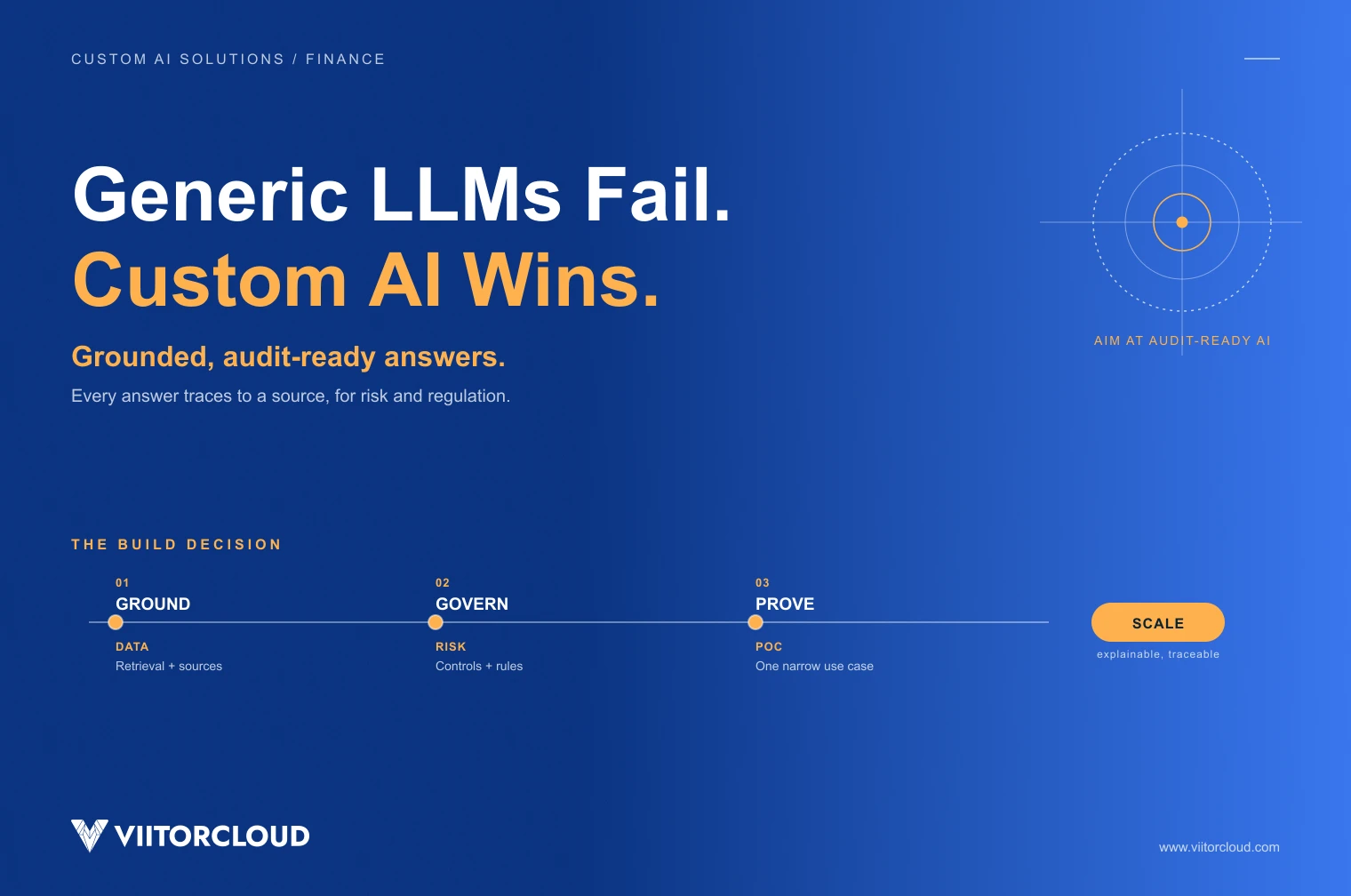
Generic large language models fail in finance because they are trained on the open web, not on your regulated data, your controls, or your risk policies. Custom AI solutions fix this by grounding the model in your institution’s own data, lineage, and compliance rules, so the answers are accurate, explainable, and ready for an auditor. That is the short version. The rest of this article explains why the gap exists and how to close it.
Most AI demos in banking look flawless. Then they meet a live portfolio and start inventing numbers.
If you have already piloted a general-purpose model and watched it cite a regulation that does not exist, you are not alone. I have seen capable risk and data teams lose a quarter to a tool that summarized beautifully and reconciled nothing. The problem was never the model’s fluency. It was the absence of grounding.
Here is what you will get from this article. A clear reason generic models break on financial work, a working definition of domain-specific AI, and a decision framework for choosing between an off-the-shelf model and custom AI development. I will keep it practical and skip the hype.
Key Takeaways
- Generic LLMs hallucinate in finance because they lack grounding in regulated data, controls, and current rules, which makes raw outputs unsafe for risk and compliance decisions.
- Custom AI solutions combine your data pipelines, retrieval, and explainability so every answer traces to a source and holds up in an audit.
- Domain-specific AI, including vertical AI and domain-specific LLMs, beats general models on financial tasks because it learns your data structures and terminology.
- A build decision should rest on data sensitivity, regulatory exposure, and accuracy tolerance, not on model size or vendor branding.
- Start with one narrow proof-of-concept on real data before scaling, the same phased discipline behind platforms we engineered that processed $192.2M in regulated revenue.
Why Generic LLMs Fail in Finance
A general-purpose model is trained to sound right. A finance system has to be right. Those are different goals, and the gap between them is where most pilots collapse.
Generic models learn from a snapshot of the public internet. They have never seen your core banking data, your loan tape, your actuarial tables, or your internal control language. So when you ask a sharp question about a specific exposure, the model fills the gap with the most likely-sounding text. In casual use that looks like a small error. In finance it looks like a fabricated counterparty limit or a misquoted capital rule.
If you want a model built around regulated workflows instead of bolted on after the fact, explore our custom AI solutions.
This is the hallucination problem, and it is well documented. Research from Stanford HAI has shown that large models confidently produce false statements on legal and regulatory questions at rates no compliance team would accept. Confidence is not accuracy. A model that is wrong a small share of the time, with no signal about which answers are wrong, is unusable for a credit decision or a regulatory filing.
The data quality and lineage problem
There is a second, quieter failure. Even when a model is pointed at your data, the data is often not ready. Financial data lives across core systems, spreadsheets, vendor feeds, and decades of legacy records. If you cannot trace where a number came from, you cannot defend the answer built on top of it.
Regulators do not accept the AI said so. They ask for lineage. Where did this figure originate, who transformed it, and when. Without clean pipelines and traceability, even an accurate-looking output is a liability. This is why I tell finance teams to fix the data pipeline before they fine-tune anything.
Consider Priya, a model risk lead at a mid-size lender. Her team trialed a popular assistant to summarize credit memos in early 2025. It worked well in the demo. On real files it quietly merged two borrowers with similar names and produced a clean, wrong risk summary. Nobody caught it for two weeks. The fix was not a better prompt. It was grounding the system in the lender’s verified records with a clear audit trail.
See What Custom AI Looks Like in Finance
Explore how we build domain-specific AI grounded in your data, controls, and regulations for risk and compliance teams.
What Domain Specific AI Really Means for Financial Data
Domain-specific AI is a system shaped around one field’s data, language, and rules rather than the whole internet. In finance that means models that understand instruments, accounting standards, and the difference between a provision and a write-off without guessing.
You will hear several terms for this. Vertical AI describes systems purpose-built for one industry. A domain-specific LLM is a language model adapted, through fine-tuning or retrieval, to a narrow body of knowledge. Financial AI models are the broader family, including the credit, fraud, and forecasting models that predate the current wave. They are converging, and the strongest results come from combining them.
The proof is already public. Bloomberg built a finance-specific language model trained on decades of financial data and showed it beat general models of similar size on financial tasks. The lesson is simple. On specialized work, the data a model learns from matters more than the raw parameter count.
Domain grounding is what turns a generic chatbot into a tool a risk officer trusts. For a deeper technical view, our breakdown of AI and ML development for vertical LLMs shows how this is engineered.
Fine tuning, retrieval, and guardrails
Three techniques do most of the work. Fine-tuning teaches the model your language and patterns. Retrieval-augmented generation keeps answers tied to current, approved sources instead of memory. Guardrails block the model from answering outside its competence and route hard cases to a human. Together they replace confident guessing with sourced, checkable responses.
How Custom AI Solutions Ground Models in Risk and Regulation
Custom AI solutions earn trust in finance by making every answer traceable, current, and reviewable. The model does not recite from memory. It retrieves from approved data, shows its sources, and records what it did.
In practice, grounding a financial system in risk and regulation involves a few connected layers.
- Verified data foundation. Clean pipelines with documented lineage, so every figure traces back to a system of record.
- Retrieval over generation. Answers pull from your current policies and filings, not from training data that may be a year stale.
- Explainable outputs. Each response carries citations and a reasoning trail an auditor can follow, the practice often called explainable AI.
- Human review gates. High-stakes decisions get a person in the loop by design, not as an afterthought.
- Access and audit controls. Role-based permissions and full logs, so you can prove who saw what and when.
This is where model risk management meets engineering. Frameworks like the NIST AI Risk Management Framework give institutions a shared language for governing these systems, and well-built custom AI solutions map to that language directly. If your data carries sensitive customer information, this often points toward private LLM development so nothing leaves your control.
Test One Finance Use Case First
Start with a focused proof-of-concept on a single workflow and measure accuracy and auditability before you scale.
A Decision Framework for Building Financial AI Models
Not every problem needs a custom build. The decision comes down to three questions about the work itself.
Use these as a quick test. The more you answer yes, the stronger the case for custom AI development.
- Sensitivity. Does the task touch customer data, positions, or anything that cannot leave your environment? Higher sensitivity favors a custom, private build.
- Regulatory exposure. Will the output inform a decision a regulator could review? If yes, you need the lineage and explainability that generic tools do not provide.
- Accuracy tolerance. What is the cost of a confident wrong answer? For credit, fraud, and reporting, that cost is high, so grounding is mandatory.
Where generic tools fit, use them. Drafting internal emails, summarizing public market commentary, or brainstorming a campaign does not require a custom system. Spending custom-build money there is waste.
Where the work is sensitive, regulated, or unforgiving of errors, a general model is the wrong tool no matter how impressive the demo. That is the line. When all three tests point the same way, custom AI solutions earn their cost. For a fuller comparison, see our breakdown of custom AI versus off-the-shelf tools.
Daniel runs analytics at a regional insurer. He wanted an enterprise LLM for finance teams that could answer reserve and claims questions from internal data. Rather than buy a generic seat for everyone, his team built a narrow assistant grounded in their actuarial and policy documents, with citations on every answer. Adoption rose because underwriters could verify the source in one click. Trust, not novelty, drove usage.
Ready to test a finance use case against your real risk and compliance constraints? We at ViitorCloud, are focused proof-of-concept on a single workflow before any large commitment.
What Custom AI Solutions Deliver for Banks, Lenders, and Insurers
Done well, custom AI solutions move financial institutions from cautious experiments to systems they can defend in front of a board and a regulator. The returns show up in three places.
- Accuracy you can audit. Grounded answers with citations cut rework and review time, and they hold up under scrutiny.
- Risk you can see. Fraud and anomaly detection tuned on your transactions catches patterns generic tools miss.
- Speed without recklessness. Teams get faster answers from their own data while humans stay on the decisions that matter.
The track record behind this approach is concrete. Our teams have engineered platforms that processed $192.2M in regulated healthcare revenue, generated $46.4M for a single travel and deals platform, and cut livestock mortality by 30 percent through AI-driven monitoring. Different industries, same discipline. Build on clean data, ground the model, and prove the outcome. The same engineering backs our work across banking, financial services, and insurance.
Where this shows up in practice
The strongest early use cases share a trait. They are high-value, data-rich, and painful when wrong.
- Credit and underwriting support that reads your files and cites the source for every claim.
- Fraud and anomaly detection built on your transaction history rather than generic patterns.
- Compliance and reporting assistants that draft from current, approved rules and flag what needs review.
- Customer and advisor copilots grounded in your products, not the open web.
These are the workflows where custom AI solutions pay for themselves fastest.
Talk to a ViitorCloud AI Specialist
Pressure-test a financial AI idea against your real risk and compliance constraints. A short conversation, no long contract.
How to Start Custom AI Solutions Without Adding Risk
The safest way into custom AI solutions is also the fastest. Start small, prove value on one workflow, then scale what works. I call it think big, start small, and it has carried hundreds of engagements from idea to production.
- Pick one painful, measurable workflow. Choose a task where a wrong answer has a clear cost and a right answer has a clear value.
- Test on real data, not a sandbox. The edge cases in production data are exactly where generic tools fail, so meet them early.
- Measure against a human baseline. Track accuracy, review time, and auditability, not just speed.
- Scale only what clears the bar. Expand the system once it beats the baseline and satisfies your controls.
Marcus, a transformation lead at a commercial bank, resisted a full rollout. Instead his team shipped one grounded assistant for a single reporting task in a few weeks. It cut review time and passed an internal audit on the first try. That small win funded the next three. The phased path turned a nervous board into a willing sponsor.
The Bottom Line for Finance Leaders
Generic models fail in finance for one reason. They are not grounded in your data, your controls, or the rules you answer to. Custom AI solutions close that gap by building accuracy, lineage, and explainability into the system from the first line of code.
The path forward is steady, not dramatic. Pick one high-value workflow, ground it in verified data, prove it against a human baseline, and scale what earns the right to scale. That is how regulated institutions get real value from AI without inheriting new risk.
If you are weighing a build, the next step is a short conversation, not a long contract. Talk to a ViitorCloud AI specialist about a focused proof-of-concept, and pressure-test one finance use case against your own risk and compliance requirements before you commit to anything larger.

Vishal Shukla
Vishal Shukla is Vice President of Technology at ViitorCloud Technologies.
Frequently Asked Questions
What is domain-specific AI for finance?
It is AI built around financial data, language, and regulation, so outputs stay accurate, explainable, and grounded in your sources.
Why do generic LLMs hallucinate on financial data?
Are custom AI solutions worth the cost for finance?
How long does it take to build a financial AI model?