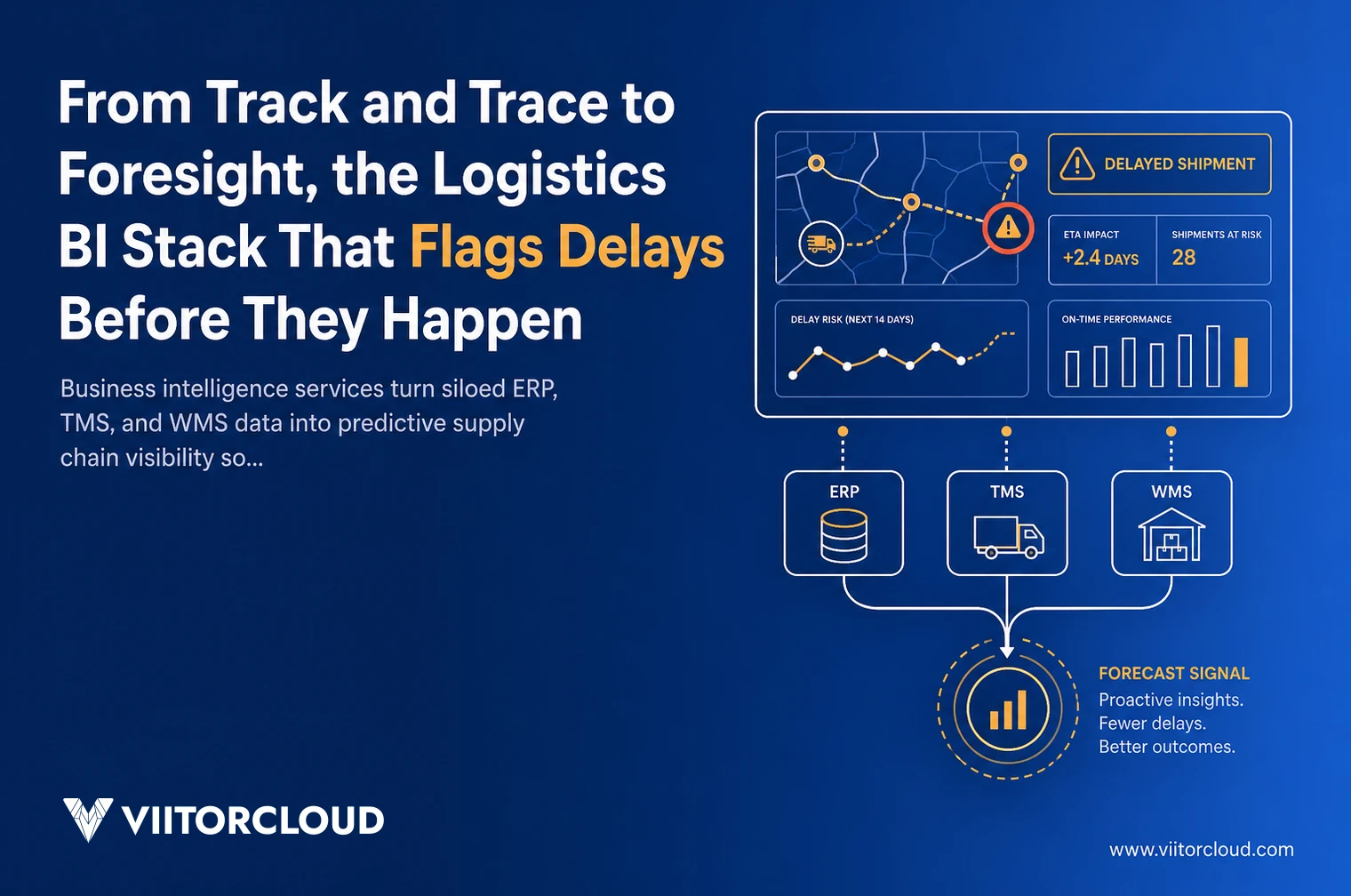
Business intelligence services turn fragmented logistics data into predictive, decision-ready insight, so your operations team can flag delays before they happen instead of reacting after a shipment is already stuck. That one shift, from tracking what already went wrong to forecasting what is about to, separates supply chains that hold their service levels from the ones that keep apologizing.
Most logistics operations already collect enough data to see trouble coming. The trouble is that the data sits in disconnected systems, and nobody watches it in one place. I have spent years building the analytics layer that fixes this, and the pattern rarely changes. The tracking works. The foresight does not.
This guide covers why track and trace keeps teams a step behind, what business intelligence services actually do inside a supply chain, and how to build a logistics BI stack that predicts delays instead of reporting them after the fact.
Key Takeaways
- Track and trace tells you a shipment is late. Business intelligence services tell you it will be late while you can still act.
- Around 72% of supply chain leaders lack real-time coordination because data is trapped in separate ERP, TMS, and WMS systems.
- A logistics BI stack has three layers: a unified data foundation, advanced analytics and predictive models, and a control tower analytics view.
- Predictive analytics converts historical and live signals into delay forecasts and dynamic ETAs, not just dashboards of the past.
- Supply chain visibility is a data integration problem first and a reporting problem second, so fix the pipeline before buying another dashboard.
Why Logistics Teams Still Learn About Delays Too Late
Most delay management is reactive by design. A truck misses a slot, a container sits at a port, a warehouse falls behind on picking, and the operations team finds out only when a status turns red, or a customer complains.
I once sat with a distribution team that discovered a three-day port hold from an angry retailer email, not from any of their own systems. The data existed. Their port feed, their transport management system, and their order records each held a piece of the story. No tool had put those pieces together in time to matter.
This is the ceiling of track and trace. It records events after they occur. It answers where is my shipment, but never the more valuable question: which shipments are about to slip and what should I do first. The gap is well documented by analysts who study supply chain operations, who consistently rank real-time visibility among the hardest problems leaders face. Industry surveys put it starkly, with around 72% of supply chain leaders still lacking real-time coordination across their networks.
The cost is not only late deliveries. Reactive operations erode service levels, inflate expedite and detention charges, and stretch cash cycles because invoices wait on proof of delivery. A network that only reports the past leaves all of that money on the table.
See Where Your Delay Risk Is Hiding
We map your ERP, TMS, and WMS data and show where predictive analytics can flag delays before they cost you. Start with a focused data assessment, no full build required.
What Business Intelligence Services Do for a Modern Supply Chain
Business intelligence services collect data from every operational system, clean and unify it, then turn it into reports, dashboards, and predictions people can act on. In logistics, that means pulling signals from your ERP, transport management system, warehouse management system, telematics, and carrier feeds into one trusted view of what is happening and what is likely to happen next.
Strong business intelligence services do four things for a supply chain:
- Unify fragmented data into a single, consistent source of truth.
- Describe what is happening with accurate, real-time supply chain visibility.
- Predict what is likely to happen using advanced analytics and predictive models.
- Recommend the next best action through control tower analytics and exception alerts.
The first two are table stakes. The last two, prediction and recommendation, are where data analytics services stop describing history and start protecting your service levels. That is the jump from track and trace to foresight.
The Hidden Cost of Data Trapped in ERP, TMS, and WMS Silos
Every logistics business I have worked with already owns the data it needs to predict most delays. The blocker is rarely missing data. It is data scattered across systems that define the same thing differently and never sync in real time.
One 3PL I advised ran a capable TMS, a solid WMS, and an ERP that handled billing. Each system named a shipment with a different identifier. When a customer asked one simple question about an order, three people pulled three different numbers from three screens, and nobody trusted any of them. That is not a reporting failure. It is an integration failure, and it quietly caps every attempt at supply chain visibility.
Fragmented sources also drag down forecast accuracy, because a predictive model cannot reason across data it never receives. Before any dashboard adds value, the pipeline underneath has to reconcile identifiers, standardize units, and stream updates as they happen. This is why serious data engineering in logistics and disciplined data analytics services come before analytics dashboards, not after.
The order matters. Add another dashboard on top of siloed data, and you get a prettier view of the same blind spots. Fix the foundation first, and real supply chain visibility follows.
Build a Logistics BI Stack That Predicts
From unified data pipelines to control tower analytics, we turn fragmented logistics data into decision-ready foresight. Prove it on one lane, then scale across your network.
How to Build a Logistics BI Stack That Flags Delays Early
A logistics BI stack that predicts delays has three layers. Each one has a job, and skipping any of them creates the silent failure that looks like a bad model but is really a weak foundation.
Layer One, a Unified Data Foundation
This layer ingests and reconciles data from every source, including ERP, TMS, WMS, telematics, and external feeds like weather and port status. It standardizes identifiers and units, then streams clean records into one store. A reliable data pipeline is the difference between a model that sees reality and one that guesses. This is where most of the engineering effort goes, and where good data analytics services earn their keep.
Layer Two, Advanced Analytics and Predictive Models
With clean data flowing, advanced analytics finds the patterns that precede a delay. Predictive analytics then scores each shipment for risk, forecasts realistic ETAs, and flags the orders most likely to slip. Instead of a static report, the team gets a ranked list of what needs attention now. This engine is what moves an operation from reactive to genuinely predictive.
Layer Three, Control Tower Analytics and Alerts
The top layer turns predictions into action. Control tower analytics presents a live command view of the network, with exception alerts routed to the right person before a problem hardens. When a shipment crosses a risk threshold, the system does not wait for a status to turn red. It tells someone while there is still time to reroute, reslot, or call ahead.
Where Predictive Analytics Moves You From Tracking to Foresight
Foresight is not magic. It is predictive analytics applied to data you already own, made usable by the layers beneath it.
The value shows up in three concrete places:
- Dynamic ETAs that update from live traffic, weather, and port conditions instead of a fixed promise made at dispatch.
- Delay risk scoring that ranks open shipments so the team works the small share of orders that cause most of the pain first.
- Root cause patterns that reveal which lanes, carriers, or facilities repeatedly break, so you fix the source instead of the symptom.
Done well, advanced analytics of this kind pays for itself quickly. McKinsey research on operations has found that analytics-driven automation across supply chains can cut logistics costs by 15% to 30%. The saving comes from fewer expedites, better asset use, and delays caught early enough to stay cheap.
This is also the foundation that AI-driven decision systems for logistics build on, adding autonomous recommendations on top of the predictions.
Turn Supply Chain Data Into Foresight
Explore how ViitorCloud data analytics services help 3PLs, shippers, and distributors move from track and trace to prediction and protect service levels.
What Strong Logistics Business Intelligence Services Look Like
After enough of these builds, I judge logistics business intelligence services by one test. Can they turn scattered operational data into a decision the team trusts before the delay lands. That takes equal strength in data engineering and analytics, not a dashboard bolted onto broken pipes.
It is the same discipline behind the enterprise port management platform my team built for a global port operator. That system now tracks cargo across 14 active port sites in more than 10 countries, unifying operational data that used to live in separate silos. The hard part was never the charts. It was the foundation that makes the charts worth trusting.
If your ERP, TMS, and WMS data is not yet feeding one predictive view, that gap is where most of your delay risk hides. Our logistics technology solutions and data analytics services exist to close it, starting with a focused assessment of your data before any build begins. Think big, start small, and prove the foresight on one lane before scaling it across the network.
Turning Foresight Into an Operating Advantage
The move from track and trace to foresight is not a new dashboard. It is a different operating model, one where business intelligence services predict disruptions early enough for your team to act. Get the three layers right: a unified data foundation, advanced analytics and predictive models, and control tower analytics, and delays stop arriving as surprises.
Start where the pain is sharpest. Pick one high-value lane, connect its ERP, TMS, and WMS data, and prove that predictive analytics can flag a slip before a customer does. The right data analytics services turn those siloed records into foresight, and that first win builds the case for network-wide supply chain visibility. Our team at ViitorCloud makes this shift not just to track shipments better but to protect service levels, margins, and cash while everyone else refreshes a status screen.
Stop reacting to disruptions and start predicting them. Contact us today to discuss how we can help you build a proactive operating model that safeguards your bottom line.

Vishal Shukla
Vishal Shukla is Vice President of Technology at ViitorCloud Technologies.
Frequently Asked Questions
What is business intelligence in logistics?
Business intelligence in logistics unifies ERP, TMS, and WMS data into dashboards and predictions that help teams act before delays actually occur.
How is business intelligence different from track and trace?
What does supply chain visibility actually require?
Can predictive analytics really flag delays before they happen?