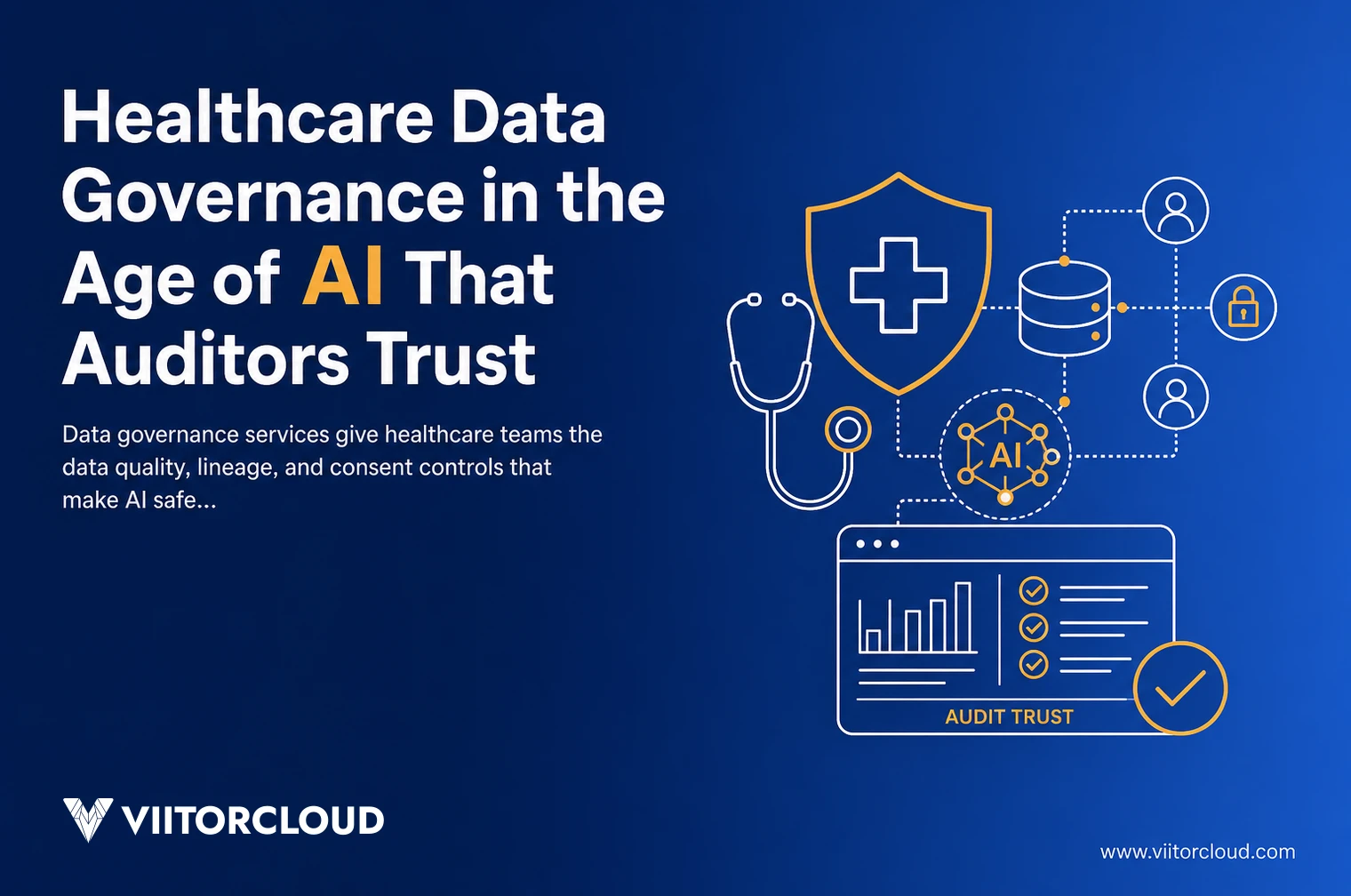
Healthcare data governance is the discipline of keeping health data accurate, traceable, and lawfully used, so that both AI models and auditors can rely on it. In the age of AI, that discipline is no longer optional. Strong data governance services give hospitals, payers, and HealthTech firms the data quality, lineage, and consent controls that hold up under regulatory review.
I have spent years building data platforms for healthcare and other regulated industries, and the pattern is always the same. The AI model gets the attention. The data underneath it decides whether the project survives an audit. Most health systems today run AI on a foundation that cannot answer three basic questions. Is this data correct? Where did it come from? Did the patient agree to this use?
This guide explains what healthcare data governance means today, why the HTI-1 rule made it urgent, and the exact quality, lineage, and consent controls auditors look for. You will leave with a framework you can apply before your next AI initiative or compliance review.
Key Takeaways
- Healthcare data governance manages the quality, lineage, and consent of health data so AI outputs and audit trails stay defensible.
- The ONC HTI-1 rule now requires transparency for predictive algorithms, which turns ungoverned data into a direct compliance risk.
- Auditors check data quality, data lineage, and consent that stays attached to each record before anything else.
- Master data management creates the single patient and provider records that stop AI from learning on duplicates and conflicts.
- Data governance services deliver faster than a full rebuild by fixing the highest-risk data domains first.
What Healthcare Data Governance Means When AI Enters the Picture
Healthcare data governance is the set of policies, roles, and controls that manage how health data is defined, validated, tracked, and used across an organization. It answers who owns each data element, how quality is measured, where data moves, and on what legal basis it can be used.
For years, governance was treated as a documentation exercise. AI changed that. A model trained on inconsistent or unconsented data does not simply produce weak predictions. It produces decisions a regulator can challenge and a patient can dispute.
When I assess a hospital or payer, I look at governance across four layers that shape how ViitorCloud approaches healthcare technology solutions.
- Definitions, so a diagnosis, a claim, or a patient identifier means the same thing in every system.
- Quality, so records are complete, accurate, and current before a model ever reads them.
- Lineage, so every value can be traced back to its origin.
- Consent, so each use of data has a lawful and recorded basis.
Get these four right, and AI becomes an asset. Get them wrong, and every model you deploy inherits the same hidden liabilities.
Is Your Health Data Ready for an AI Audit?
ViitorCloud builds the data quality, lineage, consent, and master data management controls that hold up under HTI-1 and HIPAA review. Let’s assess your foundation.
Why HTI-1 Made Data Quality, Lineage, and Consent Urgent
The shift from optional to mandatory has a name. In early 2024, the ONC finalized the HTI-1 rule, which introduced transparency requirements for predictive decision support built into certified health IT. Developers now have to expose source attributes for their algorithms, so buyers and clinicians can see what data trained them.
You can review the details through the ONC and its HealthIT.gov guidance, but the practical message is simple. If you cannot describe the data behind an algorithm, you cannot certify it, sell it, or defend it.
Here is the gap I see across the market. Surveys of health and technology leaders keep showing the same split. Nearly nine in ten organizations now use AI in some form, while only a fraction have governance mature enough to prove how their data was sourced, cleaned, and consented. That mismatch is exactly where compliance risk and model risk meet.
This is why data governance services have moved from the data team wish list to the board agenda. The question is no longer whether to govern health data. It is how fast you can close the quality, lineage, and consent gaps before an auditor or an AI incident finds them first.
The Three Governance Controls Auditors Actually Check
When auditors review an AI-enabled health system, they rarely start with the model. They start with the data behind it. Three controls decide whether that review goes smoothly or turns into a finding.
Data Quality That Holds Up Under Scrutiny
Data quality is the foundation. If records are incomplete, duplicated, or stale, every downstream model and report inherits the error. Strong data quality services measure accuracy, completeness, consistency, timeliness, and validity as continuous metrics, not one-time cleanups.
In practice, I build data quality services as automated gates inside the pipeline. Each gate validates records at ingestion, flags anomalies, and blocks bad data before it reaches a model. When an auditor asks how you know a dataset is reliable, those gates are the answer.
One payer I worked with ran three systems that each defined an active member differently, and their AI risk model trained on all three at once. We introduced data quality services that reconciled the definitions and validated every record daily. The model stopped producing large volumes of false positives, and the compliance team finally had a number it could defend.
Data Lineage That Traces Every Value to Its Source
Data lineage is the map of where each value came from and everything that happened to it along the way. It records the source system, every transformation, and each handoff between platforms. Without data lineage, HTI-1 transparency is impossible, because you cannot describe data you cannot trace.
Good data lineage answers an auditor’s hardest question in seconds. Show me exactly how this field reached this model. I build lineage tracking into the pipeline itself, so the trail is captured automatically rather than reconstructed under pressure. That difference separates a clean audit from a scramble.
Consent That Stays Attached to the Record
Consent is the control most systems handle worst. A patient may agree to share data for treatment but not for model training or research. When consent lives in a separate spreadsheet, that distinction disappears the moment data moves.
Governed consent travels with the record. Every dataset carries a machine-readable flag describing what the patient permitted, and the pipeline enforces it automatically. This is where healthcare data governance protects patients and the organization at the same time.
These controls sit on top of existing privacy law, so they must align with HIPAA privacy requirements rather than replace them.
Start With Your Highest-Risk Data Domain
Our phased governance approach delivers one audit-ready, AI-ready data domain in weeks, not a year. See how we scope the first phase.
Where Master Data Management Fits in a Governed Health System
Master data management is how you create one trusted version of the entities that matter most, including patients, providers, facilities, and payers. Most health systems hold the same patient across five systems under five slightly different records. Master data management resolves those into a single golden record.
This matters enormously for AI. A model that sees one patient as five people learns from noise. Master data management removes the duplicates and conflicts, so the data feeding your algorithms reflects reality. It also makes data lineage cleaner, because there is one authoritative source to trace back to.
I treat master data management as the backbone of any healthcare data governance program. Get the golden records right and quality, lineage, and consent all become easier to enforce. When master data management connects to clinical systems, it often runs alongside AI integration in EHR and EMR platforms, so the golden record stays current as new data arrives.
How I Build Data Governance Services That Survive an Audit
The mistake I see most often is treating governance as a single, all-at-once program. That approach stalls. The data governance services I deliver follow a phased model that produces audit-ready results on the highest-risk data first.
- Map the highest-risk data domains. Start with the data that feeds live AI models or regulatory reports, not the entire warehouse.
- Fix quality at the source. Deploy data quality services as pipeline gates so bad records never reach production.
- Capture lineage automatically. Build data lineage into every transformation so the trail exists before anyone asks for it.
- Attach consent to the data. Replace separate consent logs with flags that move with each record.
- Anchor everything to master data management. Resolve golden records so quality, lineage, and consent all reference one truth.
- Prove it continuously. Stand up dashboards and alerts so governance is a live state, not an annual report.
This sequence mirrors how I approach AI-powered data pipeline development, because governance and pipelines are the same problem seen from two angles. It also follows ViitorCloud’s think big, start small model, which lets a team show one governed, audit-ready domain in weeks rather than waiting a year for a full rebuild.
A HealthTech founder came to me after a failed certification review. Their model worked, but they could not show where the training data came from. We rebuilt the pipeline with automated data lineage and consent flags, resolved the golden records through master data management, and returned with a complete trail. The second review passed.
Governed Data Behind Real Outcomes
The same governance discipline supports platforms processing $192M+ in healthcare revenue and 70M+ citizen records. Bring it to your health system.
Getting Your Health Data Ready for AI and Auditors
I have built platforms in healthcare and regulated sectors where the data foundation had to withstand real scrutiny. One healthcare revenue platform, ViitorCloud, engineered processes that generated more than $192 million in healthcare revenue, which only works when the underlying data is governed to the standard auditors expect. The same discipline supports a government identity platform used by more than 70 million registered citizens.
That experience is what our data analytics and governance services bring to hospitals, payers, and HealthTech firms. We combine data quality services, automated data lineage, consent controls, and master data management into one governed foundation, built with GDPR and HIPAA compliance from day one. If you are preparing for an AI initiative or a compliance review, this is the groundwork that decides whether either one succeeds.
Governance Is the AI Foundation Auditors Reward
Healthcare AI does not fail at the model. It fails at the data underneath, where quality gaps, missing lineage, and unclear consent turn promising projects into compliance exposure. HTI-1 made that exposure explicit, and the organizations that treat governance as core infrastructure will move faster than those that bolt it on later.
Start with your highest-risk data. Fix quality at the source, capture data lineage automatically, attach consent to every record, and anchor it all to master data management. That is how data governance services turn health data into something both AI and auditors can trust.

Vishal Shukla
Vishal Shukla is Vice President of Technology at ViitorCloud Technologies.
Frequently Asked Questions
What is healthcare data governance?
Healthcare data governance manages health data quality, lineage, and consent so AI outputs and audit trails stay accurate and defensible.
What is data lineage in healthcare?
What does the HTI-1 rule require?
Why do data governance services matter for AI?