GDPR compliance services now do far more than manage consent banners and subject access requests. For banks, insurers, and fintechs, they are the layer that ties GDPR, DORA compliance, and the EU AI Act into one defensible audit trail. That is the direct answer to the question most compliance leaders ask me this year.
Here is the problem I keep seeing across regulated finance teams. Three heavy obligations arrived almost together. DORA demands near-real-time incident reporting. GDPR still governs every piece of personal data you hold. The EU AI Act now reaches into the credit and fraud models your business runs on. Most firms try to meet all three with fragmented controls and spreadsheets, so audits get slower and riskier, and financial data protection suffers.
I have spent years building regulated systems for financial and enterprise clients. The firms that pass audits cleanly are not the ones with the most policies. They are the ones whose data privacy services and technical controls produce evidence automatically, which is the real goal of good data privacy consulting. This playbook shows how to build that stack before your next audit, not during it.
Key Takeaways
- DORA compliance, GDPR, and the EU AI Act now overlap, so financial firms need one control layer rather than three disconnected programs.
- GDPR compliance services should automate breach evidence, data lineage, and the 72-hour notification workflow instead of relying on manual collection.
- The EU AI Act treats many credit scoring and fraud models as high risk, which makes logging and traceability mandatory.
- A unified data privacy stack turns audit preparation from a recurring scramble into a continuous, evidence-backed process.
- ViitorCloud builds GDPR and HIPAA-compliant systems for regulated clients including KPMG, Royal Navy, ADNOC, and DP World.
Why DORA, GDPR, and the EU AI Act Are Converging on Finance Now
For a decade, financial firms treated data protection, operational resilience, and model governance as separate projects. That separation no longer holds. The three frameworks now ask for the same evidence from the same systems, and they ask for it faster than manual processes can deliver.
DORA governs operational resilience and ICT risk. GDPR governs personal data and privacy rights. The EU AI Act governs how automated models make decisions. A single customer transaction can touch all three at once. When your controls are fragmented, you prove the same fact three times in three formats.
A head of compliance at a mid-sized insurer described her last audit to me in one line. Her team spent six weeks pulling logs from eleven systems to answer questions an auditor raised in a single afternoon. The data existed. It was scattered, undated, and hard to reconcile. That gap between holding data and proving control sits at the center of compliance and risk in financial systems today, and closing it is the first job of serious data privacy consulting.
Map Your DORA and GDPR Gaps Before the Auditor Does
Get a focused readiness assessment that scores your current controls against DORA, GDPR, and the EU AI Act, then shows the fastest path to audit ready evidence.
What DORA Compliance Demands From Your Whole Estate
DORA compliance requires financial entities to detect, classify, and report major ICT-related incidents on tight, tiered deadlines. It also extends to the critical technology providers your firm depends on, which means your vendors are now part of your audit scope.
The regulation has applied across the sector since early 2025, so this is a live obligation rather than a future one. Four demands matter most for the stack you build.
- Incident reporting on regulated timelines, from first detection through the final report.
- ICT risk management with clear ownership and documented controls.
- Resilience testing that proves systems recover from disruption.
- Third-party oversight covering the providers inside your estate.
The near real-time reporting clock is what catches most teams. If you cannot detect and classify an incident quickly, you cannot report it on time. Late reporting is exactly what auditors flag, and reactive data privacy services rarely catch these events soon enough.
How GDPR Compliance Services Close the Evidence Gap
GDPR compliance services exist to make personal data defensible on demand. Under GDPR, a breach must be reported to the supervisory authority within 72 hours of discovery, and penalties reach up to 20 million euros or 4 percent of global annual turnover, whichever is higher. Those rules are set out in the EU official data protection framework.
The firms that struggle here are rarely short on policy. Their evidence lives in disconnected tools that cannot be reconciled under time pressure. Strong data privacy services turn each requirement into an automated workflow rather than a manual scramble.
Effective GDPR compliance services should automate four things.
- Records of processing that update as systems change, not once a year.
- Data lineage that shows where every personal record started and where it flows.
- Breach detection wired directly to the 72-hour notification clock.
- Access and erasure requests fulfilled from a single source of truth.
That lineage layer is where disciplined data pipeline development pays for itself, because you cannot protect data you cannot trace.
Build One Privacy Stack Instead of Three Programs
We unify data lineage, evidence capture, incident reporting, and model logging into a single governed system for banks, insurers, and fintechs.
Where the EU AI Act Catches Credit and Fraud, Models
The EU AI Act is where many finance teams get surprised. Its risk-based framework classifies AI systems by the harm they can cause, and models that assess creditworthiness or score consumers for credit are treated as high risk. You can see how the tiers work in the EU AI Act regulatory framework.
High-risk classification brings hard duties. You keep detailed logs, document training data, ensure human oversight, and prove the model behaves as intended. Fraud detection models often fall into scope too, depending on how their decisions affect customers.
One risk officer I worked with had a strong fraud model and no way to explain a single decision after the fact. The model worked. The audit trail did not exist. We rebuilt the logging layer so every score traced back to its inputs and model version. That retrofit took months, when building it in from the start would have taken weeks. The same lesson repeats across regulated sectors, as I covered in this look at AI implementation risks in regulated industries.
Building the Data Privacy Stack That Survives an Audit
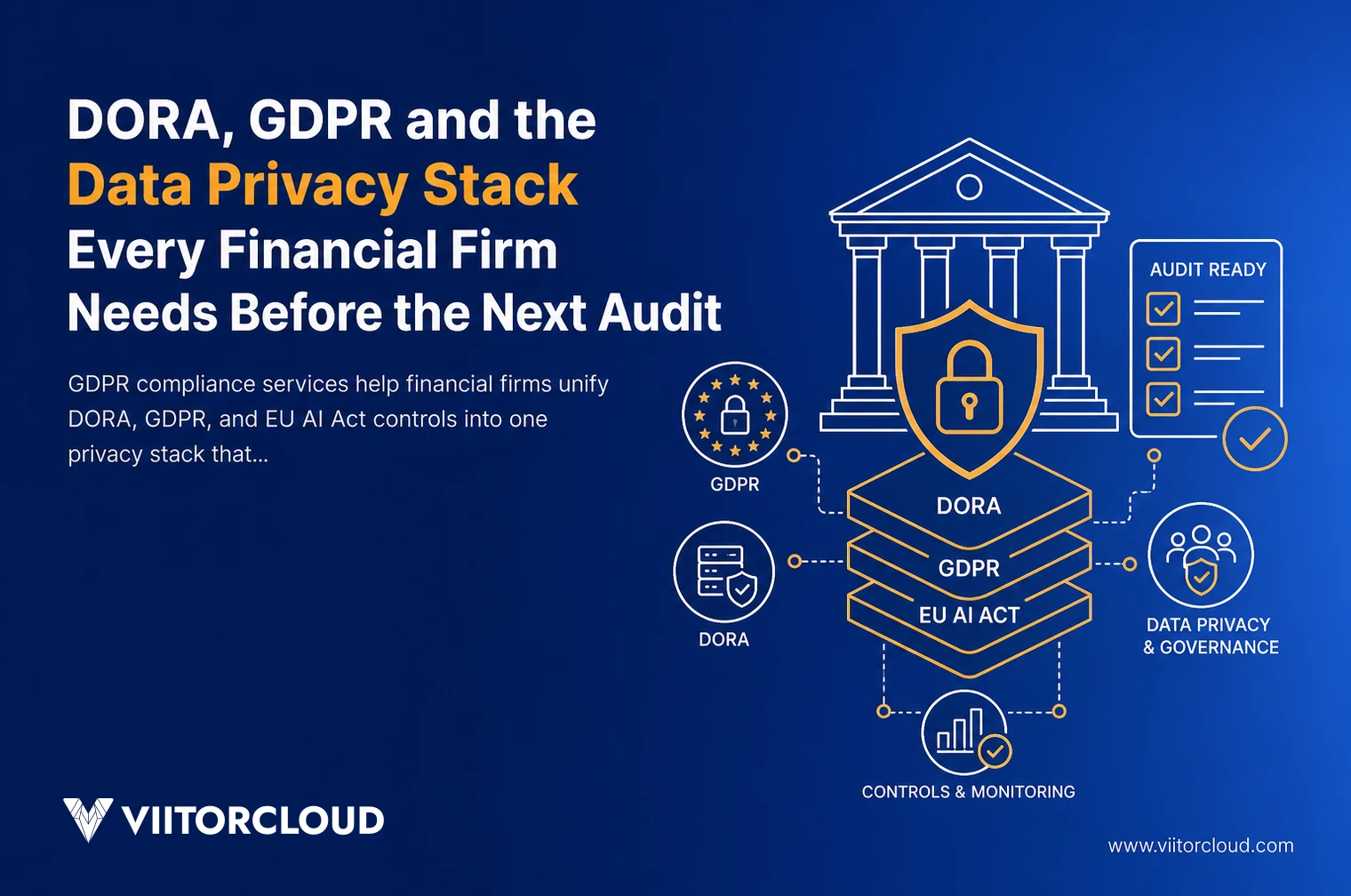
A privacy and resilience stack is not a single product. It is a set of layers, delivered as integrated data privacy services, that together make financial data protection continuous and provable. When I design one for a regulated client, it has five layers that map directly to what auditors ask for.
- Unified data inventory and lineage. Every personal and financial record is catalogued, classified, and traceable across the estate.
- Automated evidence capture. Controls generate timestamped logs continuously, so evidence is a query rather than a project.
- Incident detection and reporting. Monitoring feeds straight into DORA and GDPR reporting workflows on their required timelines.
- Model governance and logging. Every AI decision, its inputs, and its model version are recorded for EU AI Act traceability.
- Access control and encryption. Role-based access and strong encryption protect data at rest and in transit across every layer.
Notice what this design does. It collapses three regulatory programs into one evidence system. The lineage that satisfies a GDPR subject request also supports a DORA incident report and an EU AI Act model audit.
This is where good data privacy consulting proves its value. I have built these evidence layers for enterprise and government clients, including a government records platform that consolidated more than 70 million citizen records into one governed system. If your controls are spread across a dozen tools, unifying them is the highest value work you can do before an audit. Our work across banking, financial services, and insurance is built around exactly this problem.
Partner With a Regulated Security Engineering Team
ViitorCloud has delivered GDPR and HIPAA compliant systems since 2011 for clients including KPMG, Royal Navy, and DP World. Start with a scoped project.
How ViitorCloud Builds Audit-Ready Compliance Into the Stack
I have delivered regulated systems since 2011 across more than 300 client engagements, and the pattern is consistent. Compliance bolted on after the build always costs more than compliance designed into the architecture. That is why ViitorCloud builds GDPR and HIPAA-compliant practices into every layer from day one.
Our enterprise and regulated clients include KPMG, Royal Navy, ADNOC, DP World, and Biocon. For one healthcare revenue platform we engineered, the system now processes more than 192 million dollars in regulated transactions. For a global port operator, our systems run across 14 active sites in more than 10 countries with the resilience that scale demands.
We start small and prove value fast. A focused readiness assessment maps your current controls against DORA, GDPR, and EU AI Act requirements, then we build the missing layers in phases. If you want a partner who treats data privacy consulting and secure engineering as one discipline, that is where we are strongest. Explore how our teams use data analytics and governance as the foundation of the stack.
Conclusion
The next audit will not wait for your controls to catch up. DORA compliance, GDPR, and the EU AI Act now demand the same thing from different angles, which is provable control over your data and your models. The firms that treat these as one problem, not three, are the ones that pass cleanly.
Start by mapping your current evidence against all three frameworks, then find the gaps where data exists but proof does not. Build the privacy stack that makes evidence collection continuous. Strong GDPR compliance services, dependable data privacy services, and disciplined data privacy consulting make that shift possible, and they pay for themselves the first time an auditor asks a hard question about financial data protection.

Vishal Shukla
Vishal Shukla is Vice President of Technology at ViitorCloud Technologies.
Frequently Asked Questions
What is DORA compliance?
DORA compliance means meeting EU Digital Operational Resilience Act rules for ICT risk, incident reporting, and third party oversight in finance.
How does GDPR apply to financial services?
Does the EU AI Act affect credit and fraud models?
What should a financial data protection stack include?