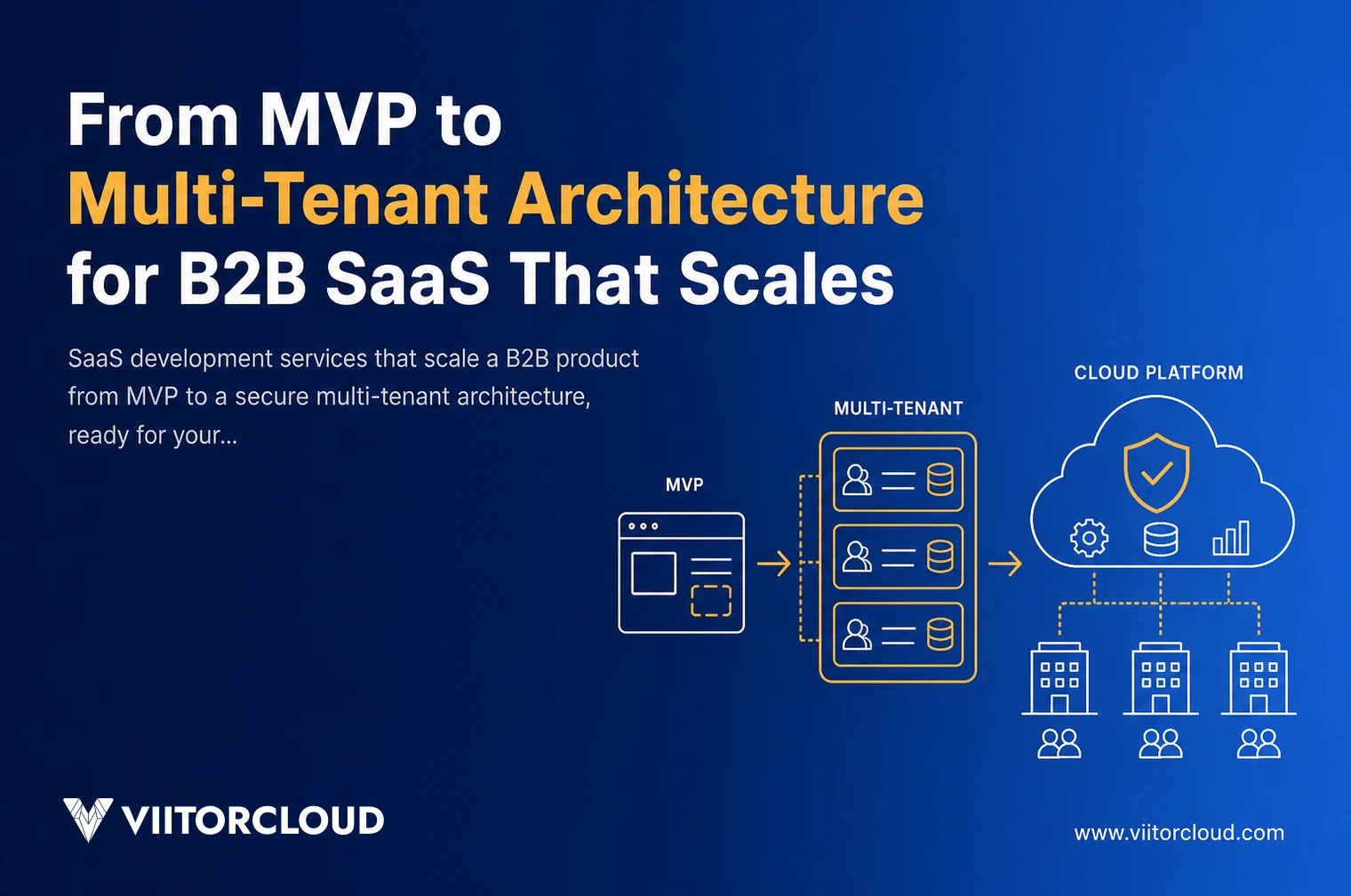
The SaaS development services that carry a product from a first release to an enterprise contract share one decision most early teams get wrong, which is how they handle tenancy. A single-tenant MVP wins your first customers quickly, and then it quietly becomes the reason you cannot close the enterprise deal you want. This guide maps the journey from an MVP to a secure multi-tenant architecture built for B2B SaaS development at real scale.
I have reviewed dozens of B2B SaaS codebases at the exact point where growth stalls. The pattern is almost always the same. The team shipped fast, built an MVP customers loved, and took an architecture shortcut that made sense at 10 customers and starts to fail at 100.
The right SaaS development services plan treats each stage as a deliberate decision. Below I cover why MVP architectures break, what multi-tenant SaaS architecture means, the four stages of scaling, where teams waste cloud budget, and how to build tenancy that enterprise buyers will approve.
Key Takeaways
- Single-tenant MVP shortcuts are the most common reason a B2B SaaS cannot move upmarket to enterprise buyers.
- Multi-tenant architecture lets one application serve many customer organizations while keeping each tenant’s data isolated.
- The three tenancy models, silo, pool, and bridge, trade cost against isolation, and most scaling platforms use a mix.
- Cloud spend of $15,000 to $50,000 a month usually signals an architecture problem rather than a pricing problem.
- Enterprise deals depend on isolation, security, and compliance being designed in early, not retrofitted under deal pressure.
Why the Architecture That Wins Your MVP Breaks at Scale
Most MVPs ship as single-tenant systems, and that is the right call at the start. You run one database and one app instance per customer, or a shared database with no real tenant boundaries. It is fast to build and easy to reason about.
The trouble starts when you win customers. Every new logo adds another instance to deploy, patch, monitor, and bill for. SaaS scalability stops being a code question and becomes an operations problem. Your engineers spend their weeks on release operations instead of product.
One founder I worked with had 40 paying customers on 40 separate deployments. Onboarding a new customer took three days of manual setup, and a single security patch meant 40 deploys. Their B2B SaaS development roadmap had stalled because the team had no hours left to build features.
This is the point where growth stalls. The architecture that helped you find product-market fit is now capping it. Choosing the right SaaS development company or internal approach here decides whether you break past it. If you are still validating the idea, move fast with MVP development first and plan the tenancy refactor as a deliberate next step.
Planning the jump from MVP to multi-tenant SaaS?
Talk to engineers who have taken B2B SaaS products from first customers to enterprise scale, and get a tenancy plan built for your stage.
What Multi-Tenant SaaS Architecture Actually Means
Multi-tenant SaaS architecture is a design where a single application and shared infrastructure serve many customer organizations, called tenants, while keeping each tenant’s data isolated. One codebase, one deployment, many customers. It is the default model for scalable B2B SaaS because it keeps the cost of serving each new customer low.
The real design work is in how you isolate tenants, and that choice drives your long-term SaaS scalability. There are three common models, and mature platforms usually combine them.
The Pool Model
All tenants share the same database and compute, separated by a tenant identifier on every record. It is the cheapest and most efficient model, and the hardest to get right, because one missing tenant filter can leak data across customers. Disciplined custom SaaS development and automated tests are what make the pool model safe.
The Silo Model
Each tenant gets dedicated resources, such as a separate database or schema. Isolation is strong, which enterprise and regulated buyers prefer, but cost per tenant is high. This is where many teams place their largest or most sensitive accounts.
The Bridge Model
A blend of the two, where most tenants share a pool and specific tenants are siloed on demand. You get cost efficiency for the long tail and hard isolation for the accounts that require it. Cloud vendors document these tradeoffs in depth, and the AWS Well-Architected SaaS Lens is a solid reference for tenant isolation patterns.
The Four Stages of Scaling a B2B SaaS Architecture
A B2B SaaS does not jump from MVP to enterprise in one step. It moves through four stages, and each one asks a different architecture question. Sound B2B SaaS development plans for each stage in advance rather than reacting to each crisis.
Stage 1, The MVP
Ship fast and prove people will pay. Single-tenant is fine here. Do not spend months on multi-tenant infrastructure before you know the product works. The one thing to protect is a clean data model, because a future refactor will depend on it.
Stage 2, Product-Market Fit and the Refactor Window
Once customers renew and referrals start, open the refactor window. This is the cheapest moment to introduce a tenant model, add a tenant identifier to your schema, and centralize authentication. Waiting past this point makes the change far more expensive. A good SaaS development company treats this window as a planned phase, guided by a clear SaaS product development framework.
Stage 3, Scale-Up and Cost Control
Now you move most tenants into a pooled multi-tenant architecture and start watching unit economics. The goal is simple. Adding a customer should add revenue without adding proportional infrastructure and operations cost. A capable SaaS development company designs those cost controls in at this stage, which is where real SaaS scalability shows up on your margin.
Stage 4, Enterprise-Ready
Large buyers bring new demands like data residency, single sign-on, audit trails, and sometimes a dedicated instance. This is where custom SaaS development earns its place, extending your core platform for enterprise requirements without forking the codebase for every account.
Is your cloud bill climbing faster than revenue?
A scalability review pinpoints the architecture decisions quietly inflating your monthly spend and maps the fix before it compounds.
Where Scaling SaaS Teams Burn 15K to 50K a Month on Cloud
When a B2B SaaS development team tells me its cloud bill has hit $15,000 to $50,000 a month with no clear reason, the cause is rarely the provider’s pricing. It is almost always the architecture underneath. Single-tenant sprawl and pooled systems without cost controls both waste money, in different ways.
Single-tenant sprawl wastes money on idle capacity, because every customer instance reserves resources it rarely fully uses. Pooled systems waste money when queries are not tenant-aware, and one heavy customer degrades performance for everyone, which pushes you to over-provision.
The fix is to design for cost from Stage 3 onward, with shared resources, per-tenant usage metering, autoscaling tied to real demand, and query patterns that isolate heavy tenants. For a detailed view of what a build actually costs, this SaaS development services cost breakdown is worth reviewing before you set a budget.
Calenso, an appointment scheduling platform we engineered, is a useful reference point. It serves 100,000 daily users and more than 10,000 business customers on one multi-tenant architecture. That ratio – many business customers on shared infrastructure – is what keeps a SaaS profitable as it grows.
How to Build Tenancy That Enterprise Buyers Will Approve
The move upmarket is where weak tenancy models cost you deals. Enterprise buyers run security reviews before they sign, and a shared system with fuzzy tenant boundaries will not pass. Designing this early is what turns a scrappy product into an enterprise-grade platform.
Five controls matter most in enterprise security reviews:
- Tenant isolation that provably keeps one customer’s data unreachable by another.
- Role-based access control so each tenant manages its own users and permissions.
- Audit logging that records who accessed what, per tenant.
- Data residency options for buyers with regional compliance rules.
- Per-tenant encryption and key management for sensitive workloads.
These are hard to add under deal pressure, which is why custom SaaS development for enterprise readiness belongs in your roadmap before the first big deal. The major cloud platforms publish detailed guidance here, and the Azure multitenant architecture guide is a strong reference for isolation and compliance design.
Compliance is often the gate for regulated industries. We built LogixHealth, a healthcare revenue platform that has processed $192.2M in revenue, with custom SaaS development on infrastructure designed for strict data-handling rules. When compliance is part of the architecture from the start, it becomes a reason enterprise buyers say yes.
Chasing your first enterprise deal?
We build tenant isolation, security, and compliance into your platform early, so enterprise buyers say yes instead of flagging risks.
Building Multi-Tenant SaaS With a Partner Who Has Shipped It
Most teams face the multi-tenant transition once. I have worked on it repeatedly across industries, and the difference shows in the details that only surface at scale. That is the value of an experienced SaaS development company at this stage.
ViitorCloud has delivered B2B SaaS platforms since 2011 for more than 300 clients, using custom SaaS development to take products from first MVPs to enterprise systems. MariDeal, a platform we built, has generated $46.4M in revenue and handled $7.1M in a single 72-hour sales peak. That is SaaS scalability proven under real load. Our SaaS product engineering teams cover the full path from MVP to multi-tenant platform, and we work with fast-growing technology companies on exactly this transition.
If your SaaS development services plan needs to take a product from an MVP to an enterprise-ready multi-tenant platform, the right time to design the tenancy model is before growth forces the decision.
Conclusion
Scaling a B2B SaaS is an architecture story before it is a sales story. The single-tenant MVP that wins your first customers will cap your growth unless you plan the move to a multi-tenant architecture deliberately. SaaS scalability is the payoff when you get tenancy, cost control, and compliance right, and the enterprise deals become reachable.
Start where you are. If you are pre-fit, protect a clean data model and move fast. If you are scaling, open the refactor window now. If you are chasing enterprise, design isolation and compliance in early. Strong SaaS development services and honest B2B SaaS development choices at each stage carry a product from startup to enterprise, and the right SaaS development company makes that path far shorter.

Vishal Shukla
Vishal Shukla is Vice President of Technology at ViitorCloud Technologies.
Frequently Asked Questions
What is multi-tenant SaaS architecture?
It is a design where one application instance serves many customer organizations while keeping each tenant's data isolated and secure.
When should a B2B SaaS move from single-tenant to multi-tenant architecture?
Does multi-tenant architecture meet enterprise security requirements?
How much do SaaS development services cost for a multi-tenant build?