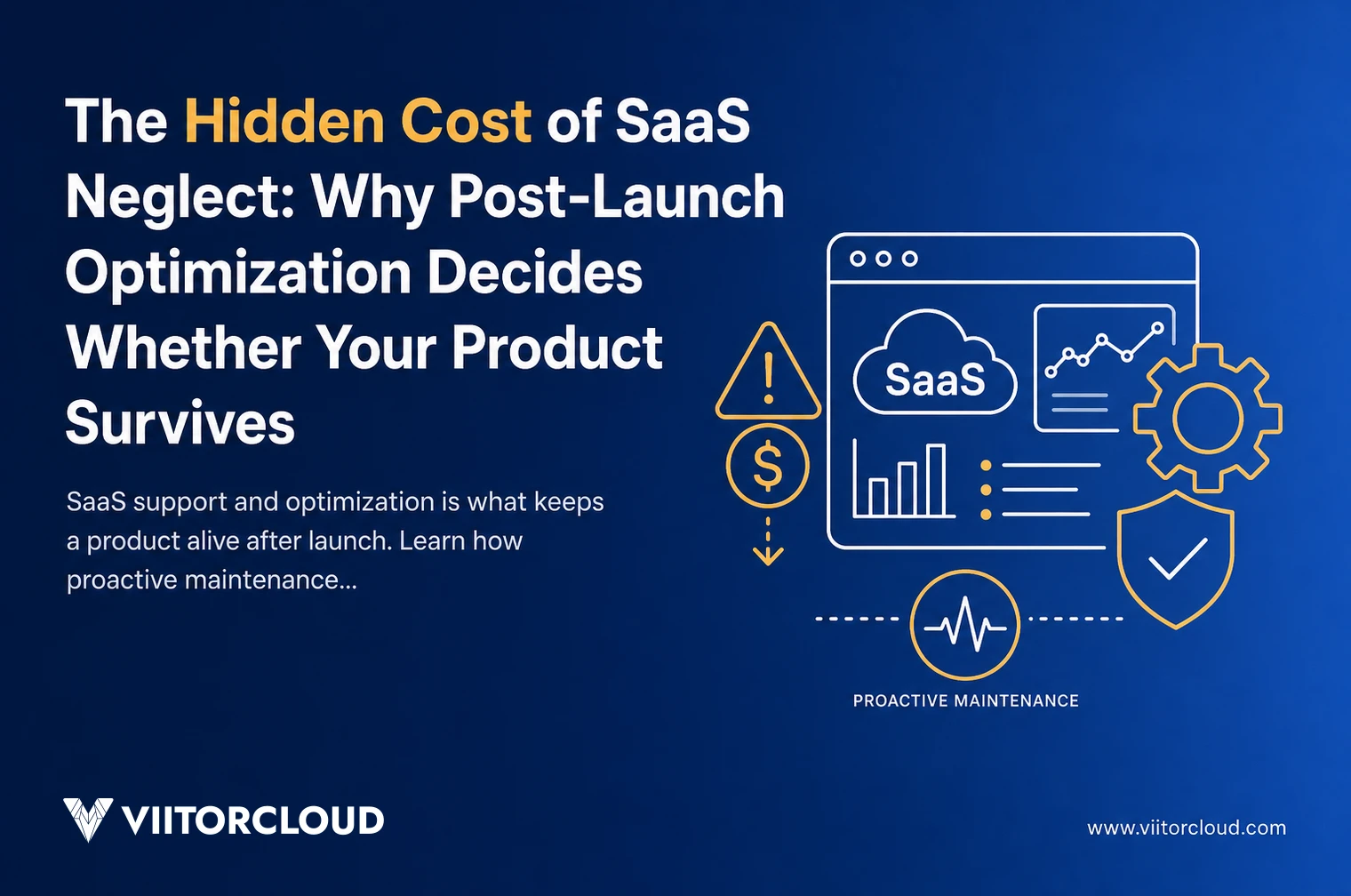
SaaS support and optimization is the work that decides whether your product grows or quietly dies after launch. Most teams treat the launch as the finish line. It is the starting line. The product that wins attention in month one is rarely the product that survives to year three.
I have spent years building and maintaining SaaS platforms, and the pattern is consistent. Teams that keep investing in SaaS maintenance, performance tuning, and steady iteration pull ahead. Teams that stop after launch watch their cloud bills climb, their speed drop, and their users leave.
This guide breaks down the real cost of neglect, the areas that matter most, and how proactive SaaS optimization keeps a product alive long enough to win. You will leave knowing exactly where to spend your attention after launch.
Key Takeaways
- SaaS support and optimization, not the launch itself, decides whether a product survives and scales.
- Neglect compounds quietly through rising cloud costs, tech debt, and churn before it ever shows up in revenue.
- Performance tuning and SaaS cost optimization protect retention and margins at the same time.
- Treating product support as part of the roadmap keeps feature velocity high instead of stalling.
- Budgeting for ongoing SaaS maintenance from day one is far cheaper than a forced rebuild later.
What SaaS Support and Optimization Actually Means After Launch
SaaS support and optimization is the ongoing work of keeping a live product fast, secure, affordable, and improving. It covers bug fixes, security patching, performance tuning, SaaS cost optimization, monitoring, and the steady stream of small features that keep users engaged. It is the difference between a product that ages well and one that decays.
Think of it in four parts:
- Keep it running: Monitoring, incident response, security patches, and dependency updates.
- Keep it fast: Performance tuning of queries, APIs, and front-end load times as usage grows.
- Keep it affordable: SaaS cost optimization across cloud infrastructure, storage, and third-party services.
- Keep it improving: A predictable cadence of fixes and features that answers real user feedback.
Most founders fund the build and forget the upkeep. In my experience, the build is maybe a third of a product’s real lifecycle. The rest is everything that happens after launch, and handling it well is what good SaaS product engineering is built for.
Is Your SaaS Quietly Losing Ground After Launch?
Get a clear read on where performance tuning and SaaS cost optimization will protect your product first.
Why Products Stagnate When SaaS Maintenance Stops
Stagnation rarely arrives as a single failure. It creeps in. A team ships an ambitious launch, moves its engineers onto the next priority, and SaaS maintenance drops to whatever is most urgent that week.
The damage shows up as tech debt. Small bugs pile up, dependencies fall behind, and the roadmap slows because every new feature has to work around unmaintained code. McKinsey research found that companies divert a significant share of new development budgets just to service existing technical debt. The longer SaaS maintenance is deferred, the more of your roadmap gets consumed by fixing old problems instead of building new value.
I point to Calenso when founders ask what longevity looks like. It is an appointment scheduling platform that serves 100,000 daily users and more than 10,000 business customers, and it has stayed competitive for nine years. That staying power comes from continuous SaaS maintenance and SaaS optimization, not one strong launch day.
The Hidden Cost of SaaS Neglect Most Founders Miss
The danger of neglect is that it stays invisible on the surface. The product still loads. Users still log in. Underneath, three costs compound, and each one gets more expensive the longer SaaS support and optimization is delayed.
Where SaaS Cost Optimization Gets Ignored
Cloud spend is the first thing to drift. Idle instances, oversized databases, and forgotten storage quietly inflate the monthly bill. For a SaaS business, that is lost margin every month, and disciplined SaaS cost optimization is how you recover it. Our guide to SaaS optimization strategies goes deeper on where to look first.
Tech Debt That Slows Every Release
Unmaintained code turns into tech debt, and tech debt slows everything you build next. Each release takes longer, each estimate grows, and the team spends more time working around old decisions than shipping new value. Left alone, it pushes a team toward the most expensive outcome of all, a full rebuild.
Churn From Slow and Buggy Experiences
Users do not file a complaint when a page takes four seconds to load. They simply leave. Slow screens, recurring bugs, and stale features push people toward alternatives. This is where performance tuning pays off, because keeping a customer costs far less than winning a new one.
Stop Paying the Hidden Cost of SaaS Neglect
We sustain platforms like MariDeal and Calenso for years past launch with proactive maintenance and optimization.
How Performance Tuning and Cost Control Keep Products Alive
The fix is not dramatic. It is disciplined. Two levers do most of the work in SaaS optimization after launch. The first keeps the product fast. The second keeps it affordable. Together, they protect retention and margin at the same time.
Performance tuning is where I start, because speed is the most visible signal of quality. Profiling slow database queries, adding the right indexes, caching hot paths, and trimming front-end payloads can turn a sluggish app into a fast one without a rewrite. Faster screens keep users, and retained users are the cheapest growth a SaaS business has.
Cost control runs in parallel. SaaS cost optimization means right-sizing instances, removing idle resources, and matching infrastructure to real demand instead of worst-case guesses. We have built systems for autonomous cloud optimization that scale resources automatically, so spend tracks usage. Flexera’s State of the Cloud research finds organizations waste close to 30 percent of their cloud spend, and most of that is recoverable with steady attention.
MariDeal is the proof I trust most here. The travel platform we engineered has generated $46.4M in revenue and once processed $7.1M in just 72 hours during a single Black Friday peak. Numbers like that only hold up when performance tuning has prepared the system for the load before it arrives.
Make Product Support Part of the Roadmap, Not an Afterthought
Product support is usually treated as a cost center. I treat it as a roadmap input. Every support ticket is a user telling you where the product is weak, and that feedback is the cheapest research you will ever get.
When product support feeds the backlog, three things improve at once. Bugs get fixed before they spread, feature priorities reflect real usage, and the team builds trust with the users who stay. That loop is how feature velocity stays high instead of stalling under a pile of complaints.
Planning matters here too. Building maintainability and long-term support into the architecture from the start, rather than bolting it on later, is what lets a team keep shipping. The goal is sustained velocity, where the product keeps improving quarter after quarter without a painful rebuild.
Keep Your Product Growing, Not Stagnating
Partner with one accountable team for SaaS support, performance tuning, and cost optimization across the full lifecycle.
How ViitorCloud Approaches SaaS Support and Optimization
At ViitorCloud, I have watched SaaS support and optimization sustain products well past their launch. We have engineered and supported platforms like MariDeal, LogixHealth, which has processed more than $192M in healthcare revenue, and Calenso, which serves 100,000 users a day after nine years. None of those outcomes came from the launch alone. They came from the years of optimization that followed.
Our model is built for that. We cover the full lifecycle, from SaaS product engineering through performance tuning, SaaS cost optimization, and ongoing product support, with one accountable team rather than a handoff to a vendor who disappears after delivery. If your product has launched and you want it to keep growing, start a conversation with our team about where post-launch optimization will have the most impact first.
Post-Launch Optimization Decides Whether Your Product Survives
The launch gets the attention. The years after it decide whether the product lives. Neglect is quiet and expensive, while steady SaaS support and optimization protects your speed, your margins, and your users.
Start simple. Put SaaS maintenance on a real schedule, make performance tuning routine, treat SaaS cost optimization as a monthly habit, and let product support shape your roadmap. Do that, and your product is far more likely to survive into a second and third year.
The choice is not whether to invest in SaaS optimization. It is whether you do it on purpose now or pay for it in a rebuild later.

Vishal Shukla
Vishal Shukla is Vice President of Technology at ViitorCloud Technologies.
Frequently Asked Questions
Why does SaaS post-launch optimization matter?
Because most products stagnate after launch. Ongoing optimization sustains performance, controls cloud costs, reduces churn, and keeps your roadmap moving.
What does SaaS support and optimization include?
What happens if you neglect SaaS maintenance?
How much should you budget for SaaS maintenance?