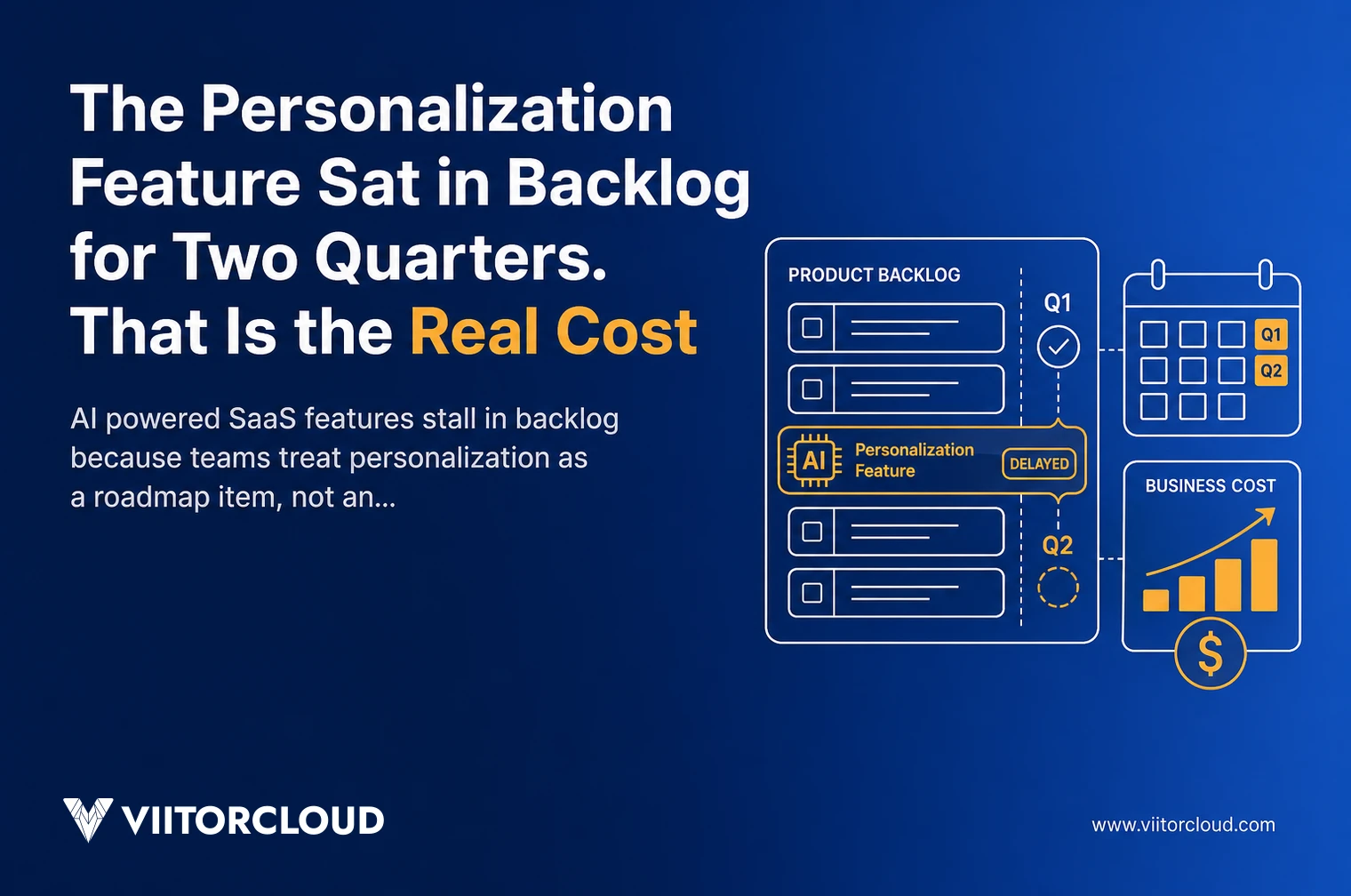
Retail SaaS teams ship AI personalization slower than rivals because they treat it as a roadmap item rather than an architecture decision. A roadmap item waits for capacity. An architecture decision gets resourced. That single framing difference is why one product team ships in-product AI agents in six weeks, and another watches the same ticket roll from Q1 into Q3.
I have sat in the sprint planning call where the personalization epic gets pushed for the fourth time. Nobody argues against it. The data science spike is unscoped, the event schema needs work, and there is a billing migration that cannot slip. So it moves. The cost of that decision never appears on any dashboard, which is exactly why it keeps getting made.
This article covers what the delay actually costs in revenue terms, why AI-powered SaaS features stall in mid-market product organizations, and the specific architectural choices that let a small team ship personalization in weeks instead of quarters.
Key Takeaways
- Personalization leaders earn 40% more revenue from those activities than average players, with typical lifts of 5% to 15% (McKinsey, Next in Personalization).
- The AI-in-retail market reached $18.4B in 2026 and is projected to hit $130.88B by 2033, so a two-quarter delay concedes share during the steepest part of the curve.
- Backlog stalls are usually caused by three unowned dependencies: event schema quality, inference latency budget, and a missing feature-flag path to production.
- Shipping a scoped recommendation engine against one surface in six weeks beats a platform-wide personalization program that never ships.
- Agentic features need a data contract before a model. Teams that invert this order spend two sprints debugging outputs that were never going to work.
Why Two Quarters of Delay Costs More Than the Build
Put a number on it. A retail commerce SaaS doing $40M ARR, where personalization touches 30% of revenue-driving surfaces, sits on roughly $12M of influenced revenue. McKinsey’s research on personalization puts the typical lift at 5% to 15%. Take the conservative end, and that is $600K in annual influenced revenue.
Two quarters of delay costs about $300K. The engineering build costs a fraction of that.
The compounding effect is worse than the arithmetic. Personalization models improve with interaction data. A team that ships in March has nine months of behavioural signal by year-end. A team that ships in September has three. The second team is not six months behind; it is behind on model quality too, and that gap widens every month the first team collects data.
The Cost Nobody Puts in the Business Case
Three costs that never make it into the delay justification:
- Renewal exposure: Enterprise buyers now ask about AI capability in RFPs. Not having an answer costs you deals you never learn you lost.
- Data decay: Event data collected without a personalization use case in mind is usually unusable when the use case arrives.
- Internal credibility: A feature that slips twice stops being planned seriously. The third slip is nearly automatic.
Ship One Personalization Surface in Six Weeks
We scope a single high-traffic surface, write the data contract, and deliver a recommendation engine behind a feature flag while your team keeps shipping the rest of the roadmap.
What AI-Powered SaaS Actually Means in a Product Roadmap
AI-powered SaaS means the intelligence lives inside the product workflow, not beside it. The distinction matters because it changes what you build. A dashboard that displays a model score is analytics. An AI copilot for SaaS that drafts the merchandising decision and explains its reasoning inside the same screen is a product feature.
Three layers separate them:
- Data layer: Event streams with a stable schema, identity resolution, and a feature store the model reads from at request time.
- Inference layer: The model itself, whether that is a recommendation engine, a ranking model, or an LLM call with retrieval.
- Experience layer: Where the output lands in the interface, how the user accepts or rejects it, and how that response feeds back into training.
Most stalled roadmap items are stuck at layer one while the team debates layer two. I see this pattern in almost every mid-market AI-native SaaS engagement. The team has spent six weeks comparing model approaches, and nobody owns the event schema.
Person A and Person B, Same Quarter
Two CPOs I have worked with, same problem, opposite outcomes.
Person A ran a retail inventory SaaS with 140 staff. Her team scoped a full personalization platform: unified customer profiles, a real-time feature store, and cross-surface recommendations. Eleven weeks of discovery produced a 40-page architecture document and no shipped code. The epic moved to the next quarter because the platform work could not be broken down small enough to fit a sprint.
Person B ran a smaller commerce analytics product, 60 staff. Same ambition, different sequencing. His team picked one surface, the product detail page, defined a single event contract for six behavioural signals, and shipped a scoped recommendation engine behind a feature flag in seven weeks. It was live for 5% of accounts by week eight. The measured lift funded the next three surfaces.
Person A had the better architecture on paper. Person B had a feature in production collecting data. Eighteen months later, Person B’s platform looked a lot like Person A’s document, except it had been built one shipped surface at a time.
The Three Dependencies That Stall Agentic Features
When a personalization ticket slips repeatedly, the cause is nearly always one of three unowned dependencies. Name the owner and the ticket moves.
Event Schema Nobody Owns
Product analytics events were instrumented for reporting, not for model input. Field names drift between platforms, timestamps are inconsistent, and identity resolution across sessions is approximate. A model trained on this produces outputs the team cannot explain, which triggers another round of investigation and another slip.
The fix is a written data contract for the specific signals the feature needs. Six well-defined events beat sixty inconsistent ones. Get this right, and the rest of the work behind hyper-personalized product engineering becomes tractable.
Inference Latency With No Budget
Nobody sets a latency target, so the model is built without one and then fails the performance review before launch. Set the budget first: a product page recommendation has maybe 120ms. That number determines whether you precompute, cache, or call live, and it eliminates most architectural debate in a single meeting.
No Path to Production Behind a Flag
If the only way to release is a full rollout, the feature will be delayed until it feels safe, which is never. A feature flag with account-level targeting turns a high-stakes launch into a 5% experiment. This is the single change that most reliably unblocks a stalled roadmap.
Get a Data Contract Review Before You Build
Most stalled AI features are stuck on event schema, not model choice. We review your current event instrumentation against the signals a personalization model actually needs.
How to Add AI Personalization to a SaaS Product in Weeks
The sequence that works is deliberately narrow. One surface, one model, one measurable outcome.
- Week 1: Pick the single highest-traffic surface and define the success metric before anything else. Conversion rate on that surface, not engagement.
- Weeks 2 to 3: Write and instrument the data contract for the six to ten signals the model needs. Validate the data by hand against real sessions.
- Weeks 3 to 4: Build the inference path with a deliberately simple model. Collaborative filtering or a ranking model beats an LLM for most retail recommendation cases, and it runs inside your latency budget.
- Weeks 5 to 6: Ship the experience layer behind a flag, including the accept and reject signals that feed retraining.
- Weeks 7 onward: Roll from 5% to 25% to 100% on measured lift. Then repeat on the next surface.
This is the approach I recommend for SaaS product engineering teams carrying an enterprise-grade requirement on an SME-sized headcount. It works because each step produces something shippable, so the epic never becomes unbreakable.
Where Vertical Focus Beats General Capability
A vertical ai saas feature built on retail-specific signals such as basket composition, seasonal demand, and margin tiers outperforms a general-purpose engine on the same traffic. Domain constraints are a feature, not a limitation. A retail model that knows a category never cross-sells to another is more useful than one that has to learn it from sparse data.
Buying Feature Velocity Instead of Building the Capability First
The honest constraint for most mid-market product teams is not knowledge; it is feature velocity. Your engineers could build this. They are also carrying the billing migration, the SOC 2 remediation, and the integration your largest account demanded in renewal.
Hiring an ML engineer takes six to nine months from requisition to productive output. That is longer than the delay you are trying to fix.
This is where an external engineering team earns its place. Not to own your roadmap, but to deliver one scoped surface into production while your team keeps shipping everything else. ViitorCloud has built this pattern across 300+ client engagements since 2011. On the Creator platform, we delivered an AI content management system where the model output sat directly inside the authoring workflow rather than in a separate analytics view. On MariDeal, the commerce platform we engineered has processed $46.4M in revenue, including $7.1M in 72 hours during a single Black Friday peak, which is the load profile retail personalization has to survive.
If the personalization epic has slipped twice, the useful next step is a scoped six-week engagement on one surface. Talk to our engineering team about which surface to pick and what the data contract needs to cover.
See How We Engineer AI Into Product Workflows
From an AI content management platform to a commerce system that processed $7.1M in 72 hours, our SaaS product engineering work puts model output inside the user’s task.
What Changes When the Feature Finally Ships
The measurable outcome is conversion lift on one surface. The structural outcome matters more.
- The data contract exists: Every subsequent AI feature is faster because the schema question is already answered.
- The latency budget is proven: Your team knows what the inference path can carry.
- The flag infrastructure works: The next model ships as an experiment, not an event.
- The roadmap regains credibility: A shipped AI feature changes how the next one gets estimated and staffed.
Teams building toward a genuine AI-first SaaS development advantage get there by shipping narrow features repeatedly, not by designing the platform first. The same logic applies to placing AI co-pilots on a product roadmap: scope the first one to a single job and ship it.
For retail-specific context on how these features perform against operational data, our retail technology work covers the patterns that hold up under real traffic.
Conclusion
The personalization feature sitting in your backlog has a price, and it is larger than the build. At a 5% lift on influenced revenue, two quarters of delay costs a mid-market retail SaaS in the low hundreds of thousands, before you count the model quality gap that opens while a faster team collects interaction data.
The fix is not more planning. It is narrower scope. Pick one surface, write the data contract, set the latency budget, ship behind a flag, and measure. That sequence turns an AI-powered SaaS ambition into a shipped feature in weeks.
Whichever path you choose, decide it deliberately this quarter rather than letting the epic move a third time. The delay is a decision either way. Make it the one you would defend in a board meeting.

Vishal Shukla
Vishal Shukla is Vice President of Technology at ViitorCloud Technologies.
Frequently Asked Questions
What is AI-powered SaaS?
AI-powered SaaS is software where machine learning drives the product workflow itself, not a separate analytics view. The model runs inside the user's task, generating recommendations, drafting decisions, or ranking options at request time. The user acts on the output directly, and that response feeds back into model training.
How do I add AI personalization to a SaaS product?
Why do AI features stay stuck in the product backlog?
Should we build in-product AI agents in house or with a partner?
How long should a first AI personalization feature take to ship?