Bolting AI onto a legacy transport management system does not cut costs, because intelligent automation only pays when it can read live data and finish a decision without a person in the loop. A chatbot sitting on top of a 12-year-old TMS still waits for someone to approve the exception. Cost per shipment stays exactly where it was.
I have spent years building operations software for port, freight, and field logistics teams. The pattern repeats. Operators who fund point tools report activity. Operators who rebuild the operations layer report margin.
This article covers why bolt-on AI stalls, what an AI-native operations layer actually contains, and how to sequence a TMS WMS modernization without pausing the business.
Key Takeaways
- Bolt-on AI fails because legacy TMS and WMS platforms hand it read-only, overnight data and no permission to execute, so intelligent automation never closes a loop.
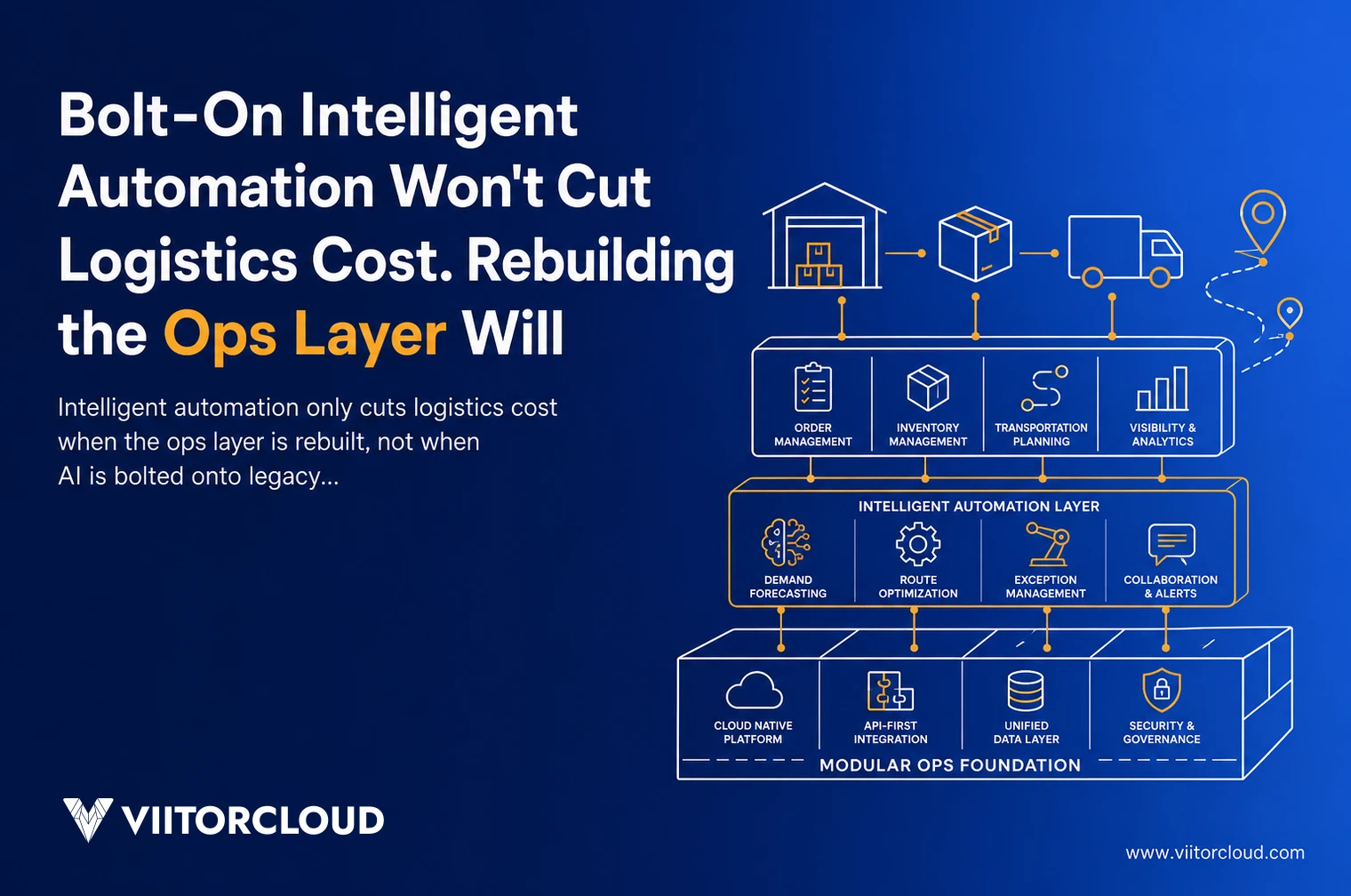
- An AI-native operations layer has four parts. An event backbone, a unified operational data model, decision services, and write-back execution.
- Agentic AI logistics agents cut costs by clearing exceptions end to end, which is where most mid-market operators lose hours per shipment.
- McKinsey found AI-enabled supply chain management improved logistics costs by 15% and inventory levels by 35% for early adopters.
- TMS WMS modernization works in phases. Start with one high-volume exception type, prove the savings, then widen scope.
Why Bolt-On Intelligent Automation Does Not Move Cost Per Shipment
Bolt-on intelligent automation does not move cost per shipment because it sits outside the system of record. It reads a snapshot, produces a suggestion, and hands the work back to a person. Cost falls only when a decision is made and executed automatically, and most legacy platforms will not allow that.
Four structural blockers show up in almost every assessment I run.
- Read-only integration: The model can see a load, a rate, or a stock level. It cannot change one.
- Batch data: An overnight sync means the model reasons about yesterday while the yard reacts to today.
- No event model: Legacy platforms store states rather than events, so nothing exists to trigger an automated response.
- Fragmented master data: A customer, a lane, and a SKU are defined differently in the TMS, the WMS, and finance.
The market is already showing the result. Gartner predicts that over 40% of agentic AI projects will be cancelled by the end of 2027, citing unclear business value and inadequate controls. Teams that treat AI-driven automation as a feature purchase rather than an architecture decision are the ones filling that statistic.
Find the exception that is costing you the most
We assess your exception volume, touch time, and cost per shipment, then show where an AI-native operations layer would pay first. No commitment to the first conversation.
What an AI Native Operations Layer Gives Intelligent Automation
An AI-native operations layer is the software tier between your data sources and your users, where events are captured, decisions are made, and actions are written back. It is what turns supply chain AI from a reporting exercise into an operating capability.
Four components carry the weight.
- An event backbone. Every scan, gate-in, telemetry ping, and rate change becomes a timestamped event instead of a row updated in place.
- A unified operational data model. One definition of shipment, lane, asset, and customer across every connected system.
- Decision services. Small, testable services that each answer one question, such as which carrier, which dock, or which reorder quantity.
- Write-back execution. The permission and the audit trail to change the plan in the source system.
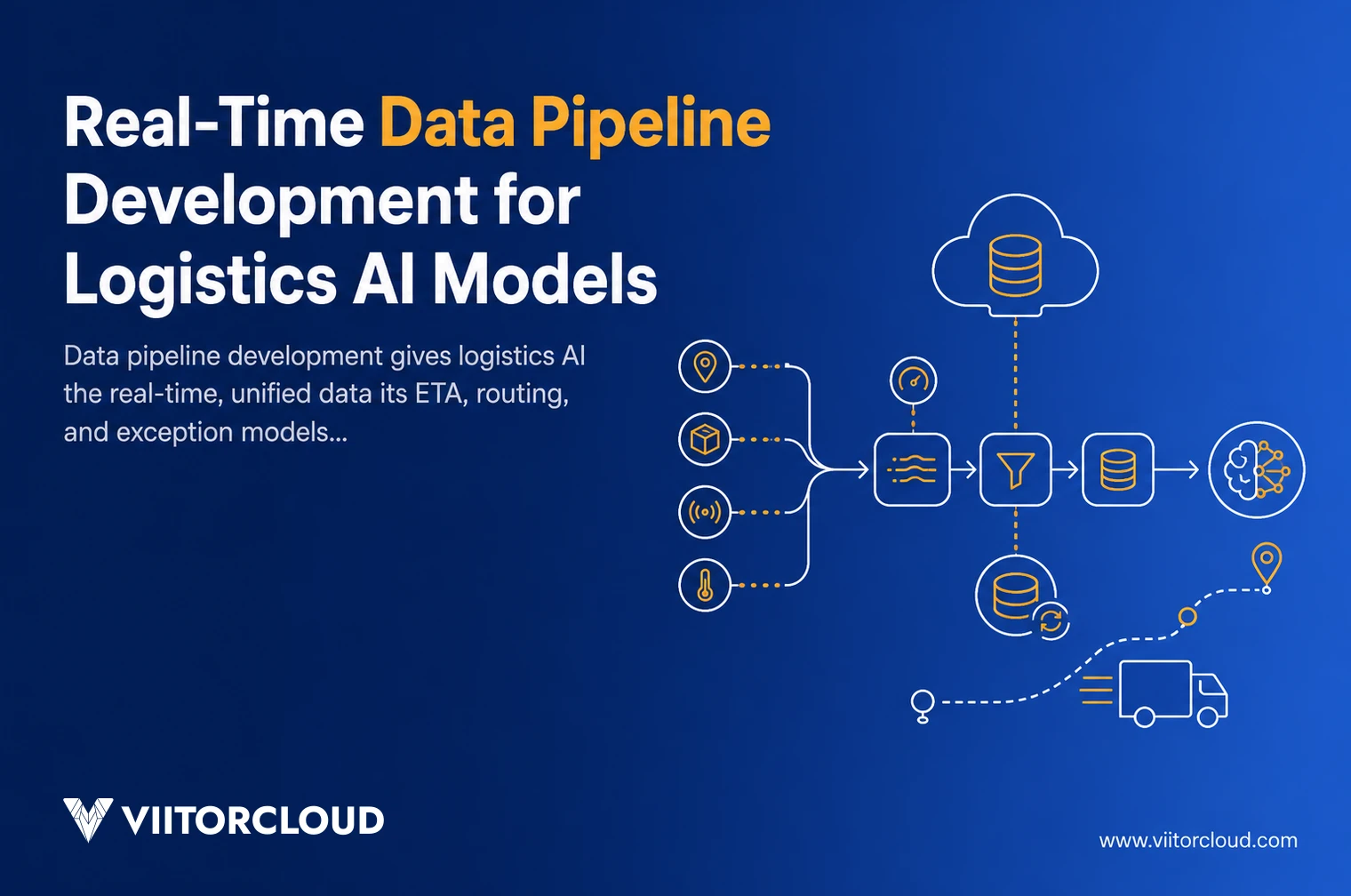
Raw volume is rarely the hard part. On a livestock monitoring platform we built, the pipeline handles more than 1 million sensor readings a day across 15,000 deployed sensors. In logistics, the difficulty is event ordering, deduplication, and late arrivals, which is why real-time data streaming in logistics deserves its own design phase in any AI-native operations programme. Intelligent automation without write-back is still a dashboard.
How Agentic AI Logistics Clears Exceptions Without a Human Queue
Agentic AI logistics means software agents that detect an exception, diagnose the cause, choose a resolution, execute it in the source system, and escalate only what falls outside policy. The saving comes from removing the queue, not from writing a better alert.
Take a late inbound container. The traditional path creates a task, a coordinator reads three screens, calls the carrier, moves the appointment, and emails the customer. An agentic AI logistics agent runs the same sequence in seconds and logs every step for audit.
Three design rules keep these agents safe in production.
- Bounded authority. Each agent has a written policy defining the value, lane, and exception types it may act on.
- Deterministic fallbacks. When confidence drops below threshold, the agent routes to a human with the evidence already assembled.
- Full traceability. Every action is reversible and attributable, which is the first thing auditors and insurers ask for.
That is the same principle behind AI-driven decision systems for logistics. The model is a component. The decision architecture around it is the product, and it is where intelligent automation earns its budget.
See how we rebuilt a port operations layer
The platform we built for a global port operator runs across 14 active sites in more than 10 countries and handles 2.2 million-plus freight tons of container and general cargo.
Why Predictive Logistics Only Pays When It Triggers an Action
Predictive logistics pays when a forecast automatically changes a plan. A screen that predicts a stockout and waits for a planner to notice produces no savings. The same forecast, wired to an automatic reorder or a re-slotting instruction, moves the cost line.
McKinsey reports that AI-enabled supply-chain management improved logistics costs by 15%, inventory levels by 35%, and service levels by 65% for early adopters. Those gains sit in execution, not in visibility.
Three predictive logistics use cases consistently fund the rebuild in mid-market operations.
- Dynamic ETA and re-routing driven by live traffic, weather, and yard congestion rather than static transit tables.
- Demand and slot forecasting that pre-assigns labour and dock windows before the shift starts.
- Dwell and maintenance prediction that keeps assets out of unplanned downtime.
Each one needs a model trained on your operational history. That is why supply chain AI delivered as custom AI solutions outperforms a generic module tied to a vendor roadmap.
How to Sequence TMS WMS Modernization Without Stopping Operations
A full platform replacement is rarely the right first move. TMS WMS modernization succeeds when the new layer runs alongside the existing systems and takes over one workflow at a time.
- Measure the baseline: Cost per shipment, exception volume by type, and touch time per exception. Without this, no rebuild can be defended to a board.
- Stand up the event backbone: Stream events out of the TMS and WMS into your own layer. The legacy platforms keep running untouched.
- Rebuild one exception end to end: Pick the highest-volume exception and automate detection through to execution.
- Add write-back and controls: Move from recommendation to action once the audit trail and rollback path are proven.
- Widen, then retire: Migrate workflow by workflow. Legacy modules switch off only when nothing depends on them.
This is the same phased pattern that works across wider digital transformation services engagements. Prove the value in one slice of supply chain AI, then fund the next slice from the savings.
Plan a TMS WMS modernization that keeps operations running
Phased delivery means the legacy platform stays live while the new operations layer takes over one workflow at a time. Validate the saving before you scale it.
Where I Would Start If You Are Funding Intelligent Automation This Year
Start with the exception type that costs the most touch time, and rebuild it end to end. That is how we approached the port management platform built for a global port operator, now live across 14 active sites in more than 10 countries and handling 2.2 million-plus freight tons of container and general cargo.
ViitorCloud has delivered software for 300+ clients since 2011, including enterprise port and field logistics operations. On a separate deployment, we built a fleet and route tracking platform where the value came from the data layer underneath, not the interface on top.
If you are weighing a bolt-on tool against an ops layer rebuild, the fastest way to settle it is a short assessment of your own exception data. Talk to our engineering team, and we will scope it against your current cost per shipment.
The Ops Layer Decides Whether AI Cuts Cost
Intelligent automation is an architecture decision before it is a tooling decision. Bolt-on AI produces suggestions. An AI-native operations layer produces executed decisions, and only executed decisions change cost per shipment.
Three things to act on. Measure exception touch time before you buy anything. Build the event backbone before the model. Sequence TMS WMS modernization one workflow at a time so operations never stop.
Agentic AI logistics and predictive logistics rest on the same foundation. Get the ops layer right, and supply chain AI stops being a pilot and starts showing up in the margin.

Vishal Shukla
Vishal Shukla is Vice President of Technology at ViitorCloud Technologies.
Frequently Asked Questions
Why doesn't bolt-on AI cut logistics cost?
Bolt-on AI reads data from a legacy TMS or WMS but cannot execute changes inside it. It produces a recommendation and returns the work to a person, so touch time and cost per shipment stay flat. Intelligent automation cuts cost only when it is allowed to act.
What is intelligent automation in logistics?
What is agentic AI logistics?
Do we need to replace our TMS and WMS to use AI?
How long before an AI-native operations rebuild shows savings?