Data pipeline development is the deciding factor in whether a logistics AI model produces accurate predictions or expensive guesses. Your ETA, routing, and exception models are only as good as the data reaching them, and in most operations that data arrives late, fragmented, or already wrong.
Here is the pattern I see across carriers, 3PLs, and shippers. The models are usually competent. The infrastructure feeding them is not. Industry research consistently shows enterprise AI projects stall on data problems more than model quality, and surveys suggest roughly 72% of logistics leaders still lack real-time coordination across their ERP, TMS, WMS, and IoT systems.
This guide covers what real-time data pipeline development looks like for logistics AI in practice. I will walk through the logistics data sources that ETA and routing models depend on, the architecture I use to move that data at low latency, the quality gates that keep predictions reliable, and how to evaluate a data pipeline development partner before you commit.
Key Takeaways
- Logistics AI accuracy depends on data pipeline development, not model choice. Stale or fragmented inputs are the main cause of poor ETA and routing predictions.
- Around 72% of logistics leaders lack real-time coordination across ERP, TMS, WMS, and IoT, which starves exception models of the signals they need.
- Streaming pipelines with change data capture deliver logistics data in seconds, while batch ETL still suits reconciliation and reporting.
- Quality gates, schema governance, and lineage tracking decide model ROI long before the algorithm does.
- Reliable real-time data processing lets ViitorCloud run systems like a global port platform across 14 active sites in more than 10 countries.
What a Real-Time Data Pipeline Actually Does for Logistics AI
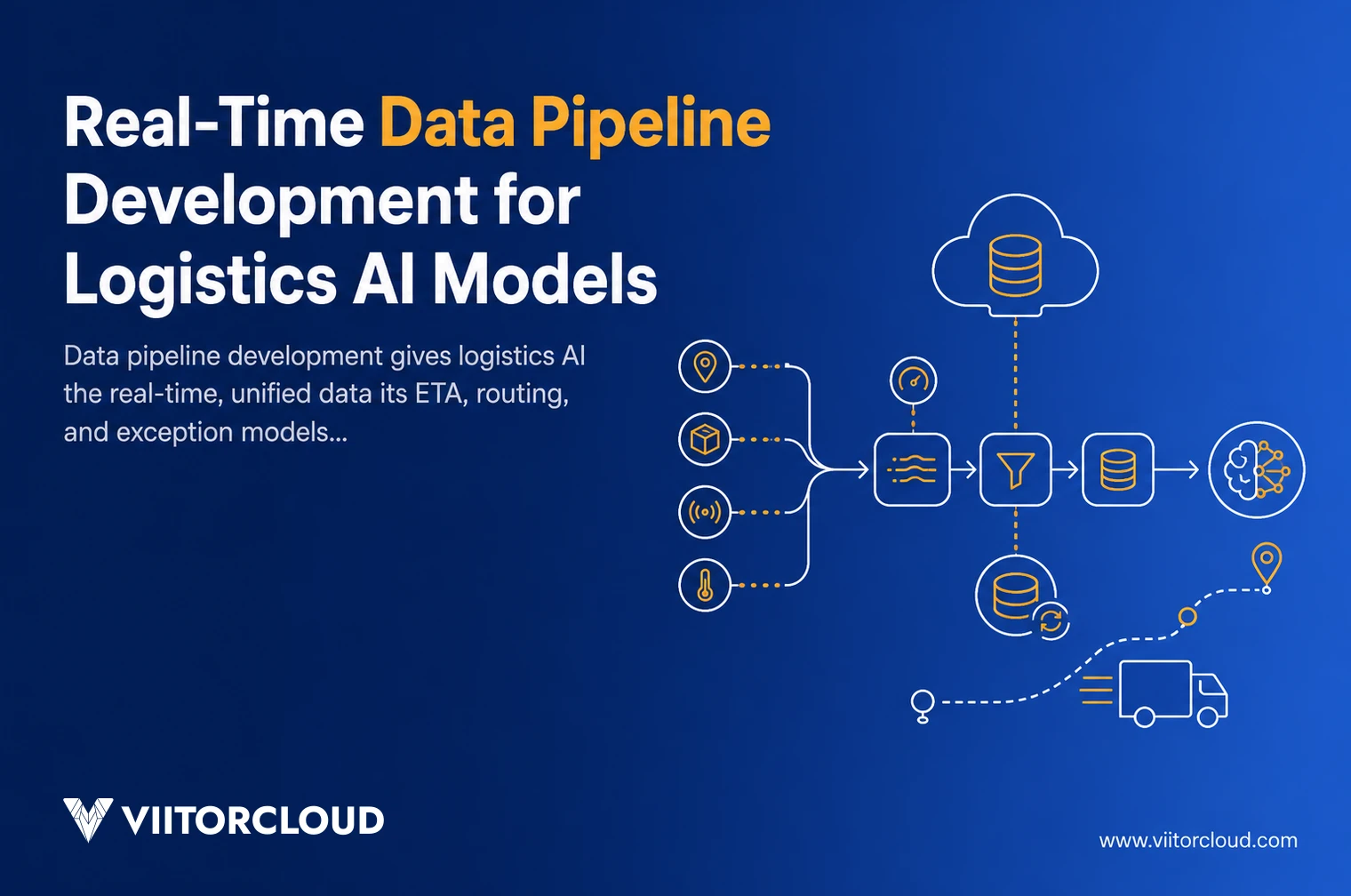
A real-time data pipeline is an automated system that collects, cleans, transforms, and delivers data to applications and AI models within seconds of that data being created. For logistics AI, it connects operational sources to the models that predict arrival times, plan routes, and flag exceptions.
The difference from a traditional batch job is latency. Batch processing moves logistics data on a schedule, often overnight. Real-time data processing moves it continuously, so a delayed truck, a port congestion alert, or a temperature breach reaches the model while the information still matters.
Three capabilities define a production-grade pipeline for logistics AI:
- Continuous ingestion from ERP, TMS, WMS, and IoT devices without manual exports.
- In-flight transformation that standardizes formats so every system agrees on what a shipment, location, or status means.
- Low-latency delivery to models and dashboards, measured in seconds rather than hours.
I go deeper on the engineering behind this in AI-powered data pipeline development, but the principle is simple. Fresh data in, useful predictions out.
Feed Your Logistics AI Real-Time Data
ViitorCloud builds governed, real-time data pipelines that unify ERP, TMS, WMS, and IoT so your ETA, routing, and exception models run on current logistics data.
Why Logistics AI Fails Without Real-Time Data Processing
Most logistics AI underperforms for one reason. The model runs on stale, fragmented inputs. When your ERP updates overnight, your TMS syncs hourly, and your IoT sensors stream continuously, the model sees three versions of reality and reconciles none of them.
I worked with an operations team that could not understand why their ETA model kept missing by hours. The model was fine. The problem was structural. GPS pings from the fleet landed in one system, order status lived in the TMS, and yard events sat in the WMS, each on a different refresh cycle. By the time the data merged, the truck had already arrived. We rebuilt the ingestion layer for real-time data processing, and prediction error dropped without a single change to the model.
This is what weak data pipeline development costs a logistics operation:
- ETA models quote arrival windows from positions that are already an hour old.
- Routing models optimize around traffic and capacity data that no longer matches the road.
- Exception models catch problems after they escalate instead of before.
The financial impact is well documented. Gartner research has repeatedly found that data issues, not model design, are the leading reason enterprise AI projects stall before production. In logistics, where margins are thin, that gap between a good model and good data shows up directly in fuel, labor, and missed delivery windows.
The Logistics Data Sources ETA, Routing and Exception Models Depend On
Every logistics AI model draws on the same four source categories. The job of data pipeline development is to unify them into one clean, timely stream. Fragmentation across these sources is exactly what most logistics leaders are still fighting.
Here is what each source contributes to your logistics data and which models rely on it most:
- ERP systems provide orders, inventory, and financial context that ground demand and capacity planning.
- TMS platforms supply shipment status, carrier assignments, and rate data that ETA and routing models consume directly.
- WMS platforms report yard, dock, and warehouse events that exception models watch for delays.
- IoT and telematics stream GPS, temperature, and vehicle health signals that only become useful with real-time data processing.
None of these systems was built to talk to the others. Connecting them reliably is the core of data engineering in logistics, and it is where most in-house teams run short on time and specialized skill.
Start With a Data Pipeline Assessment
Get a focused review of how your logistics data flows today and where low-latency data pipeline development will lift model accuracy fastest.
How I Build Streaming Pipelines for Logistics Data
Reliable streaming pipelines follow a layered design. Each layer has one job, and skipping any of them creates the silent failures that look like model problems months later.
Ingestion With Change Data Capture and Event Streaming
I capture changes at the source with change data capture and message streaming rather than scheduled exports. This turns overnight batch jobs into continuous streaming pipelines that move logistics data the moment it changes.
Transformation Through Modern ETL and ELT
The transformation layer standardizes and enriches data in flight. Strong ETL development services define shared meaning across systems, so a shipment ID from the TMS matches the same record in the ERP. Good ETL development services also handle the messy reality of logistics data, including missing fields, duplicate events, and out-of-order timestamps.
Delivery to Models and Feature Stores
Cleaned data flows into feature stores and model endpoints built for real-time data processing. This is where ETA, routing, and exception models read fresh features instead of yesterday’s snapshot.
Not everything needs to stream. I use streaming pipelines for live tracking, routing, and exception detection, and scheduled ETL development services for reconciliation, billing, and historical reporting. Matching the method to the latency the business actually needs keeps cloud costs sensible.
This layered approach is the foundation of the custom AI solutions and data pipeline development work I lead for logistics clients, where the pipeline is treated as part of the model rather than a prerequisite to it.
Governance and Quality Gates That Keep Logistics AI Accurate
The data layer decides model ROI long before the algorithm does, which is why I treat data pipeline development and governance as one discipline. A pipeline that moves fast but delivers wrong data just produces confident errors faster.
Five gates I build into every logistics pipeline:
- Ingestion validation that rejects malformed records before they enter the stream.
- Schema governance so a change in one source system does not silently break downstream models.
- Freshness monitoring that alerts when a feed falls behind its expected latency.
- Lineage tracking so you can trace any prediction back to the exact data that produced it.
- Drift detection that flags when incoming logistics data shifts away from what the model learned in training.
Scale makes this non-negotiable. On one IoT platform my team built, the pipeline ingests more than 1 million data points a day from over 15,000 sensors, and automated quality gates are the only reason a few faulty sensors cannot corrupt the model. That same discipline reduced livestock mortality by 30% in one deployment, and it transfers directly to logistics data at fleet scale. The payoff is measurable. McKinsey research has linked AI-driven supply chain work to logistics cost reductions of 15% to 30%.
Build Logistics AI That Holds Up in Production
From streaming pipelines to ETL development services, ViitorCloud engineers the data foundation behind AI systems running across global port and fleet operations.
Choosing a Data Pipeline Development Partner for Logistics
If you are evaluating data pipeline services for logistics AI, the vendor matters as much as the technology. Many firms can move data. Fewer understand what ETA, routing, and exception models actually need from it.
Questions I would put to any data pipeline development partner before signing:
- Have you built for logistics before? ERP, TMS, WMS, and telematics integration is specialized work, not generic ETL.
- Do your data pipeline services include governance? Ingestion without quality gates creates technical debt fast.
- Can you handle both patterns? Real logistics needs streaming pipelines and scheduled ETL development services together.
- Do you own outcomes after delivery? Pipelines need monitoring and tuning, not a handoff.
The right partner treats data pipeline development as an ongoing capability. ViitorCloud pairs data pipeline services with real logistics domain experience, which is why our logistics technology solutions hold up in live port and fleet environments.
Building Logistics AI on a Real-Time Data Foundation
I have seen the same result across logistics engagements. Fix the pipeline first, and model performance follows. For one global port operator, the platform ViitorCloud built now runs across 14 active sites in more than 10 countries, tracking container and general cargo where stale data is not an option.
If your ETA, routing, or exception models are running on fragmented inputs, the fastest gain is rarely a new algorithm. It is real-time data pipeline development that unifies your ERP, TMS, WMS, and IoT feeds into one dependable stream. That is the work ViitorCloud does as a logistics data-engineering partner, and it is what makes AI-driven decision systems for logistics trustworthy in production. Well-scoped data pipeline services and modern ETL development services turn a promising model into an operational one.
Conclusion
Logistics AI does not fail because the models are weak. It fails because the data reaching them is late, fragmented, or wrong. Data pipeline development is the fix, and it is the highest-leverage investment a data team can make before touching the algorithm.
Start by auditing where your ERP, TMS, WMS, and IoT data flows and how fast. Then apply real-time data processing where latency matters and reliable batch ETL where it does not. The right data pipeline services will lift your ETA, routing, and exception models on infrastructure that finally delivers clean, current logistics data.

Vishal Shukla
Vishal Shukla is Vice President of Technology at ViitorCloud Technologies.
Frequently Asked Questions
What is a real-time data pipeline?
A real-time data pipeline collects, cleans, and delivers data to AI models within seconds of creation, keeping logistics predictions current.
Why does logistics AI need data pipeline development?
What is the difference between ETL and streaming pipelines?
How do data pipeline services improve ETA accuracy?